
chapter2 线性回归实现
1 导入包
import numpy as np
2 初始化模型参数
### 初始化模型参数

def initialize_params(dims):

    w = np.zeros((dims, 1))

    b = 0

    return w, b
3 损失函数计算
### 包括线性回归公式、均方损失和参数偏导三部分

def linear_loss(X, y, w, b):

    num_train = X.shape[0]

    y_hat = np.dot(X, w) + b

    # 计算预测输出与实际标签之间的均方损失

    loss = np.sum((y_hat-y)**2)/num_train

    # 基于均方损失对权重参数的一阶偏导数

    dw = 2*np.dot(X.T, (y_hat-y)) /num_train

    # 基于均方损失对偏差项的一阶偏导数

    db = 2*np.sum((y_hat-y)) /num_train

    return y_hat, loss, dw, db
4 定义线性回归模型训练过程
### 定义线性回归模型训练过程

def linear_train(X, y, learning_rate=0.01, epochs=10000):

    loss_his = []

    # 初始化模型参数

    w, b = initialize_params(X.shape[1])

    for i in range(1, epochs):

        # 计算当前迭代的预测值、损失和梯度

        y_hat, loss, dw, db = linear_loss(X, y, w, b)

        # 基于梯度下降的参数更新

        w += -learning_rate * dw

        b += -learning_rate * db

        # 记录当前迭代的损失

        loss_his.append(loss)

        # 每1000次迭代打印当前损失信息

        if i % 10000 == 0:

            print('epoch %d loss %f' % (i, loss))

        params = {

            'w': w,

            'b': b

        }

        grads = {

            'dw': dw,

            'db': db

        }

    return loss_his, params, grads
5 导入数据集并划分数据集
from sklearn.datasets import load_diabetes

from sklearn.utils import shuffle

diabetes = load_diabetes()

data, target = diabetes.data, diabetes.target

X, y = shuffle(data, target, random_state=13)

# 按照8/2划分训练集和测试集

offset = int(X.shape[0] * 0.8)

X_train, y_train = X[:offset], y[:offset].reshape((-1,1))

X_test, y_test = X[offset:], y[offset:].reshape((-1,1))

# 打印训练集和测试集维度

print("X_train's shape: ", X_train.shape)

print("X_test's shape: ", X_test.shape)

print("y_train's shape: ", y_train.shape)

print("y_test's shape: ", y_test.shape)
结果:
X_train's shape:  (353, 10)

X_test's shape:  (89, 10)

y_train's shape:  (353, 1)

y_test's shape:  (89, 1)
6 线性回归模型训练
# 线性回归模型训练

loss_his, params, grads = linear_train(X_train, y_train, 0.01, 200000)

# 打印训练后得到模型参数

print(params)
结果:
epoch 10000 loss 3219.178670

epoch 20000 loss 2944.940452

epoch 30000 loss 2848.052938

epoch 40000 loss 2806.628090

epoch 50000 loss 2788.051589

epoch 60000 loss 2779.411239

epoch 70000 loss 2775.230777

epoch 80000 loss 2773.107175

epoch 90000 loss 2771.957481

epoch 100000 loss 2771.281723

epoch 110000 loss 2770.843500

epoch 120000 loss 2770.528226

epoch 130000 loss 2770.278899

epoch 140000 loss 2770.066388

epoch 150000 loss 2769.875394

epoch 160000 loss 2769.697658

epoch 170000 loss 2769.528602

epoch 180000 loss 2769.365613

epoch 190000 loss 2769.207165

{'w': array([[   9.84972769],

       [-240.38803204],

       [ 491.45462983],

       [ 298.20492926],

       [ -87.77291402],

       [ -98.36201742],

       [-186.17374049],

       [ 177.38726503],

       [ 424.17405761],

       [  52.48952427]]), 'b': 150.8136201371859}
7 定义线性回归预测函数
### 定义线性回归预测函数

def predict(X, params):

    w = params['w']

    b = params['b']

    y_pred = np.dot(X, w) + b

    return y_pred

y_pred = predict(X_test, params)
8 定义R2系数函数
### 定义R2系数函数

def r2_score(y_test, y_pred):

    # 测试标签均值

    y_avg = np.mean(y_test)

    # 总离差平方和

    ss_tot = np.sum((y_test - y_avg)**2)

    # 残差平方和

    ss_res = np.sum((y_test - y_pred)**2)

    # R2计算

    r2 = 1 - (ss_res/ss_tot)

    return r2
print(r2_score(y_test, y_pred))
结果:
0.5349331079250876
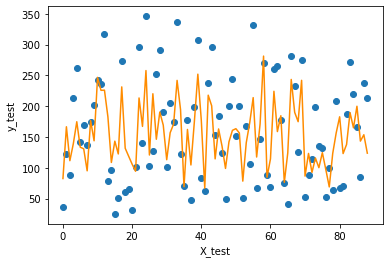
9 可视化
import matplotlib.pyplot as plt

f = X_test.dot(params['w']) + params['b']

plt.scatter(range(X_test.shape[0]), y_test)

plt.plot(f, color = 'darkorange')

plt.xlabel('X_test')

plt.ylabel('y_test')

plt.show();
结果:
plt.plot(loss_his, color = 'blue')

plt.xlabel('epochs')

plt.ylabel('loss')

plt.show()
结果:

10 手写交叉验证
from sklearn.utils import shuffle

X, y = shuffle(data, target, random_state=13)

X = X.astype(np.float32)

data = np.concatenate((X, y.reshape((-1,1))), axis=1)

data.shape
结果:
(442, 11)
from random import shuffle

def k_fold_cross_validation(items, k, randomize=True):

    if randomize:

        items = list(items)

        shuffle(items)

    slices = [items[i::k] for i in range(k)]

    for i in range(k):

        validation = slices[i]

        training = [item

                    for s in slices if s is not validation

                    for item in s]

        training = np.array(training)

        validation = np.array(validation)

        yield training, validation

for training, validation in k_fold_cross_validation(data, 5):

    X_train = training[:, :10]

    y_train = training[:, -1].reshape((-1,1))

    X_valid = validation[:, :10]

    y_valid = validation[:, -1].reshape((-1,1))

    loss5 = []

    #print(X_train.shape, y_train.shape, X_valid.shape, y_valid.shape)

    loss, params, grads = linear_train(X_train, y_train, 0.001, 100000)

    loss5.append(loss)

    score = np.mean(loss5)

    print('five kold cross validation score is', score)

    y_pred = predict(X_valid, params)

    valid_score = np.sum(((y_pred-y_valid)**2))/len(X_valid)

    print('valid score is', valid_score)
结果:
epoch 10000 loss 5092.953795

epoch 20000 loss 4625.210998

epoch 30000 loss 4280.106579

epoch 40000 loss 4021.857859

epoch 50000 loss 3825.526402

epoch 60000 loss 3673.689068

epoch 70000 loss 3554.135457

epoch 80000 loss 3458.274820

epoch 90000 loss 3380.033392

five kold cross validation score is 4095.209897465298

valid score is 3936.2234811935696

epoch 10000 loss 5583.270165

epoch 20000 loss 5048.748757

epoch 30000 loss 4655.620298

epoch 40000 loss 4362.817211

epoch 50000 loss 4141.575958

epoch 60000 loss 3971.714077

epoch 70000 loss 3839.037331

epoch 80000 loss 3733.533571

epoch 90000 loss 3648.114252

five kold cross validation score is 4447.019807745928

valid score is 2501.3520150018944

epoch 10000 loss 5200.950784

epoch 20000 loss 4730.397070

epoch 30000 loss 4382.133800

epoch 40000 loss 4120.944891

epoch 50000 loss 3922.113137

epoch 60000 loss 3768.255158

epoch 70000 loss 3647.113946

epoch 80000 loss 3550.018924

epoch 90000 loss 3470.811373

five kold cross validation score is 4191.91819552402

valid score is 3599.5500530218555

epoch 10000 loss 5392.825769

epoch 20000 loss 4859.145634

epoch 30000 loss 4465.914858

epoch 40000 loss 4172.706513

epoch 50000 loss 3951.112149

epoch 60000 loss 3781.128244

epoch 70000 loss 3648.633504

epoch 80000 loss 3543.627226

epoch 90000 loss 3458.998687

five kold cross validation score is 4256.231602795183

valid score is 3306.6604398106706

epoch 10000 loss 4991.290783

epoch 20000 loss 4547.454621

epoch 30000 loss 4219.702158

epoch 40000 loss 3974.018034

epoch 50000 loss 3786.721727

epoch 60000 loss 3641.292905

epoch 70000 loss 3526.175261

epoch 80000 loss 3433.256913

epoch 90000 loss 3356.818661

five kold cross validation score is 4043.189167421097

valid score is 4220.025355059865
11 导入数据集
from sklearn.datasets import load_diabetes

from sklearn.utils import shuffle

from sklearn.model_selection import train_test_split

diabetes = load_diabetes()

data = diabetes.data

target = diabetes.target

X, y = shuffle(data, target, random_state=13)

X = X.astype(np.float32)

y = y.reshape((-1, 1))

X_train, X_test, y_train, y_test = train_test_split(X, y, test_size=0.2, random_state=42)

print(X_train.shape, y_train.shape, X_test.shape, y_test.shape)
结果:
(353, 10) (353, 1) (89, 10) (89, 1)
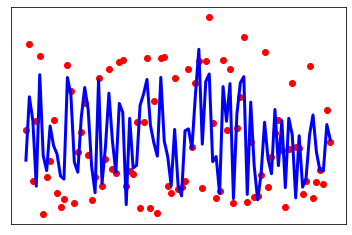
11 sklearn实现,并可视化
import matplotlib.pyplot as plt

import numpy as np

from sklearn import linear_model

from sklearn.metrics import mean_squared_error, r2_score

regr = linear_model.LinearRegression()

regr.fit(X_train, y_train)

y_pred = regr.predict(X_test)

# The coefficients

print('Coefficients: \n', regr.coef_)

# The mean squared error

print("Mean squared error: %.2f"

      % mean_squared_error(y_test, y_pred))

# Explained variance score: 1 is perfect prediction

print('Variance score: %.2f' % r2_score(y_test, y_pred))

print(r2_score(y_test, y_pred))

# Plot outputs

plt.scatter(range(X_test.shape[0]), y_test, color='red')

plt.plot(range(X_test.shape[0]), y_pred, color='blue', linewidth=3)

plt.xticks(())

plt.yticks(())

plt.show();
结果:
Coefficients:

 [[ -23.51037 -216.31213  472.36694  372.07175 -863.6967   583.2741

   105.79268  194.76984  754.073     38.2222 ]]

Mean squared error: 3028.50

Variance score: 0.53

0.5298198993375712
12 交叉验证
from sklearn.model_selection import KFold

from sklearn.linear_model import LinearRegression

### 交叉验证

def cross_validate(model, x, y, folds=5, repeats=5):

    ypred = np.zeros((len(y),repeats))

    score = np.zeros(repeats)

    for r in range(repeats):

        i=0

        print('Cross Validating - Run', str(r + 1), 'out of', str(repeats))

        x,y = shuffle(x, y, random_state=r) #shuffle data before each repeat

        kf = KFold(n_splits=folds,random_state=i+1000,shuffle=True) #random split, different each time

        for train_ind, test_ind in kf.split(x):

            print('Fold', i+1, 'out of', folds)

            xtrain,ytrain = x[train_ind,:],y[train_ind]

            xtest,ytest = x[test_ind,:],y[test_ind]

            model.fit(xtrain, ytrain)

            #print(xtrain.shape, ytrain.shape, xtest.shape, ytest.shape)

            ypred[test_ind]=model.predict(xtest)

            i+=1

        score[r] = r2_score(ypred[:,r],y)

    print('\nOverall R2:',str(score))

    print('Mean:',str(np.mean(score)))

    print('Deviation:',str(np.std(score)))

    pass

cross_validate(regr, X, y, folds=5, repeats=5)
结果:
Cross Validating - Run 1 out of 5

Fold 1 out of 5

Fold 2 out of 5

Fold 3 out of 5

Fold 4 out of 5

Fold 5 out of 5

Cross Validating - Run 2 out of 5

Fold 1 out of 5

Fold 2 out of 5

Fold 3 out of 5

Fold 4 out of 5

Fold 5 out of 5

Cross Validating - Run 3 out of 5

Fold 1 out of 5

Fold 2 out of 5

Fold 3 out of 5

Fold 4 out of 5

Fold 5 out of 5

Cross Validating - Run 4 out of 5

Fold 1 out of 5

Fold 2 out of 5

Fold 3 out of 5

Fold 4 out of 5

Fold 5 out of 5

Cross Validating - Run 5 out of 5

Fold 1 out of 5

Fold 2 out of 5

Fold 3 out of 5

Fold 4 out of 5

Fold 5 out of 5

Overall R2: [0.03209418 0.04484132 0.02542677 0.01093105 0.02690136]

Mean: 0.028038935700747846

Deviation: 0.010950454328955226
chapter2 线性回归实现的更多相关文章
- scikit-learn 线性回归算法库小结
scikit-learn对于线性回归提供了比较多的类库,这些类库都可以用来做线性回归分析,本文就对这些类库的使用做一个总结,重点讲述这些线性回归算法库的不同和各自的使用场景. 线性回归的目的是要得到输 ...
- 用scikit-learn和pandas学习线性回归
对于想深入了解线性回归的童鞋,这里给出一个完整的例子,详细学完这个例子,对用scikit-learn来运行线性回归,评估模型不会有什么问题了. 1. 获取数据,定义问题 没有数据,当然没法研究机器学习 ...
- 【scikit-learn】scikit-learn的线性回归模型
内容概要 怎样使用pandas读入数据 怎样使用seaborn进行数据的可视化 scikit-learn的线性回归模型和用法 线性回归模型的评估測度 特征选择的方法 作为有监督学习,分类问题是预 ...
- 线性回归 Linear Regression
成本函数(cost function)也叫损失函数(loss function),用来定义模型与观测值的误差.模型预测的价格与训练集数据的差异称为残差(residuals)或训练误差(test err ...
- 线性回归、梯度下降(Linear Regression、Gradient Descent)
转载请注明出自BYRans博客:http://www.cnblogs.com/BYRans/ 实例 首先举个例子,假设我们有一个二手房交易记录的数据集,已知房屋面积.卧室数量和房屋的交易价格,如下表: ...
- 回归分析法&一元线性回归操作和解释
用Excel做回归分析的详细步骤 一.什么是回归分析法 "回归分析"是解析"注目变量"和"因于变量"并明确两者关系的统计方法.此时,我们把因 ...
- R语言解读多元线性回归模型
转载:http://blog.fens.me/r-multi-linear-regression/ 前言 本文接上一篇R语言解读一元线性回归模型.在许多生活和工作的实际问题中,影响因变量的因素可能不止 ...
- R语言解读一元线性回归模型
转载自:http://blog.fens.me/r-linear-regression/ 前言 在我们的日常生活中,存在大量的具有相关性的事件,比如大气压和海拔高度,海拔越高大气压强越小:人的身高和体 ...
- deep learning 练习 多变量线性回归
多变量线性回归(Multivariate Linear Regression) 作业来自链接:http://openclassroom.stanford.edu/MainFolder/Document ...
随机推荐
- 【LeetCode】40. Combination Sum II 解题报告(Python & C++)
作者: 负雪明烛 id: fuxuemingzhu 个人博客: http://fuxuemingzhu.cn/ 目录 题目描述 题目大意 解题方法 方法一:DFS 方法二:回溯法 日期 题目地址:ht ...
- CODEFORCEs 621E. Wet Shark and Blocks
E. Wet Shark and Blocks time limit per test 2 seconds memory limit per test 256 megabytes input stan ...
- 排列组合 "n个球放入m个盒子m"问题 总结
求,盒子都可以分成是否不能区分,和能区分,还能分成是否能有空箱子,所以一共是8种情况,我们现在来一一讨论. 1.球同,盒不同,无空箱 C(n-1,m-1), n>=m0, n<m 使用插板 ...
- PHP 中的闭包函数和匿名函数
闭包函数 闭包函数通常作为函数中的函数使用. <?php $foo = function($s) { echo $s; }; $foo('hello'); <?php function t ...
- pycharm debug调试模式报“UnicodeDecodeError:'gdk' codec can't decode byte 0xac”,无法正常调试
遇到的问题: 本机python 3.8 pycharn 3.4.4 运行代码的时候,选择debug模式,提示"UnicodeDecodeError:'gdk' codec can't dec ...
- linux(CentOS7) 之 MySQL 5.7.30 下载及安装
一.下载 1.百度搜索mysql,进入官网(或直接进入官网https://www.mysql.com) 2.选择 downloads 3.翻到最下面,选择MySQL Community (GPL) D ...
- 万级K8s集群背后 etcd 稳定性及性能优化实践
1背景与挑战随着腾讯自研上云及公有云用户的迅速增长,一方面,腾讯云容器服务TKE服务数量和核数大幅增长, 另一方面我们提供的容器服务类型(TKE托管及独立集群.EKS弹性集群.edge边缘计算集群.m ...
- day4 对偶数、偶数位的操作
1.函数fun()的功能:从低位开始取出整形变量s中偶数位上的数,依次构成一个新数放在t中.高位仍在高位. 效果理想:但是经测试的时候出现了错误 输入987654321时,打印出来的却是18681.经 ...
- MATLAB中插值算法实现
%%%1.M文件%(1).以往少的程序可以在命令行窗口进行编码,但大量的程序编排到命令行窗口,%会有造成乱码的危险.(2).如果将命令编成程序存储在一个文件中(M文件),依次运行文件中的命令,则可以重 ...
- 【LeetCode】628. 三个数的最大乘积
解题思路 如果数组中全是正数或者全是负数,最大乘积就是最大的三个数的乘积.如果数组中既有正数又有负数,最大乘积可能是三个最大正数乘积,也可能是两个最小负数和最大正数的乘积.遍历数组找到最大的三个数和最 ...