
一元回归_R相关系数_多重检验
python机器学习-乳腺癌细胞挖掘(博主亲自录制视频)https://study.163.com/course/introduction.htm?courseId=1005269003&utm_campaign=commission&utm_source=cp-400000000398149&utm_medium=share

文件夹需要两个包


normality_check.py
# -*- coding: utf-8 -*-

'''

Author:Toby

QQ:231469242,all right reversed,no commercial use

normality_check.py

正态性检验脚本

'''

import scipy

from scipy.stats import f

import numpy as np

import matplotlib.pyplot as plt

import scipy.stats as stats

# additional packages

from statsmodels.stats.diagnostic import lillifors

#正态分布测试

def check_normality(testData):

    #20<样本数<50用normal test算法检验正态分布性

    if 20<len(testData) <50:

       p_value= stats.normaltest(testData)[1]

       if p_value<0.05:

           print"use normaltest"

           print "data are not normal distributed"

           return  False

       else:

           print"use normaltest"

           print "data are normal distributed"

           return True

    #样本数小于50用Shapiro-Wilk算法检验正态分布性

    if len(testData) <50:

       p_value= stats.shapiro(testData)[1]

       if p_value<0.05:

           print "use shapiro:"

           print "data are not normal distributed"

           return  False

       else:

           print "use shapiro:"

           print "data are normal distributed"

           return True

    if 300>=len(testData) >=50:

       p_value= lillifors(testData)[1]

       if p_value<0.05:

           print "use lillifors:"

           print "data are not normal distributed"

           return  False

       else:

           print "use lillifors:"

           print "data are normal distributed"

           return True

    if len(testData) >300:

       p_value= stats.kstest(testData,'norm')[1]

       if p_value<0.05:

           print "use kstest:"

           print "data are not normal distributed"

           return  False

       else:

           print "use kstest:"

           print "data are normal distributed"

           return True

#对所有样本组进行正态性检验

def NormalTest(list_groups):

    for group in list_groups:

        #正态性检验

        status=check_normality(group)

        if status==False :

            return False

'''

group1=[2,3,7,2,6]

group2=[10,8,7,5,10]

group3=[10,13,14,13,15]

list_groups=[group1,group2,group3]

list_total=group1+group2+group3

#对所有样本组进行正态性检验

NormalTest(list_groups)

'''
correlalion_multiple.py
# -*- coding: utf-8 -*-

#斯皮尔曼等级相关(Spearman’s correlation coefficient for ranked data)

import math,pylab,scipy

import numpy as np

import scipy.stats as stats

from scipy.stats import t

from scipy.stats import f

import pandas as pd

import matplotlib.pyplot as plt

from statsmodels.stats.diagnostic import lillifors

import normality_check

import statsmodels.formula.api as sm

x=[40,42,50,55,65,78,84,100,116,125,130,140]

y=[130,150,155,140,150,154,165,170,167,180,175,185]

list_group=[x,y]

sample=len(x)

#显著性

a=0.05

#数据可视化

plt.plot(x,y,'ro')

#斯皮尔曼等级相关,非参数检验

def Spearmanr(x,y):

    print("use spearmanr,Nonparametric tests")

    #样本不一致时,发出警告

    if len(x)!=len(y):

        print ("warming,the samples are not equal!")

    r,p=stats.spearmanr(x,y)

    print("spearman r**2:",r**2)

    print("spearman p:",p)

    if sample<500 and p>0.05:

        print("when sample < 500,p has no mean(>0.05)")

        print("when sample > 500,p has mean")

#皮尔森 ,参数检验

def Pearsonr(x,y):

    print("use Pearson,parametric tests")

    r,p=stats.pearsonr(x,y)

    print("pearson r**2:",r**2)

    print("pearson p:",p)

    if sample<30:

        print("when sample <30,pearson has no mean")

#皮尔森 ,参数检验,带有详细参数

def Pearsonr_details(x,y,xLabel,yLabel,formula):

    n=len(x)

    df=n-2

    data=pd.DataFrame({yLabel:y,xLabel:x})

    result = sm.ols(formula, data).fit()

    print(result.summary())

    #模型F分布显著性分析

    print('\n')

    print("linear relation Significant test:...................................")

    #如果F检验的P值<0.05,拒绝H0,x和y无显著关系,H1成立,x和y有显著关系

    if result.f_pvalue<0.05:

        print ("P value of f test<0.05,the linear relation is right.")

    #R的显著检验

    print('\n')

    print("R significant test:...................................")

    r_square=result.rsquared

    r=math.sqrt(r_square)

    t_score=r*math.sqrt(n-2)/(math.sqrt(1-r**2))

    t_std=t.isf(a/2,df)

    if t_score<-t_std or t_score>t_std:

        print ("R is significant according to its sample size")

    else:

        print ("R is not significant")

    #残差分析

    print('\n')

    print("residual error analysis:...................................")

    states=normality_check.check_normality(result.resid)

    if states==True:

        print("the residual error are normal distributed")

    else:

        print("the residual error are not normal distributed")

    #残差偏态和峰态

    Skew = stats.skew(result.resid, bias=True)

    Kurtosis = stats.kurtosis(result.resid, fisher=False,bias=True)

    if round(Skew,1)==0:

        print("residual errors normality Skew:in middle,perfect match")

    elif  round(Skew,1)>0:

        print("residual errors normality Skew:close right")

    elif  round(Skew,1)<0:

        print("residual errors normality Skew:close left")

    if round(Kurtosis,1)==3:

        print("residual errors normality Kurtosis:in middle,perfect match")

    elif  round(Kurtosis,1)>3:

        print("residual errors normality Kurtosis:more peak")

    elif  round(Kurtosis,1)<3:

        print("residual errors normality Kurtosis:more flat")

    #自相关分析autocorrelation

    print('\n')

    print("autocorrelation test:...................................")

    DW = np.sum( np.diff( result.resid.values )**2.0 )/ result.ssr

    if round(DW,1)==2:

        print("Durbin-Watson close to 2,there is no autocorrelation.OLS model works well")

    else:

        print("there may be autocorrelation")

    #共线性检查

    print('\n')

    print("multicollinearity test:")

    conditionNumber=result.condition_number

    if conditionNumber>30:

        print("conditionNumber>30,multicollinearity exists")

    else:

        print("conditionNumber<=30,multicollinearity not exists")

    #绘制残差图,用于方差齐性检验

    Draw_residual(list(result.resid))

'''

result.rsquared

Out[28]: 0.61510660055413524

'''

#kendalltau非参数检验

def Kendalltau(x,y):

    print("use kendalltau,Nonparametric tests")

    r,p=stats.kendalltau(x,y)

    print("kendalltau r**2:",r**2)

    print("kendalltau p:",p)

#选择模型

def R_mode(x,y,xLabel,yLabel,formula):

    #正态性检验

    Normal_result=normality_check.NormalTest(list_group)

    print ("normality result:",Normal_result)

    if len(list_group)>2:

        Kendalltau(x,y)

    if Normal_result==False:

        Spearmanr(x,y)

        Kendalltau(x,y)

    if Normal_result==True:

        Pearsonr_details(x,y,xLabel,yLabel,formula)

#调整的R方

def Adjust_Rsquare(r_square,n,k):

    adjust_rSquare=1-((1-r_square)*(n-1)*1.0/(n-k-1))

    return adjust_rSquare

'''

n=len(x)

n=10

k=1

 r_square=0.615

 Adjust_Rsquare(r_square,n,k)

Out[11]: 0.566875

'''

#绘图

def Plot(x,y,yLabel,xLabel,Title):

    plt.plot(x,y,'ro')

    plt.ylabel(yLabel)

    plt.xlabel(xLabel)

    plt.title(Title)

    plt.show()

#绘图参数

yLabel='Alcohol'

xLabel='Tobacco'

Title='Sales in Several UK Regions'

Plot(x,y,yLabel,xLabel,Title)

formula='Alcohol ~ Tobacco'

#绘制残点图

def Draw_residual(residual_list):

    x=[i for i in range(1,len(residual_list)+1)]

    y=residual_list

    pylab.plot(x,y,'ro')

    pylab.title("draw residual to check wrong number")

    # Pad margins so that markers don't get clipped by the axes,让点不与坐标轴重合

    pylab.margins(0.3)

    #绘制网格

    pylab.grid(True)

    pylab.show()

R_mode(x,y,xLabel,yLabel,formula)
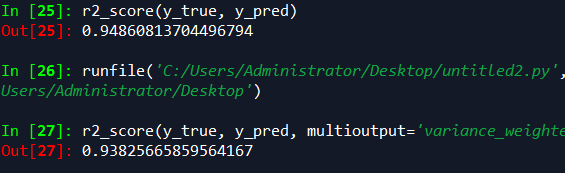
sklearn r平方计算
from sklearn.metrics import r2_score

y_true = [3, -0.5, 2, 7]

y_pred = [2.5, 0.0, 2, 8]

r2_score(y_true, y_pred)

y_true = [[0.5, 1], [-1, 1], [7, -6]]

y_pred = [[0, 2], [-1, 2], [8, -5]]

r2_score(y_true, y_pred, multioutput='variance_weighted')
https://study.163.com/provider/400000000398149/index.htm?share=2&shareId=400000000398149( 欢迎关注博主主页,学习python视频资源,还有大量免费python经典文章)

一元回归_R相关系数_多重检验的更多相关文章
- Python_sklearn机器学习库学习笔记(一)_一元回归
一.引入相关库 %matplotlib inline import matplotlib.pyplot as plt from matplotlib.font_manager import FontP ...
- 一元回归1_基础(python代码实现)
python机器学习-乳腺癌细胞挖掘(博主亲自录制视频) https://study.163.com/course/introduction.htm?courseId=1005269003&u ...
- 机器学习(2):简单线性回归 | 一元回归 | 损失计算 | MSE
前文再续书接上一回,机器学习的主要目的,是根据特征进行预测.预测到的信息,叫标签. 从特征映射出标签的诸多算法中,有一个简单的算法,叫简单线性回归.本文介绍简单线性回归的概念. (1)什么是简单线性回 ...
- 标准方程法_岭回归_LASSO算法_弹性网
程序所用文件:https://files.cnblogs.com/files/henuliulei/%E5%9B%9E%E5%BD%92%E5%88%86%E7%B1%BB%E6%95%B0%E6%8 ...
- 零相关|回归|相关|相关系数|回归解释相关|r判断相关性|相关系数的区间估计|数据类型|非线性回归
零相关是什么? 零相关亦称“不相关”.相关的一种.两个变量的相关系数r=0时的相关.零相关表示两个变量非线性相关,这时两个变量可能相互独立,也可能曲线相关.对于正态变量,两个变量零相关与两个变量相互独 ...
- 一元回归_ols参数解读(推荐AAA)
sklearn实战-乳腺癌细胞数据挖掘(博客主亲自录制视频教程) https://study.163.com/course/introduction.htm?courseId=1005269003&a ...
- Linear regression with multiple variables(多特征的线型回归)算法实例_梯度下降解法(Gradient DesentMulti)以及正规方程解法(Normal Equation)
,, ,, ,, ,, ,, ,, ,, ,, ,, ,, ,, ,, ,, ,, ,, ,, ,, ,, ,, ,, ,, ,, ,, ,, ,, ,, ,, ,, ,, ,, ,, ,, ,, , ...
- R 分析回归(一元回归)
x <- c(,,,,,,,,,) # build X(predictor) y <- c(,,,,,,,,,) # build Y(dependent variable) mode(x) ...
- 回归分析法&一元线性回归操作和解释
用Excel做回归分析的详细步骤 一.什么是回归分析法 "回归分析"是解析"注目变量"和"因于变量"并明确两者关系的统计方法.此时,我们把因 ...
随机推荐
- eBay报告:德国或将成为外贸电商热门市场
[亿邦动力网讯]1月3日消息,日前,跨境电商平台eBay发布公告称,自2014年1月中旬起,卖家在eBay德国 ( eBay.de ).eBay 奥地利 ( eBay.at ) 或eBay瑞士 ( e ...
- Sublime Text 2 - Unable to find git.exe 错误
今日打开 Sublime Text 2,随即弹出 Package Control - Unable to find git.exe 错误.如下, 原因:曾经通过 git clone 命令获取过 Sub ...
- loadrunner socket协议问题归纳(5)
获取服务器的返回值,可以用web_reg_save_param函数,该参数最好放到: 语法: int web_reg_save_param(const char *ParamName, <lis ...
- oracle执行完shutdown immediate后登陆不上了怎么办
在sqlplus 里登录后使用shutdown immediate 关闭数据库后若没有使用startup重启数据库就退出窗口则会出现下一次重启sqlplus窗口时无法登录的现象,解决方法如下 一.启动 ...
- Matlab中TCP通讯-实现外部程序提供优化目标函数解
版权声明:若无来源注明,Techie亮博客文章均为原创. 转载请以链接形式标明本文标题和地址: 本文标题:Matlab中TCP通讯-实现外部程序提供优化目标函数解 本文地址:http://te ...
- 【week10】psp
项目 内容 开始时间 结束时间 中断时间 净时间 2016/11/19(星期六) 写博客 吉林一日游规格说明书 10:30 15:10 20 260 2016/11/20(星期日) 看论文 磷酸化+三 ...
- mysql流程控制语句
mysql编程 mysql编程中语句块包含符: 其实就是相当于js或php中大括号语法: [标识符:]begin //语句.... end [标识符]: 标识符就是定义定义的任意的名字而已,比如: ...
- 【数据库】同一字段根据不同条件更新的sql语句的写法
语法: update test set 字段1=case when 条件1 then 值1 when 条件2 then 值2 end 示例: update PMS_ProjectInfo set Pr ...
- 最大流算法-ISAP
引入 最大流算法分为两类,一种是增广路算法,一种是预留推进算法.增广路算法包括时间复杂度\(O(nm^2)\)的EK算法,上界为\(O(n^2m)\)的Dinic算法,以及一些其他的算法.EK算法直接 ...
- FTP安装
FTP 一.安装,挂第3张光驱 1.挂盘 2.进入cdrom中,路径:cd /mnt/cdrom 3.进入RPMS中,路径:cd /mnt/cdrom/RedHat/RPMS 4.查看版本为:vsft ...