
10 STL-list
重新系统学习c++语言,并将学习过程中的知识在这里抄录、总结、沉淀。同时希望对刷到的朋友有所帮助,一起加油哦!
生命就像一朵花,要拼尽全力绽放!死磕自个儿,身心愉悦!
写在前面,本篇章主要介绍STL中常用容器list。
1.1 list基本概念
功能:将数据进行链式存储。
链表list 的数据存储:是非连续的,数据元素的前后顺序是通过链表中的指针链接来 实现的。
链表的组成: 由一系列的结点组成。
结点的组成:
- 一个数据域,用来存储数据元素。
- 一个指针域,用来存储上一个和下一个结点地址。
链表是一个双向循环链表。 因为指针域可以存储上一个和下一个结点地址,第一个结点的的prev指针指向的是最后一个结点的地址,最后一个结点的next指针指向的第一个结点的地址,使得头尾结点可以相互访问。
链表的迭代器:
由于链表的存储方式不是连续的内存空间,因此链表中的迭代器只支持前移和后移,属于双向迭代器。不是随机迭代器。
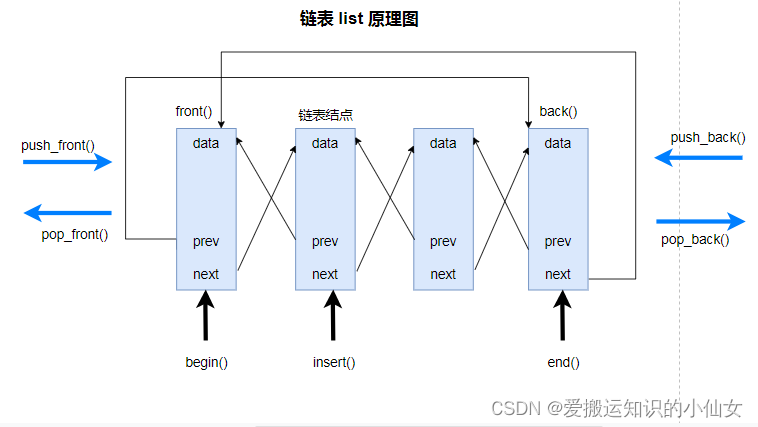
 编辑
编辑
list的优点:
- 存储不是连续的,采用动态存储分配,不会造成内存浪费和溢出。
- 插入和删除非常方便,修改指针域即可,不需要移动大量元素。
- 插入和删除都不会造成原有list迭代器失效,这在vector不成立。
list的缺点:
- 灵活,但是空间和时间消耗大。(指针域造成空间消耗大)(在遍历时需要根据指针来判断下一个结点,时间消耗大)
1.2 list构造函数
函数原型:
- list<T> lst; //list采用采用模板类实现,对象的默认构造形式:
- list(beg, end); //构造函数将[beg, end)区间中的元素拷贝给本身。
- list(n, elem); //构造函数将n个elem拷贝给本身。
- list(const list& lst); //拷贝构造函数。
示例:
#include <iostream>

#include <string>

#include<list>

using namespace std;

// list<T> lst; //list采用采用模板类实现,对象的默认构造形式:

// list(beg, end); //构造函数将[beg, end)区间中的元素拷贝给本身。

// list(n, elem); //构造函数将n个elem拷贝给本身。

// list(const list& lst); //拷贝构造函数。

void printList(const list<int>& l) {

    for (list<int>::const_iterator it = l.begin(); it != l.end(); it++) {

        cout << *it << " ";

    }

    cout << endl;

}

void test() {

    list<int> l;

    l.push_back(1);

    l.push_back(2);

    l.push_front(3);

    l.push_front(4);

    printList(l);

    list<int> l2(l.begin(), l.end());

    printList(l2);

    list<int> l3(l2);

    printList(l3);

    list<int>l4(10, 3);

    printList(l4);

}

int main() {

    test();

    system("pause");

    return 0;

}
1.3 list赋值和交换
函数原型:
- size(); //返回容器中元素的个数empty(); //判断容器是否为空
- resize(num); //重新指定容器的长度为num,若容器变长,则以默认值填充新位置。//如果容器变短,则末尾超出容器长度的元素被删除。
- resize(num, elem); //重新指定容器的长度为num,若容器变长,则以elem值填充新位置。//如果容器变短,则末尾超出容器长度的元素被删除。
示例:
#include <iostream>

#include <string>

#include<list>

using namespace std;

void printList(const list<int>& l) {

	for (list<int>::const_iterator it = l.begin(); it != l.end(); it++) {

		cout << *it << " ";

	}

	cout << endl;

}

void test() {

	//assign(beg, end); //将[beg, end)区间中的数据拷贝赋值给本身。

	list<int> l1;

	for (int i = 0; i < 5; i++) {

		l1.push_back(i);

	}

	printList(l1);

	list<int>l2;

	l2.assign(l1.begin(), l1.end());

	printList(l2);

	//assign(n, elem); //将n个elem拷贝赋值给本身。

	l2.assign(10, 3);

	printList(l2);

	//list& operator=(const list & lst); //重载等号操作符

	list<int> l3;

	l3 = l2;

	printList(l3);

	//swap(lst); //将lst与本身的元素互换。

	l1.swap(l3);

	cout << "互换后的:" << endl;

	printList(l1);

	printList(l3);

}

int main() {

	test();

	system("pause");

	return 0;

}
1.4 list大小操作
函数原型:
- size(); //返回容器中元素的个数
- empty(); //判断容器是否为空
- resize(num); //重新指定容器的长度为num,若容器变长,则以默认值填充新位置。//如果容器变短,则末尾超出容器长度的元素被删除。
- resize(num, elem); //重新指定容器的长度为num,若容器变长,则以elem值填充新位置。//如果容器变短,则末尾超出容器长度的元素被删除。
示例:
#include <iostream>
#include <string>
#include<list>
using namespace std;
//size(); //返回容器中元素的个数
//empty(); //判断容器是否为空
//resize(num); //重新指定容器的长度为num,若容器变长,则以默认值填充新位置。
// //如果容器变短,则末尾超出容器长度的元素被删除。
//resize(num, elem); //重新指定容器的长度为num,若容器变长,则以elem值填充新位置。
// //如果容器变短,则末尾超出容器长度的元素被删除。
void printList(const list<int>& l) {
for (list<int>::const_iterator it = l.begin(); it != l.end(); it++) {
cout << *it << " ";
}
cout << endl;
}
void test() {
//assign(beg, end); //将[beg, end)区间中的数据拷贝赋值给本身。
list<int> l1;
for (int i = 0; i < 5; i++) {
l1.push_back(i);
}
printList(l1);
if (l1.empty()) {
cout << "l1 为空" << endl;
}
else {
cout << "l1 不为空" << endl;
cout << "l1 size(): " << l1.size() << endl;
}
l1.resize(10);
printList(l1);
l1.resize(20,6);
printList(l1);
l1.resize(3);
printList(l1);
}
int main() {
test();
system("pause");
return 0;
}
输出:
0 1 2 3 4
l1 不为空
l1 size(): 5
0 1 2 3 4 0 0 0 0 0
0 1 2 3 4 0 0 0 0 0 6 6 6 6 6 6 6 6 6 6
0 1 2
1.5 list插入和删除
函数原型:
- push_back(elem); //在容器尾部加入一个元素
- pop_back(); //删除容器中最后一个元素
- push_front(elem); //在容器开头插入一个元素
- pop_front(); //从容器开头移除第一个元素
- insert(pos, elem); //在pos位置插elem元素的拷贝,返回新数据的位置。
- insert(pos, n, elem); //在pos位置插入n个elem数据,无返回值。
- insert(pos, beg, end); //在pos位置插入[beg,end)区间的数据,无返回值。
- clear(); //移除容器的所有数据
- erase(beg, end); //删除[beg,end)区间的数据,返回下一个数据的位置。
- erase(pos); //删除pos位置的数据,返回下一个数据的位置。
- remove(elem); //删除容器中所有与elem值匹配的元素。
示例:
#include <iostream>

#include <string>

#include<list>

using namespace std;

void printList(const list<int>& l) {

	for (auto item : l) {

		cout << item << " ";

	}

	cout << endl;

}

void test() {

	list<int> l1;

	for (int i = 0; i < 5; i++) {

		//push_back(elem);//在容器尾部加入一个元素

		l1.push_back(i);

	}

	//push_front(elem);//在容器开头插入一个元素

	l1.push_front(5);

	printList(l1);// 5 0 1 2 3 4

	//pop_front();//从容器开头移除第一个元素

	l1.pop_front();

	printList(l1);// 0 1 2 3 4

	//pop_back();//删除容器中最后一个元素

	l1.pop_back();

	printList(l1);// 0 1 2 3

	//insert(pos, elem);//在pos位置插elem元素的拷贝,返回新数据的位置。

	l1.insert(l1.begin(), 100);

	printList(l1);// 100 0 1 2 3

	//insert(pos, n, elem);//在pos位置插入n个elem数据,无返回值。

	l1.insert(l1.end(), 3, 200);

	printList(l1);//100 0 1 2 3 200 200 200

	//insert(pos, beg, end);//在pos位置插入[beg,end)区间的数据,无返回值。

	l1.insert(l1.begin(), l1.begin(), l1.end());

	printList(l1);//100 0 1 2 3 200 200 200 100 0 1 2 3 200 200 200

	//erase(beg, end);//删除[beg,end)区间的数据,返回下一个数据的位置。

	l1.erase(l1.begin(), ++l1.begin());

	printList(l1);//0 1 2 3 200 200 200 100 0 1 2 3 200 200 200

	//erase(pos);//删除pos位置的数据,返回下一个数据的位置。

	l1.erase(++l1.begin());

	printList(l1);//0 2 3 200 200 200 100 0 1 2 3 200 200 200

	//remove(elem);//删除容器中所有与elem值匹配的元素。

	l1.remove(200);

	printList(l1);//0 2 3 100 0 1 2 3

	//clear();//移除容器的所有数据

	l1.clear();

	printList(l1);

}

int main() {

	test();

	system("pause");

	return 0;

}
1.6 list数据存取
函数原型:
- front(); //返回第一个元素
- back(); //返回最后一个元素
示例:
#include <iostream>

#include <string>

#include<list>

using namespace std;

void test() {

	list<int> l;

	l.push_back(1);

	l.push_back(2);

	l.push_back(3);

	l.push_back(4);

	// l[0];  // 错误

	// l.at(0);  // 错误

	// 原因:list本质是双向迭代器,不是随机迭代器,不支持随机访问,不是连续线性存储。

	cout << "first item: " << l.front() << endl;

	cout << "last item: " << l.back() << endl;

	list<int>::iterator it = l.begin();

	it++;// 支持双向

	it++++;

	it--;

	//it = it + 1;//不支持随机访问 即便是+1;

}

int main() {

	test();

	system("pause");

	return 0;

}
1.7 list反转和排序
函数原型:
- reverse(); 反转链表
- sort(); 链表排序,默认升序
示例:
#include <iostream>

#include <string>

#include<list>

#include<algorithm>

using namespace std;

void printList(const list<int>& l) {

	for (auto item : l) {

		cout << item << " ";

	}

	cout << endl;

}

bool myCompare(int v1, int v2) {

	// 降序 就让第一个数 > 第二个数

	return v1 > v2;

}

void test() {

	list<int> l;

	for (int i = 0; i < 5; i++) {

		l.push_back(i);

	}

	printList(l);

	l.reverse();

	printList(l);

	//所有不支持随机访问迭代器的容器,不可以用标准算法

	// 不支持随机访问迭代器的容器,内部会提供对应的算法

	//sort(l.begin(), l.end());

	//使用容器内部算法排序 sort排序,默认升序

	l.sort();

	cout << "升序:" << endl;

	printList(l);

	l.sort(myCompare);

	cout << "降序:" << endl;

	printList(l);

}

int main() {

	test();

	system("pause");

	return 0;

}
1.8 list排序案例
需求描述:
自定义person类,包含姓名、年龄、升高属性。
排序规则,按照年龄升序,若年龄相同,按照身高降序。
示例:
#include <iostream>

#include <string>

#include<list>

using namespace std;

class Person {

public:

	Person(string name,int age,int height) {

		this->m_name = name;

		this->m_age = age;

		this->m_height=height;

	}

	string m_name;

	int m_age;

	int m_height;

};

bool myCompare(Person& p1, Person& p2) {

	// 年龄相同 按照升高降序

	if (p1.m_age == p2.m_age) {

		return p1.m_height > p2.m_height;

	}

	else {

		//按照年龄 升序

		return p1.m_age < p2.m_age;

	}

}

void printPerson(const list<Person>& l) {

	for (auto item : l) {

		cout << "name: " << item.m_name

			<< " age: " << item.m_age

			<< " height: " << item.m_height

			<< endl;

	}

}

void test() {

	Person p1("echo", 20, 150);

	Person p2("lisa", 25, 170);

	Person p3("mesa", 20, 160);

	list<Person> l;

	l.push_back(p1);

	l.push_back(p2);

	l.push_back(p3);

	printPerson(l);

	l.sort(myCompare);

	cout << "排序后:" << endl;

	printPerson(l);

}

int main() {

	test();

	system("pause");

	return 0;

}
10 STL-list的更多相关文章
- 学习激动人心的C++ 11
1->创建7个Thread,跑个非常大的循环.观察CPU void func(string &name) { ;i<0xFFFFFFFF;i++) { //cout << ...
- c++高质量编程手册
怡化主管强烈要求我读这本书.... 笔记尚未完成,持续更新呗.. 第1章 高质量软件开发之道 1.1 软件质量基本概念 1.1.1 如何理解软件的质量:功能性和非公能性 1.1.2 提高软件质量的基本 ...
- C++ 11 snippets , 1
1->创建7个Thread,跑个非常大的循环.观察CPU void func(string &name) { ;i<0xFFFFFFFF;i++) { //cout << ...
- ignitius and princess 2(全排列)
A - Ignatius and the Princess II Now our hero finds the door to the BEelzebub feng5166. He opens the ...
- 我要好offer之 C++大总结
0. Google C++编程规范 英文版:http://google-styleguide.googlecode.com/svn/trunk/cppguide.xml 中文版:http://zh-g ...
- CMS系统简介(从简介到使用)
CMS系统简介 1.简介 CMS是Content Management System的缩写,意为"内容管理系统". 在中国互联网的发展历程中,一直以来默默地为中国站长提供动力的CM ...
- c++ 性能优化策略
c++ 性能优化策略 作者:D_Guco 来源:CSDN 原文:https://blog.csdn.net/D_Guco/article/details/75729259 1 关于继承:不可否认良好的 ...
- 【10.11校内测试】【优先队列(反悔贪心)】【莫队】【stl的应用??离线处理+二分】
上次做过类似的题,原来这道还要简单些?? 上次那道题是每天可以同时买进卖出,所以用两个优先队列,一个存买进,一个存卖出(供反悔的队列). 这道题实际上用一个就够了???但是不好理解!! 所以我还是用了 ...
- 10.3 c++ STL 初步
#include<Windows.h>#include<iostream>#include<algorithm> // sort swap min ma ...
- STL 小白学习(10) map
map的构造函数 map<int, string> mapS; 数据的插入:用insert函数插入pair数据,下面举例说明 mapStudent.insert(pair<, &qu ...
随机推荐
- **手把手教你安装 Anaconda + Tensor flow+Pycharm**
手把手教你安装 Anaconda + Tensor flow+Pycharm 这篇博文主要讲一下自己安装Anaconda + Tensor flow + Pycharm 的一个过程. 1. ANACO ...
- Python 第四次实验
1.(程序设计)定义函数def GetRandomChar(),返回一个随机的数字或大写或小写字母,每个符号出现的机会相等.调用该函数8次,生成并输出一个8位的验证码.用户输入该验证码,如果验证码正确 ...
- ProxySQL 防火墙白名单
ProxySQL 2.0.9 引入了防火墙功能. 在从早期版本版本中,可以通过设置查询规则来创建要阻止的黑名单,或者定义通用规则,实现白名单功能. 但是,如果面对的系统有非常多而且操作内容也不同,这时 ...
- Kubernetes 监控--Prometheus 高可用: Thanos
前面我们已经学习了 Prometheus 的使用,了解了基本的 PromQL 语句以及结合 Grafana 来进行监控图表展示,通过 AlertManager 来进行报警,这些工具结合起来已经可以帮助 ...
- 创建一个 autocomplete 输入系统 - 前端 + 后端
文章转载自:https://mp.weixin.qq.com/s/uqchdrkhdFsof0ZFtECujg 我们经常在网站搜索输入时,会帮我们提醒自动完成的功能,比如: 图片 当我们在百度上搜索 ...
- Elasticsearch:Elasticsearch HQ 介绍
- Ceph 存储集群第一部分:配置和部署
内容来源于官方,经过个人实践操作整理,官方地址:http://docs.ceph.org.cn/rados/ 所有 Ceph 部署都始于 Ceph 存储集群. 基于 RADOS 的 Ceph 对象存储 ...
- Alertmanager集成Dingtalk/Wechat/Email报警
grafana对报警的支持真的很弱,而Prometheus提供的报警系统就强大很多 Prometheus将数据采集和报警分成了两个模块.报警规则配置在Prometheus Servers上,然后发送报 ...
- 请求库之requests库
目录 一.介绍 二.基于get请求 1 基本请求 2 带参数的get请求 3 请求携带cookie 三.基于post请求 1 基本用法 2 发送post请求,模拟浏览器的登录行为 四.响应Respon ...
- 洛谷P1714 切蛋糕(单调队列)
先放代码...... 1 #include<bits/stdc++.h> 2 using namespace std; 3 const int N=5e5+10,M=0x3f3f3f3f; ...