
9.22 2020 实验 3:Mininet 实验——测量路径的损耗率
#!/usr/bin/python
# Copyright 2012 William Yu
# wyu@ateneo.edu
#
# This file is part of POX.
#
# POX is free software: you can redistribute it and/or modify
# it under the terms of the GNU General Public License as published by
# the Free Software Foundation, either version 3 of the License, or
# (at your option) any later version.
#
# POX is distributed in the hope that it will be useful,
# but WITHOUT ANY WARRANTY; without even the implied warranty of
# MERCHANTABILITY or FITNESS FOR A PARTICULAR PURPOSE. See the
# GNU General Public License for more details.
#
# You should have received a copy of the GNU General Public License
# along with POX. If not, see <http://www.gnu.org/licenses/>.
#
"""
This is a demonstration file created to show how to obtain flow
and port statistics from OpenFlow 1.0-enabled switches. The flow
statistics handler contains a summary of web-only traffic.
"""
# standard includes
from pox.core import core
from pox.lib.util import dpidToStr
import pox.openflow.libopenflow_01 as of
from pox.lib.addresses import IPAddr, EthAddr
# include as part of the betta branch
from pox.openflow.of_json import *
from pox.lib.recoco import Timer
import time
log = core.getLogger()
src_dpid = 0
dst_dpid = 0
input_pkts = 0
output_pkts = 0
def getTheTime(): #fuction to create a timestamp
flock = time.localtime()
then = "[%s-%s-%s" %(str(flock.tm_year),str(flock.tm_mon),str(flock.tm_mday))
if int(flock.tm_hour)<10:
hrs = "0%s" % (str(flock.tm_hour))
else:
hrs = str(flock.tm_hour)
if int(flock.tm_min)<10:
mins = "0%s" % (str(flock.tm_min))
else:
mins = str(flock.tm_min)
if int(flock.tm_sec)<10:
secs = "0%s" % (str(flock.tm_sec))
else:
secs = str(flock.tm_sec)
then +="]%s.%s.%s" % (hrs,mins,secs)
return then
# handler for timer function that sends the requests to all the
# switches connected to the controller.
def _timer_func ():
for connection in core.openflow._connections.values():
connection.send(of.ofp_stats_request(body=of.ofp_flow_stats_request()))
connection.send(of.ofp_stats_request(body=of.ofp_port_stats_request()))
log.debug("Sent %i flow/port stats request(s)", len(core.openflow._connections))
# handler to display flow statistics received in JSON format
# structure of event.stats is defined by ofp_flow_stats()
def _handle_flowstats_received (event):
#stats = flow_stats_to_list(event.stats)
#log.debug("FlowStatsReceived from %s: %s", dpidToStr(event.connection.dpid), stats)
global src_dpid, dst_dpid, input_pkts, output_pkts
#print "src_dpid=", dpidToStr(src_dpid), "dst_dpid=", dpidToStr(dst_dpid)
for f in event.stats:
if f.match.dl_type==0x0800 and f.match.nw_dst==IPAddr("192.168.123.2") and f.match.nw_tos==0x64 and event.connection.dpid==src_dpid:
#print "input: ", f.byte_count, f.packet_count
input_pkts = f.packet_count
if f.match.dl_type==0x0800 and f.match.nw_dst==IPAddr("192.168.123.2") and f.match.nw_tos==0x64 and event.connection.dpid==dst_dpid:
#print "output: ", f.byte_count, f.packet_count
output_pkts = f.packet_count
if input_pkts !=0:
print getTheTime(), "Path Loss Rate =", (input_pkts-output_pkts)*1.0/input_pkts*100, "%"
# handler to display port statistics received in JSON format
def _handle_portstats_received (event):
#print "\n<<<STATS-REPLY: Return PORT stats for Switch", event.connection.dpid,"at ",getTheTime()
#for f in event.stats:
#if int(f.port_no)<65534:
#print " PortNo:", f.port_no, " Fwd's Pkts:", f.tx_packets, " Fwd's Bytes:", f.tx_bytes, " Rc'd Pkts:", f.rx_packets, " Rc's Bytes:", f.rx_bytes
#print " PortNo:", f.port_no, " TxDrop:", f.tx_dropped, " RxDrop:", f.rx_dropped, " TxErr:", f.tx_errors, " RxErr:", f.rx_errors, " CRC:", f.rx_crc_err, " Coll:", f.collisions
stats = flow_stats_to_list(event.stats)
log.debug("PortStatsReceived from %s: %s", dpidToStr(event.connection.dpid), stats)
def _handle_ConnectionUp (event):
global src_dpid, dst_dpid
print "ConnectionUp: ", dpidToStr(event.connection.dpid)
for m in event.connection.features.ports:
if m.name == "s0-eth0":
src_dpid = event.connection.dpid
elif m.name == "s1-eth0":
dst_dpid = event.connection.dpid
msg = of.ofp_flow_mod()
msg.priority =1
msg.idle_timeout = 0
msg.match.in_port =1
msg.actions.append(of.ofp_action_output(port = of.OFPP_ALL))
event.connection.send(msg)
msg = of.ofp_flow_mod()
msg.priority =1
msg.idle_timeout = 0
msg.match.in_port =2
msg.actions.append(of.ofp_action_output(port = of.OFPP_ALL))
event.connection.send(msg)
msg = of.ofp_flow_mod()
msg.priority =10
msg.idle_timeout = 0
msg.hard_timeout = 0
msg.match.dl_type = 0x0800
msg.match.nw_tos = 0x64
msg.match.in_port=1
msg.match.nw_dst = "192.168.123.2"
msg.actions.append(of.ofp_action_output(port = 2))
event.connection.send(msg)
msg = of.ofp_flow_mod()
msg.priority =10
msg.idle_timeout = 0
msg.hard_timeout = 0
msg.match.dl_type = 0x0800
msg.match.nw_tos = 0x64
msg.match.nw_dst = "192.168.123.1"
msg.actions.append(of.ofp_action_output(port = 1))
event.connection.send(msg)
# main functiont to launch the module
def launch ():
# attach handsers to listners
core.openflow.addListenerByName("FlowStatsReceived",
_handle_flowstats_received)
core.openflow.addListenerByName("PortStatsReceived",
_handle_portstats_received)
core.openflow.addListenerByName("ConnectionUp", _handle_ConnectionUp)
# timer set to execute every five seconds
Timer(1, _timer_func, recurring=True)
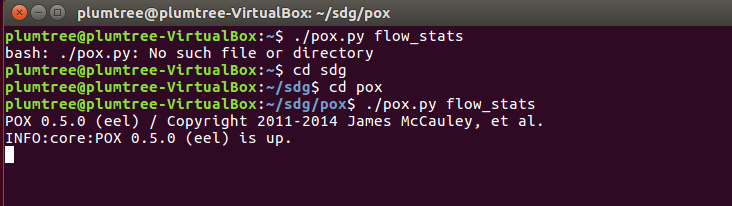

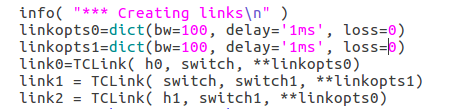
#!/usr/bin/python
from mininet.net import Mininet
from mininet.node import Node
from mininet.link import TCLink
from mininet.log import setLogLevel, info
from threading import Timer
from mininet.util import quietRun
from time import sleep
def myNet(cname='controller', cargs='-v ptcp:'):
"Create network from scratch using Open vSwitch."
info( "*** Creating nodes\n" )
controller = Node( 'c0', inNamespace=False )
switch = Node( 's0', inNamespace=False )
switch1 = Node( 's1', inNamespace=False )
h0 = Node( 'h0' )
h1 = Node( 'h1' )
info( "*** Creating links\n" )
linkopts0=dict(bw=100, delay='1ms', loss=0)
linkopts1=dict(bw=100, delay='1ms', loss=10)
link0=TCLink( h0, switch, **linkopts0)
link1 = TCLink( switch, switch1, **linkopts1)
link2 = TCLink( h1, switch1, **linkopts0)
#print link0.intf1, link0.intf2
link0.intf2.setMAC("0:0:0:0:0:1")
link1.intf1.setMAC("0:0:0:0:0:2")
link1.intf2.setMAC("0:1:0:0:0:1")
link2.intf2.setMAC("0:1:0:0:0:2")
info( "*** Configuring hosts\n" )
h0.setIP( '192.168.123.1/24' )
h1.setIP( '192.168.123.2/24' )
info( "*** Starting network using Open vSwitch\n" )
switch.cmd( 'ovs-vsctl del-br dp0' )
switch.cmd( 'ovs-vsctl add-br dp0' )
switch1.cmd( 'ovs-vsctl del-br dp1' )
switch1.cmd( 'ovs-vsctl add-br dp1' )
controller.cmd( cname + ' ' + cargs + '&' )
for intf in switch.intfs.values():
print intf
print switch.cmd( 'ovs-vsctl add-port dp0 %s' % intf )
for intf in switch1.intfs.values():
print intf
print switch1.cmd( 'ovs-vsctl add-port dp1 %s' % intf )
# Note: controller and switch are in root namespace, and we
# can connect via loopback interface
switch.cmd( 'ovs-vsctl set-controller dp0 tcp:127.0.0.1:6633' )
switch1.cmd( 'ovs-vsctl set-controller dp1 tcp:127.0.0.1:6633' )
info( '*** Waiting for switch to connect to controller' )
while 'is_connected' not in quietRun( 'ovs-vsctl show' ):
sleep( 1 )
info( '.' )
info( '\n' )
#info( "*** Running test\n" )
h0.cmdPrint( 'ping -Q 0x64 -c 20 ' + h1.IP() )
sleep( 1 )
info( "*** Stopping network\n" )
controller.cmd( 'kill %' + cname )
switch.cmd( 'ovs-vsctl del-br dp0' )
switch.deleteIntfs()
switch1.cmd( 'ovs-vsctl del-br dp1' )
switch1.deleteIntfs()
info( '\n' )
if __name__ == '__main__':
setLogLevel( 'info' )
info( '*** Scratch network demo (kernel datapath)\n' )
Mininet.init()
myNet()
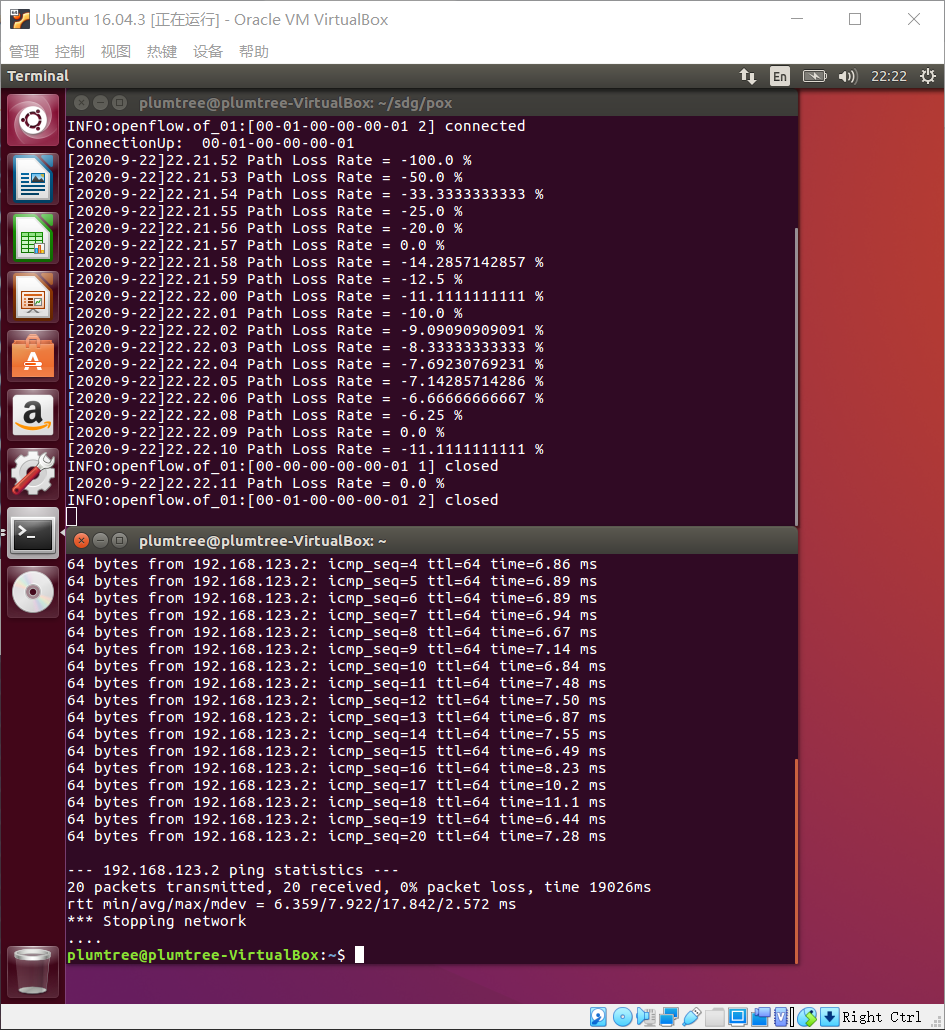
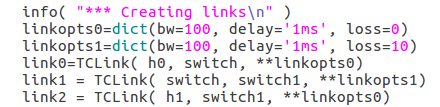
$ sudo python mymininet.py
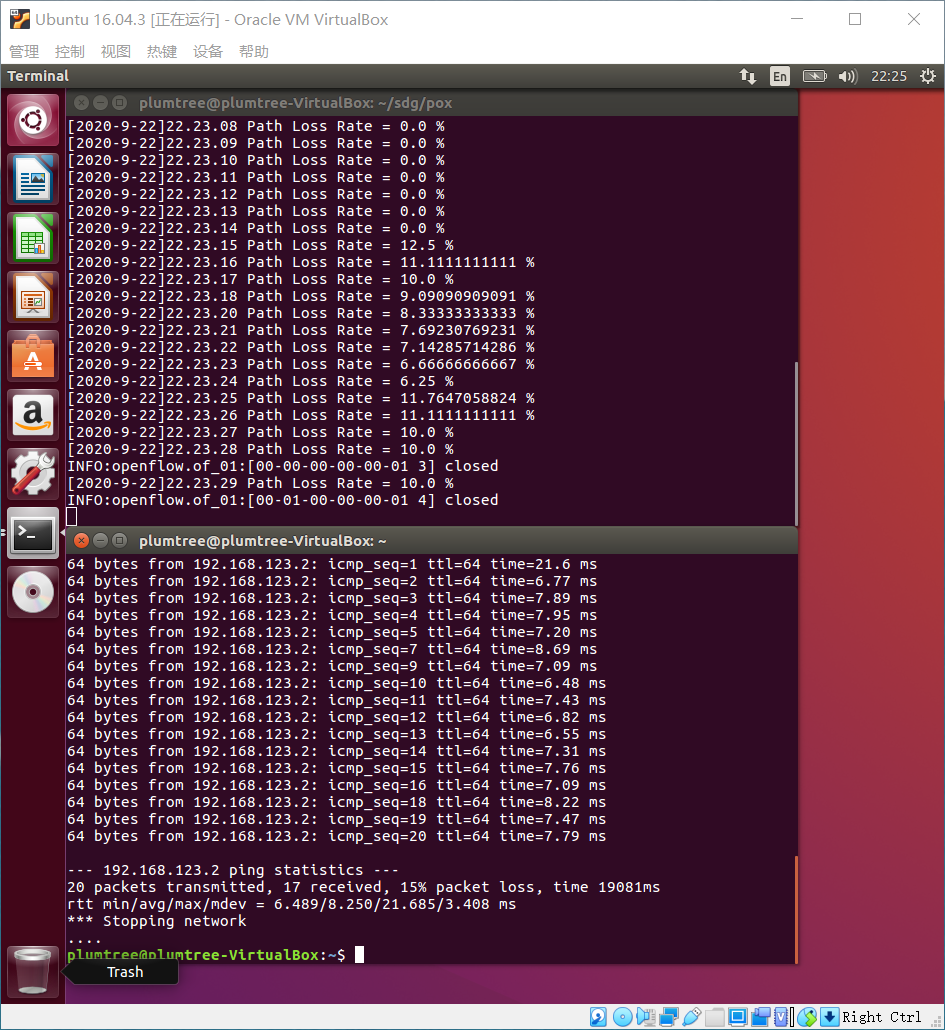
loss=15%?
9.22 2020 实验 3:Mininet 实验——测量路径的损耗率的更多相关文章
- Mininet实验 基于Mininet测量路径的损耗率
实验原理 在SDN环境中,控制器可以通过对交换机下发流表操作来控制交换机的转发行为,此外,还可以利用控制器测量路径的损耗率.在本实验中,基于Mininet脚本,设置特定的交换机间的路径损耗速率,然后编 ...
- Mininet系列实验(四):基于Mininet测量路径的损耗率
1 实验目的 熟悉Mininet自定义拓扑脚本的编写与损耗率的设定: 熟悉编写POX脚本,测量路径损耗速率 2 实验原理 在SDN环境中,控制器可以通过对交换机下发流表操作来控制交换机的转发行为,此外 ...
- 实验 3:Mininet 实验——测量路径的损耗率
实验目的 在实验 2 的基础上进一步熟悉 Mininet 自定义拓扑脚本,以及与损耗率相关的设 定:初步了解 Mininet 安装时自带的 POX 控制器脚本编写,测试路径损耗率. 实验任务 h0 向 ...
- SDN实验 3: Mininet 实验——测量路径的损耗率
验 3:Mininet 实验--测量路径的损耗率 一.实验目的 在实验 2 的基础上进一步熟悉 Mininet 自定义拓扑脚本,以及与损耗率相关的设定:初步了解 Mininet 安装时自带的 POX ...
- 基于Mininet测量路径的损耗率
基于Mininet测量路径的损耗率 控制器采用POX,基于OVS仿真 Mininet脚本 创建Node mininet.node Node 创建链路连接 mininet.link TCLink 设置i ...
- 软件定义网络实验记录③--Mininet 实验——测量路径的损耗率
一.实验目的 在实验 2 的基础上进一步熟悉 Mininet 自定义拓扑脚本,以及与损耗率相关的设定: 初步了解 Mininet 安装时自带的 POX 控制器脚本编写,测试路径损耗率. 二.实验任务 ...
- 实验 3:Mininet 实验——测量路径的损耗率
一.实验目的 在实验 2 的基础上进一步熟悉 Mininet 自定义拓扑脚本,以及与损耗率相关的设定;初步了解 Mininet 安装时自带的 POX 控制器脚本编写,测试路径损耗率. 二.实验任务 h ...
- Mininet实验 基于Mininet实现BGP路径挟持攻击实验
参考:基于Mininet实现BGP路径挟持攻击实验 实验目的: 掌握如何mininet内模拟AS. 掌握BGP路径挟持的原理和分析过程. 实验原理: 互联网是由相互连接的自治系统AS组成的,通过一个通 ...
- 软件定义网络实验记录②--Mininet 实验——拓扑的命令脚本生成
一.实验目的 掌握 Mininet 的自定义拓扑生成方法:命令行创建.Python 脚本编写 二.实验任务 通过使用命令行创建.Python 脚本编写生成拓扑,熟悉 Mininet 的基本功能. 三. ...
- 实验 2:Mininet 实验——拓扑的命令脚本生成
一.实验目的 掌握 Mininet 的自定义拓扑生成方法:命令行创建.Python 脚本编写 二.实验任务 通过使用命令行创建.Python 脚本编写生成拓扑,熟悉 Mininet 的基本功能. 三. ...
随机推荐
- jmeter-时间处理
${__time(,)} 1486091280955 //无格式化参数,返回当前毫秒时间,默认13位.一般用来做时间戳 ${__time(/1000,)} //为取10位的时间戳的函数表达式(时间精确 ...
- 关于 echarts 使用 geo 制作地图 tooltip 不显示问题(转)
原文地址 我之前遇到过这问题,单独设置 tooltip 没效果,geo 下面也有 tooltip 属性,但是也不管用,网上查了一下说 geo 不支持 tooltip 提示框显示,就自己根据 echar ...
- eclipse (4.10.0)安装sts
1.离线安装 下载对应版本 https://spring.io/tools3/sts/all 打开Eclipse,点击help下的install new software,选择Add..,再点击Arc ...
- Security Bulletin: IBM WebSphere Application Server is vulnerable to a remote code execution vulnerability (CVE-2023-23477)
Skip to content Support DownloadsDocumentationForumsCasesMonitoringManage support account ...
- Python3 文件处理相关脚本
对文件相关处理是脚本中最常见的,下面列举几种实用的案例: 批量删除: (1)删除指定目录,指定后缀文件 例:删除目录J:/start下的 .log与.tmp结尾文件 def del_files(pat ...
- Chtholly Tree 学习笔记
前言 珂朵莉树 (Chtholly Tree) 是一种简单优美的数据结构,就像 Chtholly 一样可爱.暴力即优美. 适用于一些有区间赋值操作的序列操作题. Chtholly Tree 的本质是把 ...
- 肖sir__网页线下面试
第一题: 设计一下两个两位数相加的测试用例,说只能写数字不要写文字 第二题 淘宝订单怎么测试 功能测试: 1.测试订单输入的类型 2.测试金额数量:可创建等价类划分 3.测试库存数量变更 4.测试订单 ...
- 打包Assetbundle
using UnityEngine;using System.Collections;using UnityEditor;/// <summary>/// 脚本位置:Editor文件夹下/ ...
- 一、Java简单概述
一 . Java组成部分 JDK : java development kit (Java开发工具) JDK是提供给Java开发人员使用的,其中包含了java的开发工具,也 包括了JRE. 所以安装了 ...
- [OC] 统计代码行数
1.打开终端 2. cd 路径,或者 输入cd ,然后把要统计代码的工程拖入终端,就会出现工程的路径. 然后按下回车. 3.输入: find . -name "*.m" -or - ...