
POJ 1265 Area POJ 2954 Triangle Pick定理
Area
Time Limit: 1000MS Memory Limit: 10000K Total Submissions: 5227 Accepted: 2342 Description
Being well known for its highly innovative products, Merck would definitely be a good target for industrial espionage. To protect its brand-new research and development facility the company has installed the latest system of surveillance robots patrolling the area. These robots move along the walls of the facility and report suspicious observations to the central security office. The only flaw in the system a competitor抯 agent could find is the fact that the robots radio their movements unencrypted. Not being able to find out more, the agent wants to use that information to calculate the exact size of the area occupied by the new facility. It is public knowledge that all the corners of the building are situated on a rectangular grid and that only straight walls are used. Figure 1 shows the course of a robot around an example area.
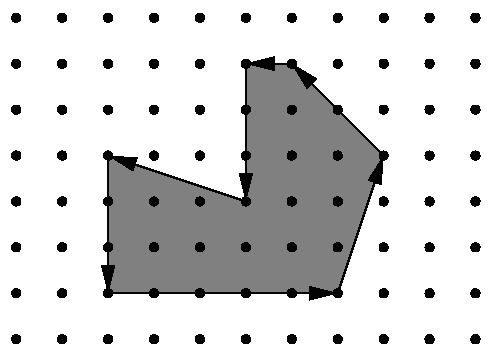
Figure 1: Example area.
You are hired to write a program that calculates the area occupied by the new facility from the movements of a robot along its walls. You can assume that this area is a polygon with corners on a rectangular grid. However, your boss insists that you use a formula he is so proud to have found somewhere. The formula relates the number I of grid points inside the polygon, the number E of grid points on the edges, and the total area A of the polygon. Unfortunately, you have lost the sheet on which he had written down that simple formula for you, so your first task is to find the formula yourself.Input
The first line contains the number of scenarios.
For each scenario, you are given the number m, 3 <= m < 100, of movements of the robot in the first line. The following m lines contain pairs 揹x dy�of integers, separated by a single blank, satisfying .-100 <= dx, dy <= 100 and (dx, dy) != (0, 0). Such a pair means that the robot moves on to a grid point dx units to the right and dy units upwards on the grid (with respect to the current position). You can assume that the curve along which the robot moves is closed and that it does not intersect or even touch itself except for the start and end points. The robot moves anti-clockwise around the building, so the area to be calculated lies to the left of the curve. It is known in advance that the whole polygon would fit into a square on the grid with a side length of 100 units.Output
The output for every scenario begins with a line containing 揝cenario #i:� where i is the number of the scenario starting at 1. Then print a single line containing I, E, and A, the area A rounded to one digit after the decimal point. Separate the three numbers by two single blanks. Terminate the output for the scenario with a blank line.Sample Input
2

4

1 0

0 1

-1 0

0 -1

7

5 0

1 3

-2 2

-1 0

0 -3

-3 1

0 -3
Sample Output
Scenario #1:

0 4 1.0

Scenario #2:

12 16 19.0
Source
#include <cstdio>

#include <iostream>

#include <cmath>

using namespace std;

const int maxn = ;

struct point{

    int x, y;

};

point p[maxn];

int n;

int x_multi(const point p1, const point p2)

{

    return (p1.x * p2.y - p2.x * p1.y);

}

int gcd(int a, int b)

{

    return b ==  ? a : gcd(b, a % b);

}

int main()

{

    int t;

    scanf("%d", &t);

    int kase = ;

    while (t--)

    {

        scanf("%d", &n);

        p[].x = p[].y = ;

        int t1, t2;

        for (int i = ; i <= n; i++)

        {

            scanf("%d %d", &t1, &t2);

            p[i].x = p[i - ].x + t1;

            p[i].y = p[i - ].y + t2;

        }

        int area = ;

        int outside = ;

        for (int i = ; i < n; i++)

        {

            area += x_multi(p[i], p[i + ]);

            outside += gcd(abs(p[i].x - p[i + ].x), abs(p[i].y - p[i + ].y));

        }

        area += x_multi(p[n], p[]);

        outside += gcd(abs(p[n].x - p[].x), abs(p[n].y - p[].y));

        if (area < )

            area = -area;

        int inside = area +  - outside;

        inside /= ;

        printf("Scenario #%d:\n", ++kase);

        if (area %  == )//如果在边界上的定点个数为偶数,面积就是整数

        {

            printf("%d %d %d.0\n\n", inside, outside, area / );

        }

        else//反之就是小数

            printf("%d %d %d.5\n\n", inside, outside, area / );

    }

    return ;

}
下面是POJ 2954的代码,原题就不粘了,大意:给三角形的三个点的坐标,求三角形内有多少个点。思路还是Pick定理
AC代码
/*************************************************************************

    > File Name:            poj_2954.cpp

    > Author:               Howe_Young

    > Mail:                 1013410795@qq.com

    > Created Time:         2015年04月17日 星期五 20时26分14秒

 ************************************************************************/

#include <cstdio>

#include <iostream>

#include <cstring>

#include <cmath>

#include <cstdlib>

#include <algorithm>

#include <cstdio>

using namespace std;

struct point{

    int x, y;

};

int x_multi(const point p1, const point p2, const point p3)

{

    return ((p3.x - p1.x) * (p2.y - p1.y) - (p2.x - p1.x) * (p3.y - p1.y));

}

int gcd(int a, int b)

{

    return b ==  ? a : gcd(b, a % b);

}

int main()

{

    point p1, p2, p3;

    while (~scanf("%d %d %d %d %d %d", &p1.x, &p1.y, &p2.x, &p2.y, &p3.x, &p3.y) && (p1.x || p2.x || p3.x || p1.y || p2.y || p3.y))

    {

        int area = x_multi(p1, p2, p3);//这里的area是两倍的area,因为面积没有除以2

        if (area < )

            area = -area;

        int on_edge = ;

        on_edge += gcd(abs(p1.x - p2.x), abs(p1.y - p2.y));

        on_edge += gcd(abs(p1.x - p3.x), abs(p1.y - p3.y));

        on_edge += gcd(abs(p2.x - p3.x), abs(p2.y - p3.y));

        int inside = area +  - on_edge;//这个就是pick公式两边同时×2

        inside /= ;

        printf("%d\n", inside);

    }

    return ;

}
POJ 1265 Area POJ 2954 Triangle Pick定理的更多相关文章
- POJ 2954 Triangle (pick 定理)
题目大意:给出三个点的坐标,问在这三个点坐标里面的整数坐标点有多少个(不包含边上的) 匹克定理:I = (A-E) / 2 + 1; A: 表示多边形面积 I : 表示多边形内部的点的个数 E: 表示 ...
- poj 1265 Area 面积+多边形内点数
Area Time Limit: 1000MS Memory Limit: 10000K Total Submissions: 5861 Accepted: 2612 Description ...
- poj 1265 Area (Pick定理+求面积)
链接:http://poj.org/problem?id=1265 Area Time Limit: 1000MS Memory Limit: 10000K Total Submissions: ...
- POJ 1265 Area (Pick定理 & 多边形面积)
题目链接:POJ 1265 Problem Description Being well known for its highly innovative products, Merck would d ...
- poj 1265 Area(Pick定理)
Area Time Limit: 1000MS Memory Limit: 10000K Total Submissions: 5666 Accepted: 2533 Description ...
- poj 1265 Area(pick定理)
Area Time Limit: 1000MS Memory Limit: 10000K Total Submissions: 4373 Accepted: 1983 Description Bein ...
- [poj 1265]Area[Pick定理][三角剖分]
题意: 给出机器人移动的向量, 计算包围区域的内部整点, 边上整点, 面积. 思路: 面积是用三角剖分, 边上整点与GCD有关, 内部整点套用Pick定理. S = I + E / 2 - 1 I 为 ...
- POJ 1265 Area (pick定理)
题目大意:已知机器人行走步数及每一步的坐标变化量,求机器人所走路径围成的多边形的面积.多边形边上和内部的点的数量. 思路:叉积求面积,pick定理求点. pick定理:面积=内部点数+边上点数/2-1 ...
- poj 1265 Area( pick 定理 )
题目:http://poj.org/problem?id=1265 题意:已知机器人行走步数及每一步的坐标 变化量 ,求机器人所走路径围成的多边形的面积.多边形边上和内部的点的数量. 思路:1.以 ...
随机推荐
- html5系列.基础知识
兼容性问题 创建一个html5页面 <!DOCTYPE html> <html> <head> <meta charset="UTF-8" ...
- PHP 字符串常用方法
implode(“”,“”)-->字符串分割方法,第一个参数以什么样的形式分割,第二个参数需要分割的字符串 数组操作 is_array(),判断这个数是否是一个数组
- bzoj3864: Hero meet devil
Description There is an old country and the king fell in love with a devil. The devil always asks th ...
- ExtJS 4 类系统
ExtJS 4的类系统(class system)进行了一次重大重构,ExtJS4的新架构就是基于这套新的类系统构建的,因此有必要先了解以下这个class system这篇文章分为四章 I: &quo ...
- hadoop hdfs 命令行 设置文件夹大小的上限 quota:配额
>bin/hdfs dfs -put readme.txt /finance >bin/hdfs dfs -du -s /finance > /finance >bin/hdf ...
- Xcode 5 解决 The operation couldn’t be completed. (NSURLErrorDomain error -1012.) 问题
使用Xcode6.1 SVN 出现问题 The operation couldn’t be completed. (NSURLErrorDomain error -1012.) 解决方法: 打开终端 ...
- memcached采用的网络模型
memcached采用的网络模型是早前提到的半同步半异步的网络模型. 简 单的说,大致流程就是:主线程负责接收新的连接,接收到新的连接之后,选择一个worker副线程,将该新连接push到副线程的连接 ...
- RS232及RTS和CTS
EIA RS-232-C标准 EIA RS-232-C是由美国电子工业协会EIA制定的串行通信物理接口标准.最初是远程数据通信时,为连接数据终端设备DTE(Data Terminal Equipmen ...
- Nodejs爬虫进阶教程之异步并发控制
Nodejs爬虫进阶教程之异步并发控制 之前写了个现在看来很不完美的小爬虫,很多地方没有处理好,比如说在知乎点开一个问题的时候,它的所有回答并不是全部加载好了的,当你拉到回答的尾部时,点击加载更多,回 ...
- ♫【Underscore.js】
Underscore.js Underscore.js 1.5.2 中文文档 Underscore 是一个JavaScript实用库,提供了类似Prototype.js (或 Ruby)的一些功能,但 ...