
Spring 环境与profile(二)——Properties with Spring
1. 简述
Spring profile用例,分3个场景(Test, Dev, Prod)相对Spring 环境与profile(一)——超简用例多了根据具体的profile获取对应的Properties
2. 代码结构
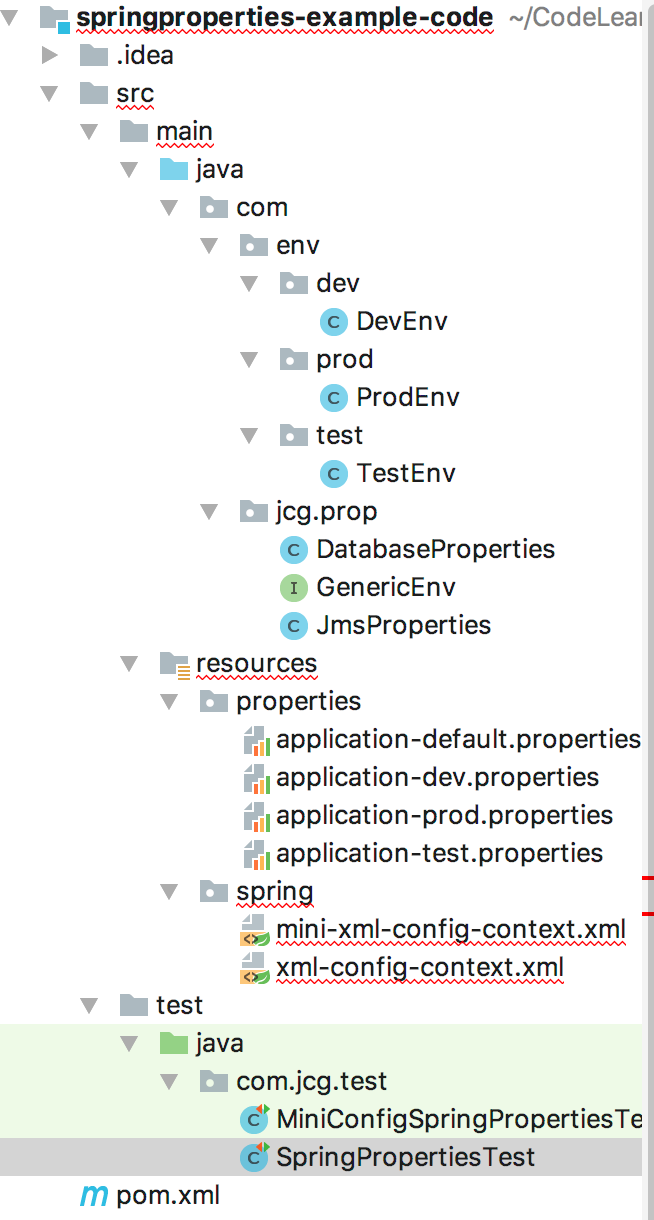
3. 各模块介绍
接口
GenericEnv
public interface GenericEnv {

}
#com.env模块
DevEnv.java
@Component

public class DevEnv implements GenericEnv {

    private String envName = "dev";

    @Value("${profile.name}")

    private String profileName;

    public String getEnvName() {

        return envName;

    }

    public void setEnvName(String envName) {

        this.envName = envName;

    }

    public String getProfileName() {

        return profileName;

    }

    public void setProfileName(String profileName) {

        this.profileName = profileName;

    }

    @Override

    public String toString() {

        return "DevEnv [envName=" + envName + ", profileName=" + profileName

                + "]";

    }

}
ProdEnv
@Component

public class ProdEnv implements GenericEnv {

    private String envName = "prod";

    @Value("${profile.name}")

    private String profileName;

    public String getEnvName() {

        return envName;

    }

    public void setEnvName(String envName) {

        this.envName = envName;

    }

    public String getProfileName() {

        return profileName;

    }

    public void setProfileName(String profileName) {

        this.profileName = profileName;

    }

    @Override

    public String toString() {

        return "ProdEnv [envName=" + envName + ", profileName=" + profileName

                + "]";

    }

}
TestEnv.java
@Component

public class TestEnv implements GenericEnv {

    private String envName = "test";

    @Value("${profile.name}")

    private String profileName;

    public String getEnvName() {

        return envName;

    }

    public void setEnvName(String envName) {

        this.envName = envName;

    }

    public String getProfileName() {

        return profileName;

    }

    public void setProfileName(String profileName) {

        this.profileName = profileName;

    }

    @Override

    public String toString() {

        return "TestEnv [envName=" + envName + ", profileName=" + profileName

                + "]";

    }

}
#resources.properties文件
application-default.properties
# Application Common Properties
profile.name=spring.profile
application-dev.properties
profile.name=dev.profiles

# Database Properties

db.driverClass=com.mysql.jdbc.Driver

db.connectionURL=jdbc:mysql://localhost:3306/emp

db.username=dev_usr

db.password=dev_pss

# JMS Properties

jms.factory.initial=org.apache.activemq.jndi.ActiveMQInitialContextFactory

jms.provider.url=tcp://localhost:61616

jms.queue=dev.queue
application-prod.properties
profile.name=prod.profiles

# Database Properties

db.driverClass=com.mysql.jdbc.Driver

db.connectionURL=jdbc:mysql://192.168.1.1:3306/emp

db.username=prod_usr

db.password=prod_pss

# JMS Properties

jms.factory.initial=org.apache.activemq.jndi.ActiveMQInitialContextFactory

jms.provider.url=tcp://192.168.1.1:61616

jms.queue=prod.queue
application-test.properties
profile.name=test.profiles

# Database Properties

db.driverClass=com.mysql.jdbc.Driver

db.connectionURL=jdbc:mysql://192.168.1.2:3306/emp

db.username=test_usr

db.password=test_pss

# JMS Properties

jms.factory.initial=org.apache.activemq.jndi.ActiveMQInitialContextFactory

jms.provider.url=tcp://192.168.1.2:61616

jms.queue=test.queue
#需解析properties的2个类
DatabaseProperties.java
package com.jcg.prop;

import org.springframework.beans.factory.annotation.Value;

import org.springframework.stereotype.Component;

@Component

public class DatabaseProperties {

    @Value("${db.driverClass}")

    private String driverClass;

    @Value("${db.connectionURL}")

    private String connectionURL;

    @Value("${db.username}")

    private String username;

    @Value("${db.password}")

    private String password;

    public String getDriverClass() {

        return driverClass;

    }

    public String getConnectionURL() {

        return connectionURL;

    }

    public String getUsername() {

        return username;

    }

    public String getPassword() {

        return password;

    }

    @Override

    public String toString() {

        return "DatabaseProperties [driverClass=" + driverClass

                + ", connectionURL=" + connectionURL + ", username=" + username

                + ", password=" + password + "]";

    }

}
JmsProperties
package com.jcg.prop;

import org.springframework.beans.factory.annotation.Value;

import org.springframework.stereotype.Component;

@Component

public class JmsProperties {

    /*

    JMS即Java消息服务(Java Message Service)应用程序接口

     */

    @Value("${jms.factory.initial}")

    private String factoryInitial;

    @Value("${jms.provider.url}")

    private String providerUrl;

    @Value("${jms.queue}")

    private String queue;

    public String getFactoryInitial() {

        return factoryInitial;

    }

    public String getProviderUrl() {

        return providerUrl;

    }

    public String getQueue() {

        return queue;

    }

    @Override

    public String toString() {

        return "JmsProperties [factoryInitial=" + factoryInitial

                + ", providerUrl=" + providerUrl + ", queue=" + queue + "]";

    }

}
#resources.spring模块
xml-config-context.xml
<?xml version="1.0" encoding="UTF-8"?>

<beans xmlns="http://www.springframework.org/schema/beans"

    xmlns:xsi="http://www.w3.org/2001/XMLSchema-instance" xmlns:context="http://www.springframework.org/schema/context"

    xsi:schemaLocation="

       http://www.springframework.org/schema/beans http://www.springframework.org/schema/beans/spring-beans.xsd

       http://cxf.apache.org/core http://cxf.apache.org/schemas/core.xsd

       http://www.springframework.org/schema/context http://www.springframework.org/schema/context/spring-context.xsd">

    <!-- scans for annotated classes in the com.company package -->

    <context:component-scan base-package="com.jcg" />

    <!-- enables annotation based configuration -->

    <context:annotation-config />

    <beans profile="dev">

        <!-- allows for ${} replacement in the spring xml configuration from the

            application-default.properties, application-dev files on the classpath -->

        <context:property-placeholder

            location="classpath:properties/application-default.properties, classpath:properties/application-dev.properties"

            ignore-unresolvable="true" />

        <!-- scans for annotated classes in the com.env.dev package -->

        <context:component-scan base-package="com.env.dev" />

    </beans>

    <beans profile="test">

        <context:property-placeholder

            location="classpath:properties/application-default.properties, classpath:properties/application-test.properties"

            ignore-unresolvable="true" />

        <context:component-scan base-package="com.env.test" />

    </beans>

    <beans profile="prod">

        <context:property-placeholder

            location="classpath:properties/application-default.properties, classpath:properties/application-prod.properties"

            ignore-unresolvable="true" />

        <context:component-scan base-package="com.env.prod" />

    </beans>

</beans>
4. 测试
package com.jcg.test;

import junit.framework.TestCase;

import org.junit.Test;

import org.junit.runner.RunWith;

import org.springframework.beans.factory.annotation.Autowired;

import org.springframework.test.context.ActiveProfiles;

import org.springframework.test.context.ContextConfiguration;

import org.springframework.test.context.junit4.SpringJUnit4ClassRunner;

import com.jcg.prop.DatabaseProperties;

import com.jcg.prop.GenericEnv;

import com.jcg.prop.JmsProperties;

@RunWith(SpringJUnit4ClassRunner.class)

//Change it to your desired profile

@ActiveProfiles(profiles = "dev")

@ContextConfiguration("classpath:spring/xml-config-context.xml")

public class SpringPropertiesTest extends TestCase {

    @Autowired

    private GenericEnv env;

    @Autowired

    private DatabaseProperties dbProp;

    @Autowired

    private JmsProperties jmsProp;

    @Test

    public void testAppProperties() {

        System.out.println("Running DatabasePropertiesTest ...");

        System.out.println("Environment        : " + env.toString());

        System.out.println("Database Properties: " + dbProp.toString());

        System.out.println("JMS Properties     : " + jmsProp.toString());

    }

}
输出
Running DatabasePropertiesTest ...

Environment        : DevEnv [envName=dev, profileName=dev.profiles]

Database Properties: DatabaseProperties [driverClass=com.mysql.jdbc.Driver, connectionURL=jdbc:mysql://localhost:3306/emp, username=dev_usr, password=dev_pss]

JMS Properties     : JmsProperties [factoryInitial=org.apache.activemq.jndi.ActiveMQInitialContextFactory, providerUrl=tcp://localhost:61616, queue=dev.queue]
5. 代码
Spring 环境与profile(二)——Properties with Spring的更多相关文章
- Spring Boot2 系列教程(二十三)理解 Spring Data Jpa
有很多读者留言希望松哥能好好聊聊 Spring Data Jpa! 其实这个话题松哥以前零零散散的介绍过,在我的书里也有介绍过,但是在公众号中还没和大伙聊过,因此本文就和大家来仔细聊聊 Spring ...
- Spring Boot2 系列教程(二十五)Spring Boot 整合 Jpa 多数据源
本文是 Spring Boot 整合数据持久化方案的最后一篇,主要和大伙来聊聊 Spring Boot 整合 Jpa 多数据源问题.在 Spring Boot 整合JbdcTemplate 多数据源. ...
- Spring Boot2 系列教程(二十六)Spring Boot 整合 Redis
在 Redis 出现之前,我们的缓存框架各种各样,有了 Redis ,缓存方案基本上都统一了,关于 Redis,松哥之前有一个系列教程,尚不了解 Redis 的小伙伴可以参考这个教程: Redis 教 ...
- Spring Boot系列(二):Spring Boot自动装配原理解析
一.Spring Boot整合第三方组件(Redis为例) 1.加依赖 <!--redis--> <dependency> <groupId>org.springf ...
- Spring Boot2 系列教程(二十四)Spring Boot 整合 Jpa
Spring Boot 中的数据持久化方案前面给大伙介绍了两种了,一个是 JdbcTemplate,还有一个 MyBatis,JdbcTemplate 配置简单,使用也简单,但是功能也非常有限,MyB ...
- Spring boot入门(二):Spring boot集成MySql,Mybatis和PageHelper插件
上一篇文章,写了如何搭建一个简单的Spring boot项目,本篇是接着上一篇文章写得:Spring boot入门:快速搭建Spring boot项目(一),主要是spring boot集成mybat ...
- Spring学习笔记(二) 初探Spring
版权声明 笔记出自<Spring 开发指南>一书. Spring 初探 前面我们简单介绍了 Spring 的基本组件和功能,现在我们来看一个简单示例: Person接口Person接口定义 ...
- Spring Boot (十二): Spring Boot 邮件服务
最早我们发邮件的时候是使用 JavaMail 来发送邮件,而在 Spring Boot 中, Spring Boot 帮我们将 JavaMail 封装好了,是可以直接拿来使用的. 1. 依赖文件 po ...
- Spring Boot2 系列教程(二十八)Spring Boot 整合 Session 共享
这篇文章是松哥的原创,但是在第一次发布的时候,忘了标记原创,结果被好多号转发,导致我后来整理的时候自己没法标记原创了.写了几百篇原创技术干货了,有一两篇忘记标记原创进而造成的一点点小小损失也能接受,不 ...
随机推荐
- express4.x socket
在这个版本下使用socket,配置比较麻烦. 使用实例:http://www.open-open.com/lib/view/open1402479198587.html 配置文件:BarOrderPr ...
- js-设置时间,获取几天后的时间
<!DOCTYPE html><html lang="en"><head> <meta charset="UTF-8&qu ...
- 用jquery将输入的文字的双向绑定
<!DOCTYPE html><html> <head> <meta charset="UTF-8"> <title>& ...
- Python自动化开发 - 函数
本节内容 函数背景介绍 函数是什么 参数与局部变量 返回值 递归函数 匿名函数 函数式编程介绍 高阶函数 一.函数背景介绍 老板让你写一个监控程序,监控服务器的系统状况,当cpu/memory/dis ...
- 微擎 人人商城 merchant.php源码
<?php define('IN_SYS', true); require '../framework/bootstrap.inc.php'; load()->web('common'); ...
- iOS4.0及以上系统,关闭程序,applicationWillTerminate为调用问题解决
iOS4.0以后系统支持多任务类型,程序按下home键后,程序进入后台运行,如果内存不足被系统关闭或者手动关闭,都不会调用applicationWillTerminate回调函数. 解决方法:可以在程 ...
- neo4j图数据库安装以及基本操作命令
neo4j图数据安装以及基本操作命令 neo4j安装配置使用, 安装环境:Ubuntu系统 jdk1.8 (neo4j 只支持jdk1.8以上版本) 下载 neo4j neo4j的下载window可以 ...
- 针对 easyui boolean 布尔值 的处理
1.html代码 <select class="easyui-combobox" data-options="editable:false,panelHeight: ...
- Lucene使用案例
Lucene是apache软件基金会4 jakarta项目组的一个子项目,是一个开放源代码的全文检索引擎工具包,但它不是一个完整的全文检索引擎,而是一个全文检索引擎的架构,提供了完整的查询引擎和索引引 ...
- 微信小程序之模版的使用(template)
WXML提供模板(template),可以在模板中定义代码片段,然后在不同的地方调用. 分为两部分,定义模板和使用模板 (1).定义模板:使用 name 属性,作为模板的名字.然后在<templ ...