
WPF源代码分析系列一:剖析WPF模板机制的内部实现(一)
众所周知,在WPF框架中,Visual类是可以提供渲染(render)支持的最顶层的类,所有可视化元素(包括UIElement、FrameworkElment、Control等)都直接或间接继承自Visual类。一个WPF应用的用户界面上的所有可视化元素一起组成了一个可视化树(visual tree),任何一个显示在用户界面上的元素都在且必须在这个树中。通常一个可视化元素都是由众多可视化元素组合而成,一个控件的所有可视化元素一起又组成了一个局部的visual tree,当然这个局部的visual tree也是整体visual tree的一部分。一个可视化元素可能是由应用直接创建(要么通过Xaml,要么通过背后的代码),也可能是从模板间接生成。前者比较容易理解,这里我们主要讨论后者,即WPF的模板机制,方法是通过简单分析WPF的源代码。由于内容较多,为了便于阅读,将分成一系列共5篇文章来叙述。本文是这一系列的第一篇,主要讨论FrameworkTemplate类和FrameworkElement的模板应用框架。
一、从FrameworkTemplate到visual tree
我们知道尽管WPF中模板众多,但是它们的类型无外乎四个,这四个类的继承关系如下图所示:
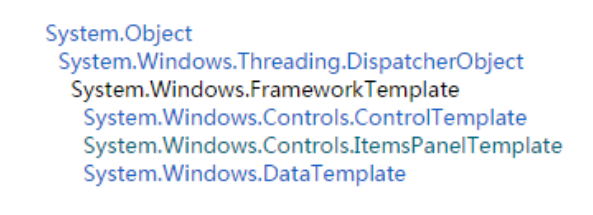
可见开发中常用的三个模板类都以FrameworkTemplate为基类。问题是,除了继承关系,这些模板类的子类与基类还有什么关系?三个子类之间有什么关系?这些模板类在WPF模板机制中的各自角色是什么?WPF究竟是如何从模板生成visual tree的?
要回答这些问题,最佳途径是从分析模板基类FrameworkTemplate着手。
FrameworkTemplate是抽象类,其定义代码比较多,为了简明,这里就不贴完整代码了,我们只看比较关键的地方。首先,注意到这个类的注释只有一句话:A generic class that allow instantiation of a tree of Framework[Content]Elements,意思是这个类是允许实例化一个Framework元素树(也即visual tree)的基类,其重要性不言而喻。浏览其代码会发现一个引人注意的方法ApplyTemplateContent():
  //****************FrameworkTemplate******************
        //

        //  This method

        //  Creates the VisualTree

        //

        internal bool ApplyTemplateContent(

            UncommonField<HybridDictionary[]> templateDataField,

            FrameworkElement container)

        {

            ValidateTemplatedParent(container);

            bool visualsCreated = StyleHelper.ApplyTemplateContent(templateDataField, container,

                _templateRoot, _lastChildIndex,

                ChildIndexFromChildName, this);

            return visualsCreated;

        }
这是删除了打印调试信息后的代码,虽然简单到只有三个语句,但是这个方法的注释提示我们这里是从FrameworkTemplate生成VisualTree的总入口。
其中最重要的是第二句,它把具体应用模板内容的工作交给了辅助类StyleHelper.ApplyTemplateContent()方法。由于这个方法的代码较多,这里为了简洁就不贴了。简而言之,这个方法的流程有三个分支:1)如果一个FrameworkTemplate的_templateRoot字段(FrameworkElementFactory类型)不为空,则调用其_templateRoot.InstantiateTree()方法来生成visual tree;2)否则,如果这个FrameworkTemplate的HasXamlNodeContent属性为真,则调用其LoadContent()方法生成visual tree;3)如果二者均不满足,则最终调用其BuildVisualTree()来生成visual tree。这些方法都比较复杂,它们的主要工作是实例化给定模板以生成visual tree。因为我们只关心模板框架和模板应用的流程,所以不妨忽略这些细节。
由于FrameworkTemplate.ApplyTemplateContent()不是虚方面,因此其子类无法覆写。用代码工具我们可以看到,这个方法只在FrameworkElement.ApplyTemplate()里被调用了一次,这意味着这个方法是WPF可视化元素实现模板应用的唯一入口,其重要性无论如何强调都不为过,以后我们还会多次提到这个方法。其代码如下:
//***************FrameworkElement********************
        /// <summary>

        /// ApplyTemplate is called on every Measure

        /// </summary>

        /// <remarks>

        /// Used by subclassers as a notification to delay fault-in their Visuals

        /// Used by application authors ensure an Elements Visual tree is completely built

        /// </remarks>

        /// <returns>Whether Visuals were added to the tree</returns>

        public bool ApplyTemplate()

        {

            // Notify the ContentPresenter/ItemsPresenter that we are about to generate the

            // template tree and allow them to choose the right template to be applied.

            OnPreApplyTemplate();

            bool visualsCreated = false;

            UncommonField<HybridDictionary[]>  dataField = StyleHelper.TemplateDataField;

            FrameworkTemplate template = TemplateInternal;

            // The Template may change in OnApplyTemplate so we'll retry in this case.

            // We dont want to get stuck in a loop doing this, so limit the number of

            // template changes before we bail out.

            int retryCount = 2;

            for (int i = 0; template != null && i < retryCount; i++)

            {

                // VisualTree application never clears existing trees. Trees

                // will be conditionally cleared on Template invalidation

                if (!HasTemplateGeneratedSubTree)

                {

                    // Create a VisualTree using the given template

                    visualsCreated = template.ApplyTemplateContent(dataField, this);

                    if (visualsCreated)

                    {

                        // This VisualTree was created via a Template

                        HasTemplateGeneratedSubTree =  true;

                        // We may have had trigger actions that had to wait until the

                        //  template subtree has been created.  Invoke them now.

                        StyleHelper.InvokeDeferredActions(this, template);

                        // Notify sub-classes when the template tree has been created

                        OnApplyTemplate();

                    }

                    if (template != TemplateInternal)

                    {

                        template = TemplateInternal;

                        continue;

                    }

                }

                break;

            }

            OnPostApplyTemplate();

            return visualsCreated;

        }
方法的注释表明FrameworkElement和其子类在每次measure时都会调用这个方法,而我们知道measure和arrange是UIElement进行布局的两个重要步骤。这个方法的代码并不复杂,它先是调用虚方法OnPreApplyTemplate();然后如果TemplateInternal非空,则调用其ApplyTemplateContent()方法生成相应的visual tree,并调用虚方法OnApplyTemplate()(这个虚方法在开发自定义控件时经常需要重写,此时visual tree已经生成并可以访问了);最后调用虚方法OnPostApplyTemplate()。
注意上面代码有一个语句:
FrameworkTemplate template = TemplateInternal;
这说明FrameworkElement实际是根据其属性TemplateInternal的值来生成visual tree的。那么这个TemplateInternal又是从哪里来的呢?事实上,这个属性与另一个属性TemplateCache是有密切关系的,二者都是FrameworkTemplate类型,它们的定义如下:
//***************FrameworkElement********************
        // Internal helper so the FrameworkElement could see the

        // ControlTemplate/DataTemplate set on the

        // Control/Page/PageFunction/ContentPresenter

        internal virtual FrameworkTemplate TemplateInternal

        {

            get { return null; }

        }

        // Internal helper so the FrameworkElement could see the

        // ControlTemplate/DataTemplate set on the

        // Control/Page/PageFunction/ContentPresenter

        internal virtual FrameworkTemplate TemplateCache

        {

            get { return null; }

            set {}

        }
可以看到二者的注释几乎都完全相同,也都是虚属性,FrameworkElement的子类可以通过覆写它们来实现多态性,提供自定义的模板。另外,利用工具我们可以看到只有4个子类重写了TemplateInternal属性:Control、ContentPresenter、ItemsPresenter、Page,这意味着只有这4个类及其子类调用ApplyTemplate()才有意义。
现在问题是:FrameworkElement的子类具体是如何通过覆写虚属性TemplateInternal来自定义模板的?FrameworkTemplate的三个子类的变量有哪些?它们在这个过程中的角色又有何不同?
为了便于理解,下面我们将按照三个模板子类,分成四篇文章来讨论(由于DataTemplate的内容较多,被分成了两篇文章)。
(原创文章,欢迎批评指正,转载请注明出处,谢谢!)
WPF源代码分析系列一:剖析WPF模板机制的内部实现(一)的更多相关文章
- MyBatis架构设计及源代码分析系列(一):MyBatis架构
如果不太熟悉MyBatis使用的请先参见MyBatis官方文档,这对理解其架构设计和源码分析有很大好处. 一.概述 MyBatis并不是一个完整的ORM框架,其官方首页是这么介绍自己 The MyBa ...
- WPF入门教程系列十五——WPF中的数据绑定(一)
使用Windows Presentation Foundation (WPF) 可以很方便的设计出强大的用户界面,同时 WPF提供了数据绑定功能.WPF的数据绑定跟Winform与ASP.NET中的数 ...
- Spark SQL 源代码分析系列
从决定写Spark SQL文章的源代码分析,到现在一个月的时间,一个又一个几乎相同的结束很快,在这里也做了一个综合指数,方便阅读,下面是读取顺序 :) 第一章 Spark SQL源代码分析之核心流程 ...
- MyCat源码分析系列之——BufferPool与缓存机制
更多MyCat源码分析,请戳MyCat源码分析系列 BufferPool MyCat的缓冲区采用的是java.nio.ByteBuffer,由BufferPool类统一管理,相关的设置在SystemC ...
- spring源码分析系列 (8) FactoryBean工厂类机制
更多文章点击--spring源码分析系列 1.FactoryBean设计目的以及使用 2.FactoryBean工厂类机制运行机制分析 1.FactoryBean设计目的以及使用 FactoryBea ...
- Cordova Android源代码分析系列一(项目总览和CordovaActivity分析)
版权声明:本文为博主offbye西涛原创文章.未经博主同意不得转载. https://blog.csdn.net/offbye/article/details/31776833 PhoneGap/Co ...
- WPF入门教程系列十八——WPF中的数据绑定(四)
六.排序 如果想以特定的方式对数据进行排序,可以绑定到 CollectionViewSource,而不是直接绑定到 ObjectDataProvider.CollectionViewSource 则会 ...
- WPF入门教程系列十六——WPF中的数据绑定(二)
三.绑定模式 通过上一文章中的示例,学习了简单的绑定方式.在这里的示例,要学习一下绑定的模式,和模式的使用效果. 首先,我们来做一个简单示例,这个示例是根据ListBox中的选中项,去改变TextBl ...
- lightning mdb 源代码分析系列(3)
本系列前两章已经描述了系统架构以及系统构建的基础内存映射,本章将详细描述lmdb的核心,外存B+Tree的操作.本文将从基本原理.内存操作方式.外存操作方式以及LMDB中的相关函数等几方面描述LMDB ...
随机推荐
- full nat
在餐馆吃饭时,连接无线网络后访问某网页会自动弹出一个认证页面,我想大家都经历过..... 其网络拓扑如下: sta-------------网络设备--------------公网 比如sta 终端i ...
- SpringBoot微服务框架
springboot 是什么? 配置如何编写 yaml 自动装配原理 集成Web开发 集成数据库Druid 分布式开发:Dubbo(RPC)+zookeeper swagger:接口文档 任务调度 S ...
- Linux安装JAVA并且配置环境
在写之前我先说一下我遇到的坑,我在配置环境的时候由于/etc/profile文件没有配置好导致系统彻底坏掉 1.ls vi等等命令使用不了,报错说找不到命令 2.在重启后虚拟机不能进入桌面 1.下载j ...
- 内核补丁热更新ceph内核模块
前言 内核模块的更新一般需要卸载模块再加载,但是很多时候使用场景决定了无法做卸载的操作,而linux支持了热更新内核模块的功能,这个已经支持了有一段时间了,一直没有拿ceph的相关模块进行验证 准备工 ...
- [原题复现]HCTF 2018 Warmup(文件包含)
HCTF 2018 Warmup 原题复现:https://gitee.com/xiaohua1998/hctf_2018_warmup 考察知识点:文件包含漏洞(phpmyadmin 4.8.1任意 ...
- tp5 跨域问题
只需要三行代码,写到入口文件public/index.php处即可解决 header("Access-Control-Allow-Origin:*"); header(" ...
- java开发两年!这些异常处理的方式你得知道,不然你凭什么涨薪!
前言 异常是在程序中导致程序中断运行的一种指令流,当异常发生时,程序将直接中断,不再执行后续的任何操作! 示例:两数相除,若不处理任何异常,则只有在正确输入两个数字时,才能显示出运算结果. publi ...
- 巧妙利用Camtasia制作网课
随着互联网的快速发展,网络学习变得非常流行.这种躺在床上就可以获取知识的方法让大家渐渐地都喜欢上了学习,那么我们是否想要了解一下网课的幕后制作呢. 今天我给大家带来的便是巧妙利用Camtasia进行网 ...
- 将input 的文本框改为不可编辑状态
<input type="text" id = "textid" name="名称" value="值" size ...
- 用FL Studio制作反向人声音效(Vocal Chops)
人声切片在各类电子音乐中都被广泛运用,在FL Studio20中我们也可以运用其自带的插件来制作属于我们自己的人声切片效果.在学完这篇文章后你就可以动手做出如Kygo.Martin Garrix等大牌 ...