
gluoncv,faster rcnn 处理难样本
难样本,是我们在标注的时候,连肉眼都看不清的小像素物体,也可以说是既不是正样本,也不是负样本。
利用gluoncv时,这些标注框也实在存在,gluoncv会实在将他当做一个GT,但我们知道这是不好的。于是,我们在标注的时候,给他一个属性,他是一个难样本。之前用过lst文件训练自己的数据集,这里的Lst文件需要改一下格式;

这里的B就是6了,包括id,xmin,ymin,xmax,ymax,hard_flag,可以自己写,结构类似即可。

Faster rcnn:
https://github.com/dmlc/gluon-cv/blob/master/scripts/detection/faster_rcnn/train_faster_rcnn.py#L313
从这个大epoch里面,我们可以知道,将我们的难样本属性应该在train_data之前就弄好了。
也是就是说在:
from gluoncv.data.transforms.presets.rcnn import FasterRCNNDefaultTrainTransform

from gluoncv.data.transforms.presets.rcnn import FasterRCNNDefaultValTransform
这两个变化里,注意import方式,pip 进来就修改site-package里面的文件。
class FasterRCNNDefaultTrainTransform(object):

    """Default Faster-RCNN training transform.

    Parameters

    ----------

    short : int, default is 600

        Resize image shorter side to ``short``.

    max_size : int, default is 1000

        Make sure image longer side is smaller than ``max_size``.

    net : mxnet.gluon.HybridBlock, optional

        The faster-rcnn network.

        .. hint::

            If net is ``None``, the transformation will not generate training targets.

            Otherwise it will generate training targets to accelerate the training phase

            since we push some workload to CPU workers instead of GPUs.

    mean : array-like of size 3

        Mean pixel values to be subtracted from image tensor. Default is [0.485, 0.456, 0.406].

    std : array-like of size 3

        Standard deviation to be divided from image. Default is [0.229, 0.224, 0.225].

    box_norm : array-like of size 4, default is (1., 1., 1., 1.)

        Std value to be divided from encoded values.

    num_sample : int, default is 256

        Number of samples for RPN targets.

    pos_iou_thresh : float, default is 0.7

        Anchors larger than ``pos_iou_thresh`` is regarded as positive samples.

    neg_iou_thresh : float, default is 0.3

        Anchors smaller than ``neg_iou_thresh`` is regarded as negative samples.

        Anchors with IOU in between ``pos_iou_thresh`` and ``neg_iou_thresh`` are

        ignored.

    pos_ratio : float, default is 0.5

        ``pos_ratio`` defines how many positive samples (``pos_ratio * num_sample``) is

        to be sampled.

    """

def __init__(self, short=600, max_size=1000, net=None, mean=(0.485, 0.456, 0.406),

                 std=(0.229, 0.224, 0.225), box_norm=(1., 1., 1., 1.),

                 num_sample=256, pos_iou_thresh=0.7, neg_iou_thresh=0.3,

                 pos_ratio=0.5, **kwargs):

        self._short = short

        self._max_size = max_size

        self._mean = mean

        self._std = std

        self._anchors = None

        if net is None:

            return

        # use fake data to generate fixed anchors for target generation

        ashape = 128

        # in case network has reset_ctx to gpu

        anchor_generator = copy.deepcopy(net.rpn.anchor_generator)

        anchor_generator.collect_params().reset_ctx(None)

        anchors = anchor_generator(

            mx.nd.zeros((1, 3, ashape, ashape))).reshape((1, 1, ashape, ashape, -1))

        self._anchors = anchors

        # record feature extractor for infer_shape

        if not hasattr(net, 'features'):

            raise ValueError("Cannot find features in network, it is a Faster-RCNN network?")

        self._feat_sym = net.features(mx.sym.var(name='data'))

        from ....model_zoo.rpn.rpn_target import RPNTargetGenerator

        self._target_generator = RPNTargetGenerator(

            num_sample=num_sample, pos_iou_thresh=pos_iou_thresh,

            neg_iou_thresh=neg_iou_thresh, pos_ratio=pos_ratio,

            stds=box_norm, **kwargs)

    def __call__(self, src, label):

        """Apply transform to training image/label."""

        # resize shorter side but keep in max_size

        h, w, _ = src.shape

        img = timage.resize_short_within(src, self._short, self._max_size, interp=1)

        bbox = tbbox.resize(label, (w, h), (img.shape[1], img.shape[0]))

        # random horizontal flip

        h, w, _ = img.shape

        img, flips = timage.random_flip(img, px=0.5)

        bbox = tbbox.flip(bbox, (w, h), flip_x=flips[0])

        # to tensor

        img = mx.nd.image.to_tensor(img)

        img = mx.nd.image.normalize(img, mean=self._mean, std=self._std)

        if self._anchors is None:

            return img, bbox.astype(img.dtype)

#       print 'xxxxxxxxxxxxxxxxxxxxxxxxxxxxlabal',label.shape

#       print label[:,5]

        # generate RPN target so cpu workers can help reduce the workload

        # feat_h, feat_w = (img.shape[1] // self._stride, img.shape[2] // self._stride)

        oshape = self._feat_sym.infer_shape(data=(1, 3, img.shape[1], img.shape[2]))[1][0]

        anchor = self._anchors[:, :, :oshape[2], :oshape[3], :].reshape((-1, 4))

        gt_bboxes = mx.nd.array(bbox[:, :4])

        cls_target, box_target, box_mask = self._target_generator(

            gt_bboxes, anchor, img.shape[2], img.shape[1],label[:,5])

        return img, bbox.astype(img.dtype), cls_target, box_target, box_mask
可以检查一下这里的label的结构,和我们修改的一样
我们可以知道rpn处生成target的部分就是.target_generator,他是
from ....model_zoo.rpn.rpn_target import RPNTargetGenerator
添加上我们难样本属性label[:,5]
过来的,于是找到那里;
class RPNTargetGenerator(gluon.Block):

    """RPN target generator network.

    Parameters

    ----------

    num_sample : int, default is 256

        Number of samples for RPN targets.

    pos_iou_thresh : float, default is 0.7

        Anchor with IOU larger than ``pos_iou_thresh`` is regarded as positive samples.

    neg_iou_thresh : float, default is 0.3

        Anchor with IOU smaller than ``neg_iou_thresh`` is regarded as negative samples.

        Anchors with IOU in between ``pos_iou_thresh`` and ``neg_iou_thresh`` are

        ignored.

    pos_ratio : float, default is 0.5

        ``pos_ratio`` defines how many positive samples (``pos_ratio * num_sample``) is

        to be sampled.

    stds : array-like of size 4, default is (1., 1., 1., 1.)

        Std value to be divided from encoded regression targets.

    allowed_border : int or float, default is 0

        The allowed distance of anchors which are off the image border. This is used to clip out of

        border anchors. You can set it to very large value to keep all anchors.

    """

    def __init__(self, num_sample=256, pos_iou_thresh=0.7, neg_iou_thresh=0.3,

                 pos_ratio=0.5, stds=(1., 1., 1., 1.), allowed_border=0):

        super(RPNTargetGenerator, self).__init__()

        self._num_sample = num_sample

        self._pos_iou_thresh = pos_iou_thresh

        self._neg_iou_thresh = neg_iou_thresh

        self._pos_ratio = pos_ratio

        self._allowed_border = allowed_border

        self._bbox_split = BBoxSplit(axis=-1)

        self._sampler = RPNTargetSampler(num_sample, pos_iou_thresh, neg_iou_thresh, pos_ratio)

        self._cls_encoder = SigmoidClassEncoder()

        self._box_encoder = NormalizedBoxCenterEncoder(stds=stds)

    # pylint: disable=arguments-differ

    def forward(self, bbox, anchor, width, height,hard_label):

        """

        RPNTargetGenerator is only used in data transform with no batch dimension.

        Be careful there's numpy operations inside

        Parameters

        ----------

        bbox: (M, 4) ground truth boxes with corner encoding.

        anchor: (N, 4) anchor boxes with corner encoding.

        width: int width of input image

        height: int height of input image

        Returns

        -------

        cls_target: (N,) value +1: pos, 0: neg, -1: ignore

        box_target: (N, 4) only anchors whose cls_target > 0 has nonzero box target

        box_mask: (N, 4) only anchors whose cls_target > 0 has nonzero mask

        """

        F = mx.nd

        with autograd.pause():

            # calculate ious between (N, 4) anchors and (M, 4) bbox ground-truths

            # ious is (N, M)

            ious = mx.nd.contrib.box_iou(anchor, bbox, format='corner')

            N, M = ious.shape

           # print '------------------ious.shape',ious.shape

           # print ious[0:5,]

#           print M==hard_label.size

            # mask out invalid anchors, (N, 4)

            a_xmin, a_ymin, a_xmax, a_ymax = F.split(anchor, num_outputs=4, axis=-1)

            invalid_mask = (a_xmin < 0) + (a_ymin < 0) + (a_xmax >= width) + (a_ymax >= height)

            invalid_mask = F.repeat(invalid_mask, repeats=bbox.shape[0], axis=-1)

            ious = F.where(invalid_mask, mx.nd.ones_like(ious) * -1, ious)

            samples, matches = self._sampler(ious,hard_label)

            # training targets for RPN

            cls_target, _ = self._cls_encoder(samples)

            box_target, box_mask = self._box_encoder(

                samples.expand_dims(axis=0), matches.expand_dims(0),

                anchor.expand_dims(axis=0), bbox.expand_dims(0))

        return cls_target, box_target[0], box_mask[0]
可以看到生成sample的地方就是self._sampler,它是
self._sampler = RPNTargetSampler(num_sample, pos_iou_thresh, neg_iou_thresh, pos_ratio)
添加自己的属性hard_label,找到那里(同一个文件里):
class RPNTargetSampler(gluon.Block):

    """A sampler to choose positive/negative samples from RPN anchors

    Parameters

    ----------

    num_sample : int

        Number of samples for RCNN targets.

    pos_iou_thresh : float

        Proposal whose IOU larger than ``pos_iou_thresh`` is regarded as positive samples.

    neg_iou_thresh : float

        Proposal whose IOU smaller than ``neg_iou_thresh`` is regarded as negative samples.

    pos_ratio : float

        ``pos_ratio`` defines how many positive samples (``pos_ratio * num_sample``) is

        to be sampled.

    """

    def __init__(self, num_sample, pos_iou_thresh, neg_iou_thresh, pos_ratio):

        super(RPNTargetSampler, self).__init__()

        self._num_sample = num_sample

        self._max_pos = int(round(num_sample * pos_ratio))

        self._pos_iou_thresh = pos_iou_thresh

        self._neg_iou_thresh = neg_iou_thresh

        self._eps = np.spacing(np.float32(1.0))

    # pylint: disable=arguments-differ

    def forward(self, ious,hard_label):

        """RPNTargetSampler is only used in data transform with no batch dimension.

        Parameters

        ----------

        ious: (N, M) i.e. (num_anchors, num_gt).

        Returns

        -------

        samples: (num_anchors,) value 1: pos, -1: neg, 0: ignore.

        matches: (num_anchors,) value [0, M).

        """

        for i,hard in enumerate(hard_label):

                if hard == 1.0:

                        ious[:,i] = 0.5

        matches = mx.nd.argmax(ious, axis=1)

        # samples init with 0 (ignore)

        ious_max_per_anchor = mx.nd.max(ious, axis=1)

        samples = mx.nd.zeros_like(ious_max_per_anchor)

        # set argmax (1, num_gt)

        ious_max_per_gt = mx.nd.max(ious, axis=0, keepdims=True)

        # ious (num_anchor, num_gt) >= argmax (1, num_gt) -> mark row as positive

        mask = mx.nd.broadcast_greater(ious + self._eps, ious_max_per_gt)

        # reduce column (num_anchor, num_gt) -> (num_anchor)

        mask = mx.nd.sum(mask, axis=1)

        # row maybe sampled by 2 columns but still only matches to most overlapping gt

        samples = mx.nd.where(mask, mx.nd.ones_like(samples), samples)

        # set positive overlap to 1

        samples = mx.nd.where(ious_max_per_anchor >= self._pos_iou_thresh,

                              mx.nd.ones_like(samples), samples)

        # set negative overlap to -1

        tmp = (ious_max_per_anchor < self._neg_iou_thresh) * (ious_max_per_anchor >= 0)

        samples = mx.nd.where(tmp, mx.nd.ones_like(samples) * -1, samples)

        # subsample fg labels

        samples = samples.asnumpy()

        num_pos = int((samples > 0).sum())

        if num_pos > self._max_pos:

            disable_indices = np.random.choice(

                np.where(samples > 0)[0], size=(num_pos - self._max_pos), replace=False)

            samples[disable_indices] = 0  # use 0 to ignore

        # subsample bg labels

        num_neg = int((samples < 0).sum())

        # if pos_sample is less than quota, we can have negative samples filling the gap

        max_neg = self._num_sample - min(num_pos, self._max_pos)

        if num_neg > max_neg:

            disable_indices = np.random.choice(

                np.where(samples < 0)[0], size=(num_neg - max_neg), replace=False)

            samples[disable_indices] = 0

        # convert to ndarray

        samples = mx.nd.array(samples, ctx=matches.context)

        return samples, matches
加上自己的hard部分,默认0.7~0.3 既不是正样本,也不是负样本。
经过试验,直接改为既不是正样本,也不是负样本,效果不好,而他标记为难gt,而其他锚框与他交为正样本,则改为既不是正样本,也不是负样本,效果会好一点点。
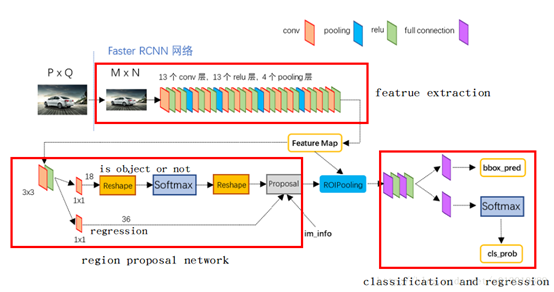
很多教程一本正经说Faster rcnn 的网络结构如下:
不可否认的,但是绝对不是gluon cv 的faster rcnn网络结构,后面的全连接层是RCNN层,想要达到更好的效果处理难样本,那里同样需要修改。
gluoncv,faster rcnn 处理难样本的更多相关文章
- 深度学习论文翻译解析(四):Faster R-CNN: Down the rabbit hole of modern object detection
论文标题:Faster R-CNN: Down the rabbit hole of modern object detection 论文作者:Zhi Tian , Weilin Huang, Ton ...
- 物体检测丨Faster R-CNN详解
这篇文章把Faster R-CNN的原理和实现阐述得非常清楚,于是我在读的时候顺便把他翻译成了中文,如果有错误的地方请大家指出. 原文:http://www.telesens.co/2018/03/1 ...
- 中文版 Faster R-CNN: Towards Real-Time Object Detection with Region Proposal Networks
Faster R-CNN: Towards Real-Time Object Detection with Region Proposal Networks 摘要 最先进的目标检测网络依靠区域提出算法 ...
- 目标检测算法的总结(R-CNN、Fast R-CNN、Faster R-CNN、YOLO、SSD、FNP、ALEXnet、RetianNet、VGG Net-16)
目标检测解决的是计算机视觉任务的基本问题:即What objects are where?图像中有什么目标,在哪里?这意味着,我们不仅要用算法判断图片中是不是要检测的目标, 还要在图片中标记出它的位置 ...
- Domain Adaptive Faster R-CNN:经典域自适应目标检测算法,解决现实中痛点,代码开源 | CVPR2018
论文从理论的角度出发,对目标检测的域自适应问题进行了深入的研究,基于H-divergence的对抗训练提出了DA Faster R-CNN,从图片级和实例级两种角度进行域对齐,并且加入一致性正则化来学 ...
- 深度学习论文翻译解析(十三):Faster R-CNN: Towards Real-Time Object Detection with Region Proposal Networks
论文标题:Faster R-CNN: Towards Real-Time Object Detection with Region Proposal Networks 标题翻译:基于区域提议(Regi ...
- 论文阅读之:Is Faster R-CNN Doing Well for Pedestrian Detection?
Is Faster R-CNN Doing Well for Pedestrian Detection? ECCV 2016 Liliang Zhang & Kaiming He 原文链接 ...
- object detection技术演进:RCNN、Fast RCNN、Faster RCNN
object detection我的理解,就是在给定的图片中精确找到物体所在位置,并标注出物体的类别.object detection要解决的问题就是物体在哪里,是什么这整个流程的问题.然而,这个问题 ...
- 读论文系列:Object Detection NIPS2015 Faster RCNN
转载请注明作者:梦里茶 Faster RCNN在Fast RCNN上更进一步,将Region Proposal也用神经网络来做,如果说Fast RCNN的最大贡献是ROI pooling layer和 ...
随机推荐
- C#语法糖($)(?.)(??)
内插字符串($) 实际上是C# 6.0对string.Format的改进,将字符串文本标识为内插字符串($)根据微软的例子来看: using System; public class Example ...
- 数据库连接池之C3P0
一.C3P0的使用步骤 1:导入相关的依赖jar包 c3p0-0.9.5.2.jar mchange-commons-java-0.2.12.jar 2:代码实现 A:硬编码的实现方式 package ...
- javaweb浏览器url上项目名称的更改
如何改变上面url项目名称地址,如把04去掉改成teachershare 如下图:在项目设置中设置web context-root属性,将04去掉. 就可以用这个登录了. 要注意的是如果之前已经部署在 ...
- python Django 路由之正则表达式
一.路由系统,URL 1. url(r'^index',views.index) #默认的 url(r'^home',views.Home.as_view()) # ...
- Struts 类型转换之局部和全局配置
我们碰到过很多情况,就是时间日期常常会出现错误,这是我们最头疼的事,在struts2中有一些内置转换器,也有一些需要我们自己配置. 我们为什么需要类型转换呢? 在基于HTTP协议的Web应用中 客户端 ...
- PoPo数据可视化周刊第3期 - 台风可视化
9月台风席卷全球,本刊特别选取台风最佳可视化案例,数据可视化应用功力最深厚者,当属纽约时报,而传播效果最佳的是The Weather Channel关于Florence的视频预报,运用了数据可视化.可 ...
- WinForm实现Rabbitmq官网6个案例-Topics
代码: namespace RabbitMQDemo { public partial class Topics : Form { private string exchangeName = &quo ...
- Leetcode算法比赛----Longest Absolute File Path
问题描述 Suppose we abstract our file system by a string in the following manner: The string "dir\n ...
- kali 的端口扫描nmap
输入“nmap+空格+“-O”+空格+IP地址或域名. 扫描所有TCP端口:输入“nmap+空格+“-sT”+空格+IP地址或域名” 扫描所有开放的UDP端口:输入“nmap+空格+”-sP”+空格+ ...
- Unity3D-NGUI动态加载图片
NGUI提供了很方便的UIAtlas,其主要作用是改进DrawCall,把众多图片整合在一张贴图上,由于UNITY3D简单易用的好处,所以只是用原生的GUI很容易忽视DrawCall的问题,所以NGU ...