
poj 2007 Scrambled Polygon(极角排序)
http://poj.org/problem?id=2007
Description A closed polygon is a figure bounded by a finite number of line segments. The intersections of the bounding line segments are called the vertices of the polygon. When one starts at any vertex of a closed polygon and traverses each bounding line segment exactly once, one comes back to the starting vertex.
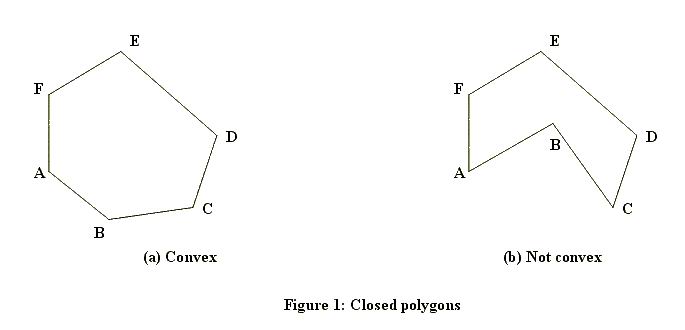
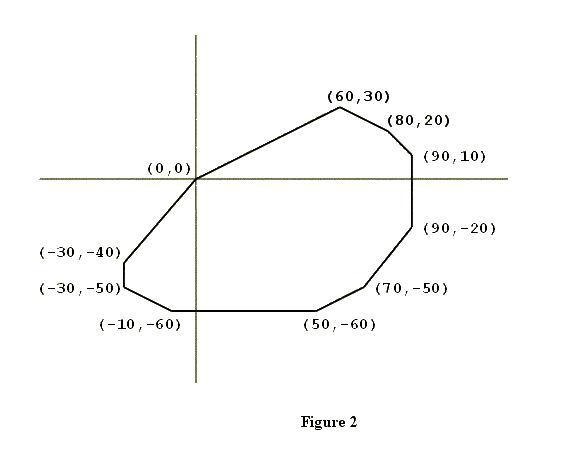
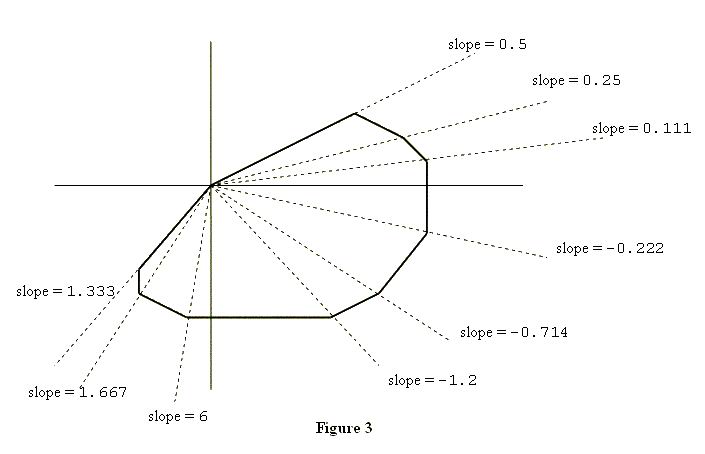
A closed polygon is called convex if the line segment joining any two points of the polygon lies in the polygon. Figure 1 shows a closed polygon which is convex and one which is not convex. (Informally, a closed polygon is convex if its border doesn't have any "dents".) The first property is that the vertices of the polygon will be confined to three or fewer of the four quadrants of the coordinate plane. In the example shown in Figure 2, none of the vertices are in the second quadrant (where x < 0, y > 0). To describe the second property, suppose you "take a trip" around the polygon: start at (0, 0), visit all other vertices exactly once, and arrive at (0, 0). As you visit each vertex (other than (0, 0)), draw the diagonal that connects the current vertex with (0, 0), and calculate the slope of this diagonal. Then, within each quadrant, the slopes of these diagonals will form a decreasing or increasing sequence of numbers, i.e., they will be sorted. Figure 3 illustrates this point. Input The input lists the vertices of a closed convex polygon in the plane. The number of lines in the input will be at least three but no more than 50. Each line contains the x and y coordinates of one vertex. Each x and y coordinate is an integer in the range -999..999. The vertex on the first line of the input file will be the origin, i.e., x = 0 and y = 0. Otherwise, the vertices may be in a scrambled order. Except for the origin, no vertex will be on the x-axis or the y-axis. No three vertices are colinear.
Output The output lists the vertices of the given polygon, one vertex per line. Each vertex from the input appears exactly once in the output. The origin (0,0) is the vertex on the first line of the output. The order of vertices in the output will determine a trip taken along the polygon's border, in the counterclockwise direction. The output format for each vertex is (x,y) as shown below.
Sample Input 0 0 Sample Output (0,0) Source |
××××××××××××××××××××××××××××××××××××××××××××××××××××××××××××××××
这题,,,,,这什么玩意啊
推荐个网站:http://www.cnblogs.com/devtang/archive/2012/02/01/2334977.html
《叉积排序,也就是可以排180度以内的,超出就会出错,

因为正弦函数在180内为正数,180到360为负数。》
#include <stdio.h>

#include <string.h>

#include <stdlib.h>

#include <iostream>

#include <algorithm>

#include <math.h>

#define MAXX 105

using namespace std;

typedef struct point

{

    int x,y;

}point;

typedef struct line

{

    point st,ed;

}beline;

int crossProduct(point a,point b,point c)

{

    return (c.x-a.x)*(b.y-a.y)-(c.y-a.y)*(b.x-a.x);

}

double Dist(point a,point b)

{

    return sqrt((a.x-b.x)*(a.x-b.x)+(a.y-b.y)*(a.y-b.y));

}

point c[MAXX];

point stk[MAXX];

int top;

bool cmp(point a,point b)

{

    int len=crossProduct(c[],a,b);

    if(len == )

        return Dist(c[],a)<Dist(c[],b);

    else

        return len<;

}

int main()

{

    int i,j,k,t,x,y;

    i=;

    while(scanf("%d%d",&x,&y)!=EOF)

    {

        c[i].x=x;

        c[i].y=y;

        i++;

    }

    sort(c+,c+i,cmp);

    for(int j=; j<i; j++)

        printf("(%d,%d)\n",c[j].x,c[j].y);

}
poj 2007 Scrambled Polygon(极角排序)的更多相关文章
- poj 2007 Scrambled Polygon 极角排序
/** 极角排序输出,,, 主要atan2(y,x) 容易失精度,,用 bool cmp(point a,point b){ 5 if(cross(a-tmp,b-tmp)>0) 6 retur ...
- POJ 2007 Scrambled Polygon 极角序 水
LINK 题意:给出一个简单多边形,按极角序输出其坐标. 思路:水题.对任意两点求叉积正负判断相对位置,为0则按长度排序 /** @Date : 2017-07-13 16:46:17 * @File ...
- POJ 2007 Scrambled Polygon [凸包 极角排序]
Scrambled Polygon Time Limit: 1000MS Memory Limit: 30000K Total Submissions: 8636 Accepted: 4105 ...
- 简单几何(极角排序) POJ 2007 Scrambled Polygon
题目传送门 题意:裸的对原点的极角排序,凸包貌似不行. /************************************************ * Author :Running_Time ...
- POJ 2007 Scrambled Polygon (简单极角排序)
题目链接 题意 : 对输入的点极角排序 思路 : 极角排序方法 #include <iostream> #include <cmath> #include <stdio. ...
- POJ 2007 Scrambled Polygon(简单极角排序)
水题,根本不用凸包,就是一简单的极角排序. 叉乘<0,逆时针. #include <iostream> #include <cstdio> #include <cs ...
- ●POJ 2007 Scrambled Polygon
题链: http://poj.org/problem?id=2007 题解: 计算几何,极角排序 按样例来说,应该就是要把凸包上的i点按 第三像限-第四像限-第一像限-第二像限 的顺序输出. 按 叉积 ...
- POJ 2007 Scrambled Polygon 凸包
Scrambled Polygon Time Limit: 1000MS Memory Limit: 30000K Total Submissions: 7214 Accepted: 3445 ...
- POJ 2007 Scrambled Polygon 凸包点排序逆时针输出
题意:如题 用Graham,直接就能得到逆时针的凸包,找到原点输出就行了,赤果果的水题- 代码: /* * Author: illuz <iilluzen[at]gmail.com> * ...
随机推荐
- 为 Macbook 安装 enca 命令
enca 是个查看.转换编码的开源软件, 地址: http://dl.cihar.com/enca/ 安装的步骤比安装 wget 简单多了: 1.用 wget 获取最新的enca 的 tar.gz 的 ...
- JNI开发流程-JNI/NDK【转】
本文转载自:http://wiki.jikexueyuan.com/project/jni-ndk-developer-guide/workflow.html 开发流程 JNI 全称是 Java Na ...
- sql回滚
rollback是针对事务的,你如果没有在执行语句之前开启事务,那么无法rollback,建议你还是想别的办法吧,事务语句如下(sqlserver的给你借鉴):--开启事务begin tran --执 ...
- [Android新手区] SQLite 操作详解--SQL语法
该文章完全摘自转自:北大青鸟[Android新手区] SQLite 操作详解--SQL语法 :http://home.bdqn.cn/thread-49363-1-1.html SQLite库可以解 ...
- Temporary Tables and the TableType Property [AX 2012]
Temporary Tables and the TableType Property [AX 2012] 1 out of 1 rated this helpful - Rate this topi ...
- Extended Data Type Properties [AX 2012]
Extended Data Type Properties [AX 2012] This topic has not yet been rated - Rate this topic Updated: ...
- php单链表实现的代码
<?php/*** 单链表*/ class Demo{private $id;public $name;public $next;public function __construct ($id ...
- php获取目录中的所有文件名
<?php /** * [php获取目录中的所有文件名] */ //1.先打开要操作的目录,并用一个变量指向它 //打开当前目录下的目录pic下的子目录common. $handler = op ...
- JavaEE基础(七)
1.面向对象(构造方法Constructor概述和格式) A:构造方法概述和作用 给对象的数据(属性)进行初始化 B:构造方法格式特点 a:方法名与类名相同(大小也要与类名一致) b:没有返回值类型, ...
- C#:实现托盘(任务栏图标与托盘图标互斥)
实现托盘(任务栏图标与托盘图标互斥),并且在点击任务栏图标时实现的最小化与点击最小化按钮分离. 具体如下: 1.向窗体上添加如下控件:MenuStrip menuStrip1, NotifyIcon ...