
POJ 2007 Scrambled Polygon [凸包 极角排序]
| Time Limit: 1000MS | Memory Limit: 30000K | |
| Total Submissions: 8636 | Accepted: 4105 |
Description
A closed polygon is called convex if the line segment joining any two points of the polygon lies in the polygon. Figure 1 shows a closed polygon which is convex and one which is not convex. (Informally, a closed polygon is convex if its border doesn't have any "dents".) 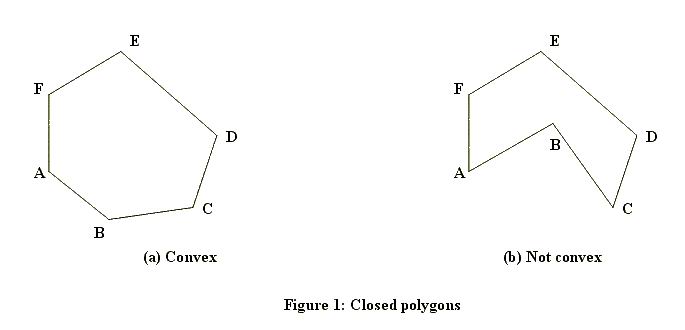
The subject of this problem is a closed convex polygon in the coordinate plane, one of whose vertices is the origin (x = 0, y = 0). Figure 2 shows an example. Such a polygon will have two properties significant for this problem.
The first property is that the vertices of the polygon will be confined to three or fewer of the four quadrants of the coordinate plane. In the example shown in Figure 2, none of the vertices are in the second quadrant (where x < 0, y > 0).
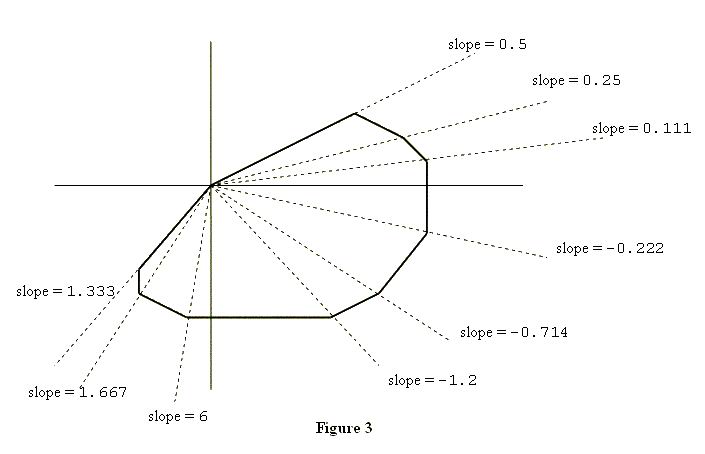
To describe the second property, suppose you "take a trip" around the polygon: start at (0, 0), visit all other vertices exactly once, and arrive at (0, 0). As you visit each vertex (other than (0, 0)), draw the diagonal that connects the current vertex with (0, 0), and calculate the slope of this diagonal. Then, within each quadrant, the slopes of these diagonals will form a decreasing or increasing sequence of numbers, i.e., they will be sorted. Figure 3 illustrates this point. 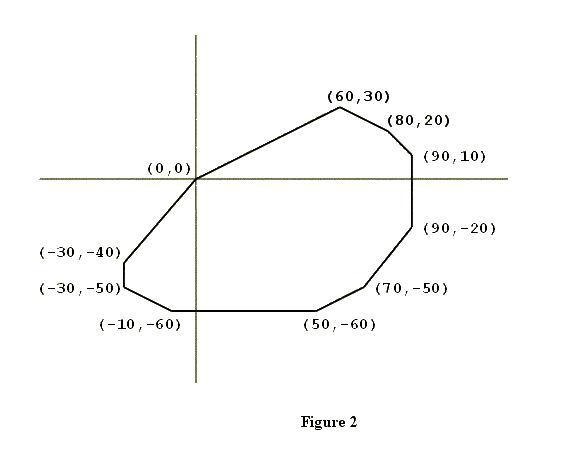
Input
Output
Sample Input
0 0

70 -50

60 30

-30 -50

80 20

50 -60

90 -20

-30 -40

-10 -60

90 10
Sample Output
(0,0)

(-30,-40)

(-30,-50)

(-10,-60)

(50,-60)

(70,-50)

(90,-20)

(90,10)

(80,20)

(60,30)
Source
显然极角排序 用叉积 但WA好多次最后发现必须要保证第一个点在开始,排序直接跳过就行了
#include <iostream>

#include <cstdio>

#include <cstring>

#include <algorithm>

#include <cmath>

using namespace std;

typedef long long ll;

const int N=;

const double eps=1e-;

inline int read(){

    char c=getchar();int x=,f=;

    while(c<''||c>''){if(c=='-')f=-; c=getchar();}

    while(c>=''&&c<=''){x=x*+c-''; c=getchar();}

    return x*f;

}

inline int sgn(double x){

    if(abs(x)<eps) return ;

    else return x<?-:;

}

struct Vector{

    double x,y;

    Vector(double a=,double b=):x(a),y(b){}

};

typedef Vector Point;

double Dot(Vector a,Vector b){return a.x*b.x+a.y*b.y;}

double Cross(Vector a,Vector b){return a.x*b.y-a.y*b.x;}

int n,x,y;

Point p[N],S;

bool cmpPolar(Point a,Point b){

    return sgn(Cross(a,b))>;

}

int main(int argc, const char * argv[]) {

    while(scanf("%d",&x)!=EOF){

        y=read();

        p[++n]=Point(x,y);

    }

    sort(p+,p++n,cmpPolar);

    for(int i=;i<=n;i++) printf("(%.0f,%.0f)\n",p[i].x,p[i].y);

    return ;

}
#include <iostream>

#include <cstdio>

#include <cstring>

#include <algorithm>

#include <cmath>

#include <vector>

using namespace std;

typedef long long ll;

const int N=;

const double eps=1e-;

const double pi=acos(-);

inline int read(){

    char c=getchar();int x=,f=;

    while(c<''||c>''){if(c=='-')f=-; c=getchar();}

    while(c>=''&&c<=''){x=x*+c-''; c=getchar();}

    return x*f;

}

inline int sgn(double x){

    if(abs(x)<eps) return ;

    else return x<?-:;

}

struct Vector{

    double x,y;

    Vector(double a=,double b=):x(a),y(b){}

    bool operator <(const Vector &a)const{

        //return x<a.x||(x==a.x&&y<a.y);

        return sgn(x-a.x)<||(sgn(x-a.x)==&&sgn(y-a.y)<);

    }

};

typedef Vector Point;

Vector operator +(Vector a,Vector b){return Vector(a.x+b.x,a.y+b.y);}

Vector operator -(Vector a,Vector b){return Vector(a.x-b.x,a.y-b.y);}

Vector operator *(Vector a,double b){return Vector(a.x*b,a.y*b);}

Vector operator /(Vector a,double b){return Vector(a.x/b,a.y/b);}

bool operator ==(Vector a,Vector b){return sgn(a.x-b.x)==&&sgn(a.y-b.y)==;}

double Dot(Vector a,Vector b){return a.x*b.x+a.y*b.y;}

double Cross(Vector a,Vector b){return a.x*b.y-a.y*b.x;}

double DisPP(Point a,Point b){

    Point t=b-a;

    return sqrt(t.x*t.x+t.y*t.y);

}

int ConvexHull(Point p[],int n,Point ch[]){//cannot handle repeat point

    sort(p+,p++n);

    int m=;

    for(int i=;i<=n;i++){

        while(m>&&sgn(Cross(ch[m]-ch[m-],p[i]-ch[m-]))<=) m--;

        ch[++m]=p[i];

    }

    int k=m;

    for(int i=n-;i>=;i--){

        while(m>k&&sgn(Cross(ch[m]-ch[m-],p[i]-ch[m-]))<=) m--;

        ch[++m]=p[i];

    }

    if(n>) m--;//the first point

    return m;

}

int n,x,y;

double ans;

Point p[N],ch[N];

int main(int argc, const char * argv[]) {

    while(scanf("%d",&x)!=EOF){

        y=read();

        p[++n]=Point(x,y);

    }

    ConvexHull(p,n,ch);

    Point S(,);int p;

    for(p=;p<=n;p++) if(ch[p]==S) break;

    for(int i=p;i<=n;i++) printf("(%.0f,%.0f)\n",ch[i].x,ch[i].y);

    for(int i=;i<p;i++) printf("(%.0f,%.0f)\n",ch[i].x,ch[i].y);

    return ;

}
POJ 2007 Scrambled Polygon [凸包 极角排序]的更多相关文章
- poj 2007 Scrambled Polygon(极角排序)
http://poj.org/problem?id=2007 Time Limit: 1000MS Memory Limit: 30000K Total Submissions: 6701 A ...
- POJ 2007 Scrambled Polygon 凸包点排序逆时针输出
题意:如题 用Graham,直接就能得到逆时针的凸包,找到原点输出就行了,赤果果的水题- 代码: /* * Author: illuz <iilluzen[at]gmail.com> * ...
- POJ 2007 Scrambled Polygon 凸包
Scrambled Polygon Time Limit: 1000MS Memory Limit: 30000K Total Submissions: 7214 Accepted: 3445 ...
- 简单几何(极角排序) POJ 2007 Scrambled Polygon
题目传送门 题意:裸的对原点的极角排序,凸包貌似不行. /************************************************ * Author :Running_Time ...
- POJ 2007 Scrambled Polygon(简单极角排序)
水题,根本不用凸包,就是一简单的极角排序. 叉乘<0,逆时针. #include <iostream> #include <cstdio> #include <cs ...
- POJ 2007 Scrambled Polygon (简单极角排序)
题目链接 题意 : 对输入的点极角排序 思路 : 极角排序方法 #include <iostream> #include <cmath> #include <stdio. ...
- poj 2007 Scrambled Polygon 极角排序
/** 极角排序输出,,, 主要atan2(y,x) 容易失精度,,用 bool cmp(point a,point b){ 5 if(cross(a-tmp,b-tmp)>0) 6 retur ...
- POJ 2007 Scrambled Polygon 极角序 水
LINK 题意:给出一个简单多边形,按极角序输出其坐标. 思路:水题.对任意两点求叉积正负判断相对位置,为0则按长度排序 /** @Date : 2017-07-13 16:46:17 * @File ...
- ●POJ 2007 Scrambled Polygon
题链: http://poj.org/problem?id=2007 题解: 计算几何,极角排序 按样例来说,应该就是要把凸包上的i点按 第三像限-第四像限-第一像限-第二像限 的顺序输出. 按 叉积 ...
随机推荐
- c# tolist() 浅析
在介绍tolist()的时候我先个大家介绍一下linq的延迟加载: var products = new List<Product> { , Category = "Electr ...
- angular2 Http和websocket
1. 注入HttpModule模块: 2. 注入http服务 map方法需要导入"rajx/Rx"组件,作用是针对流的处理.Json是将流转化为json格式.subscribe订阅 ...
- angular2 路由
路由是个模块,命令行生成:ng generate module routerTest; 自己组建: 路由模块说明: Routes:路由配置,路由配置文件类型.比如:const routing:Rout ...
- Apache Shiro 核心概念
转自:http://blog.csdn.net/peterwanghao/article/details/8015571 Shiro框架中有三个核心概念:Subject ,SecurityManage ...
- 解决jsp中编辑和删除时候弹出框闪退的问题。
---恢复内容开始--- /* 火箭设备特殊记载</li> <!-- yw4 --> */ function getYw4DL(){ var controlparm={&quo ...
- UEP-查询方式总结
public void retrieve() { QueryParamList params = getQueryParam("dataWrap"); //获取页面上的参数,即查询 ...
- 应用fstream格式化输出
我举一个我应用的例子 file.open("shoroud.jrf" ,ios_base::trunc); //打开文件,清空文件内容 if(!file.good()) { pri ...
- C#采用rabbitMQ搭建分布式日志系统
网上对于java有很多开源的组件可以搭建分布式日志系统,我参考一些组件自己开发一套简单的分布式日志系 全部使用采用.NET进行开发,所用技术:MVC.EF.RabbitMq.MySql.Autofac ...
- 随手小代码——《Python编程 从入门到实践》项目1:外星人入侵
=================================版权声明================================= 版权声明:原创文章 禁止转载 请通过右侧公告中的“联系邮 ...
- CSS background-clip 属性
<!DOCTYPE html> <html> <head> <meta charset="utf-8"> <title> ...