
9. Lab: file system
1. Large files (moderate)
1.1 要求
Modify bmap() so that it implements a doubly-indirect block, in addition to direct blocks and a singly-indirect block. You'll have to have only 11 direct blocks, rather than 12, to make room for your new doubly-indirect block; you're not allowed to change the size of an on-disk inode. The first 11 elements of ip->addrs[] should be direct blocks; the 12th should be a singly-indirect block (just like the current one); the 13th should be your new doubly-indirect block. You are done with this exercise when bigfile writes 65803 blocks and usertests runs successfully:
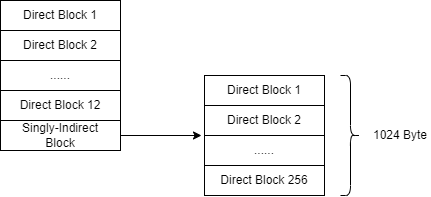
要求扩大 xv6 中文件大小上限。目前 xv6 文件限制为 268 个块,或 268*BSIZE 字节(在 xv6 中 BSIZE 为 1024)。 因为一个 xv6 inode 包含 12 个“直接”块号和一个“单独间接”块号,这是指一个块最多可以容纳 256 个块号,总共 12+256=268 块。
因此需要更改 xv6 文件系统代码以支持每个 inode 中的“双重间接”块,其中包含 256 个单间接块地址,每个块最多可包含 256 个数据块地址。 结果将是一个文件将能够包含多达 65803 个块,或 256*256+256+11 个块(11 个而不是 12 个,因为我们将为双间接块牺牲一个直接块号)
原来的结构如图下:
修改后的结构应当如下:
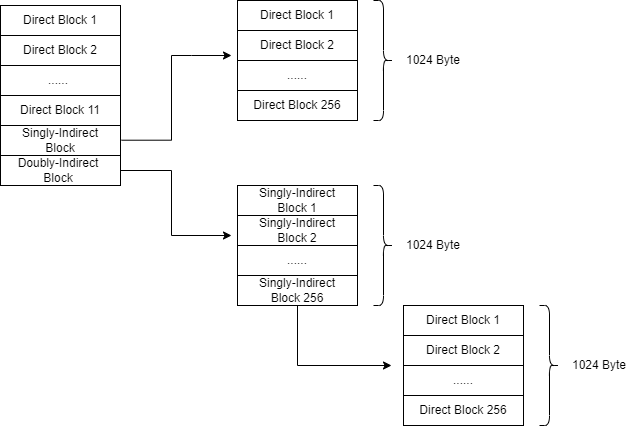
可以看到,有点类似多级页表的思路。
1.2 分析
要注意的点如下:
- 因为
inode.addrs固定为13 个,因此需要减少一个DirectBlock给Doubly-Indirect使用 bmap的函数签名如右:bmap(struct inode *ip, uint bn),bn为 block number。需要注意,当bn大于 256 + 11 的时候,需要开始在Doubly-Indirect中找到合适的Direct-Block,可以通过bn=bn-256-11去掉偏移,然后bn/256得到在第几块Singly-Indirect,bn%256得到目标块在Singly-Indirect中的偏移。- 通过
bread获取buf之后,修改buf后需要通过log_write操作写入更新。
1.3 实现
- 修改直接块数量,注意需要修改
dinode和inode的addrs大小
#define NDOUBLEINDIRECT (NINDIRECT * NINDIRECT)

#define NDIRECT 11

// On-disk inode structure

struct dinode {

  short type;           // File type

  short major;          // Major device number (T_DEVICE only)

  short minor;          // Minor device number (T_DEVICE only)

  short nlink;          // Number of links to inode in file system

  uint size;            // Size of file (bytes)

  uint addrs[NDIRECT+2];   // Data block addresses

};

// in-memory copy of an inode

struct inode {

  uint dev;           // Device number

  uint inum;          // Inode number

  int ref;            // Reference count

  struct sleeplock lock; // protects everything below here

  int valid;          // inode has been read from disk?

  short type;         // copy of disk inode

  short major;

  short minor;

  short nlink;

  uint size;

  uint addrs[NDIRECT+2];

};
- 分配间接块,此处需要注意,只有当用到时才分配块,其次修改块时需要记得
log_write
static uint

bmap(struct inode *ip, uint bn)

{

  uint addr, *a;

  struct buf *bp, *inbp;

  if(bn < (NDIRECT)){

    if((addr = ip->addrs[bn]) == 0)

      ip->addrs[bn] = addr = balloc(ip->dev);

    return addr;

  }

  bn -= NDIRECT;

  if(bn < NINDIRECT){

    // Load indirect block, allocating if necessary.

    if((addr = ip->addrs[NDIRECT]) == 0)

      ip->addrs[NDIRECT] = addr = balloc(ip->dev);

    bp = bread(ip->dev, addr);

    a = (uint*)bp->data;

    if((addr = a[bn]) == 0){

      a[bn] = addr = balloc(ip->dev);

      log_write(bp);

    }

    brelse(bp);

    return addr;

  }

  bn -= NINDIRECT;

  // load doublely-indirect block

  if(bn < NDOUBLEINDIRECT){

    if((addr = ip->addrs[NDIRECT + 1]) == 0)

      ip->addrs[NDIRECT + 1] = addr = balloc(ip->dev); // alloc doublely-indirect block

    // get indirect block index

    inbp = bread(ip->dev, addr);

    a = (uint*)(inbp->data);

    uint in_index = bn / NINDIRECT;

    uint bn_index = bn % NINDIRECT;

    // Load indirect block, allocating if necessary.

    if ((addr = a[in_index]) == 0){

      a[in_index] = addr = balloc(ip->dev);

      log_write(inbp);

    }

    brelse(inbp);

    bp = bread(ip->dev, addr);

    a = (uint*)bp->data;

    if ((addr = a[bn_index]) == 0){

      a[bn_index] = addr = balloc(ip->dev);

      log_write(bp);

    }

    brelse(bp);

    return addr;

  }

  panic("bmap: out of range");

}
- 释放块
// Truncate inode (discard contents).

// Caller must hold ip->lock.

void

itrunc(struct inode *ip)

{

  int i, j, k;

  struct buf *bp, *inbp;

  uint *a;

  uint *tmp;

  for(i = 0; i < NDIRECT; i++){

    if(ip->addrs[i]){

      bfree(ip->dev, ip->addrs[i]);

      ip->addrs[i] = 0;

    }

  }

  if(ip->addrs[NDIRECT]){

    bp = bread(ip->dev, ip->addrs[NDIRECT]);

    a = (uint*)bp->data;

    for(j = 0; j < NINDIRECT; j++){

      if(a[j])

        bfree(ip->dev, a[j]);

    }

    brelse(bp);

    bfree(ip->dev, ip->addrs[NDIRECT]);

    ip->addrs[NDIRECT] = 0;

  }

  if(ip->addrs[NDIRECT + 1]){

    inbp = bread(ip->dev, ip->addrs[NDIRECT + 1]);

    a = (uint*)(inbp->data);

    for (j = 0; j < NINDIRECT; j++){

      if (a[j]) {

        bp = bread(ip->dev, a[j]);

        tmp = (uint*)bp->data;

        for(k = 0; k < NINDIRECT; k++){

          if(tmp[k])

            bfree(ip->dev, tmp[k]);

        }

        brelse(bp);

        bfree(ip->dev, a[j]);

        a[j] = 0;

      }

    }

    brelse(inbp);

    bfree(ip->dev, ip->addrs[NDIRECT + 1]);

    ip->addrs[NDIRECT + 1] = 0;

  }

  ip->size = 0;

  iupdate(ip);

}
2. Symbolic links(moderate)
2.1 要求
You will implement the symlink(char *target, char *path) system call, which creates a new symbolic link at path that refers to file named by target. For further information, see the man page symlink. To test, add symlinktest to the Makefile and run it. Your solution is complete when the tests produce the following output (including usertests succeeding).
实现 symlink 接口,比较简单,与 link 的区别在于,symlink 会创建文件,而 link 接口只是增加目标文件的引用计数,并写入目录。
2.2 分析
实现主要有 2 点:
- 创建链接文件,通过
sys_symlink接口创建 - 访问链接文件,通过
sys_open访问
2.3 实现
- 创建文件
在 inode 结构中增加 char symlinkpath[128];,用于存储目标文件的名字。
uint64 sys_symlink(void)

{

  char path[MAXPATH], target[MAXPATH];

  struct inode *ip;

  if(argstr(0, target, MAXPATH) < 0 || argstr(1, path, MAXPATH) < 0)

    return -1;

  begin_op();

  if ((ip = namei(path)) == 0){

    ip = create(path, T_SYMLINK, 0, 0);

    if (ip == 0){

      end_op();

      return -1;

    }

  }else if (ip->type != T_SYMLINK){

    end_op();

    return -1;

  }else{

    ilock(ip);

  }

  memset(ip->symlinkpath, 0, MAXPATH);

  memmove(ip->symlinkpath, target, sizeof(target));

  iunlockput(ip);

  end_op();

  return 0;

}
- 访问文件
需要注意如果有 O_NOFOLLOW 的 flag,则直接访问链接文件,而不是访问 inode.symlinkpath 的文件。
其次要注意存在链接文件 链接 链接文件的操作,有点套娃,比如 a->b,b->c,c->a,此时如果没有防范措施会无限套娃,因此根据 hints 加了个递归层次限制。
uint64 sys_open(void)

{

  char path[MAXPATH];

  int fd, omode;

  struct file *f;

  struct inode *ip, *symip;

  int n;

  if((n = argstr(0, path, MAXPATH)) < 0 || argint(1, &omode) < 0)

    return -1;

  begin_op();

  if(omode & O_CREATE){

    ip = create(path, T_FILE, 0, 0);

    if(ip == 0){

      end_op();

      return -1;

    }

  }

  else {

    if((ip = namei(path)) == 0){

      end_op();

      return -1;

    }

    ilock(ip);

    if(ip->type == T_DIR && omode != O_RDONLY){

      iunlockput(ip);

      end_op();

      return -1;

    }

  }

  int cnt = 0;

  while(ip->type == T_SYMLINK && !(omode & O_NOFOLLOW)){

    if (cnt >= 10) {

      iunlockput(ip);

      end_op();

      return -1;

    }

    symip = namei(ip->symlinkpath);

    if (symip) {

      cnt++;

      iunlockput(ip);

      ip = symip;

      ilock(ip);

    }

    else {

      break;

    }

  }

  if (cnt == 0 && ip->type == T_SYMLINK && !(omode & O_NOFOLLOW)){

    iunlockput(ip);

    end_op();

    return -1;

  }

  if(ip->type == T_DEVICE && (ip->major < 0 || ip->major >= NDEV)){

    iunlockput(ip);

    end_op();

    return -1;

  }

  if((f = filealloc()) == 0 || (fd = fdalloc(f)) < 0){

    if(f)

      fileclose(f);

    iunlockput(ip);

    end_op();

    return -1;

  }

  if(ip->type == T_DEVICE){

    f->type = FD_DEVICE;

    f->major = ip->major;

  } else {

    f->type = FD_INODE;

    f->off = 0;

  }

  f->ip = ip;

  f->readable = !(omode & O_WRONLY);

  f->writable = (omode & O_WRONLY) || (omode & O_RDWR);

  if((omode & O_TRUNC) && ip->type == T_FILE){

    itrunc(ip);

  }

  iunlock(ip);

  end_op();

  return fd;

}
9. Lab: file system的更多相关文章
- MIT 6.S081 Lab File System
前言 打开自己的blog一看,居然三个月没更新了...回想一下前几个月,开题 + 实验室杂活貌似也没占非常多的时间,还是自己太懈怠了吧,掉线城和文明6真的是时间刹手( 不过好消息是把15445的所有l ...
- RH133读书 笔记(4) - Lab 4 System Services
Lab 4 System Services Goal: Develop skills using system administration tools and setting up and admi ...
- RH253读书笔记(1)-Lab 1 System Monitoring
Lab 1 System Monitoring Goal: To build skills to better assess system resources, performance and sec ...
- RH133读书笔记(11)-Lab 11 System Rescue and Troubleshooting
Lab 11 System Rescue and Troubleshooting Goal: To build skills in system rescue procedures. Estimate ...
- MIT-6.828-JOS-lab5:File system, Spawn and Shell
Lab 5: File system, Spawn and Shell tags: mit-6.828 os 概述 本lab将实现JOS的文件系统,只要包括如下四部分: 引入一个文件系统进程(FS进程 ...
- Can Microsoft’s exFAT file system bridge the gap between OSes?
转自:http://arstechnica.com/information-technology/2013/06/review-is-microsofts-new-data-sharing-syste ...
- File System Design Case Studies
SRC=http://www.cs.rutgers.edu/~pxk/416/notes/13-fs-studies.html Paul Krzyzanowski April 24, 2014 Int ...
- MIT6.828 La5 File system, Spawn and Shell
Lab 5: File system, Spawn and Shell 1. File system preliminaries 在lab中我们要使用的文件系统比大多数"真实"文件 ...
- Design and Implementation of the Sun Network File System
Introduction The network file system(NFS) is a client/service application that provides shared file ...
随机推荐
- tp5 缩略图自写
1:php终端 安装扩展 使用Composer安装ThinkPHP5的图像处理类库: composer require topthink/think-image2:控制器代码: public func ...
- 一比一还原axios源码(零)—— 概要
从vue2版本开始,vue-resource就不再被vue所维护和支持,官方也推荐使用axios,所以,从我使用axios至今,差不多有四五年了,这四五年的时间只能算是熟练应用,很多内部的实现和原理不 ...
- JDBC学习一---JDBC入门
原文链接 今天开始会写一系列 Java 后端学习的笔记,一方面是为了以后翻阅查看,更主要的原因是通过写作输出的方式让自己的印象更深,避免遗忘. 首先是简单记录下自己学习使用 JDBC 的历程,由于目前 ...
- Android 12(S) 图形显示系统 - BufferQueue的工作流程(十一)
题外话 我竟然已经写了这个系列的十一篇文章了,虽然内容很浅显,虽然内容很枯燥,虽然内容也许没营养,但我为自己的坚持点赞! 一.前言 前面的两篇文章,分别讲解了Producer的处理逻辑和queue b ...
- Docker——部署常用镜像
部署nginx:暴露端口 #下载nginx docker pull nginx #运行nginx docker run -d --name nginx2 -p 8081:80 nginx -d #后台 ...
- java线程池之newFixedThreadPool定长线程池
newFixedThreadPool 创建一个定长线程池,可控制线程最大并发数,超出的线程会在队列中等待. 线程池的作用: 线程池作用就是限制系统中执行线程的数量. 根 据系统的环境情况,可以 ...
- CVE-2015-5531(目录遍历漏洞)
vulhub漏洞环境搭建 https://blog.csdn.net/qq_36374896/article/details/84102101 启动docker环境 cd vulhub-master/ ...
- MySQL&SQL server&Oracle&Access&PostgreSQL数据库sql注入详解
判断数据库的类型 当我们通过一些测试,发现存在SQL注入之后,首先要做的就是判断数据库的类型. 常用的数据库有MySQL.Access.SQLServer.Oracle.PostgreSQL.虽然绝大 ...
- 实习项目1-串口IP升级调试
设计目标:设计一个串口IP,要求1:输入时钟频率任意,如0-400M时钟频率:要求2:波特率超过常见的115200,要求达到4M. 设计核心思路:波特率计算公式,divp10x = (10 * fsy ...
- 羽夏逆向指引—— Hook
写在前面 此系列是本人一个字一个字码出来的,包括示例和实验截图.可能有错误或者不全面的地方,如有错误,欢迎批评指正,本教程将会长期更新. 如有好的建议,欢迎反馈.码字不易,如果本篇文章有帮助你的, ...