
poj 1037 三维dp
| Time Limit: 1000MS | Memory Limit: 10000K | |
| Total Submissions: 7221 | Accepted: 2723 |
Description
A wooden fence consists of N wooden planks, placed vertically in a row next to each other. A fence looks cute if and only if the following conditions are met:
�The planks have different lengths, namely 1, 2, . . . , N plank length units.
�Each plank with two neighbors is either larger than each of its neighbors or smaller than each of them. (Note that this makes the top of the fence alternately rise and fall.)
It follows, that we may uniquely describe each cute fence with N planks as a permutation a1, . . . , aN of the numbers 1, . . . ,N such that (any i; 1 < i < N) (ai − ai−1)*(ai − ai+1) > 0 and vice versa, each such permutation describes a cute fence.
It is obvious, that there are many dierent cute wooden fences made of N planks. To bring some order into their catalogue, the sales manager of ACME decided to order them in the following way: Fence A (represented by the permutation a1, . . . , aN) is in the catalogue before fence B (represented by b1, . . . , bN) if and only if there exists such i, that (any j < i) aj = bj and (ai < bi). (Also to decide, which of the two fences is earlier in the catalogue, take their corresponding permutations, find the first place on which they differ and compare the values on this place.) All the cute fences with N planks are numbered (starting from 1) in the order they appear in the catalogue. This number is called their catalogue number.
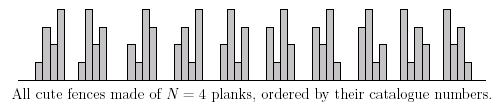
After carefully examining all the cute little wooden fences, Richard decided to order some of them. For each of them he noted the number of its planks and its catalogue number. Later, as he met his friends, he wanted to show them the fences he ordered, but he lost the catalogue somewhere. The only thing he has got are his notes. Please help him find out, how will his fences look like.
Input
Each of the following K lines contains two integers N and C (1 <= N <= 20), separated by a space. N is the number of planks in the fence, C is the catalogue number of the fence.
You may assume, that the total number of cute little wooden fences with 20 planks fits into a 64-bit signed integer variable (long long in C/C++, int64 in FreePascal). You may also assume that the input is correct, in particular that C is at least 1 and it doesn抰 exceed the number of cute fences with N planks.
Output
Sample Input
2

2 1

3 3
Sample Output
1 2

2 3 1
Source
 /******************************

 code by drizzle

 blog: www.cnblogs.com/hsd-/

 ^ ^    ^ ^

  O      O

 ******************************/

 //#include<bits/stdc++.h>

 #include<iostream>

 #include<cstring>

 #include<cmath>

 #include<cstdio>

 #define ll long long

 #define mod 1000000007

 #define PI acos(-1.0)

 using namespace std;

 int UP=;

 int DOWN=;

 ll c[][][];

 void init(int n)

 {

     memset(c,,sizeof(c));

     c[][][UP]=c[][][DOWN]=;//初始为1种

     for(int i=; i<=n; i++)

     {

         for(int k=; k<=i; k++)

         {

             for(int m=k; m<i; m++)

                 c[i][k][UP]+=c[i-][m][DOWN];//前i-1的down方案m>=k

             for(int l=; l<=k-; l++)

                 c[i][k][DOWN]+=c[i-][l][UP];//前i-1的up方案 l<k

         }

     }

 }

 void fun(int n,ll cc)//排序计数处理 ,一位一位的判断 不断靠近cc

 {

     ll skipped=;//已经跳过的方案数

     int seq[];

     int used[];

     memset(used,,sizeof(used));

     for(int i=; i<=n; i++)

     {

         ll oldval=skipped;

         int k;

         int no=;

         for(k=; k<=n; k++)

         {

             oldval=skipped;

             if(!used[k])

             {

                 no++;//k是剩下的木棒里第no短的

                 if(i==)//首位

                     skipped+=c[n][no][UP]+c[n][no][DOWN];

                 else

                 {  //剩下n-i+1条木棒 现在放置第no短的木棒k 判断k与已经确定的seq的前一条木棒的关系

                     if(k>seq[i-]&&(i<=||seq[i-]>seq[i-]))

                         skipped+=c[n-i+][no][DOWN];//判断合理的放置

                     else if(k<seq[i-]&&(i<=||seq[i-]<seq[i-]))

                         skipped+=c[n-i+][no][UP];

                 }

                 if(skipped>=cc)//当跳过的方案数大于询问的数目跳出

                     break;

             }

         }

         used[k]=;

         seq[i]=k;

         skipped=oldval;

     }

     for(int i=; i<=n; i++)

         if(i<n) printf("%d ",seq[i]);

         else    printf("%d\n",seq[i]);

 }

 int main()

 {

     int T,s;

     ll c;

     init();

     scanf("%d",&T);

     while(T--)

     {

         scanf("%d %I64d",&s,&c);

         fun(s,c);

     }

     return ;

 }
poj 1037 三维dp的更多相关文章
- POJ 1037 (计数 + DP) 一个美妙的栅栏
这道题总算勉勉强强看懂了,DP和计数都很不好想 DP部分: 称i根木棒的合法方案集合为S(i),第二根木棒比第一根长的方案称作UP方案,反之叫做DOWN方案 C[i][k][DOWN] 是S(i)中以 ...
- 三维dp&codeforce 369_2_C
三维dp&codeforce 369_2_C 标签: dp codeforce 369_2_C 题意: 一排树,初始的时候有的有颜色,有的没有颜色,现在给没有颜色的树染色,给出n课树,用m种燃 ...
- Fire (poj 2152 树形dp)
Fire (poj 2152 树形dp) 给定一棵n个结点的树(1<n<=1000).现在要选择某些点,使得整棵树都被覆盖到.当选择第i个点的时候,可以覆盖和它距离在d[i]之内的结点,同 ...
- P1006 传纸条(二维、三维dp)
P1006 传纸条 输入输出样例 输入 #1 复制 3 3 0 3 9 2 8 5 5 7 0 输出 #1 复制 34 说明/提示 [限制] 对于 30% 的数据,1≤m,n≤10: 对于 100% ...
- POJ 1037 DP
题目链接: http://poj.org/problem?id=1037 分析: 很有分量的一道DP题!!! (参考于:http://blog.csdn.net/sj13051180/article/ ...
- poj上的dp专题
更新中... http://poj.org/problem?id=1037 dp[i][j][0]表示序列长度为i,以j开始并且前两位下降的合法序列数目; dp[i][j][1]表示序列长度为i, 以 ...
- POJ 2096 (概率DP)
题目链接: http://poj.org/problem?id=2096 题目大意:n种bug,s个子系统.每天随机找一个bug,种类随机,来自系统随机.问找齐n种bug,且每个子系统至少有一个bug ...
- poj 1463(树形dp)
题目链接:http://poj.org/problem?id=1463 思路:简单树形dp,如果不选父亲节点,则他的所有的儿子节点都必须选,如果选择了父亲节点,则儿子节点可选,可不选,取较小者. #i ...
- poj 2486( 树形dp)
题目链接:http://poj.org/problem?id=2486 思路:经典的树形dp,想了好久的状态转移.dp[i][j][0]表示从i出发走了j步最后没有回到i,dp[i][j][1]表示从 ...
随机推荐
- lvs+ipvsadm负载均衡
使用LVS实现负载均衡原理及安装配置详解 负载均衡集群是 load balance 集群的简写,翻译成中文就是负载均衡集群.常用的负载均衡开源软件有nginx.lvs.haproxy,商业的硬件负载均 ...
- (转)数据库老兵:NewSQL才是未来
编者按:在数据库技术领域,Michael Stonebraker几乎是无人不知无人不晓的人物.现年70岁的Stonebraker不仅是Ingres和PostgreSQL的创始人,同时在Informix ...
- Delphi中DLL的创建和使用(转)
Delphi中DLL的创建和使用 1.DLL简介: 2.调用DLL: 3.创建DLL: 4.两个技巧: 5.初始化: 6.例外处理. 1.DLL简介 ...
- 带密匙的php加密解密示例分享
<?phpheader("content-type:text/html;charset=utf-8");$id = "http://www.jb51.net&quo ...
- 操作视频-对视频进行canny边缘检测
#include<opencv2/opencv.hpp> using namespace cv; int main() { VideoCapture capture(); //从摄像头读入 ...
- Maven系列之快速入门
文章结构 唯快不破---Maven快速入门 稳打稳扎---Maven核心知识 实用为先---Maven如何建立Web项目 1 唯快不破---Maven快速入门 1.1 Maven项目 ...
- 解决boostrap-table有水平和垂直滚动条时,滚动条滑到最右边表格标题和内容单元格无法对齐的问题
问题:boostrap-table有水平和垂直滚动条时,滚动条不高的时候(滚动高度比较大的时候没有问题),滚动条滑到最右边表格标题和内容单元格无法对齐的问题 问题原因:bootstrap-table源 ...
- 质数,$\varphi$和$\mu$线性筛
typedef long long ll; bool check[N]; int mu[N],pri[N],tot; ll phi[N]; void init(int lim){ check[]=,p ...
- Windows usb设备正在使用中
每次插上u盘之后,弹出的时候,总是提示正在使用中.后来我发现了技巧, 1.打开任务管理器 2.打开底部的 打开资源监视器 按钮 3.然后点击磁盘 4.再次弹出usb 就可以弹出了.
- 阿里巴巴Java开发规约Eclipse插件安装及使用
技术交流群:233513714 插件安装 环境:JDK1.8,Eclipse4+.有同学遇到过这样的情况,安装插件重启后,发现没有对应的菜单项,从日志上也看不到相关的异常信息,最后把JDK从1.6升级 ...