
吴裕雄 python 神经网络——TensorFlow训练神经网络:花瓣识别
import os

import glob

import os.path

import numpy as np

import tensorflow as tf

from tensorflow.python.platform import gfile

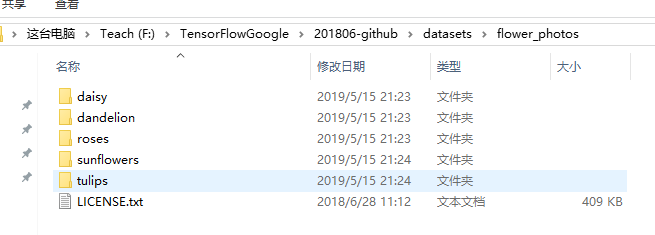
# 原始输入数据的目录,这个目录下有5个子目录,每个子目录底下保存这属于该

# 类别的所有图片。

INPUT_DATA = 'F:\\TensorFlowGoogle\\201806-github\\datasets\\flower_photos'

# 输出文件地址。我们将整理后的图片数据通过numpy的格式保存。

OUTPUT_FILE = 'F:\\flower_processed_data.npy'

# 测试数据和验证数据比例。

VALIDATION_PERCENTAGE = 10

TEST_PERCENTAGE = 10

# 读取数据并将数据分割成训练数据、验证数据和测试数据。

def create_image_lists(sess, testing_percentage, validation_percentage):

    sub_dirs = [x[0] for x in os.walk(INPUT_DATA)]

    is_root_dir = True

    # 初始化各个数据集。

    training_images = []

    training_labels = []

    testing_images = []

    testing_labels = []

    validation_images = []

    validation_labels = []

    current_label = 0

    # 读取所有的子目录。

    for sub_dir in sub_dirs:

        if is_root_dir:

            is_root_dir = False

            continue

        # 获取一个子目录中所有的图片文件。

        extensions = ['jpg', 'jpeg', 'JPG', 'JPEG']

        file_list = []

        dir_name = os.path.basename(sub_dir)

        for extension in extensions:

            file_glob = os.path.join(INPUT_DATA, dir_name, '*.' + extension)

            file_list.extend(glob.glob(file_glob))

        if not file_list: continue

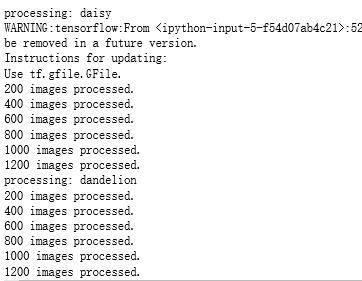
        print("processing:", dir_name)

        i = 0

        # 处理图片数据。

        for file_name in file_list:

            i += 1

            # 读取并解析图片,将图片转化为299*299以方便inception-v3模型来处理。

            image_raw_data = gfile.FastGFile(file_name, 'rb').read()

            image = tf.image.decode_jpeg(image_raw_data)

            if image.dtype != tf.float32:

                image = tf.image.convert_image_dtype(image, dtype=tf.float32)

            image = tf.image.resize_images(image, [299, 299])

            image_value = sess.run(image)

            # 随机划分数据聚。

            chance = np.random.randint(100)

            if chance < validation_percentage:

                validation_images.append(image_value)

                validation_labels.append(current_label)

            elif chance < (testing_percentage + validation_percentage):

                testing_images.append(image_value)

                testing_labels.append(current_label)

            else:

                training_images.append(image_value)

                training_labels.append(current_label)

            if i % 200 == 0:

                print(i, "images processed.")

        current_label += 1

    # 将训练数据随机打乱以获得更好的训练效果。

    state = np.random.get_state()

    np.random.shuffle(training_images)

    np.random.set_state(state)

    np.random.shuffle(training_labels)

    return np.asarray([training_images, training_labels,validation_images, validation_labels,testing_images, testing_labels])

with tf.Session() as sess:

    processed_data = create_image_lists(sess, TEST_PERCENTAGE, VALIDATION_PERCENTAGE)

    # 通过numpy格式保存处理后的数据。

    np.save(OUTPUT_FILE, processed_data)
吴裕雄 python 神经网络——TensorFlow训练神经网络:花瓣识别的更多相关文章
- 吴裕雄 python 神经网络——TensorFlow训练神经网络:不使用滑动平均
import tensorflow as tf from tensorflow.examples.tutorials.mnist import input_data INPUT_NODE = 784 ...
- 吴裕雄 python 神经网络——TensorFlow训练神经网络:不使用隐藏层
import tensorflow as tf from tensorflow.examples.tutorials.mnist import input_data INPUT_NODE = 784 ...
- 吴裕雄 python 神经网络——TensorFlow训练神经网络:不使用激活函数
import tensorflow as tf from tensorflow.examples.tutorials.mnist import input_data INPUT_NODE = 784 ...
- 吴裕雄 python 神经网络——TensorFlow训练神经网络:不使用指数衰减的学习率
import tensorflow as tf from tensorflow.examples.tutorials.mnist import input_data INPUT_NODE = 784 ...
- 吴裕雄 python 神经网络——TensorFlow训练神经网络:不使用正则化
import tensorflow as tf from tensorflow.examples.tutorials.mnist import input_data INPUT_NODE = 784 ...
- 吴裕雄 python 神经网络——TensorFlow训练神经网络:全模型
import tensorflow as tf from tensorflow.examples.tutorials.mnist import input_data INPUT_NODE = 784 ...
- 吴裕雄 python 神经网络——TensorFlow训练神经网络:MNIST最佳实践
import os import tensorflow as tf from tensorflow.examples.tutorials.mnist import input_data INPUT_N ...
- 吴裕雄 python 神经网络——TensorFlow训练神经网络:卷积层、池化层样例
import numpy as np import tensorflow as tf M = np.array([ [[1],[-1],[0]], [[-1],[2],[1]], [[0],[2],[ ...
- 吴裕雄--天生自然 Tensorflow卷积神经网络:花朵图片识别
import os import numpy as np import matplotlib.pyplot as plt from PIL import Image, ImageChops from ...
随机推荐
- MySQL学习(六)change-buffer
文章部分总结描述来自参考文章,属于半原创. 概述 文章将会介绍 change buffer 相关的知识点 查看 MySQL InnoDB 状态的命令 SHOW ENGINE INNODB ST ...
- 源码安装python 报错,openssl: error while loading shared libraries: libssl.so.1.1
在执行openssl version出现如下错误: openssl: error while loading shared libraries: libssl.so.1.1: cannot open ...
- Django_模型字段属性
""" 定义属性 概述 ·django根据属性的类型确定以下信息 ·当前选择的数据库支持字段的类型 ·渲染管理表单时使用的默认html控件 ·在管理站点最低限度的验证 · ...
- PHP中spl_autoload_register()函数用法实例详解
本文实例分析了PHP中spl_autoload_register()函数用法.分享给大家供大家参考,具体如下: 在了解这个函数之前先来看另一个函数:__autoload. 一.__autoload 这 ...
- Call to undefined function Illuminate\Encryption\openssl_cipher_iv_length()
今天遇到一个错误,没有定义一个openssl_cipher_iv_length()方法,可是我明明开启OpenSSL了啊 如果开启了还报错 只需要把php的目录加入环境变量 -重启电脑 就解决了 但 ...
- 问题总结:mysql和javaweb工程连接的过程中容易产生的问题
问题背景:自己在本机的mysql8瘫痪了,将Oracle中的数据迁移到mysql之后,配置好javaweb工程和虚拟机上的远程Mysql连接的文件之后:遇见了无法访问的问题 具体的配置: dataso ...
- HDU 1326 Box of Bricks(思维)
Little Bob likes playing with his box of bricks. He puts the bricks one upon another and builds stac ...
- 密码学笔记——Rot13
Rot13:将每个在字母表上的字母,用后数13个后的字母代替,若超过时则重新绕回26字母开头即可. eg:A换成N.B换成O.依此类推到M换成Z,然后序列反转:N换成A.O换成B.最后Z换成M 1.密 ...
- Homebrew安装和Mac使用
软件安装 1.Homebrew安装 ruby环境: curl -sSL https://get.rvm.io | bash -s stable 官网方式: /usr/bin/ruby -e & ...
- 【音乐欣赏】《PANTA RHEI》 - MYTH & ROID
曲名:PANTA RHEI 作者:MYTH & ROID [ti:PANTA RHEI (<异世界超能魔术师>TV动画片头曲)] [ar:MYTH & ROID] [al: ...