
吴裕雄 python 神经网络——TensorFlow训练神经网络:不使用正则化
import tensorflow as tf

from tensorflow.examples.tutorials.mnist import input_data

INPUT_NODE = 784     # 输入节点

OUTPUT_NODE = 10     # 输出节点

LAYER1_NODE = 500    # 隐藏层数

BATCH_SIZE = 100     # 每次batch打包的样本个数

# 模型相关的参数

LEARNING_RATE_BASE = 0.8

LEARNING_RATE_DECAY = 0.99

TRAINING_STEPS = 5000

MOVING_AVERAGE_DECAY = 0.99

def inference(input_tensor, avg_class, weights1, biases1, weights2, biases2):

    # 不使用滑动平均类

    if avg_class == None:

        layer1 = tf.nn.relu(tf.matmul(input_tensor, weights1) + biases1)

        return tf.matmul(layer1, weights2) + biases2

    else:

        # 使用滑动平均类

        layer1 = tf.nn.relu(tf.matmul(input_tensor, avg_class.average(weights1)) + avg_class.average(biases1))

        return tf.matmul(layer1, avg_class.average(weights2)) + avg_class.average(biases2)

def train(mnist):

    x = tf.placeholder(tf.float32, [None, INPUT_NODE], name='x-input')

    y_ = tf.placeholder(tf.float32, [None, OUTPUT_NODE], name='y-input')

    # 生成隐藏层的参数。

    weights1 = tf.Variable(tf.truncated_normal([INPUT_NODE, LAYER1_NODE], stddev=0.1))

    biases1 = tf.Variable(tf.constant(0.1, shape=[LAYER1_NODE]))

    # 生成输出层的参数。

    weights2 = tf.Variable(tf.truncated_normal([LAYER1_NODE, OUTPUT_NODE], stddev=0.1))

    biases2 = tf.Variable(tf.constant(0.1, shape=[OUTPUT_NODE]))

    # 计算不含滑动平均类的前向传播结果

    y = inference(x, None, weights1, biases1, weights2, biases2)

    # 定义训练轮数及相关的滑动平均类

    global_step = tf.Variable(0, trainable=False)

    variable_averages = tf.train.ExponentialMovingAverage(MOVING_AVERAGE_DECAY, global_step)

    variables_averages_op = variable_averages.apply(tf.trainable_variables())

    average_y = inference(x, variable_averages, weights1, biases1, weights2, biases2)

    # 计算交叉熵及其平均值

    cross_entropy = tf.nn.sparse_softmax_cross_entropy_with_logits(logits=y, labels=tf.argmax(y_, 1))

    cross_entropy_mean = tf.reduce_mean(cross_entropy)

    # 损失函数的计算

    loss = cross_entropy_mean

    # 设置指数衰减的学习率。

    learning_rate = tf.train.exponential_decay(

        LEARNING_RATE_BASE,

        global_step,

        mnist.train.num_examples / BATCH_SIZE,

        LEARNING_RATE_DECAY,

        staircase=True)

    # 优化损失函数

    train_step = tf.train.GradientDescentOptimizer(learning_rate).minimize(loss, global_step=global_step)

    # 反向传播更新参数和更新每一个参数的滑动平均值

    with tf.control_dependencies([train_step, variables_averages_op]):

        train_op = tf.no_op(name='train')

    # 计算正确率

    correct_prediction = tf.equal(tf.argmax(average_y, 1), tf.argmax(y_, 1))

    accuracy = tf.reduce_mean(tf.cast(correct_prediction, tf.float32))

    # 初始化会话,并开始训练过程。

    with tf.Session() as sess:

        tf.global_variables_initializer().run()

        validate_feed = {x: mnist.validation.images, y_: mnist.validation.labels}

        test_feed = {x: mnist.test.images, y_: mnist.test.labels}

        # 循环的训练神经网络。

        for i in range(TRAINING_STEPS):

            if i % 1000 == 0:

                validate_acc = sess.run(accuracy, feed_dict=validate_feed)

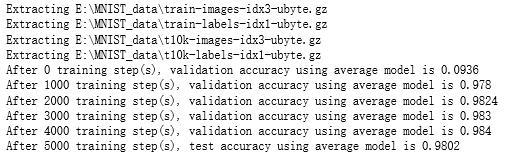
                print("After %d training step(s), validation accuracy using average model is %g " % (i, validate_acc))

            xs,ys=mnist.train.next_batch(BATCH_SIZE)

            sess.run(train_op,feed_dict={x:xs,y_:ys})

        test_acc=sess.run(accuracy,feed_dict=test_feed)

        print(("After %d training step(s), test accuracy using average model is %g" %(TRAINING_STEPS, test_acc)))

def main(argv=None):

    mnist = input_data.read_data_sets("E:\\MNIST_data\\", one_hot=True)

    train(mnist)

if __name__=='__main__':

    main()
吴裕雄 python 神经网络——TensorFlow训练神经网络:不使用正则化的更多相关文章
- 吴裕雄 python 神经网络——TensorFlow训练神经网络:不使用滑动平均
import tensorflow as tf from tensorflow.examples.tutorials.mnist import input_data INPUT_NODE = 784 ...
- 吴裕雄 python 神经网络——TensorFlow训练神经网络:不使用隐藏层
import tensorflow as tf from tensorflow.examples.tutorials.mnist import input_data INPUT_NODE = 784 ...
- 吴裕雄 python 神经网络——TensorFlow训练神经网络:不使用激活函数
import tensorflow as tf from tensorflow.examples.tutorials.mnist import input_data INPUT_NODE = 784 ...
- 吴裕雄 python 神经网络——TensorFlow训练神经网络:不使用指数衰减的学习率
import tensorflow as tf from tensorflow.examples.tutorials.mnist import input_data INPUT_NODE = 784 ...
- 吴裕雄 python 神经网络——TensorFlow训练神经网络:全模型
import tensorflow as tf from tensorflow.examples.tutorials.mnist import input_data INPUT_NODE = 784 ...
- 吴裕雄 python 神经网络——TensorFlow训练神经网络:花瓣识别
import os import glob import os.path import numpy as np import tensorflow as tf from tensorflow.pyth ...
- 吴裕雄 python 神经网络——TensorFlow训练神经网络:MNIST最佳实践
import os import tensorflow as tf from tensorflow.examples.tutorials.mnist import input_data INPUT_N ...
- 吴裕雄 python 神经网络——TensorFlow训练神经网络:卷积层、池化层样例
import numpy as np import tensorflow as tf M = np.array([ [[1],[-1],[0]], [[-1],[2],[1]], [[0],[2],[ ...
- 吴裕雄--天生自然 Tensorflow卷积神经网络:花朵图片识别
import os import numpy as np import matplotlib.pyplot as plt from PIL import Image, ImageChops from ...
随机推荐
- CentOS安装docker,及其基本操作
CentOS安装docker,及其基本操作 一.安装docker Docker要求运行在Centos 7上,要求系统为64位,系统内核版本3.10以上 1.uname -an 查看当前系统版本 2.y ...
- 【C语言】输入一个字符串,并对字符串中的偶数位置的字符按从小到大的顺序排序,奇数位置的字符不动,输出排序后的结果
#include <stdio.h> #include<string.h> int main() { ]; int i,j,k,len; gets_s(a); len= str ...
- 计算机系统概论之CPU(central processing unit)
CPI表示每条指令(Instruction)周期数,即执行一条指令所需的平均时钟周期数.可用下式计算: CPI=执行某段程序所需的CPU(Centrol Processing Unit)时钟周期数/程 ...
- 全网最详细!搭建Hexo+Coding/Gitee,实现一键生成,同步部署
全网最全小白搭建Hexo+Gitee/Coding/Github 全网最全小白搭建Hexo+Gitee/Coding/Github 本站内容已全部转移到https://www.myyuns.ltd,具 ...
- python开发基础04-函数、递归、匿名函数、高阶函数、装饰器
匿名函数 lamba lambda x,y,z=1:x+y+z 匿名就是没有名字 def func(x,y,z=1): return x+y+z 匿名 lambda x,y,z=1:x+y+z #与函 ...
- Java-POJ1000-A+B Problem
- Educational Codeforces Round 76 (Rated for Div. 2) A. Two Rival Students
You are the gym teacher in the school. There are nn students in the row. And there are two rivalling ...
- [消灭虫子] Qt 套接字发不出去东西
最近状态不是太好,导致出现bug之后心烦意乱的 遇到这样的事情,就是在 这样的函数执行之后服务端收不到任何消息,但是在调试台显示已经发送了正常的字节数. 表示大概已经发出去了,但是我确定服务端没有问题 ...
- React的React.createContext()源码解析(四)
一.产生context原因 从父组件直接传值到孙子组件,而不必一层一层的通过props进行传值,相比较以前的那种传值更加的方便.简介. 二.context的两种实现方式 1.老版本(React16.x ...
- Go标准库之Context
文章引用自 Go标准库Context 在 Go http包的Server中,每一个请求在都有一个对应的 goroutine 去处理.请求处理函数通常会启动额外的 goroutine 用来访问后端服 ...