
吴裕雄 python 神经网络——TensorFlow训练神经网络:不使用隐藏层
import tensorflow as tf

from tensorflow.examples.tutorials.mnist import input_data

INPUT_NODE = 784     # 输入节点

OUTPUT_NODE = 10     # 输出节点

BATCH_SIZE = 100     # 每次batch打包的样本个数

# 模型相关的参数

LEARNING_RATE_BASE = 0.01

LEARNING_RATE_DECAY = 0.99

REGULARAZTION_RATE = 0.0001

TRAINING_STEPS = 5000

MOVING_AVERAGE_DECAY = 0.99

def inference(input_tensor, avg_class, weights1, biases1):

    # 不使用滑动平均类

    if avg_class == None:

        layer1 = tf.nn.relu(tf.matmul(input_tensor, weights1) + biases1)

        return layer1

    else:

        # 使用滑动平均类

        layer1 = tf.nn.relu(tf.matmul(input_tensor, avg_class.average(weights1)) + avg_class.average(biases1))

        return layer1

def train(mnist):

    x = tf.placeholder(tf.float32, [None, INPUT_NODE], name='x-input')

    y_ = tf.placeholder(tf.float32, [None, OUTPUT_NODE], name='y-input')

    # 生成输出层的参数。

    weights1 = tf.Variable(tf.truncated_normal([INPUT_NODE, OUTPUT_NODE], stddev=0.1))

    biases1 = tf.Variable(tf.constant(0.1, shape=[OUTPUT_NODE]))

    # 计算不含滑动平均类的前向传播结果

    y = inference(x, None, weights1, biases1)

    # 定义训练轮数及相关的滑动平均类

    global_step = tf.Variable(0, trainable=False)

    variable_averages = tf.train.ExponentialMovingAverage(MOVING_AVERAGE_DECAY, global_step)

    variables_averages_op = variable_averages.apply(tf.trainable_variables())

    average_y = inference(x, variable_averages, weights1, biases1)

    # 计算交叉熵及其平均值

    cross_entropy = tf.nn.sparse_softmax_cross_entropy_with_logits(logits=y, labels=tf.argmax(y_, 1))

    cross_entropy_mean = tf.reduce_mean(cross_entropy)

    # 损失函数的计算

    regularizer = tf.contrib.layers.l2_regularizer(REGULARAZTION_RATE)

    regularaztion = regularizer(weights1)

    loss = cross_entropy_mean + regularaztion

    # 设置指数衰减的学习率。

    learning_rate = tf.train.exponential_decay(

        LEARNING_RATE_BASE,

        global_step,

        mnist.train.num_examples / BATCH_SIZE,

        LEARNING_RATE_DECAY,

        staircase=True)

    # 优化损失函数

    train_step = tf.train.GradientDescentOptimizer(learning_rate).minimize(loss, global_step=global_step)

    # 反向传播更新参数和更新每一个参数的滑动平均值

    with tf.control_dependencies([train_step, variables_averages_op]):

        train_op = tf.no_op(name='train')

    # 计算正确率

    correct_prediction = tf.equal(tf.argmax(average_y, 1), tf.argmax(y_, 1))

    accuracy = tf.reduce_mean(tf.cast(correct_prediction, tf.float32))

    # 初始化会话,并开始训练过程。

    with tf.Session() as sess:

        tf.global_variables_initializer().run()

        validate_feed = {x: mnist.validation.images, y_: mnist.validation.labels}

        test_feed = {x: mnist.test.images, y_: mnist.test.labels}

        # 循环的训练神经网络。

        for i in range(TRAINING_STEPS):

            if i % 1000 == 0:

                validate_acc = sess.run(accuracy, feed_dict=validate_feed)

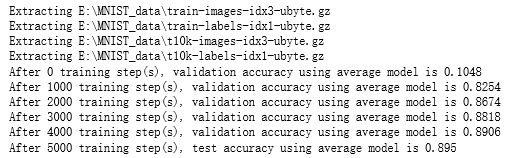
                print("After %d training step(s), validation accuracy using average model is %g " % (i, validate_acc))

            xs,ys=mnist.train.next_batch(BATCH_SIZE)

            sess.run(train_op,feed_dict={x:xs,y_:ys})

        test_acc=sess.run(accuracy,feed_dict=test_feed)

        print(("After %d training step(s), test accuracy using average model is %g" %(TRAINING_STEPS, test_acc)))

def main(argv=None):

    mnist = input_data.read_data_sets("E:\\MNIST_data\\", one_hot=True)

    train(mnist)

if __name__=='__main__':

    main()
吴裕雄 python 神经网络——TensorFlow训练神经网络:不使用隐藏层的更多相关文章
- 吴裕雄 python 神经网络——TensorFlow训练神经网络:不使用滑动平均
import tensorflow as tf from tensorflow.examples.tutorials.mnist import input_data INPUT_NODE = 784 ...
- 吴裕雄 python 神经网络——TensorFlow训练神经网络:不使用激活函数
import tensorflow as tf from tensorflow.examples.tutorials.mnist import input_data INPUT_NODE = 784 ...
- 吴裕雄 python 神经网络——TensorFlow训练神经网络:不使用指数衰减的学习率
import tensorflow as tf from tensorflow.examples.tutorials.mnist import input_data INPUT_NODE = 784 ...
- 吴裕雄 python 神经网络——TensorFlow训练神经网络:不使用正则化
import tensorflow as tf from tensorflow.examples.tutorials.mnist import input_data INPUT_NODE = 784 ...
- 吴裕雄 python 神经网络——TensorFlow训练神经网络:全模型
import tensorflow as tf from tensorflow.examples.tutorials.mnist import input_data INPUT_NODE = 784 ...
- 吴裕雄 python 神经网络——TensorFlow训练神经网络:花瓣识别
import os import glob import os.path import numpy as np import tensorflow as tf from tensorflow.pyth ...
- 吴裕雄 python 神经网络——TensorFlow训练神经网络:MNIST最佳实践
import os import tensorflow as tf from tensorflow.examples.tutorials.mnist import input_data INPUT_N ...
- 吴裕雄 python 神经网络——TensorFlow训练神经网络:卷积层、池化层样例
import numpy as np import tensorflow as tf M = np.array([ [[1],[-1],[0]], [[-1],[2],[1]], [[0],[2],[ ...
- 吴裕雄--天生自然 Tensorflow卷积神经网络:花朵图片识别
import os import numpy as np import matplotlib.pyplot as plt from PIL import Image, ImageChops from ...
随机推荐
- artTemplate使用说明
普通使用 <script id="test" type="text/html"> {{if isAdmin}} <h1>{{title} ...
- 【Python】数值运算函数
- Oracle常用函数记录
Oracle函数 --schema:hcf --不带任何参数 http://www.cnblogs.com/wuyisky/archive/2010/05/11/oracle_function.htm ...
- mysql和oracle建表语句以及数据类型的区别
1.mysql和oracle建表语句的区别 mysql DROP TABLE IF EXISTS `order`;CREATE TABLE `order` ( `id` int(11) NOT NU ...
- P1216 [IOI1994]数字三角形
史上最水的 dp 题,没有之一(By rxz) 确实很简单,就算是我这个 dp 萌新也一眼看出来了转移方程 首先考虑状态,设 \(f_{i,j}\) 表示选择第 \(i\) 层第 \(j\) 个数时获 ...
- AcWing 850. Dijkstra求最短路 II 堆优化版 优先队列 稀疏图
//稀疏图 点和边差不多 #include <cstring> #include <iostream> #include <algorithm> #include ...
- java.lang.OutOfMemoryError: GC overhead limit exceeded异常处理
今天写程序遇到个之前从没遇到的异常-----java.lang.OutOfMemoryError: GC overhead limit exceeded,下面附上解决方法 异常: 解决方法: 鼠标右击 ...
- Go项目结构
1. go项目工程结构 配置好工作目录后,就可以编码开发了,在这之前,我们看下go的通用项目结构,这里的结构主要是源代码相应地资源文件存放目录结构. 1.1 gopath目录 gopath目录就是我们 ...
- 【C语言】(指针) 将两个数排序
原理就不讲了,这里用来理解指针的使用方法 代码1: #include <stdio.h> int main() { int a, b;/* 实际变量的声明 */ int* p, * q;/ ...
- 获取目标字符串在字符串中第N次出现的位置
/** * 获取目标字符串在字符串中第N次出现的位置 * @file name * @author xiehongwei * @date 2017-8-2 下午3:29:09 * @param sou ...