
HDU 2454 Degree Sequence of Graph G(Havel定理 推断一个简单图的存在)
主题链接: pid=2454">http://acm.hdu.edu.cn/showproblem.php?pid=2454
company. There, he held a position as a navigator in a freighter and began his new life.
The cargo vessel, Wang Haiyang worked on, sails among 6 ports between which exist 9 routes. At the first sight of his navigation chart, the 6 ports and 9 routes on it reminded him of Graph Theory that he studied in class at university. In the way that Leonhard
Euler solved The Seven Bridges of Knoigsberg, Wang Haiyang regarded the navigation chart as a graph of Graph Theory. He considered the 6 ports as 6 nodes and 9 routes as 9 edges of the graph. The graph is illustrated as below.
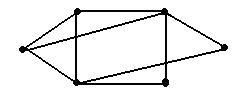
According to Graph Theory, the number of edges related to a node is defined as Degree number of this node.
Wang Haiyang looked at the graph and thought, If arranged, the Degree numbers of all nodes of graph G can form such a sequence: 4, 4, 3,3,2,2, which is called the degree sequence of the graph. Of course, the degree sequence of any simple graph (according to
Graph Theory, a graph without any parallel edge or ring is a simple graph) is a non-negative integer sequence?
Wang Haiyang is a thoughtful person and tends to think deeply over any scientific problem that grabs his interest. So as usual, he also gave this problem further thought, As we know, any a simple graph always corresponds with a non-negative integer sequence.
But whether a non-negative integer sequence always corresponds with the degree sequence of a simple graph? That is, if given a non-negative integer sequence, are we sure that we can draw a simple graph according to it.?
Let's put forward such a definition: provided that a non-negative integer sequence is the degree sequence of a graph without any parallel edge or ring, that is, a simple graph, the sequence is draw-possible, otherwise, non-draw-possible. Now the problem faced
with Wang Haiyang is how to test whether a non-negative integer sequence is draw-possible or not. Since Wang Haiyang hasn't studied Algorithm Design course, it is difficult for him to solve such a problem. Can you help him?
of the degree sequence.
2

6 4 4 3 3 2 2

4 2 1 1 1
yes

no
题意:
给出一个图的每个点的度数,求是否能构成一个简单图。
PS:
Havel定理:http://baike.baidu.com/view/8698382.htm?
fr=aladdin
关于详细图的构造,我们能够简单地把奇数度的点配对,剩下的所有搞成自环。
代码例如以下:
#include<cstdio>

#include<algorithm>

using namespace std;

bool cmp(int a,int b)

{

    return a>b;

}

int main()

{

    int t,n,i,j;

    int a[1010];

    scanf("%d",&t);

    while(t--)

    {

        scanf("%d",&n);

        int sum = 0;

        for(i=0; i<n; i++)

        {

            scanf("%d",&a[i]);

            sum+=a[i];

        }

        if(sum%2)

        {

            printf("no\n");

            continue;

        }

        for(i=0; i<n; i++)

        {

            if(a[i]>=n)

                break;

        }

        if(i<n)

        {

            printf("no\n");

            continue;

        }

        int flag = 0;

        for(i=0; i<n; i++)

        {

            int cnt=0;

            sort(a,a+n,cmp);

            for(j=1; j<n; j++)

            {

                if(cnt==a[0])

                    break;

                a[j]--;

                cnt++;

                if(a[j] < 0)

                {

                    flag = 1;

                    break;

                }

            }

            if(flag)

                break;

            if(cnt==0)

                break;

            a[0]-=cnt;

        }

        for(i=0; i<n; i++)

        {

            //printf("%d ",a[i]);

            if(a[i])

                break;

        }

        //printf("\n");

        if(i<n || flag)

            printf("no\n");

        else

            printf("yes\n");

    }

    return 0;

}

/*

4

4 3 2 1 1

*/
版权声明:本文博客原创文章,博客,未经同意,不得转载。
HDU 2454 Degree Sequence of Graph G(Havel定理 推断一个简单图的存在)的更多相关文章
- hdu 2454 Degree Sequence of Graph G (推断简单图)
///已知各点的度,推断是否为一个简单图 #include<stdio.h> #include<algorithm> #include<string.h> usin ...
- HDU 2454"Degree Sequence of Graph G"(度序列可图性判断)
传送门 参考资料: [1]:图论-度序列可图性判断(Havel-Hakimi定理) •题意 给你 n 个非负整数列,判断这个序列是否为可简单图化的: •知识支持 握手定理:在任何无向图中,所有顶点的度 ...
- HDU 2454 Degree Sequence of Graph G——可简单图化&&Heavel定理
题意 给你一个度序列,问能否构成一个简单图. 分析 对于可图化,只要满足度数之和是偶数,即满足握手定理. 对于可简单图化,就是Heavel定理了. Heavel定理:把度序列排成不增序,即 $deg[ ...
- hdu 2454 Degree Sequence of Graph G(可简单图化判定)
传送门 •Havel-Hakimi定理: 给定一个非负整数序列{d1,d2,...dn},若存在一个无向图使得图中各点的度与此序列一一对应,则称此序列可图化. 进一步,若图为简单图,则称此序列可简单图 ...
- Hdoj 2454.Degree Sequence of Graph G 题解
Problem Description Wang Haiyang is a strong and optimistic Chinese youngster. Although born and bro ...
- 【Havel 定理】Degree Sequence of Graph G
[题目链接] http://acm.hdu.edu.cn/showproblem.php?pid=2454 [别人博客粘贴过来的] 博客地址:https://www.cnblogs.com/debug ...
- cdoj913-握手 【Havel定理】
http://acm.uestc.edu.cn/#/problem/show/913 握手 Time Limit: 2000/1000MS (Java/Others) Memory Limit ...
- 2013长沙 G Graph Reconstruction (Havel-Hakimi定理)
Graph Reconstruction Time Limit: 2 Seconds Memory Limit: 65536 KB Special Judge Let there ...
- HDU 1560 DNA sequence(DNA序列)
HDU 1560 DNA sequence(DNA序列) Time Limit: 15000/5000 MS (Java/Others) Memory Limit: 32768/32768 K ...
随机推荐
- 非洲儿童(南阳oj1036)(馋)
非洲小孩 时间限制:1000 ms | 内存限制:65535 KB 难度:2 描写叙述 家住非洲的小孩,都非常黑.为什么呢? 第一.他们地处热带,太阳辐射严重. 第二,他们不常常洗澡.(常年缺水, ...
- 记得有一个奇怪的ORA-04028: cannot generate diana for object
开发商称新一package,目前已经在翻译过程中的一些错误.提示PL/SQL:ORA-00942: table or view does not exists.这是一个非常明显的错误,即要么是表不存在 ...
- 求1e11以内的素数
有两种做法,一种是打表,另一种是直接求. 打表 将1e11每隔len(len=2000w)个数字统计一下该区间内素数的个数,比如cnt[1] 表示[1,len]以内有多少个素数,cnt[2]表示[le ...
- 去掉windows文件末尾的^M: %s/\r//g
去掉windows文件末尾的^M: %s/\r//g
- 项目之软件project(我专业四年都未曾知道这四个字的含义,几句话便懂了)
潘鹏在CSDN上原创.如其它站点转载请注意排版和写明出处: 软件project的本质 一级标题 控制 质量 二级标题 成本 扩展 高内聚低耦合 效率 控制: 成本:企业要求的是以最快的速度完毕可 ...
- XSS学习笔记(一个)-点击劫持
所谓XSS这个场景被触发XSS地方,在大多数情况下,攻击者被嵌入在网页中(问题)该恶意脚本(Cross site Scripting),这里的攻击始终触发浏览器端,攻击的者的目的.一般都是获取用户的C ...
- windows使用nginx+memcached实现负载均衡和session或者缓存共享
windows使用nginx+memcached实现负载均衡和session或者缓存共享 两台server server1:115.29.186.215 windows2008 64位操作系统 ser ...
- 关于埃博拉(Ebola)基础研究病毒
关于埃博拉(Ebola)病毒的基础研究 2005年.美国哈佛大学医学研究院(Harvard Medical School)James Cunningham教授关于埃博拉病毒有一项基础研究,研究成果发表 ...
- Why 使用TLS记录封装IP层VPN IS A Bad Idea
一个很自然的想法,使用TLS套餐一IP数据报实现第三层VPN.这种想法必须经过深思熟虑的,但不幸的是,.这是一个错误的想法.有文章<Why TCP Over TCP Is A Bad Idea& ...
- [Windows]_[0基础]_[使用命令行工具dumpbin分析文件]
dumpbin(vs拥有) 1. 出口lib函数符号文件(symbols) dumpbin /exports zlib1.lib Microsoft (R) COFF/PE Dumper Versio ...