
Hdoj 2454.Degree Sequence of Graph G 题解
Problem Description
Wang Haiyang is a strong and optimistic Chinese youngster. Although born and brought up in the northern inland city Harbin, he has deep love and yearns for the boundless oceans. After graduation, he came to a coastal city and got a job in a marine transportation company. There, he held a position as a navigator in a freighter and began his new life.
The cargo vessel, Wang Haiyang worked on, sails among 6 ports between which exist 9 routes. At the first sight of his navigation chart, the 6 ports and 9 routes on it reminded him of Graph Theory that he studied in class at university. In the way that Leonhard Euler solved The Seven Bridges of Knoigsberg, Wang Haiyang regarded the navigation chart as a graph of Graph Theory. He considered the 6 ports as 6 nodes and 9 routes as 9 edges of the graph. The graph is illustrated as below.
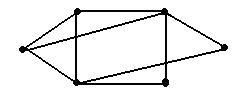
According to Graph Theory, the number of edges related to a node is defined as Degree number of this node.
Wang Haiyang looked at the graph and thought, If arranged, the Degree numbers of all nodes of graph G can form such a sequence: 4, 4, 3,3,2,2, which is called the degree sequence of the graph. Of course, the degree sequence of any simple graph (according to Graph Theory, a graph without any parallel edge or ring is a simple graph) is a non-negative integer sequence?
Wang Haiyang is a thoughtful person and tends to think deeply over any scientific problem that grabs his interest. So as usual, he also gave this problem further thought, As we know, any a simple graph always corresponds with a non-negative integer sequence. But whether a non-negative integer sequence always corresponds with the degree sequence of a simple graph? That is, if given a non-negative integer sequence, are we sure that we can draw a simple graph according to it.?
Let's put forward such a definition: provided that a non-negative integer sequence is the degree sequence of a graph without any parallel edge or ring, that is, a simple graph, the sequence is draw-possible, otherwise, non-draw-possible. Now the problem faced with Wang Haiyang is how to test whether a non-negative integer sequence is draw-possible or not. Since Wang Haiyang hasn't studied Algorithm Design course, it is difficult for him to solve such a problem. Can you help him?
Input
The first line of input contains an integer T, indicates the number of test cases. In each case, there are n+1 numbers; first is an integer n (n<1000), which indicates there are n integers in the sequence; then follow n integers, which indicate the numbers of the degree sequence.
Output
For each case, the answer should be "yes"or "no" indicating this case is "draw-possible" or "non-draw-possible"
Sample Input
2

6 4 4 3 3 2 2

4 2 1 1 1
Sample Output
yes

no
Source
思路
根据Havel-Hakimi定理 :
- 非递增排序当前数列\(d[n]\)
- 让\(k=d[1]\),将k从数组中移除
- 从第2个开始的前K个元素都-1
- 不断重复上述过程直到序列出现负数=不可图,全都为0=可图
详细见代码注释
代码
#include<bits/stdc++.h>

using namespace std;

int a[1001];

int main()

{

	int t;

	cin >> t;

	while(t--)

	{

		int n;

		cin >> n;

		for(int i=1;i<=n;i++)

			cin >> a[i];

		sort(a+1,a+n+1,[](int x,int y)->bool{ return x>y;});

		bool flag = false;

		while(true)

		{

			int k = a[1];

			if(k < 0 || a[n] < 0)//如果之前出现了负数那么排序后最后一个肯定小于0不符合

			{

				flag = false;

				break;

			}else

			if(k==0)

			{

				flag = true;

				break;

			}else

			{

				for(int i=2;k>0;i++)//从第2个起接下来k个元素都-1

				{

					a[i]--;

					if(a[i] < 0)

					{

						flag = false;

						break;

					}

					k--;

				}

				a[1] = 0;

				sort(a+1,a+n+1,[](int x,int y)->bool{ return x>y;});

			}

			if(flag) break;

		}

		if(flag)

			cout << "yes" << endl;

		else

			cout << "no" << endl;

	}

	return 0;

}
Hdoj 2454.Degree Sequence of Graph G 题解的更多相关文章
- HDU 2454 Degree Sequence of Graph G(Havel定理 推断一个简单图的存在)
主题链接:pid=2454">http://acm.hdu.edu.cn/showproblem.php?pid=2454 Problem Description Wang Haiya ...
- hdu 2454 Degree Sequence of Graph G (推断简单图)
///已知各点的度,推断是否为一个简单图 #include<stdio.h> #include<algorithm> #include<string.h> usin ...
- HDU 2454"Degree Sequence of Graph G"(度序列可图性判断)
传送门 参考资料: [1]:图论-度序列可图性判断(Havel-Hakimi定理) •题意 给你 n 个非负整数列,判断这个序列是否为可简单图化的: •知识支持 握手定理:在任何无向图中,所有顶点的度 ...
- HDU 2454 Degree Sequence of Graph G——可简单图化&&Heavel定理
题意 给你一个度序列,问能否构成一个简单图. 分析 对于可图化,只要满足度数之和是偶数,即满足握手定理. 对于可简单图化,就是Heavel定理了. Heavel定理:把度序列排成不增序,即 $deg[ ...
- hdu 2454 Degree Sequence of Graph G(可简单图化判定)
传送门 •Havel-Hakimi定理: 给定一个非负整数序列{d1,d2,...dn},若存在一个无向图使得图中各点的度与此序列一一对应,则称此序列可图化. 进一步,若图为简单图,则称此序列可简单图 ...
- 【Havel 定理】Degree Sequence of Graph G
[题目链接] http://acm.hdu.edu.cn/showproblem.php?pid=2454 [别人博客粘贴过来的] 博客地址:https://www.cnblogs.com/debug ...
- POJ 2553 The Bottom of Graph 强连通图题解
Description We will use the following (standard) definitions from graph theory. Let V be a nonempty ...
- Rabin_Karp(hash) HDOJ 1711 Number Sequence
题目传送门 /* Rabin_Karp:虽说用KMP更好,但是RK算法好理解.简单说一下RK算法的原理:首先把模式串的哈希值算出来, 在文本串里不断更新模式串的长度的哈希值,若相等,则找到了,否则整个 ...
- 洛谷P3104 Counting Friends G 题解
题目 [USACO14MAR]Counting Friends G 题解 这道题我们可以将 \((n+1)\) 个边依次去掉,然后分别判断去掉后是否能满足.注意到一点, \(n\) 个奶牛的朋友之和必 ...
随机推荐
- WebSocket实现一个聊天室
聊天室页面-->index.html <!DOCTYPE html> <html> <head> <meta charset="UTF-8&q ...
- js-跨域源资源共享(CORS)
### 一. CORS(Cross-Origin Resource Sharing,跨域源资源共享) 基本思想:使用自定义HTTP头部让浏览器与服务器进行沟通 发送请求时,需附加一个Origin头部 ...
- [转帖]Linux分页机制之分页机制的演变--Linux内存管理(七)
Linux分页机制之分页机制的演变--Linux内存管理(七) 2016年09月01日 20:01:31 JeanCheng 阅读数:4543 https://blog.csdn.net/gatiem ...
- Django--CRM--菜单排序等
一 . 菜单排序 1.我们想把菜单排序.首先给菜单加上权重,权重大的排在上面, 这就要在菜单表上加上一个权重字段. 2. 我们在菜单表里面把权重改一下 3. 需要把权重字段的信息拿出来放到sessio ...
- windows 10 multi virtual desktop keyboard shortcut
windows 10 multi virtual desktop keyboard shortcut windows 10 multi desktop keyboard shortcut https: ...
- QTP自动化测试-笔记 注释、大小写
1 rem 注释内容 2 ' 注释内容 3 快捷键注释-选择代码行-ctrl+M 4 ctrl+shift+同- 取消注释 大小写 qtp:对小写敏感:如果 变量.sheet页是用小写字母命名,则使用 ...
- lr分布式测试--笔记
LR 架构: controller做测试控制 scenario做测试场景的控制 vuser模拟用户和 load generator做负载产生 通过MI listener 跨防火墙监听 来实现分布式测试 ...
- 三、zookeeper安装
一.简介 二.下载解压: #wget http://mirrors.hust.edu.cn/apache/zookeeper/zookeeper-3.4.12/zookeeper-3.4.12.tar ...
- string.Format出现异常:输入字符串的格式不正确 Exception during StringFormat
错误信息:Exception during StringFormat:输入字符串的格式不正确 “System.FormatException”类型的未经处理的异常在 mscorlib.dll 中发生 ...
- Using MongoDB with Web API and ASP.NET Core
MongoDB is a NoSQL document-oriented database that allows you to define JSON based documents which a ...