
深度增强学习--DDPG
ddpg输出的不是行为的概率, 而是具体的行为, 用于连续动作 (continuous action) 的预测
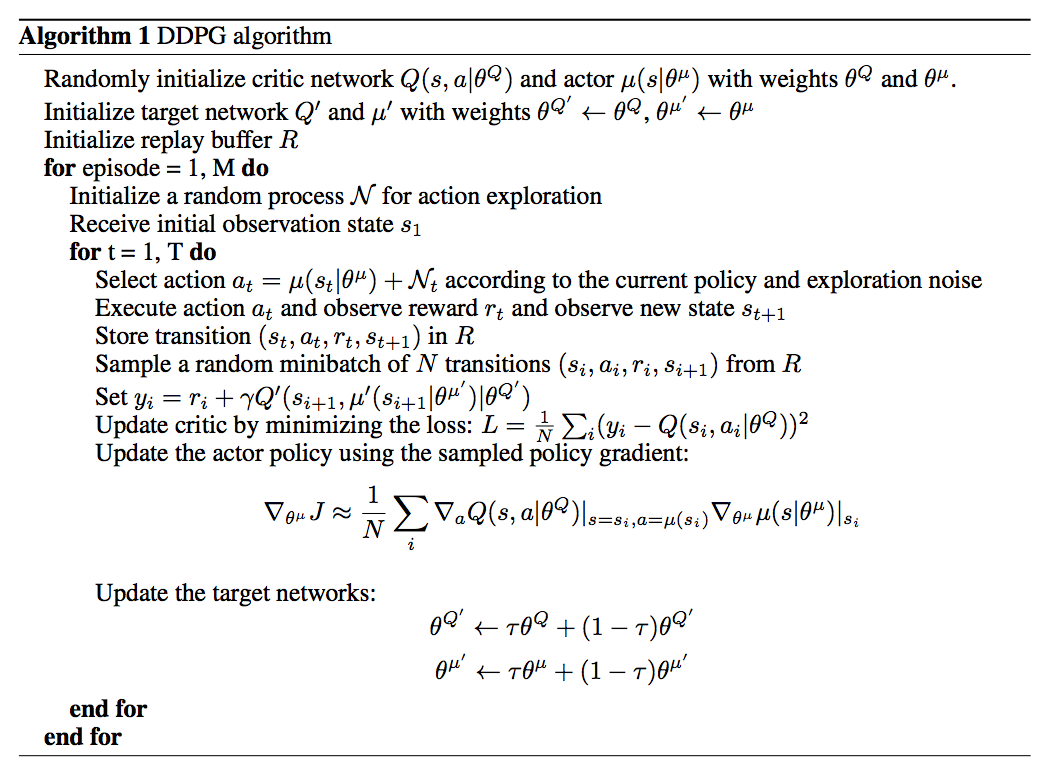
代码实现的gym的pendulum游戏,这个游戏是连续动作的

"""

Deep Deterministic Policy Gradient (DDPG), Reinforcement Learning.

DDPG is Actor Critic based algorithm.

Pendulum example.

View more on my tutorial page: https://morvanzhou.github.io/tutorials/

Using:

tensorflow 1.0

gym 0.8.0

"""

import tensorflow as tf

import numpy as np

import gym

import time

np.random.seed(1)

tf.set_random_seed(1)

#####################  hyper parameters  ####################

MAX_EPISODES = 200

MAX_EP_STEPS = 200

lr_a = 0.001    # learning rate for actor

lr_c = 0.001    # learning rate for critic

gamma = 0.9     # reward discount

REPLACEMENT = [

    dict(name='soft', tau=0.01),

    dict(name='hard', rep_iter_a=600, rep_iter_c=500)

][0]            # you can try different target replacement strategies

MEMORY_CAPACITY = 10000

BATCH_SIZE = 32

RENDER = True

OUTPUT_GRAPH = True

ENV_NAME = 'Pendulum-v0'

###############################  Actor  ####################################

class Actor(object):

    def __init__(self, sess, action_dim, action_bound, learning_rate, replacement):

        self.sess = sess

        self.a_dim = action_dim

        self.action_bound = action_bound

        self.lr = learning_rate

        self.replacement = replacement

        self.t_replace_counter = 0

        with tf.variable_scope('Actor'):

            # 这个网络用于及时更新参数

            # input s, output a

            self.a = self._build_net(S, scope='eval_net', trainable=True)

            ##这个网络不及时更新参数, 用于预测action

            # input s_, output a, get a_ for critic

            self.a_ = self._build_net(S_, scope='target_net', trainable=False)

        self.e_params = tf.get_collection(tf.GraphKeys.GLOBAL_VARIABLES, scope='Actor/eval_net')

        self.t_params = tf.get_collection(tf.GraphKeys.GLOBAL_VARIABLES, scope='Actor/target_net')

        if self.replacement['name'] == 'hard':

            self.t_replace_counter = 0

            self.hard_replace = [tf.assign(t, e) for t, e in zip(self.t_params, self.e_params)]

        else:

            self.soft_replace = [tf.assign(t, (1 - self.replacement['tau']) * t + self.replacement['tau'] * e)

                                 for t, e in zip(self.t_params, self.e_params)]

    def _build_net(self, s, scope, trainable):#根据state预测action的网络

        with tf.variable_scope(scope):

            init_w = tf.random_normal_initializer(0., 0.3)

            init_b = tf.constant_initializer(0.1)

            net = tf.layers.dense(s, 30, activation=tf.nn.relu,

                                  kernel_initializer=init_w, bias_initializer=init_b, name='l1',

                                  trainable=trainable)

            with tf.variable_scope('a'):

                actions = tf.layers.dense(net, self.a_dim, activation=tf.nn.tanh, kernel_initializer=init_w,

                                          bias_initializer=init_b, name='a', trainable=trainable)

                scaled_a = tf.multiply(actions, self.action_bound, name='scaled_a')  # Scale output to -action_bound to action_bound

        return scaled_a

    def learn(self, s):   # batch update

        self.sess.run(self.train_op, feed_dict={S: s})

        if self.replacement['name'] == 'soft':

            self.sess.run(self.soft_replace)

        else:

            if self.t_replace_counter % self.replacement['rep_iter_a'] == 0:

                self.sess.run(self.hard_replace)

            self.t_replace_counter += 1

    def choose_action(self, s):

        s = s[np.newaxis, :]    # single state

        return self.sess.run(self.a, feed_dict={S: s})[0]  # single action

    def add_grad_to_graph(self, a_grads):

        with tf.variable_scope('policy_grads'):

            # ys = policy;

            # xs = policy's parameters;

            # a_grads = the gradients of the policy to get more Q

            # tf.gradients will calculate dys/dxs with a initial gradients for ys, so this is dq/da * da/dparams

            self.policy_grads = tf.gradients(ys=self.a, xs=self.e_params, grad_ys=a_grads)

        with tf.variable_scope('A_train'):

            opt = tf.train.AdamOptimizer(-self.lr)  # (- learning rate) for ascent policy

            self.train_op = opt.apply_gradients(zip(self.policy_grads, self.e_params))#对eval_net的参数更新

###############################  Critic  ####################################

class Critic(object):

    def __init__(self, sess, state_dim, action_dim, learning_rate, gamma, replacement, a, a_):

        self.sess = sess

        self.s_dim = state_dim

        self.a_dim = action_dim

        self.lr = learning_rate

        self.gamma = gamma

        self.replacement = replacement

        with tf.variable_scope('Critic'):

            # Input (s, a), output q

            self.a = tf.stop_gradient(a)    # stop critic update flows to actor

            # 这个网络用于及时更新参数

            self.q = self._build_net(S, self.a, 'eval_net', trainable=True)

            # 这个网络不及时更新参数, 用于评价actor

            # Input (s_, a_), output q_ for q_target

            self.q_ = self._build_net(S_, a_, 'target_net', trainable=False)    # target_q is based on a_ from Actor's target_net

            self.e_params = tf.get_collection(tf.GraphKeys.GLOBAL_VARIABLES, scope='Critic/eval_net')

            self.t_params = tf.get_collection(tf.GraphKeys.GLOBAL_VARIABLES, scope='Critic/target_net')

        with tf.variable_scope('target_q'):

            self.target_q = R + self.gamma * self.q_#target计算

        with tf.variable_scope('TD_error'):

            self.loss = tf.reduce_mean(tf.squared_difference(self.target_q, self.q))#计算loss

        with tf.variable_scope('C_train'):

            self.train_op = tf.train.AdamOptimizer(self.lr).minimize(self.loss)#训练

        with tf.variable_scope('a_grad'):

            self.a_grads = tf.gradients(self.q, a)[0]   # tensor of gradients of each sample (None, a_dim)

        if self.replacement['name'] == 'hard':

            self.t_replace_counter = 0

            self.hard_replacement = [tf.assign(t, e) for t, e in zip(self.t_params, self.e_params)]

        else:

            self.soft_replacement = [tf.assign(t, (1 - self.replacement['tau']) * t + self.replacement['tau'] * e)

                                     for t, e in zip(self.t_params, self.e_params)]

    def _build_net(self, s, a, scope, trainable):#Q网络,计算Q(s,a)

        with tf.variable_scope(scope):

            init_w = tf.random_normal_initializer(0., 0.1)

            init_b = tf.constant_initializer(0.1)

            with tf.variable_scope('l1'):

                n_l1 = 30

                w1_s = tf.get_variable('w1_s', [self.s_dim, n_l1], initializer=init_w, trainable=trainable)

                w1_a = tf.get_variable('w1_a', [self.a_dim, n_l1], initializer=init_w, trainable=trainable)

                b1 = tf.get_variable('b1', [1, n_l1], initializer=init_b, trainable=trainable)

                net = tf.nn.relu(tf.matmul(s, w1_s) + tf.matmul(a, w1_a) + b1)

            with tf.variable_scope('q'):

                q = tf.layers.dense(net, 1, kernel_initializer=init_w, bias_initializer=init_b, trainable=trainable)   # Q(s,a)

        return q

    def learn(self, s, a, r, s_):

        self.sess.run(self.train_op, feed_dict={S: s, self.a: a, R: r, S_: s_})

        if self.replacement['name'] == 'soft':

            self.sess.run(self.soft_replacement)

        else:

            if self.t_replace_counter % self.replacement['rep_iter_c'] == 0:

                self.sess.run(self.hard_replacement)

            self.t_replace_counter += 1

#####################  Memory  ####################

class Memory(object):

    def __init__(self, capacity, dims):

        self.capacity = capacity

        self.data = np.zeros((capacity, dims))

        self.pointer = 0

    def store_transition(self, s, a, r, s_):

        transition = np.hstack((s, a, [r], s_))

        index = self.pointer % self.capacity  # replace the old memory with new memory

        self.data[index, :] = transition

        self.pointer += 1

    def sample(self, n):

        assert self.pointer >= self.capacity, 'Memory has not been fulfilled'

        indices = np.random.choice(self.capacity, size=n)

        return self.data[indices, :]

import pdb; pdb.set_trace()

env = gym.make(ENV_NAME)

env = env.unwrapped

env.seed(1)

state_dim = env.observation_space.shape[0]#

action_dim = env.action_space.shape[0]#1 连续动作,一维

action_bound = env.action_space.high#[2]

# all placeholder for tf

with tf.name_scope('S'):

    S = tf.placeholder(tf.float32, shape=[None, state_dim], name='s')

with tf.name_scope('R'):

    R = tf.placeholder(tf.float32, [None, 1], name='r')

with tf.name_scope('S_'):

    S_ = tf.placeholder(tf.float32, shape=[None, state_dim], name='s_')

sess = tf.Session()

# Create actor and critic.

# They are actually connected to each other, details can be seen in tensorboard or in this picture:

actor = Actor(sess, action_dim, action_bound, lr_a, REPLACEMENT)

critic = Critic(sess, state_dim, action_dim, lr_c, gamma, REPLACEMENT, actor.a, actor.a_)

actor.add_grad_to_graph(critic.a_grads)# # 将 critic 产出的 dQ/da 加入到 Actor 的 Graph 中去

sess.run(tf.global_variables_initializer())

M = Memory(MEMORY_CAPACITY, dims=2 * state_dim + action_dim + 1)

if OUTPUT_GRAPH:

    tf.summary.FileWriter("logs/", sess.graph)

var = 3  # control exploration

t1 = time.time()

for i in range(MAX_EPISODES):

    s = env.reset()

    ep_reward = 0

    for j in range(MAX_EP_STEPS):

        if RENDER:

            env.render()

        # Add exploration noise

        a = actor.choose_action(s)

        a = np.clip(np.random.normal(a, var), -2, 2)    # add randomness to action selection for exploration

        s_, r, done, info = env.step(a)

        M.store_transition(s, a, r / 10, s_)

        if M.pointer > MEMORY_CAPACITY:

            var *= .9995    # decay the action randomness

            b_M = M.sample(BATCH_SIZE)

            b_s = b_M[:, :state_dim]

            b_a = b_M[:, state_dim: state_dim + action_dim]

            b_r = b_M[:, -state_dim - 1: -state_dim]

            b_s_ = b_M[:, -state_dim:]

            critic.learn(b_s, b_a, b_r, b_s_)

            actor.learn(b_s)

        s = s_

        ep_reward += r

        if j == MAX_EP_STEPS-1:

            print('Episode:', i, ' Reward: %i' % int(ep_reward), 'Explore: %.2f' % var, )

            if ep_reward > -300:

                RENDER = True

            break

print('Running time: ', time.time()-t1)
深度增强学习--DDPG的更多相关文章
- 深度增强学习--DPPO
PPO DPPO介绍 PPO实现 代码DPPO
- 深度增强学习--A3C
A3C 它会创建多个并行的环境, 让多个拥有副结构的 agent 同时在这些并行环境上更新主结构中的参数. 并行中的 agent 们互不干扰, 而主结构的参数更新受到副结构提交更新的不连续性干扰, 所 ...
- 深度增强学习--DQN的变形
DQN的变形 double DQN prioritised replay dueling DQN
- 深度增强学习--Actor Critic
Actor Critic value-based和policy-based的结合 实例代码 import sys import gym import pylab import numpy as np ...
- 深度增强学习--Policy Gradient
前面都是value based的方法,现在看一种直接预测动作的方法 Policy Based Policy Gradient 一个介绍 karpathy的博客 一个推导 下面的例子实现的REINFOR ...
- 深度增强学习--Deep Q Network
从这里开始换个游戏演示,cartpole游戏 Deep Q Network 实例代码 import sys import gym import pylab import random import n ...
- 常用增强学习实验环境 II (ViZDoom, Roboschool, TensorFlow Agents, ELF, Coach等) (转载)
原文链接:http://blog.csdn.net/jinzhuojun/article/details/78508203 前段时间Nature上发表的升级版Alpha Go - AlphaGo Ze ...
- 马里奥AI实现方式探索 ——神经网络+增强学习
[TOC] 马里奥AI实现方式探索 --神经网络+增强学习 儿时我们都曾有过一个经典游戏的体验,就是马里奥(顶蘑菇^v^),这次里约奥运会闭幕式,日本作为2020年东京奥运会的东道主,安倍最后也已经典 ...
- 增强学习 | AlphaGo背后的秘密
"敢于尝试,才有突破" 2017年5月27日,当今世界排名第一的中国棋手柯洁与AlphaGo 2.0的三局对战落败.该事件标志着最新的人工智能技术在围棋竞技领域超越了人类智能,借此 ...
随机推荐
- Django web框架之权限管理二
1. login登录 def login(request): if request.method=="GET": return render(request,'login.html ...
- jpa缓存导致无法查询到更新后的数据&android出现ANR的一个解决办法
1. 向服务器更新记录后查询,始终查询不到更新后的信息 只能查到更新之前的,马上推断出是缓存的问题.网上搜索一番,将问题定位为jpa缓存,我们要设置jpa查询时不从缓存中取,直接从数据库中取,这样便能 ...
- BZOJ1898: [Zjoi2004]Swamp 沼泽鳄鱼
1898: [Zjoi2004]Swamp 沼泽鳄鱼 Time Limit: 5 Sec Memory Limit: 64 MBSubmit: 478 Solved: 286[Submit][St ...
- Flexigrid默认是可以选择多行
1.Flexigrid默认是可以选择多行,那么如何设置其只能选一行呢?今天看了看Flexigrid的源码,发现有个属性可以控制: $(this).click(function (e) { var ob ...
- 【ASP.NET MVC】 路由机制:命名路由
首先看一下命名路由和没有命名的差别: 命名路由: routes.MapRoute( name: "Test", // Route name url: "code/p/{a ...
- python中文转换url编码
今天要处理百度贴吧的东西.想要做一个关键词的list,每次需要时,直接添加 到list里面就可以了.但是添加到list里面是中文的情况(比如‘丽江’),url的地址编码却是’%E4%B8%BD%E6% ...
- HDU3487 Play With Chain [Splay]
题目传送门 题目描述 Problem Description YaoYao is fond of playing his chains. He has a chain containing n dia ...
- go chapter 8 - 初始化对象
http://blog.haohtml.com/archives/14239 struct定义的属性如果是小写开头的,那么该属性不是public的,不能跨包调用 (implicit assignmen ...
- maven "Generating project in Batch mode"问题的解决
在maven的五分钟入门里面,有这样一个命令: mvn archetype:generate -DgroupId=com.mycompany.app -DartifactId=my-app -Darc ...
- 洛谷——P1346 电车
P1346 电车 题目描述 在一个神奇的小镇上有着一个特别的电车网络,它由一些路口和轨道组成,每个路口都连接着若干个轨道,每个轨道都通向一个路口(不排除有的观光轨道转一圈后返回路口的可能).在每个路口 ...