
Morley's Theorem (计算几何基础+向量点积、叉积、旋转、夹角等+两直线的交点)
题目链接:https://uva.onlinejudge.org/index.php?option=com_onlinejudge&Itemid=8&page=show_problem&problem=2119
题面:Morleys theorem states that that the lines trisecting the angles of an arbitrary plane triangle meet at the vertices of an equilateral triangle. For example in the figure below the tri-sectors of angles A, B and C has intersected and created an equilateral triangle DEF. Of course the theorem has various generalizations, in particular if all of the trisectors are intersected one obtains four other equilateral triangles. But in the original theorem only tri-sectors nearest to BC are allowed to intersect to get point D, tri-sectors nearest to CA are allowed to intersect point E and tri-sectors nearest to AB are intersected to get point F. Trisector like BD and CE are not allowed to intersect. So ultimately we get only one equilateral triangle DEF. Now your task is to find the Cartesian coordinates of D, E and F given the coordinates of A, B, and C.
Input
First line of the input file contains an integer N (0 < N < 5001) which denotes the number of test cases to follow. Each of the next lines contain six integers XA,YA,XB,YB,XC,YC. This six integers actually indicates that the Cartesian coordinates of point A, B and C are (XA,YA),(XB,YB) and (XC,YC) respectively. You can assume that the area of triangle ABC is not equal to zero, 0 ≤ XA,YA,XB,YB,XC,YC ≤ 1000 and the points A, B and C are in counter clockwise order.
Output
For each line of input you should produce one line of output. This line contains six floating point numbers XD,YD,XE,YE,XF,YF separated by a single space. These six floating-point actually means that the Cartesian coordinates of D, E and F are (XD,YD),(XE,YE) ,(XF,YF) respectively. Errors less than 10−5 will be accepted.
Sample Input
2
1 1 2 2 1 2
0 0 100 0 50 50
Sample Output
1.316987 1.816987 1.183013 1.683013 1.366025 1.633975
56.698730 25.000000 43.301270 25.000000 50.000000 13.397460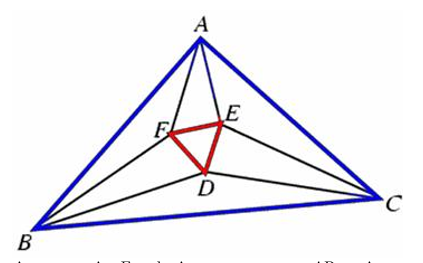
思路:本题为一道比较简单的计算几何入门题,运用了很多的计算几何知识,不过只要想通如何求DEF的话,就只需通过套用模板即可解决
代码实现如下:
 #include <cstdio>

 #include <cmath>

 using namespace std;

 struct Point{

     double x,y;

     Point(double x = , double y = ) : x(x), y(y) {}

 };

 typedef Point Vector;

 int t;

 Point A, B, C, D, E, F;

 Vector operator + (Vector A, Vector B){

     return Vector(A.x + B.x, A.y + B.y);

 }

 Vector operator - (Vector A, Vector B){

     return Vector(A.x - B.x, A.y - B.y);

 }

 Vector operator * (Vector A, double p){

     return Vector(A.x * p, A.y * p);

 }

 Vector operator / (Vector A, double p){

     return Vector(A.x / p, A.y / p);

 }

 double Dot(Vector A, Vector B){

     return A.x * B.x + A.y * B.y;

 }

 double Length(Vector A){

     return sqrt(Dot(A, A));

 }

 double Angle(Vector A, Vector B){

     return acos(Dot(A, B) / Length(A) / Length(B));

 }

 Vector Rotate(Vector A, double rad){

     return Vector(A.x * cos(rad) - A.y * sin(rad), A.x * sin(rad) + A.y * cos(rad));

 }

 double Cross(Vector A, Vector B){

     return A.x * B.y - A.y * B.x;

 }

 Point GetLineIntersection(Point P, Vector v, Point Q, Vector w){

     Vector u = P - Q;

     double t = Cross(w, u) / Cross(v, w);

     return P + v * t;

 }

 Point GetD(Point A, Point B, Point C){

     Vector v1 = C - B;

     double a1 = Angle((A - B), v1);

     v1 = Rotate(v1, a1 / );

     Vector v2 = B - C;

     double a2 = Angle((A - C), v2);

     v2 = Rotate(v2, -a2 / );

     return GetLineIntersection(B, v1, C, v2);

 }

 int main(){

     scanf("%d", &t);

     while(t--){

         scanf("%lf%lf%lf%lf%lf%lf", &A.x, &A.y, &B.x, &B.y, &C.x, &C.y);

         D = GetD(A, B, C);

         E = GetD(B, C, A);

         F = GetD(C, A, B);

         printf("%.6f %.6f %.6f %.6f %.6f %.6f\n", D.x, D.y, E.x, E.y, F.x, F.y);

     }

 }
Morley's Theorem (计算几何基础+向量点积、叉积、旋转、夹角等+两直线的交点)的更多相关文章
- 51nod--1265 四点共面 (计算几何基础, 点积, 叉积)
题目: 1265 四点共面 基准时间限制:1 秒 空间限制:131072 KB 分值: 0 难度:基础题 收藏 关注 给出三维空间上的四个点(点与点的位置均不相同),判断这4个点是否在同一个平面内(4 ...
- Uva 11178 Morley's Theorem 向量旋转+求直线交点
http://uva.onlinejudge.org/index.php?option=com_onlinejudge&Itemid=9 题意: Morlery定理是这样的:作三角形ABC每个 ...
- UVA_11178_Morley's_Theorem_(计算几何基础)
描述 https://uva.onlinejudge.org/index.php?option=com_onlinejudge&Itemid=8&category=23&pag ...
- uva 11178二维几何(点与直线、点积叉积)
Problem D Morley’s Theorem Input: Standard Input Output: Standard Output Morley’s theorem states tha ...
- AC日记——向量点积计算 openjudge 1.6 09
09:向量点积计算 总时间限制: 1000ms 内存限制: 65536kB 描述 在线性代数.计算几何中,向量点积是一种十分重要的运算. 给定两个n维向量a=(a1,a2,...,an)和b=(b ...
- UVa 11178:Morley’s Theorem(两射线交点)
Problem DMorley’s TheoremInput: Standard Input Output: Standard Output Morley’s theorem states that ...
- UVA 11178 Morley's Theorem(几何)
Morley's Theorem [题目链接]Morley's Theorem [题目类型]几何 &题解: 蓝书P259 简单的几何模拟,但要熟练的应用模板,还有注意模板的适用范围和传参不要传 ...
- SAM4E单片机之旅——24、使用DSP库求向量数量积
DSP(Digital Signal Processing,数字信号处理)中会使用大量的数学运算.Cortex-M4中,配置了一些强大的部件,以提高DSP能力.同时CMSIS提供了一个DSP库,提供了 ...
- uva11178 Morley’s Theorem(求三角形的角三分线围成三角形的点)
Morley’s Theorem Input: Standard Input Output: Standard Output Morley’s theorem states that that the ...
随机推荐
- iOS- 用UICollectionViewController 来进行横竖屏九宫格布局
1.简单说说UICollectionViewController 我们在做九宫格布局时,可以使用UIScrollView,也可以使用UICollectionViewController. 当我们用UI ...
- netem设置了网卡的流量控制,为啥发包的延迟就搞不定呢?
为啥我用netem做了一个流量的控制 但是发送的时候,感觉真正发送数据的时候还是没有达到每一个数据包都是1s的延迟呀,这里的1s的延迟是啥意思啊? 这里的delay并不是说每个数据包都delay 5s ...
- 使用dom4j修改XML格式的字符串
XML格式 <data> <ryzd> <record> <western> <record> <diagnoses> < ...
- hdu 1528 Card Game Cheater (二分匹配)
Card Game Cheater Time Limit: 2000/1000 MS (Java/Others) Memory Limit: 65536/32768 K (Java/Others ...
- Codeforces Gym 101142 G Gangsters in Central City (lca+dfs序+树状数组+set)
题意: 树的根节点为水源,编号为 1 .给定编号为 2, 3, 4, …, n 的点的父节点.已知只有叶子节点都是房子. 有 q 个操作,每个操作可以是下列两者之一: + v ,表示编号为 v 的房子 ...
- Dom选择器以及内容文本操作
1. DOM:文档对象模型.把整个HTML当做大的对象.每一个标签认为是一个对象.(每一个个体就是一个对象) 2. 查找: 直接查找 var obj=document.getElementById(& ...
- MySQL中数据表的基本操纵
本文基于对国家863中部软件孵化器编著的<MySQL从入门到精通>一书的操作实践. 一.创建数据表 数据表属于数据库,在创建数据表之前,应该使用语句 USE 数据库名 指定操作是在那个 ...
- NOIP2015Day2T2子串(字符串dp)
又被“if(a=b)”坑了QAQ...写C++还是得开Warning,这么久了pascal还没改过来咋回事啊QWQ 题目大意就不说了OWO 网上的题解都不怎么看得懂啊...好像写得都很乱?还是我太sb ...
- Nginx 配置解析
概述:本篇文章主要对Nginx配置文件中一些常用配置进行了讲解,和如何使用Docker进行安装Nginx.因为该文章是回首在工作闲暇之余整理的,还有待完善,如果有疑义和更好的建议的朋友可以留言给我. ...
- MyBatis子查询
一.父查询BaseChildResultMap: <?xml version="1.0" encoding="UTF-8" ?> <!DOCT ...