https://mp.weixin.qq.com/s/afRVgTCYs1Mxu898uSmVaQ
整理一篇介绍Diplomacy和TileLink的文章。
0. ABSTRACT
Modern systems-on-chip (SoCs) incorporate a large and growing number of specialized hardware units that must be integrated into a unified address space via a shared bus topology.
This process is labor-intensive and error-prone because the interface requirements of all connected blocks must be mutually satisfied.
The design productivity gains derived from the modularity of RISC-V are bottlenecked by the need to integrate the cross product of processor variants, bus ordering behaviors, and slave device capabilities.
This growing complexity has stimulated development of new tools and methodologies to enable the completion of complex and parameterized SoC designs.
We present two tools used to create correct-by-construction interconnects in the Rocket Chip generator:
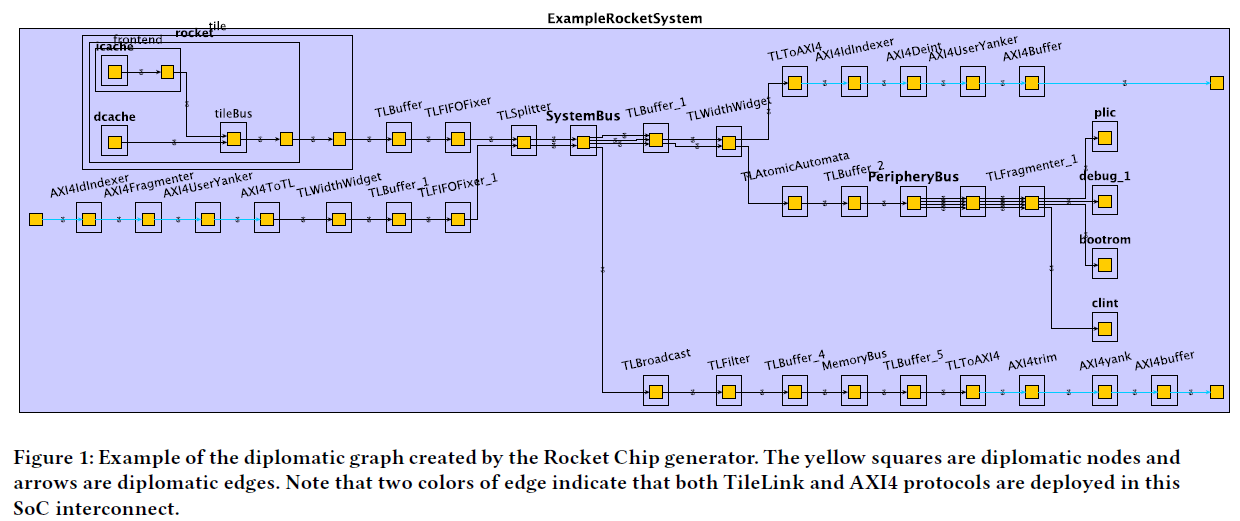
Diplomacy is a parameter negotiation framework for generating parameterized protocol implementations. Beyond confirming the mutual compatibility of the system endpoints, Diplomacy enables them to specialize themselves based on knowledge of the other endpoints included in a particular system.
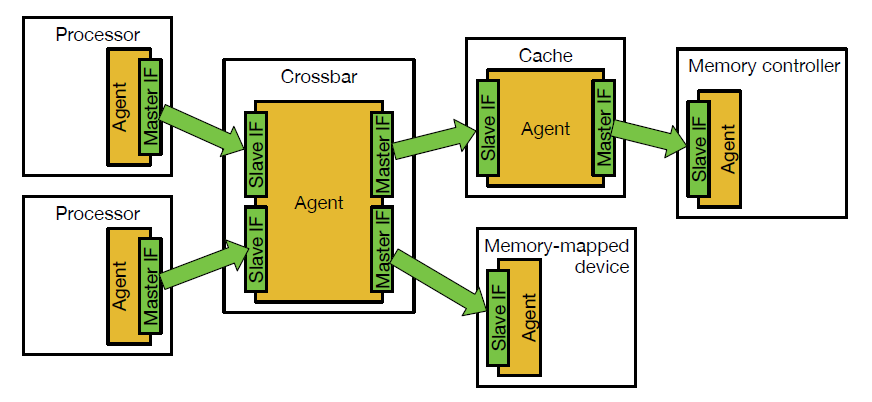
TileLink is a highly-parameterized chip-scale shared-memory interconnect standard. The implementation of TileLink in the Rocket chip generator exploits Diplomacy to specialize the interconnect to different levels of protocol conformance.
1. INTRODUCTION
Modern systems-on-chip (SoCs) incorporate an ever-growing number of hardware units specialized to perform particular computational tasks. In order to communicate with one another and memory, these diverse compute resources must be integrated into a shared interconnection network. Such a network typically consists of a hierarchical topology of buses that provide the compute engines with a shared global address space.
The process of creating such interconnects is labor-intensive and error-prone because the interface requirements of all connected blocks must be mutually satisfied.
The design productivity gains derived from the modularity of RISCV are bottlenecked by the need to integrate the cross product of processor variants, bus ordering behaviors, and slave device capabilities. This growing complexity has stimulated development of new tools and methodologies to enable the completion of complex and parameterized chip designs [8].
We present two tools used to create provably-correct interconnects in the Rocket Chip SoC generator [1].
Our approach is centered around first constructing a graphical model of the properties
of the proposed interconnect design, and then using this model to reason as to whether the solution provides all required functionality and will exhibit correct behavior.
"Correct" in this case means (a)the generated design will be free from protocol-level deadlock, (b)is guaranteed to make forward progress, and that (c)the cross-product of masters' and slaves' operational requirements is satisfied.
Diplomacy is a framework for negotiating the parameterization of protocol implementations.
Given (a)a description of sets of interconnected master and slave devices, and (b)a bus protocol template,
Diplomacy cross-checks the requirements of all connected devices, negotiates free parameters, and supplies final parameter bindings to adapters and endpoints for use in their own hardware generation processes.
Beyond confirming the mutual compatibility of the system endpoints, Diplomacy enables them to specialize themselves based on knowledge about the capabilities of other endpoints included in a particular system.
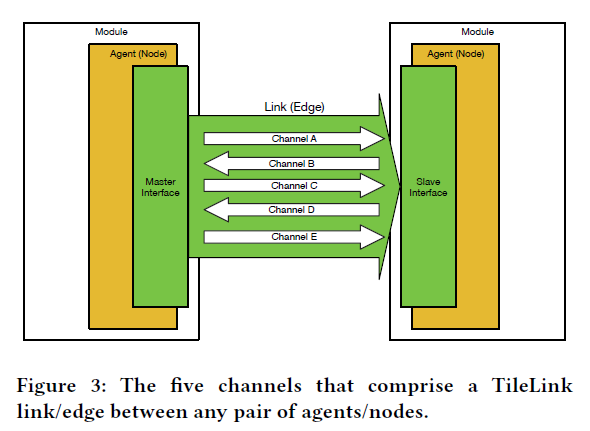
TileLink is a highly-parameterized chip-scale shared-memory interconnect protocol standard [5].
The protocol is hierarchically composable and guaranteed to deadlock-free at the transaction level[9]. The implementation of TileLink in the Rocket Chip generator exploits Diplomacy to supply a heterogeneous level of protocol conformance across the interconnect, specialized for the capabilities of devices connected to certain buses.
This paper discusses how various features of diplomatic TileLink have guided the design patterns we have adopted in the Rocket Chip generator.
(a)We avoid manually specifying any protocol parameters that can be inferred from a declarative description of the system interconnection network graph.
(b)We parameterize our generators to emit hardware based on their view of the rest of the system.
(c)We deploy a set of graph transformation patterns that make it easy to re-time links by inserting queues, that comprise thin single-purpose adapters, and that safely create hierarchies of interoperable components.
2. DIPLOMACY
3. TILELINK
4. DESIGN PATTERNS
4.1 DRYing Out Parameterization
4.2 Hardware Generation with A View
4.3 Correct By Composition
5. CONCLUSION
In this paper we have discussed how various features of diplomatic TileLink have guided the design patterns adopted in the Rocket Chip generator.
We avoid re-specifying any parameters that can be inferred from a declarative description of the system interconnect graph.
We parameterize our generators to emit hardware based on a diplomatically negotiated view of the system.
We deploy a set of safe graph transformation patterns that make it easy to re-time
links with queues, that compose more complicated adapters from single-purpose ones, and that inject hierarchies of composable components at standardized attachment points.
We see many forthcoming opportunities to deploy correct-by-construction
software development methods to other aspects of SoC hardware component integration.
Clock domains are one area where each mixed-in component could specify how it relates to the overall interconnect graph, and the correct clock and reset would be supplied to the second phase elaboration automatically.
Interrupts are another type of signal where we would like to avoid any explicit notion of cardinality and instead infer it from graphical structure.
Finally, we are working to develop endpoint generators that are protocol-independent, presenting generator authors with standard APIs that allow their device to be deployed regardless of the underlying interconnect protocol.
The Rocket Chip code base containing Diplomacy itself, all of our diplomatic bus protocol implementations, and a variety of TileLink-compatible cache, interconnect, and device generators, is open source and available as part of the Free Chips Project at
6. REFERENCES
略
- Rocket - 断句 - Diplomacy and TileLink from the Rocket Chip
https://mp.weixin.qq.com/s/rfgptF9YxDpzDoespYtQvA 整理Diplomacy and TileLink from the Rocket Chip这篇文 ...
- Head First Design Patterns
From Head First Design Patterns. Design Principle: Idnetify the aspects of your application that var ...
- 设计模式(Design Patterns)Java版
设计模式(Design Patterns) ——可复用面向对象软件的基础 设计模式(Design pattern)是一套被反复使用.多数人知晓的.经过分类编目的.代码设计经验的总结.使用设计模式是为了 ...
- java Design Patterns
设计模式(Design Patterns) ——可复用面向对象软件的基础 设计模式(Design pattern)是一套被反复使用.多数人知晓的.经过分类编目的.代码设计经验的总结.使用设计模式是为了 ...
- Java基础学习总结(37)——Java23中设计模式(Design Patterns)详解
设计模式(Design Patterns) --可复用面向对象软件的基础 设计模式(Design pattern)是一套被反复使用.多数人知晓的.经过分类编目的.代码设计经验的总结.使用设计模式是为了 ...
- 图书-软件架构:《Design Patterns: Elements of Reusable Object-Oriented Software》(即后述《设计模式》一书)
ylbtech-图书-软件架构:<Design Patterns: Elements of Reusable Object-Oriented Software>(即后述<设计模式&g ...
- Design Patterns Simplified - Part 3 (Simple Factory)【设计模式简述--第三部分(简单工厂)】
原文链接:http://www.c-sharpcorner.com/UploadFile/19b1bd/design-patterns-simplified-part3-factory/ Design ...
- word-break|overflow-wrap|word-wrap——CSS英文断句浅析
---恢复内容开始--- word-break|overflow-wrap|word-wrap--CSS英文断句浅析 一 问题引入 今天在再次学习 overflow 属性的时候,查看效果时,看到如下结 ...
- Design Patterns Simplified - Part 2 (Singleton)【设计模式简述--第二部分(单例模式)】
原文链接: http://www.c-sharpcorner.com/UploadFile/19b1bd/design-patterns-simplified-part-2-singleton/ De ...
随机推荐
- C. Okabe and Boxes 思维 模拟 or 线段树
C. Okabe and Boxes 这个题目是一个有点思维的模拟,当时没有想到, 思维就是这个栈的排序这里,因为每次直接排序肯定会t的,所以不可以这么写,那怎么表示排序呢? 就是直接把栈清空,如果栈 ...
- python2执行程序报错:NameError: name 'y' is not defined
然后运行一直报错 这个错误,是由于版本不同造成的语法错误,在python3中,输入可以使用input,但如果你的版本是python2,那么此时input就得改成raw_input,否则你输入数据会被当 ...
- Coursera课程笔记----P4E.Capstone----Week 2&3
Building a Search Engine(week 2&3) Search Engine Architecture Web Crawling Index Building Search ...
- Mysql常用sql语句(14)- 多表查询
测试必备的Mysql常用sql语句,每天敲一篇,每次敲三遍,每月一循环,全都可记住!! https://www.cnblogs.com/poloyy/category/1683347.html 前言 ...
- [hdu4763]next数组的应用
http://acm.hdu.edu.cn/showproblem.php?pid=4763 题目大意:给一个字符串,判断是否可以写成ABACA,B.C表示长度大于等于0的字符串. 方法:ans = ...
- [hdu4598]二分图判定,差分约束
题意: 给一个图,问能否给每个点分配一个实数值,使得存在一个数实数T,所有点满足:|value(i)| < T 且 u,v之间有边<=> |value(u)-value(v)| &g ...
- mysql查询日期分组,不存在的补全0,做每天数据图表,根据日期,N天数往前查
SELECT IFNULL( DATA.count, 0 ) AS count, day_list.DAY AS createTime FROM ( SELECT DATE_FORMAT( creat ...
- JS中各种变量类型在条件判断为false的情况
var a = undefined; ->false var a = 0; ->false var a = 0.0; ->false var a = NaN; ->false ...
- 手把手numpy教程【二】——数组与切片
本文始发于个人公众号:TechFlow,原创不易,求个关注 今天是Numpy专题的第二篇,我们来进入正题,来看看Numpy的运算. 上一篇文章当中曾经提到过,同样大小的数据,使用Numpy的运算速度会 ...
- Detect operating system [zabbix]
zabbix 默认会有3个script功能,分别是Detect operating system ,ping ,traceroute ,都比较好用.默认安装完毕需要做一些修改才能正常使用. 1.tra ...
