
《DSP using MATLAB》Problem 5.19

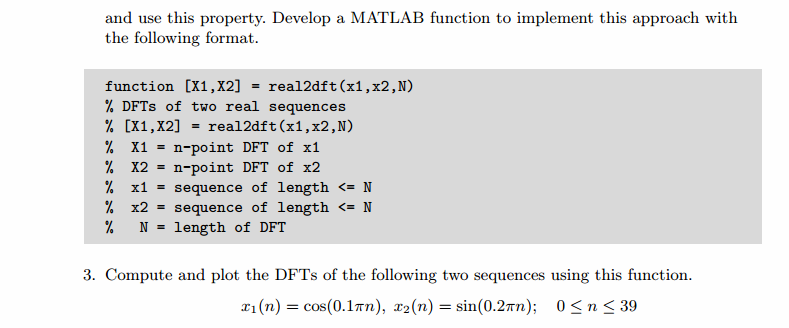
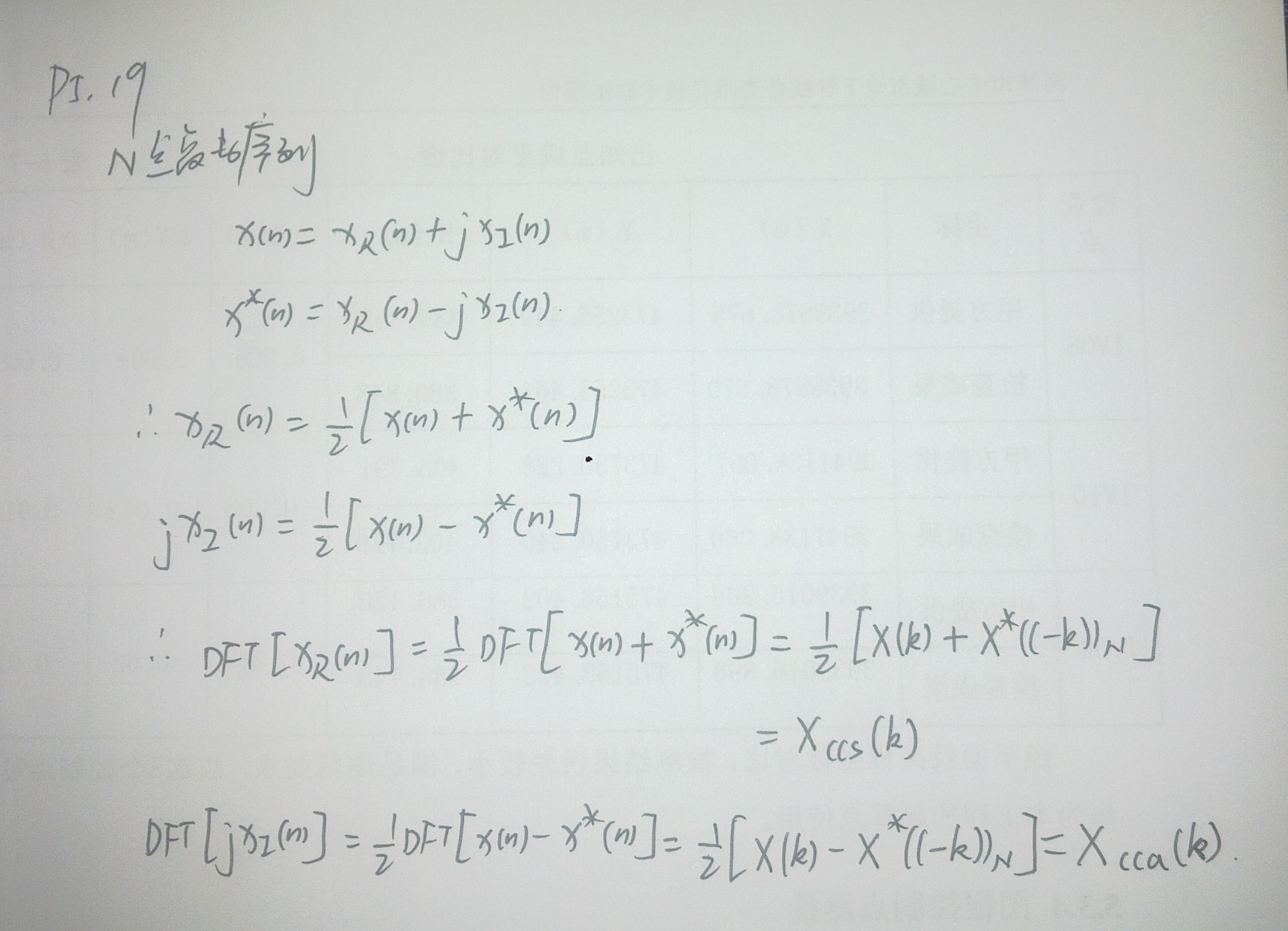
代码:
function [X1k, X2k] = real2dft(x1, x2, N)

    %% ---------------------------------------------------------------------

	%%    DFT of two Real-Valued N-Point sequence x1(n) and x2(n)

	%% ---------------------------------------------------------------------

	%% [X1, X2] = real2dft(x1, x2, N)

	%%      X1k = n-point DFT of x1

	%%      X2k = n-point DFT of x2

	%%       x1 = sequence of length <= N

	%%       x2 = sequence of length <= N

	%%       N  = length of DFT

	% ----------------------------------------

	%    if length of x1 and x2 < N,

	%       then padding zeros

	% ----------------------------------------

	if ( length(x1) < N)

		x1 = [x1 zeros(1, N-length(x1))];

    end

	if ( length(x2) < N)

		x2 = [x2 zeros(1, N-length(x2))];

    end

	x = x1 + j * x2;

	N = length(x); k = 0:(N-1);

    Xk_DFT = dft(x, N);

    Xk_DFT_fold = Xk_DFT(mod_1(-k,N)+1);

    Xk_CCS = 0.5*(Xk_DFT + conj(Xk_DFT_fold));

    Xk_CCA = 0.5*(Xk_DFT - conj(Xk_DFT_fold));

	X1k = Xk_CCS;

	X2k = Xk_CCA;
%% ++++++++++++++++++++++++++++++++++++++++++++++++++++++++++++++++++++++++++++++++++++++++

%%            Output Info about this m-file

fprintf('\n***********************************************************\n');

fprintf('        <DSP using MATLAB> Problem 5.19 \n\n');

banner();

%% ++++++++++++++++++++++++++++++++++++++++++++++++++++++++++++++++++++++++++++++++++++++++

% ---------------------------------------------------------------------------------

%          X(k) is N-point DFTs of N-point Complex-valued sequence x(n)

%               x(n) = xR(n) + j xI(n)

%            xR(n) and xI(n) are real and image parts of x(n);

%            DFT[xR]=Xccs(k)   DFT[j*xI]=Xcca(k)

%

%            Xccs = 0.5*[X(k)+ X*((-k))]      Xcca = 0.5*[X(k) - X*((-k))]

%

% ---------------------------------------------------------------------------------

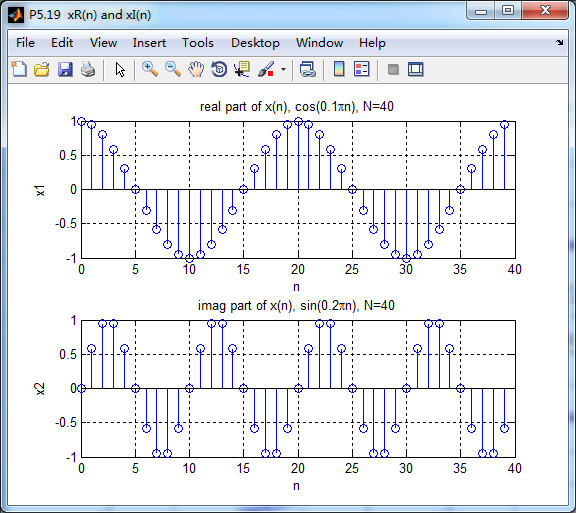
 n = [0:39];

x1 = cos(0.1*pi*n);                 % N=40 real-valued sequence

x2 = sin(0.2*pi*n);                 % N=40 real-valued sequence

x = x1 + j * x2;

N = length(x); k = 0:(N-1);

    Xk_DFT = dft(x, N);

    Xk_DFT_fold = Xk_DFT(mod_1(-k,N)+1);

    magXk_DFT = abs( [ Xk_DFT ] );                                    % DFT magnitude

    angXk_DFT = angle( [Xk_DFT] )/pi;                                 % DFT angle

   realXk_DFT = real(Xk_DFT);

   imagXk_DFT = imag(Xk_DFT);

    magXk_DFT_fold = abs( [ Xk_DFT_fold ] );                                    % DFT magnitude

    angXk_DFT_fold = angle( [Xk_DFT_fold] )/pi;                                 % DFT angle

   realXk_DFT_fold = real(Xk_DFT_fold);

   imagXk_DFT_fold = imag(Xk_DFT_fold);

% --------------------------------------------------------

%        Calculater one N-point DFT to get

%                two N-point DFT

% --------------------------------------------------------

[X1k_DFT, X2k_DFT] = real2dft(x1, x2, N);

    magX1k_DFT = abs( [ X1k_DFT ] );                                    % DFT magnitude

    angX1k_DFT = angle( [X1k_DFT] )/pi;                                 % DFT angle

   realX1k_DFT = real(X1k_DFT);

   imagX1k_DFT = imag(X1k_DFT);

    magX2k_DFT = abs( [ X2k_DFT ] );                                    % DFT magnitude

    angX2k_DFT = angle( [X2k_DFT] )/pi;                                 % DFT angle

   realX2k_DFT = real(X2k_DFT);

   imagX2k_DFT = imag(X2k_DFT);

% -------------------------------------------------------

%         Get DFT of xR and xI directorly

% -------------------------------------------------------

XRk_DFT = dft(x1, N);

XIk_DFT = dft(j*x2, N);

    magXRk_DFT = abs( [ XRk_DFT ] );                                    % DFT magnitude

    angXRk_DFT = angle( [XRk_DFT] )/pi;                                 % DFT angle

   realXRk_DFT = real(XRk_DFT);

   imagXRk_DFT = imag(XRk_DFT);

    magXIk_DFT = abs( [ XIk_DFT ] );                                    % DFT magnitude

    angXIk_DFT = angle( [XIk_DFT] )/pi;                                 % DFT angle

   realXIk_DFT = real(XIk_DFT);

   imagXIk_DFT = imag(XIk_DFT);

figure('NumberTitle', 'off', 'Name', 'P5.19  xR(n) and xI(n)')

set(gcf,'Color','white');

subplot(2,1,1); stem(n, x1);

xlabel('n'); ylabel('x1');

title('real part of x(n), cos(0.1\pin), N=40');  grid on;

subplot(2,1,2); stem(n, x2);

xlabel('n'); ylabel('x2');

title('imag part of x(n), sin(0.2\pin), N=40');  grid on;

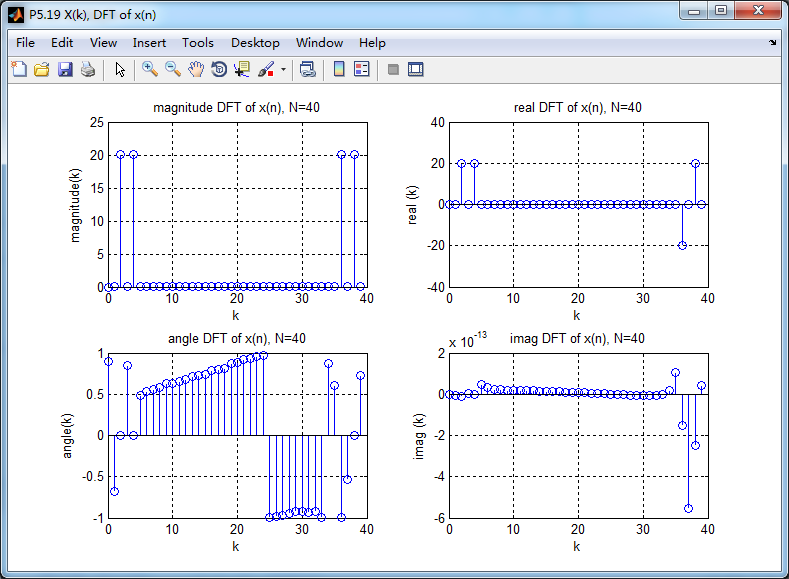
figure('NumberTitle', 'off', 'Name', 'P5.19 X(k), DFT of x(n)')

set(gcf,'Color','white');

subplot(2,2,1); stem(k, magXk_DFT);

xlabel('k'); ylabel('magnitude(k)');

title('magnitude DFT of x(n), N=40');  grid on;

subplot(2,2,3); stem(k, angXk_DFT);

%axis([-N/2, N/2, -0.5, 50.5]);

xlabel('k'); ylabel('angle(k)');

title('angle DFT of x(n), N=40');  grid on;

subplot(2,2,2); stem(k, realXk_DFT);

xlabel('k'); ylabel('real (k)');

title('real DFT of x(n), N=40');  grid on;

subplot(2,2,4); stem(k, imagXk_DFT);

%axis([-N/2, N/2, -0.5, 50.5]);

xlabel('k'); ylabel('imag (k)');

title('imag DFT of x(n), N=40');  grid on;

figure('NumberTitle', 'off', 'Name', 'P5.19 X((-k))_N')

set(gcf,'Color','white');

subplot(2,2,1); stem(k, magXk_DFT_fold);

xlabel('k'); ylabel('magnitude(k)');

title('magnitude X((-k)), N=40');  grid on;

subplot(2,2,3); stem(k, angXk_DFT_fold);

%axis([-N/2, N/2, -0.5, 50.5]);

xlabel('k'); ylabel('angle(k)');

title('angle X((-k)), N=40');  grid on;

subplot(2,2,2); stem(k, realXk_DFT_fold);

xlabel('k'); ylabel('real (k)');

title('real X((-k)), N=40');  grid on;

subplot(2,2,4); stem(k, imagXk_DFT_fold);

%axis([-N/2, N/2, -0.5, 50.5]);

xlabel('k'); ylabel('imag (k)');

title('imag X((-k)), N=40');  grid on;

figure('NumberTitle', 'off', 'Name', 'P5.19 X1(k) by real2dft')

set(gcf,'Color','white');

subplot(2,2,1); stem(k, magX1k_DFT);

xlabel('k'); ylabel('magnitude(k)');

title('magnitude, N=40');  grid on;

subplot(2,2,3); stem(k, angX1k_DFT);

%axis([-N/2, N/2, -0.5, 50.5]);

xlabel('k'); ylabel('angle(k)');

title('angle, N=40');  grid on;

subplot(2,2,2); stem(k, realX1k_DFT);

xlabel('k'); ylabel('real (k)');

title('real, N=40');  grid on;

subplot(2,2,4); stem(k, imagX1k_DFT);

%axis([-N/2, N/2, -0.5, 50.5]);

xlabel('k'); ylabel('imag (k)');

title('imag, N=40');  grid on;

figure('NumberTitle', 'off', 'Name', 'P5.19 X2(k) by real2dft')

set(gcf,'Color','white');

subplot(2,2,1); stem(k, magX2k_DFT);

xlabel('k'); ylabel('magnitude(k)');

title('magnitude, N=40');  grid on;

subplot(2,2,3); stem(k, angX2k_DFT);

%axis([-N/2, N/2, -0.5, 50.5]);

xlabel('k'); ylabel('angle(k)');

title('angle, N=40');  grid on;

subplot(2,2,2); stem(k, realX2k_DFT);

xlabel('k'); ylabel('real (k)');

title('real, N=40');  grid on;

subplot(2,2,4); stem(k, imagX2k_DFT);

%axis([-N/2, N/2, -0.5, 50.5]);

xlabel('k'); ylabel('imag (k)');

title('imag, N=40');  grid on;

figure('NumberTitle', 'off', 'Name', 'P5.19 XR(k) by direct')

set(gcf,'Color','white');

subplot(2,2,1); stem(k, magXRk_DFT);

xlabel('k'); ylabel('magnitude(k)');

title('magnitude, N=40');  grid on;

subplot(2,2,3); stem(k, angXRk_DFT);

%axis([-N/2, N/2, -0.5, 50.5]);

xlabel('k'); ylabel('angle(k)');

title('angle, N=40');  grid on;

subplot(2,2,2); stem(k, realXRk_DFT);

xlabel('k'); ylabel('real (k)');

title('real, N=40');  grid on;

subplot(2,2,4); stem(k, imagXRk_DFT);

%axis([-N/2, N/2, -0.5, 50.5]);

xlabel('k'); ylabel('imag (k)');

title('imag, N=40');  grid on;

figure('NumberTitle', 'off', 'Name', 'P5.19 XI(k) by direct')

set(gcf,'Color','white');

subplot(2,2,1); stem(k, magXIk_DFT);

xlabel('k'); ylabel('magnitude(k)');

title('magnitude, N=40');  grid on;

subplot(2,2,3); stem(k, angXIk_DFT);

%axis([-N/2, N/2, -0.5, 50.5]);

xlabel('k'); ylabel('angle(k)');

title('angle, N=40');  grid on;

subplot(2,2,2); stem(k, realXIk_DFT);

xlabel('k'); ylabel('real (k)');

title('real, N=40');  grid on;

subplot(2,2,4); stem(k, imagXIk_DFT);

%axis([-N/2, N/2, -0.5, 50.5]);

xlabel('k'); ylabel('imag (k)');

title('imag, N=40');  grid on;
运行结果:
复数序列的实部和虚部
复数序列的DFT,X(k)
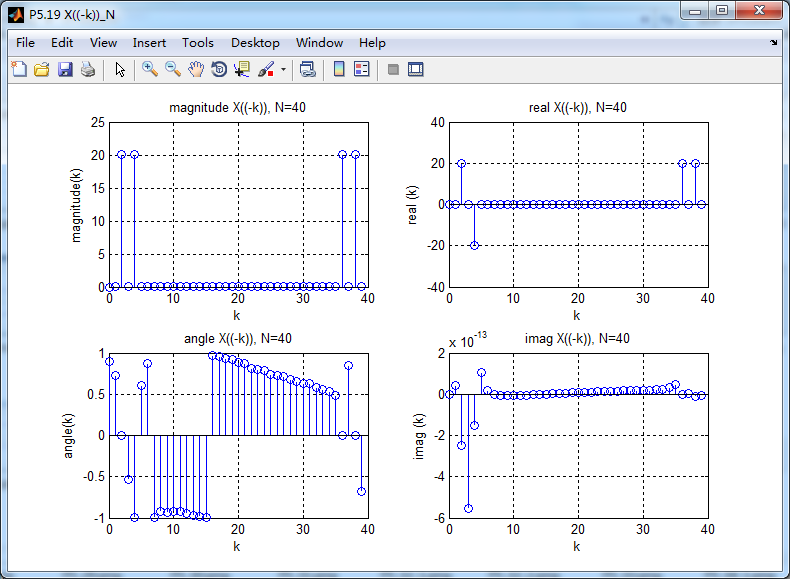
X((-k))
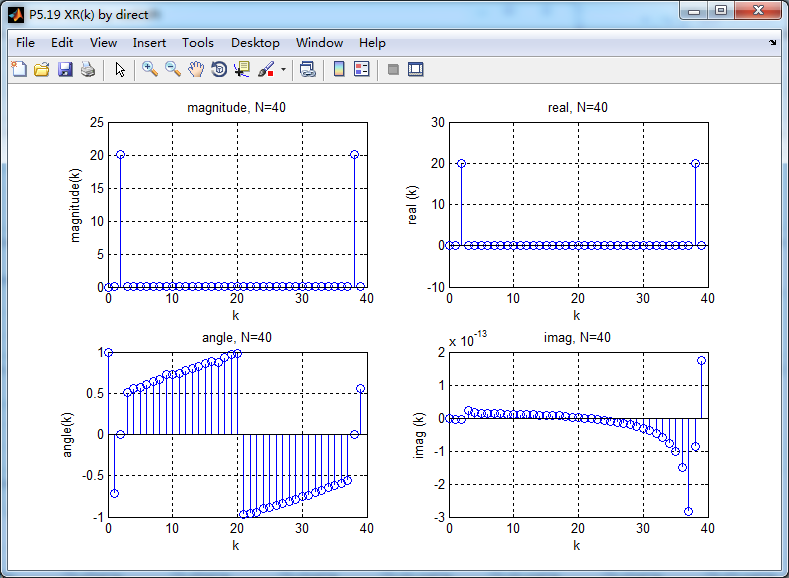
直接计算实部和虚部的DFT,XR(k)和XI(k)

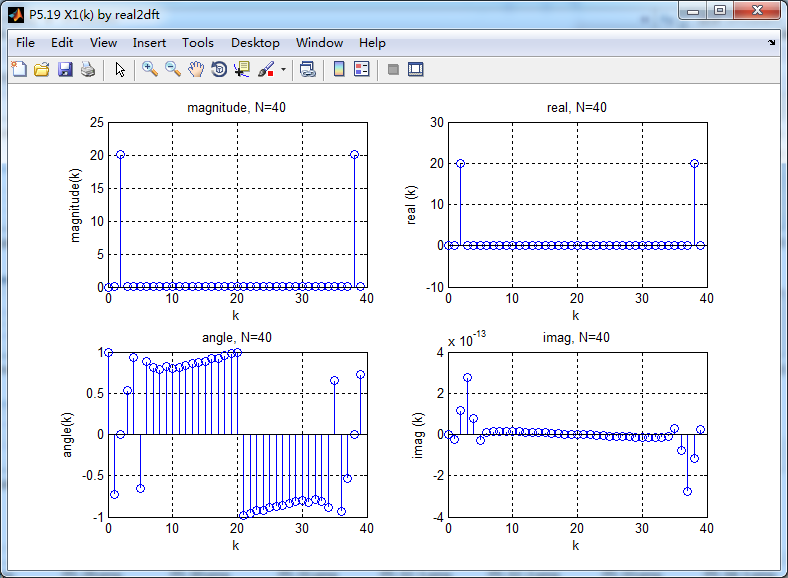
利用函数real2dft计算实部和虚部对应的DFT,Xccs(k)和Xcca(k)

结论:
如果X(k)是N点复数序列x(n)的N点DFT,x(n)=xR(n)+jxI(n),那么有
DFT[xR]=Xccs(k) DFT[j*xI]=Xcca(k)
实部序列的DFT是复数序列的DFT的共轭圆周对称分量
虚部序列的DFT是复数序列的DFT的共轭圆周反对称分量。
《DSP using MATLAB》Problem 5.19的更多相关文章
- 《DSP using MATLAB》 Problem 3.19
先求模拟信号经过采样后,对应的数字角频率: 明显看出,第3种采样出现假频了.DTFT是以2π为周期的,所以假频出现在10π-2kπ=0处. 代码: %% ----------------------- ...
- 《DSP using MATLAB》Problem 2.19
代码: %% ------------------------------------------------------------------------ %% Output Info about ...
- 《DSP using MATLAB》Problem 8.19
代码: %% ------------------------------------------------------------------------ %% Output Info about ...
- 《DSP using MATLAB》Problem 7.16
使用一种固定窗函数法设计带通滤波器. 代码: %% ++++++++++++++++++++++++++++++++++++++++++++++++++++++++++++++++++++++++++ ...
- 《DSP using MATLAB》Problem 5.18
代码: %% ++++++++++++++++++++++++++++++++++++++++++++++++++++++++++++++++++++++++++++++++++++++++ %% O ...
- 《DSP using MATLAB》Problem 5.5
代码: %% ++++++++++++++++++++++++++++++++++++++++++++++++++++++++++++++++++++++++++++++++ %% Output In ...
- 《DSP using MATLAB》Problem 5.4
代码: %% ++++++++++++++++++++++++++++++++++++++++++++++++++++++++++++++++++++++++++++++++ %% Output In ...
- 《DSP using MATLAB》Problem 5.3
这段时间爬山去了,山中林密荆棘多,沟谷纵横,体力增强不少. 代码: %% +++++++++++++++++++++++++++++++++++++++++++++++++++++++++++++++ ...
- 《DSP using MATLAB》Problem 4.23
代码: %% ------------------------------------------------------------------------ %% Output Info about ...
随机推荐
- Uboot代码分析
(1)确定链接脚本文件:uboot根目录下Makefile中的LDSCRIPT宏值,就是指定链接脚本(如:arch/arm/cpu/u-boot.lds)路径用的.(2)从脚本文件找入口: 在链接脚本 ...
- U帮忙U盘装系统工具使用教程
在用U盘装系统时首先我们需要了解一下U帮忙U盘启动盘的制作以及BIOS设置U盘启动和U盘装系统步骤后才能让操作更顺利的完成,下面就来说说U帮忙U盘装系统工具使用教程,希望对大家有所帮助! 如果您不了解 ...
- opencv测试代码
摄像头摄影 #include <iostream>#include <opencv2/opencv.hpp>using namespace cv;using namespace ...
- 四:(之四)基于已有镜像构建自己的Docker镜像
4构建自己的Docker镜像 4.1常用命令: 等同于docker commit 将一个被改变的容器创建成一个新的image 等同于docker build 通过Dockerfile创建一个image ...
- thymeleaf之下拉框回显选中
#1.select下拉框取值 <div class="form-group "> <label id="resource" ...
- Install SharePoint 2013 with SP1 on Windows Server 2012 R2 error - This Product requires .NF 4.5
博客地址:http://blog.csdn.net/FoxDave 最近因为项目需要要搭建SharePoint 2013的开发环境. 准备了Windows Server 2012 R2系统和Sha ...
- mvc4使用KindEditor文本编辑器
最近做项目要用文本编辑器,编辑器好多种,这里介绍KindEditor在asp.net mvc4中的使用方法. 一.准备工作: 1.下载KindEditor.去官网:http://www.kindsof ...
- requests保持登录session ,cookie 和 token
一.request提供了一个一个叫做session的类,来实现客户端和服务端的会话保持 # coding:utf-8 import requests url = "https://passp ...
- Oracle备份归档日志文件的两种方法比较
备份归档日志方式有两种: 1 单独备份归档日志:backup archivelog all 2 在执行备库时一起备份归档日志:backup database plus archivelog; 这 ...
- golang实现一个代理服务器(proxy)学习笔记
golang是google公司开发一门新的编程语言.对于老的程序员来说,学习一门语言最好的方式,不过是做一个小的项目. 网上看到这一篇使用golang开发proxy的例子,觉得挺有意思.希望通过实际模 ...