
7.5 数据注解特性--MaxLength&&MinLength
MaxLength attribute can be applied to a string or array type property of a domain class. EF Code First will set the size of a column as specified in MaxLength attribute. Note that it can also be used with ASP.Net MVC as a validation attribute.
Consider the following example.
using System.ComponentModel.DataAnnotations;

public class Student
{
    public Student()
    {

    }
    public int StudentID { get; set; }

    [MaxLength(50)]
    public string StudentName { get; set; }

}
As you can see in the above code, we have applied MaxLength attribute to StudentName. So, Code-First will create a nvarchar(50) column StudentName in the Student table as shown below.
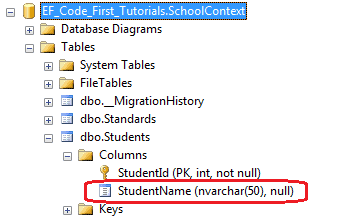
Entity Framework also validates the value of a property for MaxLength attribute if you set the value more than the specified size. For example, if you set more than 50 chars long StudentName then EF will throw EntityValidationError.
MinLength:
MinLength attribute is a validation attribute. It does not have an impact on the database schema. EF will throw EntityValidationError if you set a value of a string or array property less than the specified length in MinLength attribute.
MinLength attribute can also be used with MaxLength attribute as shown below.
using System.ComponentModel.DataAnnotations;

public class Student
{
    public Student()
    {

    }
    public int StudentID { get; set; }

    [MaxLength(50),MinLength(2)]
    public string StudentName { get; set; }

}
In the above example, StudentName can not be less than 2 chars and more than 50 chars.
7.5 数据注解特性--MaxLength&&MinLength的更多相关文章
- 9.9 翻译系列:数据注解特性之--MaxLength 【EF 6 Code-First系列】
原文链接:https://www.entityframeworktutorial.net/code-first/maxlength-minlength-dataannotations-attribut ...
- 9.翻译系列:EF 6以及EF Core中的数据注解特性(EF 6 Code-First系列)
原文地址:http://www.entityframeworktutorial.net/code-first/dataannotation-in-code-first.aspx EF 6 Code-F ...
- 7.7 数据注解特性--Table
大家可能注意到,有几个特性,我没有翻译,因为实在是太简单了,看一下就知道,之前也学过,现在只是系统学一下,所以就粗略的看一下就行了. 现在学习数据注解特性的--Table特性. Table 特性可以被 ...
- 9.10 翻译系列:EF数据注解特性之StringLength【EF 6 Code-First系列】
原文链接:https://www.entityframeworktutorial.net/code-first/stringlength-dataannotations-attribute-in-co ...
- 9.7 翻译系列:EF数据注解特性之--InverseProperty【EF 6 Code-First系列】
原文链接:https://www.entityframeworktutorial.net/code-first/inverseproperty-dataannotations-attribute-in ...
- 9.3 翻译系列:数据注解特性之Key【EF 6 Code-First 系列】
原文链接:http://www.entityframeworktutorial.net/code-first/key-dataannotations-attribute-in-code-first.a ...
- 9.2 翻译系列:数据注解特性之---Column【EF 6 Code First系列】
原文链接:http://www.entityframeworktutorial.net/code-first/column-dataannotations-attribute-in-code-firs ...
- 9.1 翻译系列:数据注解特性之----Table【EF 6 Code-First 系列】
原文地址:http://www.entityframeworktutorial.net/code-first/table-dataannotations-attribute-in-code-first ...
- 9.8 翻译系列:数据注解特性之--Required 【EF 6 Code-First系列】
原文链接:https://www.entityframeworktutorial.net/code-first/required-attribute-dataannotations-in-code-f ...
随机推荐
- 用DataGridView导入TXT文件,并导出为XLS文件
使用 DataGridView 控件,可以显示和编辑来自多种不同类型的数据源的表格数据.也可以导出.txt,.xls等格式的文件.今天我们就先介绍一下用DataGridView把导入txt文件,导出x ...
- ASP.NET MVC 多语言方案
前言: 好多年没写文章了,工作很忙,天天加班, 每天都相信不用多久,就会升职加薪,当上总经理,出任CEO,迎娶白富美,走上人生巅峰,想想还有点小激动~~~~ 直到后来发生了邮箱事件,我竟然忘了给邮箱密 ...
- Visual Studio LightSwitch
LightSwitch是一个基于模板的自动化开发Silverlight和HTML5应用程序的工具,不同于一般的基于数据字典,配置生成的应用程序的工具,因为LightSwtich提供的所有模板都是可以扩 ...
- 探索c#之跳跃表(SkipList)
阅读目录: 基本介绍 算法思想 演化步骤 实现细节 总结 基本介绍 SkipList是William Pugh在1990年提出的,它是一种可替代平衡树的数据结构. SkipList在实现上相对比较简单 ...
- MySQL 提高Insert性能
插入一个记录需要的时间由下列因素组成,其中的数字表示大约比例: 连接:(3) 发送查询给服务器:(2) 分析查询:(2) 插入记录:(1x记录大小) 插入索引:(1x索引) 关闭:(1) 这不考虑打开 ...
- 备忘-Android ViewPager 子页监听事件
@Override public Object instantiateItem(View arg0, int arg1) { ((ViewPager) arg0).addView(mListViews ...
- 如何创建一个AJAX-Enabled WCF Service
原创地址:http://www.cnblogs.com/jfzhu/p/4041638.html 转载请注明出处 前面的文章中介绍过<Step by Step 创建一个WCF Servi ...
- Viewport---响应式 Web 设计----在路上(13)
什么是 Viewport? viewport 是用户网页的可视区域. viewport 翻译为中文可以叫做"视区". 手机浏览器是把页面放在一个虚拟的"窗口"( ...
- json、javaBean、xml互转的几种工具介绍
json.javaBean.xml互转的几种工具介绍 转载至:http://blog.csdn.net/sdyy321/article/details/7024236 工作中经常要用到Json.Jav ...
- 测试框架Mocha与断言expect
测试框架Mocha与断言expect在浏览器和Node环境都可以使用除了Mocha以外,类似的测试框架还有Jasmine.Karma.Tape等,也很值得学习. 整个项目源代码: 为什么学习测试代码? ...