
Kafka(四) —— KafkaProducer源码阅读
一、doSend()方法
Kafka中的每一条消息都对应一个ProducerRecord对象。
public class ProducerRecord<K, V> {

    private final String topic;

    private final Integer partition;

    private final Headers headers;

    private final K key;

    private final V value;

    private final Long timestamp;

}
doSend() 源码如下:
private Future<RecordMetadata> doSend(ProducerRecord<K, V> record, Callback callback) {

        TopicPartition tp = null;

        try {

            throwIfProducerClosed();

            // first make sure the metadata for the topic is available

            ClusterAndWaitTime clusterAndWaitTime;

            // 1、获取集群的元数据

            try {

                clusterAndWaitTime = waitOnMetadata(record.topic(), record.partition(), maxBlockTimeMs);

            } catch (KafkaException e) {

                if (metadata.isClosed())

                    throw new KafkaException("Producer closed while send in progress", e);

                throw e;

            }

            long remainingWaitMs = Math.max(0, maxBlockTimeMs - clusterAndWaitTime.waitedOnMetadataMs);

            Cluster cluster = clusterAndWaitTime.cluster;

            //2、 Key、Value 序列化

            byte[] serializedKey;

            try {

                serializedKey = keySerializer.serialize(record.topic(), record.headers(), record.key());

            } catch (ClassCastException cce) {

                throw new SerializationException("Can't convert key of class " + record.key().getClass().getName() +

                        " to class " + producerConfig.getClass(ProducerConfig.KEY_SERIALIZER_CLASS_CONFIG).getName() +

                        " specified in key.serializer", cce);

            }

            byte[] serializedValue;

            try {

                serializedValue = valueSerializer.serialize(record.topic(), record.headers(), record.value());

            } catch (ClassCastException cce) {

                throw new SerializationException("Can't convert value of class " + record.value().getClass().getName() +

                        " to class " + producerConfig.getClass(ProducerConfig.VALUE_SERIALIZER_CLASS_CONFIG).getName() +

                        " specified in value.serializer", cce);

            }

            // 3、分区器

            int partition = partition(record, serializedKey, serializedValue, cluster);

            // 对topic和分区进行封装,封装后的结果  topic-partition ,[return topic + "-" + partition;]

            tp = new TopicPartition(record.topic(), partition);

            setReadOnly(record.headers());

            Header[] headers = record.headers().toArray();

            int serializedSize = AbstractRecords.estimateSizeInBytesUpperBound(apiVersions.maxUsableProduceMagic(),

                    compressionType, serializedKey, serializedValue, headers);

            ensureValidRecordSize(serializedSize);

            long timestamp = record.timestamp() == null ? time.milliseconds() : record.timestamp();

            log.trace("Sending record {} with callback {} to topic {} partition {}", record, callback, record.topic(), partition);

            // producer callback will make sure to call both 'callback' and interceptor callback

            Callback interceptCallback = new InterceptorCallback<>(callback, this.interceptors, tp);

            if (transactionManager != null && transactionManager.isTransactional())

                transactionManager.maybeAddPartitionToTransaction(tp);

            // 4、将数据放到accumulator中

            RecordAccumulator.RecordAppendResult result = accumulator.append(tp, timestamp, serializedKey,

                    serializedValue, headers, interceptCallback, remainingWaitMs);

            // 5、如果batch已经满了,唤醒 Sender线程发送数据

            if (result.batchIsFull || result.newBatchCreated) {

                log.trace("Waking up the sender since topic {} partition {} is either full or getting a new batch", record.topic(), partition);

                this.sender.wakeup();

            }

            return result.future;

        } catch (Exception e) {

            // ...

        }

    }
获取集群元数据
doSend()中相关的源码
            try {

                clusterAndWaitTime = waitOnMetadata(record.topic(), record.partition(), maxBlockTimeMs);

            } catch (KafkaException e) {

                if (metadata.isClosed())

                    throw new KafkaException("Producer closed while send in progress", e);

                throw e;

            }

            long remainingWaitMs = Math.max(0, maxBlockTimeMs - clusterAndWaitTime.waitedOnMetadataMs);

            Cluster cluster = clusterAndWaitTime.cluster;
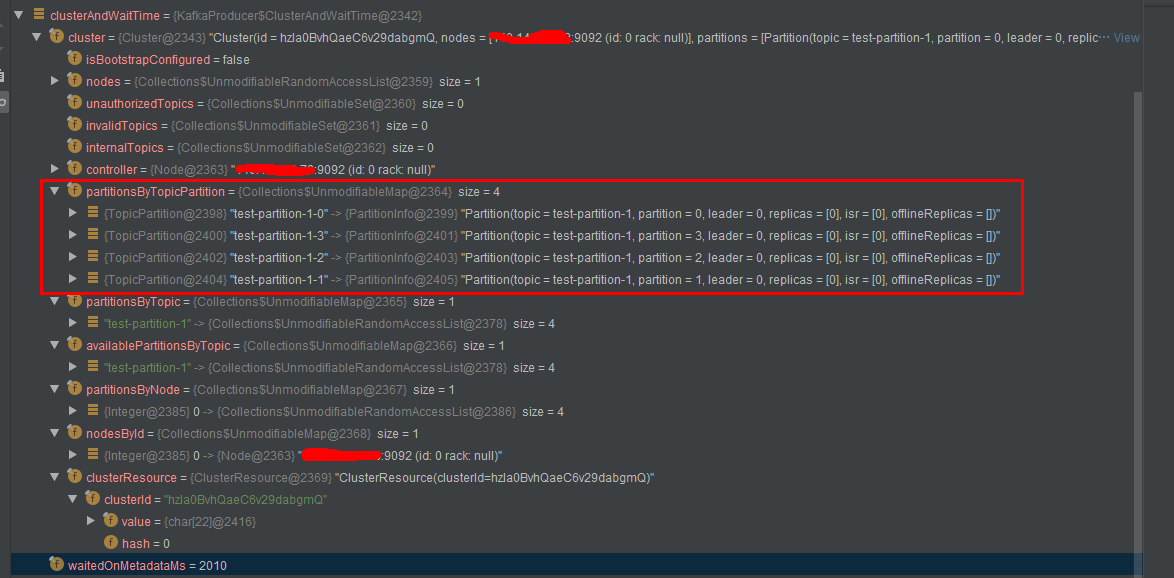
Cluster类定义
public final class Cluster {

    private final boolean isBootstrapConfigured;

    // broker 节点列表

    private final List<Node> nodes;

    private final Set<String> unauthorizedTopics;

    private final Set<String> invalidTopics;

    private final Set<String> internalTopics;

    // controller所在节点

    private final Node controller;

    // 记录TopicPartition和PartitionInfo的管理

    // TopicPartition中定义了partition、topic两个字段

    // PartitionInfo记录详细的partition信息,定义了leader节点的位置、以Node数组的形式定义了 副本节点的位置、ISR、offline副本

    private final Map<TopicPartition, PartitionInfo> partitionsByTopicPartition;

    //Topic 与 分区 的映射关系

    private final Map<String, List<PartitionInfo>> partitionsByTopic;

    private final Map<String, List<PartitionInfo>> availablePartitionsByTopic;

    private final Map<Integer, List<PartitionInfo>> partitionsByNode;

    private final Map<Integer, Node> nodesById;

    private final ClusterResource clusterResource;

}
调试获得clusterAndWaitTime对象的显示结果
二、partition()方法
当Record没有被指定分区时,会调用partiton方法,分配到分区。
传入的参数是,record的topic、k-v序列化、以及集群信息。
public int partition(String topic, Object key, byte[] keyBytes, Object value, byte[] valueBytes, Cluster cluster) {

        // 从集群中获取Topic对应的分区信息

        List<PartitionInfo> partitions = cluster.partitionsForTopic(topic);

        int numPartitions = partitions.size();

        //判断key是否为空

        if (keyBytes == null) {

            int nextValue = nextValue(topic);

            List<PartitionInfo> availablePartitions = cluster.availablePartitionsForTopic(topic);

            if (availablePartitions.size() > 0) {

                int part = Utils.toPositive(nextValue) % availablePartitions.size();

                return availablePartitions.get(part).partition();

            } else {

                // no partitions are available, give a non-available partition

                return Utils.toPositive(nextValue) % numPartitions;

            }

        } else {

            // 若key不为空,则对key进行hash,然后对分区数取余

            // hash the keyBytes to choose a partition

            return Utils.toPositive(Utils.murmur2(keyBytes)) % numPartitions;

        }

    }
三、append()方法
在调用KafkaProducer构造方法的时候,会创建Accumulator对象。
RecordAccumulator
RecordAccumulator主要用来缓存消息以便Sender线程可以批量发送数据,减少网络传输的资源消耗,以提升性能。
RecordAccumulator内部每个分区都维护一个Deque,其中ProducerBatch包含一至多个ProducerRecord。
消息写入缓存(RecordAccumulator)时,消息(ProducerRecord)会追加到双端队列(Deque)尾部,追加的过程是,找到分区对应的Deque,然后取出Deque最后一个ProducerBatch,看能否追加,若追加不了,则新建一个ProducerBatch,将消息追加到ProducerBatch中。ProducerBatch的大小,由参数batch.size来确定。
Sender读取消息时,会从双端队列头部读取消息。
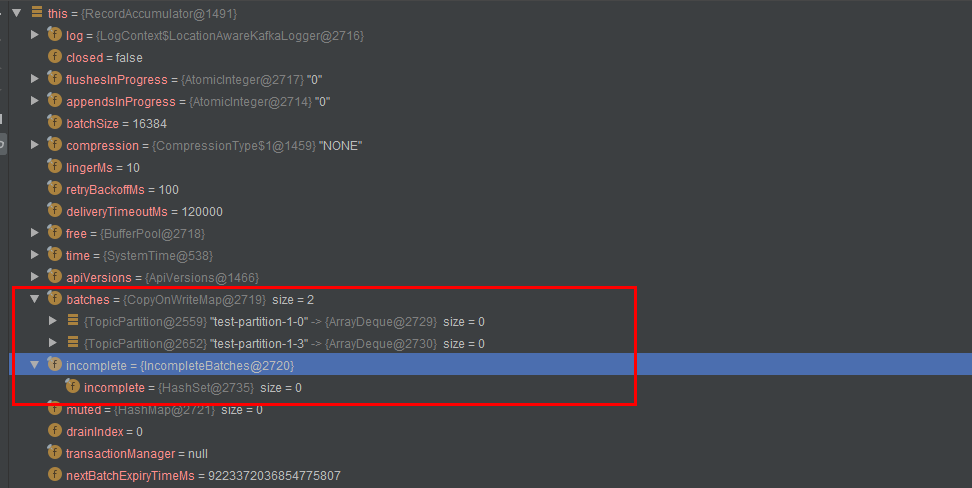
RecordAccumulator类定义
public final class RecordAccumulator {

    private final Logger log;

    private volatile boolean closed;

    private final AtomicInteger flushesInProgress;

    private final AtomicInteger appendsInProgress;

    private final int batchSize;

    private final CompressionType compression;

    private final int lingerMs;

    private final long retryBackoffMs;

    private final int deliveryTimeoutMs;

    private final BufferPool free;

    private final Time time;

    private final ApiVersions apiVersions;

    // 在RecordAccumulator的构造方法中实例化 this.batches = new CopyOnWriteMap<>();

    private final ConcurrentMap<TopicPartition, Deque<ProducerBatch>> batches;

    private final IncompleteBatches incomplete;

    // The following variables are only accessed by the sender thread, so we don't need to protect them.

    private final Map<TopicPartition, Long> muted;

    private int drainIndex;

    private final TransactionManager transactionManager;

    private long nextBatchExpiryTimeMs = Long.MAX_VALUE;

}
调试结果
append()方法
public RecordAppendResult append(TopicPartition tp,

                                     long timestamp,

                                     byte[] key,

                                     byte[] value,

                                     Header[] headers,

                                     Callback callback,

                                     long maxTimeToBlock) throws InterruptedException {

        // We keep track of the number of appending thread to make sure we do not miss batches in

        // abortIncompleteBatches().

        appendsInProgress.incrementAndGet();

        ByteBuffer buffer = null;

        if (headers == null) headers = Record.EMPTY_HEADERS;

        try {

            // check if we have an in-progress batch

            // 从上文中我们知道batches的结构是ConcurrentMap<TopicPartition, Deque<ProducerBatch>>

            // 从batches中检查是否存在这个tp,如果有则返回Deque,若没有则创建

            // 这里的Deque是ArrayDeque

            Deque<ProducerBatch> dq = getOrCreateDeque(tp);

            synchronized (dq) {

                if (closed)

                    throw new KafkaException("Producer closed while send in progress");

                RecordAppendResult appendResult = tryAppend(timestamp, key, value, headers, callback, dq);

                if (appendResult != null)

                    return appendResult;

            }

            // 下面一大步是将record中的信息转成buffer对象,进而封装成ProducerBatch对象,再放到dq中。

            // we don't have an in-progress record batch try to allocate a new batch

            byte maxUsableMagic = apiVersions.maxUsableProduceMagic();

            int size = Math.max(this.batchSize, AbstractRecords.estimateSizeInBytesUpperBound(maxUsableMagic, compression, key, value, headers));

            log.trace("Allocating a new {} byte message buffer for topic {} partition {}", size, tp.topic(), tp.partition());

            buffer = free.allocate(size, maxTimeToBlock);

            synchronized (dq) {

                // Need to check if producer is closed again after grabbing the dequeue lock.

                if (closed)

                    throw new KafkaException("Producer closed while send in progress");

                RecordAppendResult appendResult = tryAppend(timestamp, key, value, headers, callback, dq);

                if (appendResult != null) {

                    // Somebody else found us a batch, return the one we waited for! Hopefully this doesn't happen often...

                    return appendResult;

                }

                MemoryRecordsBuilder recordsBuilder = recordsBuilder(buffer, maxUsableMagic);

                ProducerBatch batch = new ProducerBatch(tp, recordsBuilder, time.milliseconds());

                FutureRecordMetadata future = Utils.notNull(batch.tryAppend(timestamp, key, value, headers, callback, time.milliseconds()));

                dq.addLast(batch);

                incomplete.add(batch);

                // Don't deallocate this buffer in the finally block as it's being used in the record batch

                buffer = null;

                return new RecordAppendResult(future, dq.size() > 1 || batch.isFull(), true);

            }

        } finally {

            if (buffer != null)

                free.deallocate(buffer);

            appendsInProgress.decrementAndGet();

        }

    }
四、BufferPool
ByteBuffer的创建和释放比较消耗资源,所以Kafka客户端使用BufferPool来实现ByteBuffer的复用。
public class BufferPool {

    private final long totalMemory;

    private final int poolableSize;

    private final ReentrantLock lock;

    private final Deque<ByteBuffer> free;

    // ...

}
五、Sender
run()方法
 /**

     * Run a single iteration of sending

     *

     * @param now The current POSIX time in milliseconds

     */

    void run(long now) {

        // 省略前面的代码

        long pollTimeout = sendProducerData(now);

        client.poll(pollTimeout, now);

    }
sendProducerData()方法
private long sendProducerData(long now) {

        // 获取Kafka集群元数据

        Cluster cluster = metadata.fetch();

        // get the list of partitions with data ready to send

        // 获取准备发送数据的partition列表

        // ReadyCheckResult的成员变量有Set<Node> readyNodes(准备发送的节点),Set<String> unknownLeaderTopics

        RecordAccumulator.ReadyCheckResult result = this.accumulator.ready(cluster, now);

        // if there are any partitions whose leaders are not known yet, force metadata update

        // 如果有不知道leader节点在哪的partition,强制更新元数据

        // 向元数据中增加topic,并且进行更新

        if (!result.unknownLeaderTopics.isEmpty()) {

            // The set of topics with unknown leader contains topics with leader election pending as well as

            // topics which may have expired. Add the topic again to metadata to ensure it is included

            // and request metadata update, since there are messages to send to the topic.

            for (String topic : result.unknownLeaderTopics)

                this.metadata.add(topic);

            this.metadata.requestUpdate();

        }

        // remove any nodes we aren't ready to send to

        // 移除所有不准备发送的节点

        Iterator<Node> iter = result.readyNodes.iterator();

        long notReadyTimeout = Long.MAX_VALUE;

        while (iter.hasNext()) {

            Node node = iter.next();

            if (!this.client.ready(node, now)) {

                iter.remove();

                notReadyTimeout = Math.min(notReadyTimeout, this.client.connectionDelay(node, now));

            }

        }

        // create produce requests

        // 创建一个produce 请求

        Map<Integer, List<ProducerBatch>> batches = this.accumulator.drain(cluster, result.readyNodes,

                this.maxRequestSize, now);

        if (guaranteeMessageOrder) {

            // Mute all the partitions drained

            for (List<ProducerBatch> batchList : batches.values()) {

                for (ProducerBatch batch : batchList)

                    this.accumulator.mutePartition(batch.topicPartition);

            }

        }

        List<ProducerBatch> expiredBatches = this.accumulator.expiredBatches(this.requestTimeout, now);

        // Reset the producer id if an expired batch has previously been sent to the broker. Also update the metrics

        // for expired batches. see the documentation of @TransactionState.resetProducerId to understand why

        // we need to reset the producer id here.

        if (!expiredBatches.isEmpty())

            log.trace("Expired {} batches in accumulator", expiredBatches.size());

        for (ProducerBatch expiredBatch : expiredBatches) {

            failBatch(expiredBatch, -1, NO_TIMESTAMP, expiredBatch.timeoutException(), false);

            if (transactionManager != null && expiredBatch.inRetry()) {

                // This ensures that no new batches are drained until the current in flight batches are fully resolved.

                transactionManager.markSequenceUnresolved(expiredBatch.topicPartition);

            }

        }

        sensors.updateProduceRequestMetrics(batches);

        // If we have any nodes that are ready to send + have sendable data, poll with 0 timeout so this can immediately

        // loop and try sending more data. Otherwise, the timeout is determined by nodes that have partitions with data

        // that isn't yet sendable (e.g. lingering, backing off). Note that this specifically does not include nodes

        // with sendable data that aren't ready to send since they would cause busy looping.

        long pollTimeout = Math.min(result.nextReadyCheckDelayMs, notReadyTimeout);

        if (!result.readyNodes.isEmpty()) {

            log.trace("Nodes with data ready to send: {}", result.readyNodes);

            // if some partitions are already ready to be sent, the select time would be 0;

            // otherwise if some partition already has some data accumulated but not ready yet,

            // the select time will be the time difference between now and its linger expiry time;

            // otherwise the select time will be the time difference between now and the metadata expiry time;

            pollTimeout = 0;

        }

        sendProduceRequests(batches, now);

        return pollTimeout;

    }
参考文档
Kafka(四) —— KafkaProducer源码阅读的更多相关文章
- 36 网络相关函数(四)——live555源码阅读(四)网络
36 网络相关函数(四)——live555源码阅读(四)网络 36 网络相关函数(四)——live555源码阅读(四)网络 简介 7)createSocket创建socket方法 8)closeSoc ...
- 【原】AFNetworking源码阅读(四)
[原]AFNetworking源码阅读(四) 本文转载请注明出处 —— polobymulberry-博客园 1. 前言 上一篇还遗留了很多问题,包括AFURLSessionManagerTaskDe ...
- 【原】SDWebImage源码阅读(四)
[原]SDWebImage源码阅读(四) 本文转载请注明出处 —— polobymulberry-博客园 1. 前言 SDWebImage中主要实现了NSURLConnectionDataDelega ...
- 40 网络相关函数(八)——live555源码阅读(四)网络
40 网络相关函数(八)——live555源码阅读(四)网络 40 网络相关函数(八)——live555源码阅读(四)网络 简介 15)writeSocket向套接口写数据 TTL的概念 函数send ...
- 39 网络相关函数(七)——live555源码阅读(四)网络
39 网络相关函数(七)——live555源码阅读(四)网络 39 网络相关函数(七)——live555源码阅读(四)网络 简介 14)readSocket从套接口读取数据 recv/recvfrom ...
- 38 网络相关函数(六)——live555源码阅读(四)网络
38 网络相关函数(六)——live555源码阅读(四)网络 38 网络相关函数(六)——live555源码阅读(四)网络 简介 12)makeSocketNonBlocking和makeSocket ...
- 37 网络相关函数(五)——live555源码阅读(四)网络
37 网络相关函数(五)——live555源码阅读(四)网络 37 网络相关函数(五)——live555源码阅读(四)网络 简介 10)MAKE_SOCKADDR_IN构建sockaddr_in结构体 ...
- 35 网络相关函数(三)——live555源码阅读(四)网络
35 网络相关函数(三)——live555源码阅读(四)网络 35 网络相关函数(三)——live555源码阅读(四)网络 简介 5)NoReuse不重用地址类 6)initializeWinsock ...
- 34 网络相关函数(二)——live555源码阅读(四)网络
34 网络相关函数(二)——live555源码阅读(四)网络 34 网络相关函数(二)——live555源码阅读(四)网络 2)socketErr 套接口错误 3)groupsockPriv函数 4) ...
随机推荐
- 连续子数组的最大乘积及连续子数组的最大和(Java)
1. 子数组的最大和 输入一个整形数组,数组里有正数也有负数.数组中连续的一个或多个整数组成一个子数组,每个子数组都有一个和.求所有子数组的和的最大值.例如数组:arr[]={1, 2, 3, -2, ...
- Linux添加硬盘创建新的逻辑卷方式
有同仁看了上文<Linux添加硬盘扩充已有分区存储空间方式>一文后,提出疑问,现在很多云服务器本来没有逻辑卷,添加数据盘后需要自行添加,如何处理? 此文将以某云服务器为例,详细进行解说. ...
- day 19 作业
今日作业 1.什么是对象?什么是类? 对象是特征与技能的结合体,类是一系列对象相同的特征与技能的结合体 2.绑定方法的有什么特点 由对象来调用称之为对象的绑定方法,不同的对象调用该绑定方法,则会将不同 ...
- docker启动报错解决及分析(Cannot create container for service *******: cannot mount volume over existing file, file exists /var/lib/docker/overlay2/)
现象: Cannot create container for service *******: cannot mount volume over existing file, file exists ...
- USB之hub3
============= 本系列参考 ============= <圈圈教你玩USB>.<Linux那些事儿之我是USB> 协议文档:https://www.usb.or ...
- linux下nm命令的使用
linux下强大的文件分析工具 -- nm 什么是nm nm命令是linux下自带的特定文件分析工具,一般用来检查分析二进制文件.库文件.可执行文件中的符号表,返回二进制文件中各段的信息. 目标文件. ...
- Gerrit和OpenLDAP服务器集成
Gerrit和OpenLDAP服务器集成 作者:尹正杰 版权声明:原创作品,谢绝转载!否则将追究法律责任. 一.安装LDAP服务器 详情请参考:https://www.cnblogs.com/yinz ...
- ansible中的常用循环模块with_items
ansible中的循环模块有很多,不过with_items最为常用,且较为简单,循环模块最多的功能就是将重复性的任务简单化,如下例子所示: - hosts: all remote_user: root ...
- beta版本——第一次冲刺
第一次冲刺 (1)SCRUM部分☁️ ✨成员描述: 姓名 李星晨 完成了哪个任务 增加了个人中心返回主页按钮 花了多少时间 1h 还剩余多少时间 1h 遇到什么困难 没有遇到问题 这两天解决的进度 1 ...
- ELK日志分析系统搭建 windows
1 分别下载elk包 下载地址 https://www.elastic.co/cn/downloads 2 将这三个解压到同一个目录下,便于管理 3 elasticsearch不需要修改配置 默认即可 ...