
Hierarchical Question-Image Co-Attention for Visual Question Answering
Hierarchical Question-Image Co-Attention for Visual Question Answering
NIPS 2016
Paper: https://arxiv.org/pdf/1606.00061.pdf
Code: https://github.com/jiasenlu/HieCoAttenVQA
Related Blog: 【AI前沿】机器阅读理解与问答·Dynamic Co-Attention Networks
Introduction:
本文提出了一种新的联合图像和文本特征的协同显著性的概念,使得两个不同模态的特征可以相互引导。
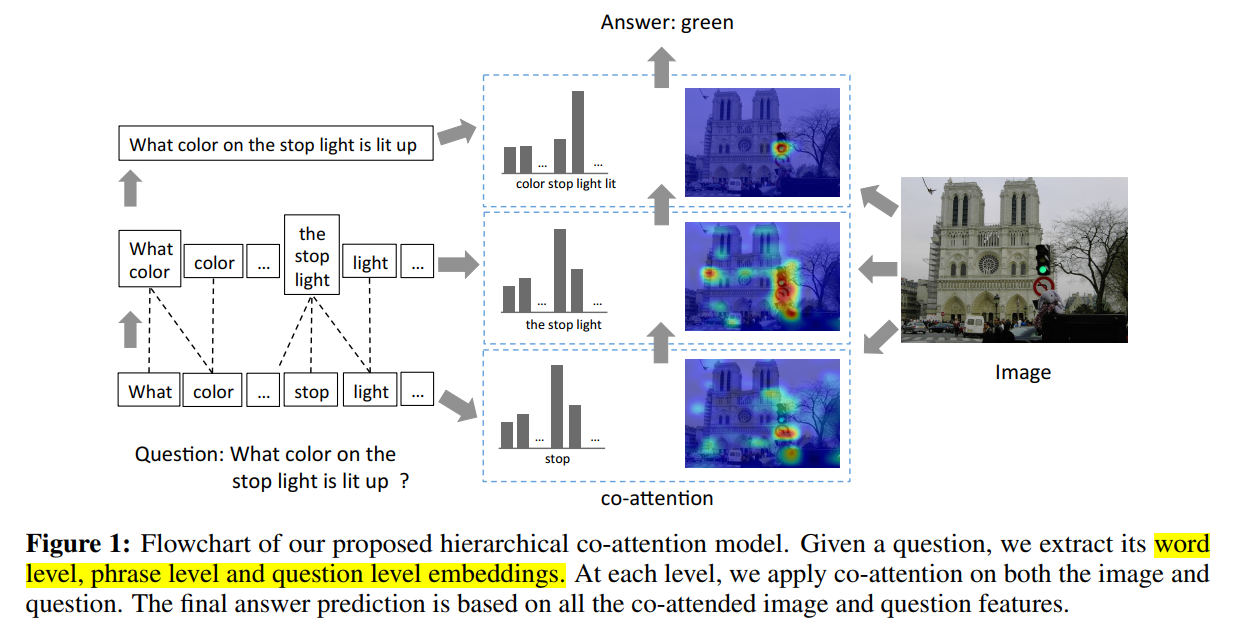
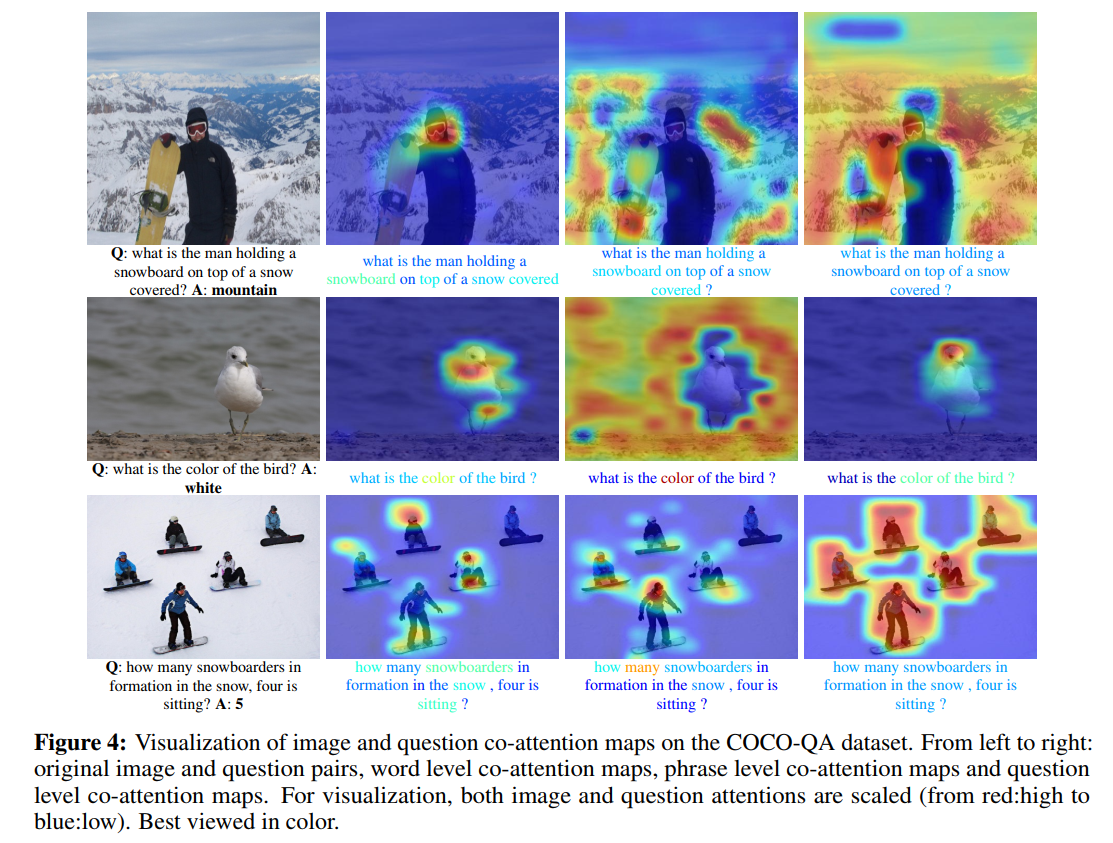
此外,作者也对输入的文本信息,从多个角度进行加权处理,构建多个不同层次的 image-question co-attention maps,即:word-level,phrase-level and question-level。
最后,在 phrase level,我们提出一种新颖的 卷积-池化策略(convolution-pooling strategy)来自适应的选择 the phase size。
Methods:
1. Notation:
问题 Q = {q1, ... , qT},其中 qt 是第 t 个单词的特征向量。我们用 qtw, qtp, qts 分别表示 在位置 t 处的 Word embedding,phrase embedding 以及 question embedding。
图像特征表示为 V = {v1, ... ,vN},其中,vn 是空间位置 n 处的特征向量。
图像和问题的 co-attention features 在每一个层次,都可以表示为:v^, q^。
不同模块和层的权重可以表示为 W。
2. Question Hierarchy:
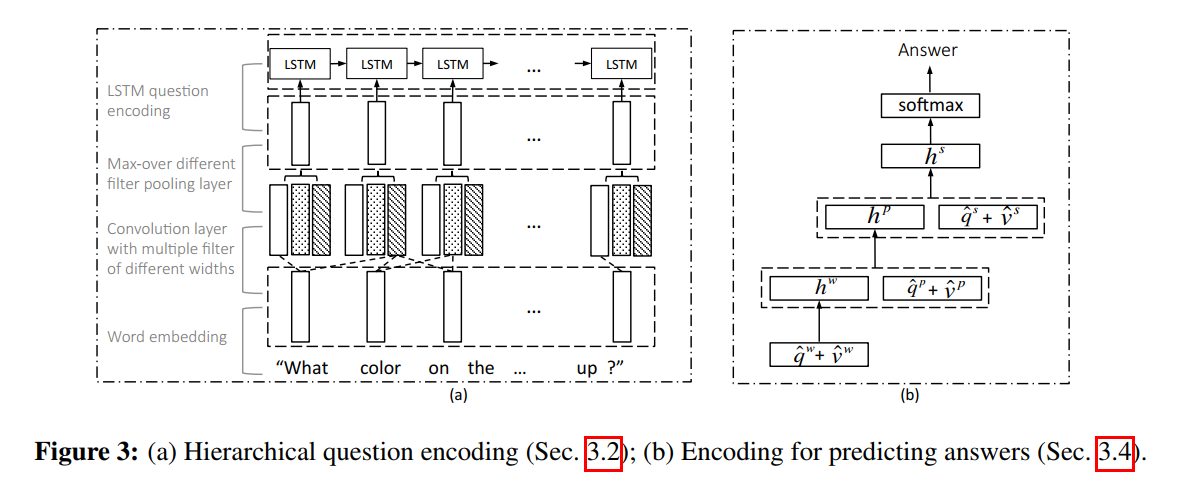
给定 the 1-hot encoding of the question words Q, 我们首先将单词映射到单词空间,以得到:Qw. 为了计算词汇的特征,我们采用在单词映射向量上采用 1-D 卷积。具体来说,在每一个单词位置,我们计算 the Word vectors with filters of three window sizes 的内积:unigram, bigram and trigram. 对于第 t 个单词,在窗口大小为 s 时的卷积输出为:

其中,Wcs 是权重参数。单词级别的向量 Qw 是 approximately 0-padding before feeding into bigram and trigram convolutions to maintain the length of the sequence after convolution. 给定卷积的结果,我们然后 在每一个单词位置,跨越不同的 n-grams 采用 max-pooling 以得到 phrase-level features:

我们的 pooling method 不同于前人的方法,可以自适应的选择 different gram features at each time step, 并且可以保持原始序列的长度和序列。我们利用 LSTM 来编码 max-pooling 之后的 sequence 。对应的 question-level feature 是第 t 个时间步骤的 LSTM hidden vector。
3. Co-Attention:
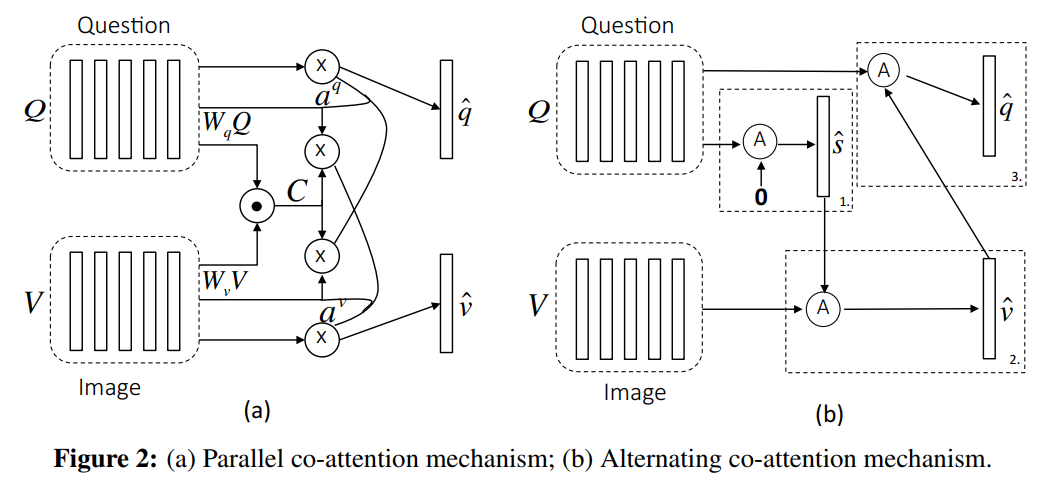
我们提出两种协同显著的机制(two co-attention mechanism),第一种是 parallel co-attention,同时产生 image 和 question attention。第二种是 alternating co-attention,顺序的产生 image 和 question attentions。如图2所示,这些 co-attention mechanisms 可以在所有问题等级上执行。
【Parallel Co-Attention】 这种 attention 机制尝试同时对 image 和 question 进行 attend。我们通过计算 图像 和 问题特征在所有的 image-locations and question-locations 进行相似度的计算。具体来说,给定一个图像特征图 V,以及 问题的表达 Q,放射矩阵 (the affinity matrix)C 可以计算如下:

其中,Wb 包括了权重。在计算得到 affinity matrix 之后,计算 image attention 的一种可能的方法是:simply maximize out the affinity over the locations of other modality, i.e.

并非选择 the max activation,我们发现如果我们将这个 affinity matrix 看做是一个 feature,然后学习去预测 image 和 question attention maps 可以提升最终的结果:

其中 Wv 和 Wq,whv,whq 是权重参数。av 和 aq 是每一个图像区域 vn 和 单词 qt 的 attention probability。放射矩阵 C 将 question attention space 转换为 image attention space. 基于上述 attention weights,图像 和 问题 attention vectors 可以看做是 image feature 和 question feature 的加权求和:

【Alternating Co-Attention】分步的协同 attention ,简单来讲,包括三个步骤:
1)summarize the question into a single vecror q;
2)attend to the image based on the question summary q ;
3)attend to the question based on the attended image feature.
我们定义 attention operation x^ = A(X; g),将图像特征 X 以及 从问题得到的 attention guidance g 作为输入,然后输出 the attended image vector。这些操作可以表达为:

其中,空心符号1 是元素全为 1 的向量。
4. Encoding for Predicting Answers :
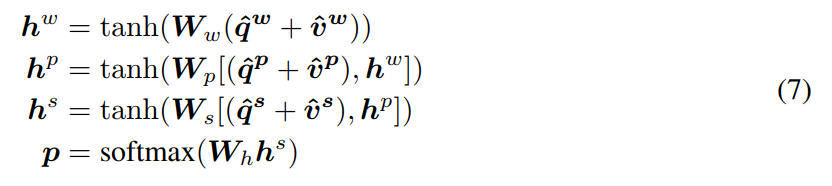
我们将 VQA 看做是一个 classification task,我们从所有的三个层次的 attended image and question features 来预测答案。我们用 MLP 来迭代的编码 the attention features:
Experiments:
Hierarchical Question-Image Co-Attention for Visual Question Answering的更多相关文章
- 论文阅读:Learning Visual Question Answering by Bootstrapping Hard Attention
Learning Visual Question Answering by Bootstrapping Hard Attention Google DeepMind ECCV-2018 2018 ...
- 论文:Bottom-Up and Top-Down Attention for Image Captioning and Visual Question Answering-阅读总结
Bottom-Up and Top-Down Attention for Image Captioning and Visual Question Answering-阅读总结 笔记不能简单的抄写文中 ...
- Visual Question Answering with Memory-Augmented Networks
Visual Question Answering with Memory-Augmented Networks 2018-05-15 20:15:03 Motivation: 虽然 VQA 已经取得 ...
- Learning Conditioned Graph Structures for Interpretable Visual Question Answering
Learning Conditioned Graph Structures for Interpretable Visual Question Answering 2019-05-29 00:29:4 ...
- 【自然语言处理】--视觉问答(Visual Question Answering,VQA)从初始到应用
一.前述 视觉问答(Visual Question Answering,VQA),是一种涉及计算机视觉和自然语言处理的学习任务.这一任务的定义如下: A VQA system takes as inp ...
- 论文笔记:Visual Question Answering as a Meta Learning Task
Visual Question Answering as a Meta Learning Task ECCV 2018 2018-09-13 19:58:08 Paper: http://openac ...
- A Regularized Competition Model for Question Diffi culty Estimation in Community Question Answering Services-20160520
1.Information publication:EMNLP 2014 author:Jing Liu(在前一篇sigir基础上,拓展模型的论文) 2.What 衡量CQA中问题的困难程度,提出从两 ...
- (zhuan) Recurrent Neural Network
Recurrent Neural Network 2016年07月01日 Deep learning Deep learning 字数:24235 this blog from: http:/ ...
- 香侬科技独家对话Facebook人工智能研究院首席科学家Devi Parikh
Facebook 人工智能研究院(FAIR)首席科学家 Devi Parikh 是 2017 年 IJCAI 计算机和思想奖获得者(IJCAI 两个最重要的奖项之一,被誉为国际人工智能领域的「菲尔兹奖 ...
随机推荐
- sitecore系列教程之Sitecore个性化-试点开始,测试,优化,增量
这是利用Sitecore的个性化引擎实现数字化转型的三部分系列的第三部分.之前的帖子旨在通过为您的个性化体验定义内容策略并在Sitecore中配置该策略来设置基础. 在此之前,我们讨论了内容策略以 ...
- MySql 存储过程 光标只循环一次
[1]MqSql 存储过程 光标只循环一次 针对MySql存储过程,光标只循环一次就退出的场景,可能原因分析: (1)存储过程有问题(仔细检查语法.控制变量.条件等等) (2)保证存储过程正确.调用过 ...
- jQuery懒加载插件jquery.lazyload.js使用说明实例
jQuery懒加载插件jquery.lazyload.js使用说明实例很多网站都会用到‘图片懒加载’这种方式对网站进行优化,即延迟加载图片或符合某些条件才开始加载图片.懒加载原理:浏览器会自动对页面中 ...
- SQL 语法笔记
➪SQL ➪基本类型 char / varchar / int / smallint / numeric / real, double precision / float ➪数据定义 create t ...
- 前端框架VUE----导入Bootstrap以及jQuery的两种方式
Vue引入bootstrap主要有两种方法 方法一:在main.js中引入,此方法导入的bootstrap中对于html,body的一些预设置的css样式可能无效. 一.引入jQuery 在当前项目的 ...
- 怎样从外网访问内网Apache HTTP Server
本地安装了一个Apache HTTP Server,只能在局域网内访问,怎样从外网也能访问到本地的Apache HTTP Server呢?本文将介绍具体的实现步骤. 1. 准备工作 1.1 安装并启动 ...
- 怎样从外网访问内网MySQL数据库?
本地安装了一个MySQL数据库,只能在局域网内访问到,怎样从外网也能访问到本地的MySQL数据库呢?本文将介绍具体的实现步骤. 1. 准备工作 1.1 安装并启动MySQL数据库 默认安装的MySQL ...
- vivado 连接不上板子 There is no current hw_target
前情提要: vivado连接板子点击auto connect报错 [Labtoolstcl 44-469] There is no current hw_target. 处理步骤: 首先排除硬件问题, ...
- Urllib库及cookie的使用
https://blog.csdn.net/pipisorry/article/details/47905781
- Docker学习笔记之Copy on Write机制
0x00 概述 Copy-On-Write简称COW,是一种用于程序设计中的优化策略.其基本思路是,从一开始大家都在共享同一个内容,当某个人想要修改这个内容的时候,才会真正把内容Copy出去形成一个新 ...