
Event Recommendation Engine Challenge分步解析第四步
一、请知晓
本文是基于:
Event Recommendation Engine Challenge分步解析第一步
Event Recommendation Engine Challenge分步解析第二步
Event Recommendation Engine Challenge分步解析第三步
需要读者先阅读前三篇文章解析
二、构建event和event相似度数据
我们先看看events.csv.gz:
import pandas as pd

df_events_csv = pd.read_csv('events.csv.gz', compression='gzip')

df_events_csv.head()
代码实例结果:
文件记录了用户对某event的信息(c_100后面还有一列:c_101):
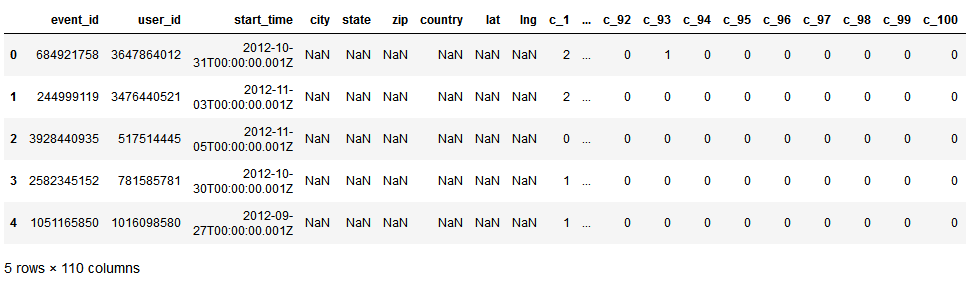
我们来看看如何对上面表中的列信息进行数值转换
1)start_time:参考Event Recommendation Engine Challenge分步解析第二步4)中的joinedAt列处理
2)city,3)state,4)zip,5)country列处理都利用了hashlib包:注意这里处理event信息的时候,只有那些出现在train.csv和test.csv中的event才会进入数值转换程序
import hashlib

def FeatureHash(value):

        if len(value.strip()) == 0:

            return -1

        else:

            return int( hashlib.sha224(value.encode('utf-8')).hexdigest()[0:4] ,16)

print(FeatureHash('Muaraenim'))#47294

print(FeatureHash('a test demo'))#4030
所以,我们在对NA值进行填充或者多种字符串进行数值转换的时候,使用hashlib也是一个不错的选择
6),lat和7)lon列处理:
def getFloatValue(self, value):

    if len(value.strip()) == 0:

        return 0.0

    else:

        return float(value)
空值用0.0填充,其他转换为自身的float型
8)c_1之后列(也就是第10列之后)处理:
这里用了一个矩阵eventContMatrix来保存c_1到c_100列信息,但是没有用的c_other列,why?
9)将eventPropMatrix和eventContMatrix矩阵归一化后进行文件保存
10)根据第一步中的uniqueEventPairs来计算event pairs相似度
利用了scipy.spatial.distance的correlation和cosine方法
11)变量介绍
nevents:events数目,即train.csv和test.csv总共多少个events,13418个
self.eventPropMatrix:稀疏矩阵,shape为(13418,7),7代表events.csv.gz中的7列特征,最后进行了归一化
self.eventContMatrix:稀疏矩阵,shape为(13418,100),100代表events.csv.gz文件中的c_1到c_100特征,最后进行了归一化
self.eventPropSim:由user-event行为计算出来的event pair相似度,需要用到第一步中的uniqueEventPairs
import pandas as pd

pd.DataFrame(eventPropSim)
代码示例结果:


self.eventContSim:由event本身的信息计算出的event pair相似度,需要用到第一步中的uniqueEventPairs
import pandas as pd

pd.DataFrame(eventContSim)
代码示例结果:


12)我们来看看第四步代码
from collections import defaultdict

import locale, pycountry

import scipy.sparse as ss

import scipy.io as sio

import itertools

#import cPickle

#From python3, cPickle has beed replaced by _pickle

import _pickle as cPickle

import scipy.spatial.distance as ssd

import datetime

from sklearn.preprocessing import normalize

import gzip

import numpy as np

import hashlib

#处理user和event关联数据

class ProgramEntities:

    """

    我们只关心train和test中出现的user和event,因此重点处理这部分关联数据,

    经过统计:train和test中总共3391个users和13418个events

    """

    def __init__(self):

        #统计训练集中有多少独立的用户的events

        uniqueUsers = set()#uniqueUsers保存总共多少个用户:3391个

        uniqueEvents = set()#uniqueEvents保存总共多少个events:13418个

        eventsForUser = defaultdict(set)#字典eventsForUser保存了每个user:所对应的event

        usersForEvent = defaultdict(set)#字典usersForEvent保存了每个event:哪些user点击

        for filename in ['train.csv', 'test.csv']:

            f = open(filename)

            f.readline()#跳过第一行

            for line in f:

                cols = line.strip().split(',')

                uniqueUsers.add( cols[0] )

                uniqueEvents.add( cols[1] )

                eventsForUser[cols[0]].add( cols[1] )

                usersForEvent[cols[1]].add( cols[0] )

            f.close()

        self.userEventScores = ss.dok_matrix( ( len(uniqueUsers), len(uniqueEvents) ) )

        self.userIndex = dict()

        self.eventIndex = dict()

        for i, u in enumerate(uniqueUsers):

            self.userIndex[u] = i

        for i, e in enumerate(uniqueEvents):

            self.eventIndex[e] = i

        ftrain = open('train.csv')

        ftrain.readline()

        for line in ftrain:

            cols = line.strip().split(',')

            i = self.userIndex[ cols[0] ]

            j = self.eventIndex[ cols[1] ]

            self.userEventScores[i, j] = int( cols[4] ) - int( cols[5] )

        ftrain.close()

        sio.mmwrite('PE_userEventScores', self.userEventScores)

        #为了防止不必要的计算,我们找出来所有关联的用户或者关联的event

        #所谓关联用户指的是至少在同一个event上有行为的用户user pair

        #关联的event指的是至少同一个user有行为的event pair

        self.uniqueUserPairs = set()

        self.uniqueEventPairs = set()

        for event in uniqueEvents:

            users = usersForEvent[event]

            if len(users) > 2:

                self.uniqueUserPairs.update( itertools.combinations(users, 2) )

        for user in uniqueUsers:

            events = eventsForUser[user]

            if len(events) > 2:

                self.uniqueEventPairs.update( itertools.combinations(events, 2) )

        #rint(self.userIndex)

        cPickle.dump( self.userIndex, open('PE_userIndex.pkl', 'wb'))

        cPickle.dump( self.eventIndex, open('PE_eventIndex.pkl', 'wb') )

#数据清洗类

class DataCleaner:

    def __init__(self):

        #一些字符串转数值的方法

        #载入locale

        self.localeIdMap = defaultdict(int)

        for i, l in enumerate(locale.locale_alias.keys()):

            self.localeIdMap[l] = i + 1

        #载入country

        self.countryIdMap = defaultdict(int)

        ctryIdx = defaultdict(int)

        for i, c in enumerate(pycountry.countries):

            self.countryIdMap[c.name.lower()] = i + 1

            if c.name.lower() == 'usa':

                ctryIdx['US'] = i

            if c.name.lower() == 'canada':

                ctryIdx['CA'] = i

        for cc in ctryIdx.keys():

            for s in pycountry.subdivisions.get(country_code=cc):

                self.countryIdMap[s.name.lower()] = ctryIdx[cc] + 1

        self.genderIdMap = defaultdict(int, {'male':1, 'female':2})

    #处理LocaleId

    def getLocaleId(self, locstr):

        #这样因为localeIdMap是defaultdict(int),如果key中没有locstr.lower(),就会返回默认int 0

        return self.localeIdMap[ locstr.lower() ]

    #处理birthyear

    def getBirthYearInt(self, birthYear):

        try:

            return 0 if birthYear == 'None' else int(birthYear)

        except:

            return 0

    #性别处理

    def getGenderId(self, genderStr):

        return self.genderIdMap[genderStr]

    #joinedAt

    def getJoinedYearMonth(self, dateString):

        dttm = datetime.datetime.strptime(dateString, "%Y-%m-%dT%H:%M:%S.%fZ")

        return "".join( [str(dttm.year), str(dttm.month) ] )

    #处理location

    def getCountryId(self, location):

        if (isinstance( location, str)) and len(location.strip()) > 0 and location.rfind('  ') > -1:

            return self.countryIdMap[ location[location.rindex('  ') + 2: ].lower() ]

        else:

            return 0

    #处理timezone

    def getTimezoneInt(self, timezone):

        try:

            return int(timezone)

        except:

            return 0

    def getFeatureHash(self, value):

        if len(value.strip()) == 0:

            return -1

        else:

            #return int( hashlib.sha224(value).hexdigest()[0:4], 16) python3会报如下错误

            #TypeError: Unicode-objects must be encoded before hashing

            return int( hashlib.sha224(value.encode('utf-8')).hexdigest()[0:4], 16)#python必须先进行encode

    def getFloatValue(self, value):

        if len(value.strip()) == 0:

            return 0.0

        else:

            return float(value)

#用户与用户相似度矩阵

class Users:

    """

    构建user/user相似度矩阵

    """

    def __init__(self, programEntities, sim=ssd.correlation):#spatial.distance.correlation(u, v) #计算向量u和v之间的相关系数

        cleaner = DataCleaner()

        nusers = len(programEntities.userIndex.keys())#3391

        #print(nusers)

        fin = open('users.csv')

        colnames = fin.readline().strip().split(',') #7列特征

        self.userMatrix = ss.dok_matrix( (nusers, len(colnames)-1 ) )#构建稀疏矩阵

        for line in fin:

            cols = line.strip().split(',')

            #只考虑train.csv中出现的用户,这一行是作者注释上的,但是我不是很理解

            #userIndex包含了train和test的所有用户,为何说只考虑train.csv中出现的用户

            if cols[0] in programEntities.userIndex:

                i = programEntities.userIndex[ cols[0] ]#获取user:对应的index

                self.userMatrix[i, 0] = cleaner.getLocaleId( cols[1] )#locale

                self.userMatrix[i, 1] = cleaner.getBirthYearInt( cols[2] )#birthyear,空值0填充

                self.userMatrix[i, 2] = cleaner.getGenderId( cols[3] )#处理性别

                self.userMatrix[i, 3] = cleaner.getJoinedYearMonth( cols[4] )#处理joinedAt列

                self.userMatrix[i, 4] = cleaner.getCountryId( cols[5] )#处理location

                self.userMatrix[i, 5] = cleaner.getTimezoneInt( cols[6] )#处理timezone

        fin.close()

        #归一化矩阵

        self.userMatrix = normalize(self.userMatrix, norm='l1', axis=0, copy=False)

        sio.mmwrite('US_userMatrix', self.userMatrix)

        #计算用户相似度矩阵,之后会用到

        self.userSimMatrix = ss.dok_matrix( (nusers, nusers) )#(3391,3391)

        for i in range(0, nusers):

            self.userSimMatrix[i, i] = 1.0

        for u1, u2 in programEntities.uniqueUserPairs:

            i = programEntities.userIndex[u1]

            j = programEntities.userIndex[u2]

            if (i, j) not in self.userSimMatrix:

                #print(self.userMatrix.getrow(i).todense()) 如[[0.00028123,0.00029847,0.00043592,0.00035208,0,0.00032346]]

                #print(self.userMatrix.getrow(j).todense()) 如[[0.00028123,0.00029742,0.00043592,0.00035208,0,-0.00032346]]

                usim = sim(self.userMatrix.getrow(i).todense(),self.userMatrix.getrow(j).todense())

                self.userSimMatrix[i, j] = usim

                self.userSimMatrix[j, i] = usim

        sio.mmwrite('US_userSimMatrix', self.userSimMatrix)

#用户社交关系挖掘

class UserFriends:

    """

    找出某用户的那些朋友,想法非常简单

    1)如果你有更多的朋友,可能你性格外向,更容易参加各种活动

    2)如果你朋友会参加某个活动,可能你也会跟随去参加一下

    """

    def __init__(self, programEntities):

        nusers = len(programEntities.userIndex.keys())#3391

        self.numFriends = np.zeros( (nusers) )#array([0., 0., 0., ..., 0., 0., 0.]),保存每一个用户的朋友数

        self.userFriends = ss.dok_matrix( (nusers, nusers) )

        fin = gzip.open('user_friends.csv.gz')

        print( 'Header In User_friends.csv.gz:',fin.readline() )

        ln = 0

        #逐行打开user_friends.csv.gz文件

        #判断第一列的user是否在userIndex中,只有user在userIndex中才是我们关心的user

        #获取该用户的Index,和朋友数目

        #对于该用户的每一个朋友,如果朋友也在userIndex中,获取其朋友的userIndex,然后去userEventScores中获取该朋友对每个events的反应

        #score即为该朋友对所有events的平均分

        #userFriends矩阵记录了用户和朋友之间的score

        #如851286067:1750用户出现在test.csv中,该用户在User_friends.csv.gz中一共2151个朋友

        #那么其朋友占比应该是2151 / 总的朋友数sumNumFriends=3731377.0 = 2151 / 3731377 = 0.0005764627910822198

        for line in fin:

            if ln % 200 == 0:

                print( 'Loading line:', ln )

            cols = line.decode().strip().split(',')

            user = cols[0]

            if user in programEntities.userIndex:

                friends = cols[1].split(' ')#获得该用户的朋友列表

                i = programEntities.userIndex[user]

                self.numFriends[i] = len(friends)

                for friend in friends:

                    if friend in programEntities.userIndex:

                        j = programEntities.userIndex[friend]

                        #the objective of this score is to infer the degree to

                        #and direction in which this friend will influence the

                        #user's decision, so we sum the user/event score for

                        #this user across all training events

                        eventsForUser = programEntities.userEventScores.getrow(j).todense()#获取朋友对每个events的反应:0, 1, or -1

                        #print(eventsForUser.sum(), np.shape(eventsForUser)[1] )

                        #socre即是用户朋友在13418个events上的平均分

                        score = eventsForUser.sum() / np.shape(eventsForUser)[1]#eventsForUser = 13418,

                        #print(score)

                        self.userFriends[i, j] += score

                        self.userFriends[j, i] += score

            ln += 1

        fin.close()

        #归一化数组

        sumNumFriends = self.numFriends.sum(axis=0)#每个用户的朋友数相加

        #print(sumNumFriends)

        self.numFriends = self.numFriends / sumNumFriends#每个user的朋友数目比例

        sio.mmwrite('UF_numFriends', np.matrix(self.numFriends) )

        self.userFriends = normalize(self.userFriends, norm='l1', axis=0, copy=False)

        sio.mmwrite('UF_userFriends', self.userFriends)

#构造event和event相似度数据

class Events:

    """

    构建event-event相似度,注意这里有2种相似度

    1)由用户-event行为,类似协同过滤算出的相似度

    2)由event本身的内容(event信息)计算出的event-event相似度

    """

    def __init__(self, programEntities, psim=ssd.correlation, csim=ssd.cosine):

        cleaner = DataCleaner()

        fin = gzip.open('events.csv.gz')

        fin.readline()#skip header

        nevents = len(programEntities.eventIndex)

        print(nevents)#13418

        self.eventPropMatrix = ss.dok_matrix( (nevents, 7) )

        self.eventContMatrix = ss.dok_matrix( (nevents, 100) )

        ln = 0

        for line in fin:

            #if ln > 10:

                #break

            cols = line.decode().strip().split(',')

            eventId = cols[0]

            if eventId in programEntities.eventIndex:

                i = programEntities.eventIndex[eventId]

                self.eventPropMatrix[i, 0] = cleaner.getJoinedYearMonth( cols[2] )#start_time

                self.eventPropMatrix[i, 1] = cleaner.getFeatureHash( cols[3] )#city

                self.eventPropMatrix[i, 2] = cleaner.getFeatureHash( cols[4] )#state

                self.eventPropMatrix[i, 3] = cleaner.getFeatureHash( cols[5] )#zip

                self.eventPropMatrix[i, 4] = cleaner.getFeatureHash( cols[6] )#country

                self.eventPropMatrix[i, 5] = cleaner.getFloatValue( cols[7] )#lat

                self.eventPropMatrix[i, 6] = cleaner.getFloatValue( cols[8] )#lon

                for j in range(9, 109):

                    self.eventContMatrix[i, j-9] = cols[j]

            ln += 1

        fin.close()

        self.eventPropMatrix = normalize(self.eventPropMatrix, norm='l1', axis=0, copy=False)

        sio.mmwrite('EV_eventPropMatrix', self.eventPropMatrix)

        self.eventContMatrix = normalize(self.eventContMatrix, norm='l1', axis=0, copy=False)

        sio.mmwrite('EV_eventContMatrix', self.eventContMatrix)

        #calculate similarity between event pairs based on the two matrices

        self.eventPropSim = ss.dok_matrix( (nevents, nevents) )

        self.eventContSim = ss.dok_matrix( (nevents, nevents) )

        for e1, e2 in programEntities.uniqueEventPairs:

            i = programEntities.eventIndex[e1]

            j = programEntities.eventIndex[e2]

            if not ((i, j) in self.eventPropSim):

                epsim = psim( self.eventPropMatrix.getrow(i).todense(), self.eventPropMatrix.getrow(j).todense())

                self.eventPropSim[i, j] = epsim

                self.eventPropSim[j, i] = epsim

            if not ((i, j) in self.eventContSim):

                ecsim = csim( self.eventContMatrix.getrow(i).todense(), self.eventContMatrix.getrow(j).todense())

                self.eventContSim[i, j] = ecsim

                self.eventContSim[j, i] = ecsim

        sio.mmwrite('EV_eventPropSim', self.eventPropSim)

        sio.mmwrite('EV_eventContSim', self.eventContSim)

print('第1步:统计user和event相关信息...')

pe = ProgramEntities()

print('第1步完成...\n')

print('第2步:计算用户相似度信息,并用矩阵形式存储...')

#Users(pe)

print('第2步完成...\n')

print('第3步:计算用户社交关系信息,并存储...')

UserFriends(pe)

print('第3步完成...\n')

print('第4步:计算event相似度信息,并用矩阵形式存储...')

Events(pe)

print('第4步完成...\n')
至此,第四步完成,哪里有不明白的请留言
我们来看看Event Recommendation Engine Challenge分步解析第五步
Event Recommendation Engine Challenge分步解析第四步的更多相关文章
- Event Recommendation Engine Challenge分步解析第七步
一.请知晓 本文是基于: Event Recommendation Engine Challenge分步解析第一步 Event Recommendation Engine Challenge分步解析第 ...
- Event Recommendation Engine Challenge分步解析第六步
一.请知晓 本文是基于: Event Recommendation Engine Challenge分步解析第一步 Event Recommendation Engine Challenge分步解析第 ...
- Event Recommendation Engine Challenge分步解析第五步
一.请知晓 本文是基于: Event Recommendation Engine Challenge分步解析第一步 Event Recommendation Engine Challenge分步解析第 ...
- Event Recommendation Engine Challenge分步解析第三步
一.请知晓 本文是基于: Event Recommendation Engine Challenge分步解析第一步 Event Recommendation Engine Challenge分步解析第 ...
- Event Recommendation Engine Challenge分步解析第二步
一.请知晓 本文是基于Event Recommendation Engine Challenge分步解析第一步,需要读者先阅读上篇文章解析 二.用户相似度计算 第二步:计算用户相似度信息 由于用到:u ...
- Event Recommendation Engine Challenge分步解析第一步
一.简介 此项目来自kaggle:https://www.kaggle.com/c/event-recommendation-engine-challenge/ 数据集的下载需要账号,并且需要手机验证 ...
- Cwinux源码解析(四)
我在我的 薛途的博客 上发表了新的文章,欢迎各位批评指正. Cwinux源码解析(四)
- (转) Quick Guide to Build a Recommendation Engine in Python
本文转自:http://www.analyticsvidhya.com/blog/2016/06/quick-guide-build-recommendation-engine-python/ Int ...
- 卷积神经网络 cnnff.m程序 中的前向传播算法 数据 分步解析
最近在学习卷积神经网络,哎,真的是一头雾水!最后决定从阅读CNN程序下手! 程序来源于GitHub的DeepLearnToolbox 由于确实缺乏理论基础,所以,先从程序的数据流入手,虽然对高手来讲, ...
随机推荐
- Modeling Filters and Whitening Filters
Colored and White Process White Process White Process,又称为White Noise(白噪声),其中white来源于白光,寓意着PSD的平坦分布,w ...
- 实验吧 WEB 头有点大
看到了良心的提示,http header,之后看到了要求.NET framework 9.9 英国 IE,我想想.NET好像还没有更新到9.9,就无视了这重要的提示. 我就看了一眼题解,发现burps ...
- BZOJ2561最小生成树——最小割
题目描述 给定一个边带正权的连通无向图G=(V,E),其中N=|V|,M=|E|,N个点从1到N依次编号,给定三个正整数u,v,和L (u≠v),假设现在加入一条边权为L的边(u,v),那么需要删掉最 ...
- BZOJ4849[Neerc2016]Mole Tunnels——模拟费用流+树形DP
题目描述 鼹鼠们在底下开凿了n个洞,由n-1条隧道连接,对于任意的i>1,第i个洞都会和第i/2(取下整)个洞间有一条隧 道,第i个洞内还有ci个食物能供最多ci只鼹鼠吃.一共有m只鼹鼠,第i只 ...
- BZOJ 2049 洞穴勘测
LCT判断联通性 没什么特别的..还是一个普通的板子题,把LCT当并查集用了,只不过LCT灵活一些,还可以断边 话说自从昨天被维修数列那题榨干之后我现在写splay都不用动脑子了,,机械式的码spla ...
- codeforces553C Love Triangles
题目链接:codeforces553C Love Triangles 我们来看一下对于一个合法三角形可能出现的边 我们发现,在确定了两边之后,第三条边是什么也就随之确定了 我们用\(1\)表示\(lo ...
- 启发式合并&线段树合并/分裂&treap合并&splay合并
启发式合并 有\(n\)个集合,每次让你合并两个集合,或询问一个集合中是否存在某个元素. 我们可以用平衡树/set维护集合. 对于合并两个\(A,B\),如果\(|A|<|B|\),那么 ...
- Xadmin 组件基础使用以及全局配置
xadmin 的安装 方式一 pip 安装 会因为编码问题导致报错 因此需要下载 更改 README.rst 后本地安装 详情点击这里 方式二 源码方式安装 在 github 上下载源码后 将 xad ...
- MT【306】圆与椭圆公切线段
已知椭圆方程$\dfrac{x^2}{4}+\dfrac{y^2}{3}=1$,圆方程$x^2+y^2=r^2,(3<r^2<4)$,若直线$l$与椭圆和圆分别切于点$P,Q$求$|PQ| ...
- ftp文件共享服务详解
ftp 文件共享服务,文件的上传下载 跨平台,tcp协议 21号(命令端口) 20号(数据端口,主动模式) 默认情况 ftp服务运行被动模式 vsftpd:软件 非常安全的rpm -qi vsftp ...