
Floyd(弗洛伊德)算法(C语言)
转载:https://blog.csdn.net/qq_35644234/article/details/60875818
Floyd算法的介绍
算法的特点
弗洛伊德算法是解决任意两点间的最短路径的一种算法,可以正确处理有向图或有向图或负权(但不可存在负权回路)的最短路径问题,同时也被用于计算有向图的传递闭包。
算法的思路
通过Floyd计算图G=(V,E)中各个顶点的最短路径时,需要引入两个矩阵,矩阵S中的元素a[i][j]表示顶点i(第i个顶点)到顶点j(第j个顶点)的距离。矩阵P中的元素b[i][j],表示顶点i到顶点j经过了b[i][j]记录的值所表示的顶点。
假设图G中顶点个数为N,则需要对矩阵D和矩阵P进行N次更新。初始时,矩阵D中顶点a[i][j]的距离为顶点i到顶点j的权值;如果i和j不相邻,则a[i][j]=∞,矩阵P的值为顶点b[i][j]的j的值。 接下来开始,对矩阵D进行N次更新。第1次更新时,如果”a[i][j]的距离” > “a[i][0]+a[0][j]”(a[i][0]+a[0][j]表示”i与j之间经过第1个顶点的距离”),则更新a[i][j]为”a[i][0]+a[0][j]”,更新b[i][j]=b[i][0]。 同理,第k次更新时,如果”a[i][j]的距离” > “a[i][k-1]+a[k-1][j]”,则更新a[i][j]为”a[i][k-1]+a[k-1][j]”,b[i][j]=b[i][k-1]。更新N次之后,操作完成!
补充:以下面图为例子,b[i][j]中存储的是Vi~Vj之间的中介点,b[i][j]初始值为j,比如V0~V3最短路径是V0-->V2-->V1-->v3,在计算最短路径时转换为V0-->V2的距离加上V2-->V3的最短距离,接下来类似于递归,V2-->V3的最短路径就是以V1为中介点,V2-->V1的距离加上V1-->V3的距离。因此,b[0][3]=2
实例说明
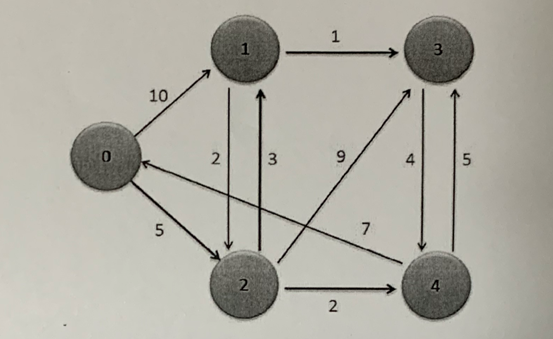
将整体分为两个步骤
1.计算metrixD矩阵(两顶点之间的最短距离)和P矩阵(两顶点的中介点)
#include <stdio.h>

#include <stdlib.h>

void Create_metrixD_P(int** metrixD, int **P ,int VerNum, int EdgNum)

{

    int x, y, Weight, edg_count = ;

    int i, j, k;

    for (i = ; i < VerNum; ++i) {

        for (j = ; j < VerNum; ++j) {

            metrixD[i][j] = INT_MAX;

            P[i][j] = j;

        }

    }

    while (edg_count < EdgNum) {

        scanf("%d%d%d", &x, &y, &Weight);

        metrixD[x - ][y - ] = Weight;

        edg_count++;

    }

}

//Floyd algorithm

void Floyd(int **metirxD, int **P, int VerNum) {

    int n, x, y, temp = ;

    //The triple loop looks for shortest paths and weights

    for (n = ; n < VerNum; ++n) {

        for (x = ; x < VerNum; ++x) {

            for (y = ; y < VerNum; ++y) {

                //The distance between two vertices is compared to the distance through a vertex

                temp = (metirxD[x][n] == INT_MAX || metirxD[n][y] == INT_MAX) ? INT_MAX : (metirxD[x][n] + metirxD[n][y]);

                if (temp < metirxD[x][y]) {

                    //Update matrix information

                    metirxD[x][y] = temp;

                    P[x][y] = n;

                }

            }

        }

    }

}

void Show_metrixD_P(int** metrixD, int **P, int VerNum)

{

    int x, y;

    printf("metrixD:\n");

    for (x = ; x < VerNum; ++x) {

        for (y = ; y < VerNum; ++y) {

            if (metrixD[x][y] == INT_MAX) {

                printf("∞ ");

            }

            else {

                printf("%d ", metrixD[x][y]);

            }

        }

        printf("\n");

    }

    printf("P:\n");

    for (x = ; x < VerNum; ++x) {

        for (y = ; y < VerNum; ++y) {

            printf("%d ", P[x][y]);

        }

        printf("\n");

    }

}

int main(void)

{

    int VerNum, EdgNum, i;

    int** metrixD, ** P;

    printf("Enter the number of vertices and edges:");

    scanf("%d%d", &VerNum, &EdgNum);

    metrixD = (int**)malloc(VerNum * sizeof(int));

    P = (int**)malloc(VerNum * sizeof(int));

    for (i = ; i < VerNum; ++i) {

        metrixD[i] = (int*)malloc(VerNum * sizeof(int));

        P[i] = (int*)malloc(VerNum * sizeof(int));

    }

    printf("Input vertices and weights:");

    Create_metrixD_P(metrixD, P, VerNum, EdgNum);

    Floyd(metrixD, P, VerNum);

    Show_metrixD_P(metrixD, P, VerNum);

    for (i = ; i < VerNum; ++i) {

        free(metrixD[i]);

        free(P[i]);

    }

    free(metrixD);

    free(P);

    return ;

}
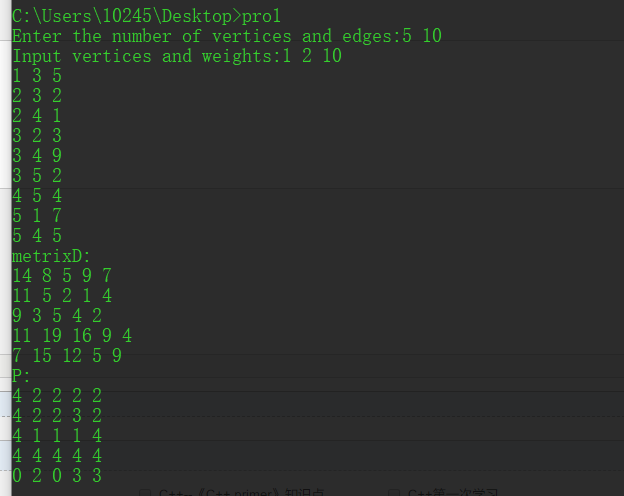
2.输出顶点之间的最短距离与路径
#include <stdio.h>

#include <stdlib.h>

#define VEXNUM 5

//Adjacency matrix: shows the distance between vertices

int metirxD[VEXNUM][VEXNUM] = {

INT_MAX,,        ,        INT_MAX,INT_MAX,

INT_MAX,INT_MAX,,        ,        INT_MAX,

INT_MAX,,        INT_MAX,,        ,

INT_MAX,INT_MAX,INT_MAX,INT_MAX,,

,        INT_MAX,INT_MAX,,        INT_MAX

};

//Path: passing vertex between two vertices

int P[VEXNUM][VEXNUM] = {

,,,,,

,,,,,

,,,,,

,,,,,

,,,,

};

//Floyd algorithm

void Floyd() {

    int n, x, y, temp = ;

    //The triple loop looks for shortest paths and weights

    for (n = ; n < VEXNUM; ++n) {

        for (x = ; x < VEXNUM; ++x) {

            for (y = ; y < VEXNUM; ++y) {

                //The distance between two vertices is compared to the distance through a vertex

                temp = (metirxD[x][n] == INT_MAX || metirxD[n][y] == INT_MAX) ? INT_MAX : (metirxD[x][n] + metirxD[n][y]);

                if (temp < metirxD[x][y]) {

                    //Update matrix information

                    metirxD[x][y] = temp;

                    P[x][y] = n;

                }

            }

        }

    }

}

void Show_Path() {

    int x, y, temp = ;

    //Output the shortest path between two vertices

    for (x = ; x < VEXNUM - ; ++x) {

        for (y = x + ; y < VEXNUM; ++y) {

            printf("V%d-->V%d  weight:%d  path:V%d", x, y, metirxD[x][y], x);

            temp = P[x][y];

            while (temp != y) {

                printf("-->V%d", temp);

                temp = P[temp][y];

            }

            printf("-->V%d", y);

            printf("\n");

        }

    }

}

int main(void)

{

    Floyd();

    Show_Path();

    return ;

}

完整代码
#include <stdio.h>

#include <stdlib.h>

void Create_metrixD_P(int** metrixD, int **P ,int VerNum, int EdgNum)

{

    int x, y, Weight, edg_count = ;

    int i, j, k;

    for (i = ; i < VerNum; ++i) {

        for (j = ; j < VerNum; ++j) {

            metrixD[i][j] = INT_MAX;

            P[i][j] = j;

        }

    }

    while (edg_count < EdgNum) {

        scanf("%d%d%d", &x, &y, &Weight);

        metrixD[x - ][y - ] = Weight;

        edg_count++;

    }

}

//Floyd algorithm

void Floyd(int **metirxD, int **P, int VerNum) {

    int n, x, y, temp = ;

    //The triple loop looks for shortest paths and weights

    for (n = ; n < VerNum; ++n) {

        for (x = ; x < VerNum; ++x) {

            for (y = ; y < VerNum; ++y) {

                //The distance between two vertices is compared to the distance through a vertex

                temp = (metirxD[x][n] == INT_MAX || metirxD[n][y] == INT_MAX) ? INT_MAX : (metirxD[x][n] + metirxD[n][y]);

                if (temp < metirxD[x][y]) {

                    //Update matrix information

                    metirxD[x][y] = temp;

                    P[x][y] = n;

                }

            }

        }

    }

}

void Show_metrixD_P(int** metrixD, int **P, int VerNum)

{

    int x, y;

    printf("metrixD:\n");

    for (x = ; x < VerNum; ++x) {

        for (y = ; y < VerNum; ++y) {

            if (metrixD[x][y] == INT_MAX) {

                printf("∞ ");

            }

            else {

                printf("%d ", metrixD[x][y]);

            }

        }

        printf("\n");

    }

    printf("P:\n");

    for (x = ; x < VerNum; ++x) {

        for (y = ; y < VerNum; ++y) {

            printf("%d ", P[x][y]);

        }

        printf("\n");

    }

}

void Show_Path(int **metirxD, int **P, int VerNum) {

    int x, y, temp = ;

    //Output the shortest path between two vertices

    for (x = ; x < VerNum - ; ++x) {

        for (y = x + ; y < VerNum; ++y) {

            printf("V%d-->V%d  weight:%d  path:V%d", x, y, metirxD[x][y], x);

            temp = P[x][y];

            while (temp != y) {

                printf("-->V%d", temp);

                temp = P[temp][y];

            }

            printf("-->V%d", y);

            printf("\n");

        }

    }

}

int main(void)

{

    int VerNum, EdgNum, i;

    int** metrixD, ** P;

    printf("Enter the number of vertices and edges:");

    scanf("%d%d", &VerNum, &EdgNum);

    metrixD = (int**)malloc(VerNum * sizeof(int));

    P = (int**)malloc(VerNum * sizeof(int));

    for (i = ; i < VerNum; ++i) {

        metrixD[i] = (int*)malloc(VerNum * sizeof(int));

        P[i] = (int*)malloc(VerNum * sizeof(int));

    }

    printf("Input vertices and weights:");

    Create_metrixD_P(metrixD, P, VerNum, EdgNum);

    Floyd(metrixD, P, VerNum);

    Show_metrixD_P(metrixD, P, VerNum);

    Show_Path(metrixD, P, VerNum);

    for (i = ; i < VerNum; ++i) {

        free(metrixD[i]);

        free(P[i]);

    }

    free(metrixD);

    free(P);

    return ;

}
Floyd(弗洛伊德)算法(C语言)的更多相关文章
- 经典问题----最短路径(Floyd弗洛伊德算法)(HDU2066)
问题简介: 给定T条路,S个起点,D个终点,求最短的起点到终点的距离. 思路简介: 弗洛伊德算法即先以a作为中转点,再以a.b作为中转点,直到所有的点都做过中转点,求得所有点到其他点的最短路径,Flo ...
- Floyd弗洛伊德算法
先看懂如何使用 用Java实现一个地铁票价计算程序 String station = "A1 A2 A3 A4 A5 A6 A7 A8 A9 T1 A10 A11 A12 A13 T2 A1 ...
- 数据结构C语言版 弗洛伊德算法实现
/* 数据结构C语言版 弗洛伊德算法 P191 编译环境:Dev-C++ 4.9.9.2 */ #include <stdio.h>#include <limits.h> # ...
- Floyd算法(弗洛伊德算法)
算法描述: Floyd算法又称为弗洛伊德算法,插点法,是一种用于寻找给定的加权图中顶点间最短路径的算法.从图的带权邻接矩阵A=[a(i,j)] n×n开始,递归地进行n次更新,即由矩阵D(0)=A,按 ...
- 弗洛伊德算法(Floyd算法)
原博来自http://www.cnblogs.com/skywang12345/ 弗洛伊德算法介绍 和Dijkstra算法一样,弗洛伊德(Floyd)算法也是一种用于寻找给定的加权图中顶点间最短路径的 ...
- 弗洛伊德算法(Floyd )
package com.rao.graph; /** * @author Srao * @className Floyd * @date 2019/12/11 18:43 * @package com ...
- [从今天开始修炼数据结构]图的最短路径 —— 迪杰斯特拉算法和弗洛伊德算法的详解与Java实现
在网图和非网图中,最短路径的含义不同.非网图中边上没有权值,所谓的最短路径,其实就是两顶点之间经过的边数最少的路径:而对于网图来说,最短路径,是指两顶点之间经过的边上权值之和最少的路径,我们称路径上第 ...
- Floyd最短路径算法
看完这篇文章写的小程序,Floyd最短路径算法,求从一个点到另一个点的最短距离,中间可以经过其他任意个点.三个for循环,从i到j依次经过k的最短距离,最外层for循环是经过点K,内部两个循环是从i( ...
- 【转】位置式、增量式PID算法C语言实现
位置式.增量式PID算法C语言实现 芯片:STM32F107VC 编译器:KEIL4 作者:SY 日期:2017-9-21 15:29:19 概述 PID 算法是一种工控领域常见的控制算法,用于闭环反 ...
随机推荐
- 黑客代码HTML
Crash firefox, chrome, safari browsers, and also restart iPhone using this javascript code. #dos #0d ...
- javascript之大文件分段上传、断点续传(一)
需求: 支持大文件批量上传(20G)和下载,同时需要保证上传期间用户电脑不出现卡死等体验: 内网百兆网络上传速度为12MB/S 服务器内存占用低 支持文件夹上传,文件夹中的文件数量达到1万个以上,且包 ...
- 6.12友谊赛T4城市交通费题解
与普通的最短路径不同的是,题目中新引入了一个计入总体的费用——城市建设费.由于城市建设费由整体的某最大值决定,导致解没有最优子结构的性质,给思维带来难度. 既然最棘手的是城市建设费,我们就对它分类讨论 ...
- django model 操作总结
使用场景 一对一:在某表中创建一行数据时,有一个单选的下拉框(下拉框中的内容被用过一次就消失了).//两个表的数据一一对应 例如:原有含10列数据的一张表保存相关信息,经过一段时间之后,10列无法满足 ...
- Linux用户和用户组指令
1.创建用户 >useradd username 创建用户 >passwd username 给用户设置密码 ======================================= ...
- UOJ418. 【集训队作业2018】三角形
http://uoj.ac/problem/418 题解 考虑激活每个节点时,它的每个儿子都是放满的. 那每一次的操作我们可以用一个二元组来表示\((w_i-\sum w_{son},\sum w_{ ...
- 学习日记15-1布局页同时引用多个model
@model Tuple<model1,model2> mvc布局页同时引用多个model 使用m.Item1.xxx m.Item2.xxx
- 大数据笔记(十八)——Pig的自定义函数
Pig的自定义函数有三种: 1.自定义过滤函数:相当于where条件 2.自定义运算函数: 3.自定义加载函数:使用load语句加载数据,生成一个bag 默认:一行解析成一个Tuple 需要MR的ja ...
- 9 关联管理器(RelatedManager)
知识预览: class RelatedManager class RelatedManager "关联管理器"是在一对多或者多对多的关联上下文中使用的管理器.它存在于下面两种情况: ...
- iView 实战系列教程(21课时)_1.iView 实战教程之配置篇_图片优化
首先需要安装vue cli 3.0版本 点击添加插件, 输入iview 选中后安装 全部导入还是按需导入. 2.是否需要自定义主题变量 3.多语言的设置. 这里我们全部选择为默认 然后点击继续. 启动 ...