
Microcontroller measures resistance without an ADC
Sensors automate most of the processes in industry. Most of these sensors, such as those for ammonia gas, temperature, and the like, are resistive devices in which electrical resistance changes—mostly nonlinearly—as the surrounding conditions change. The sensors’ resistances may vary from 1 mΩ to 10 MΩ.
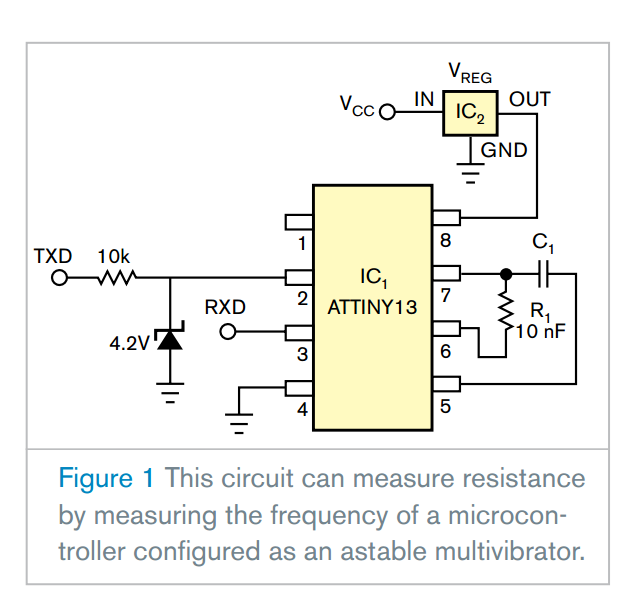
Figure 1 illustrates a circuit for resistance measurement. The circuit uses an eight-pin AVR microcontroller, a Tiny13V from Atmel, for the controller. The Tiny13V works over a supply-voltage range of 1.8 to 5.5V.
This design implements an equivalent oscillator based on the principle of an astable multivibrator in the Tiny13 (Figure 2).
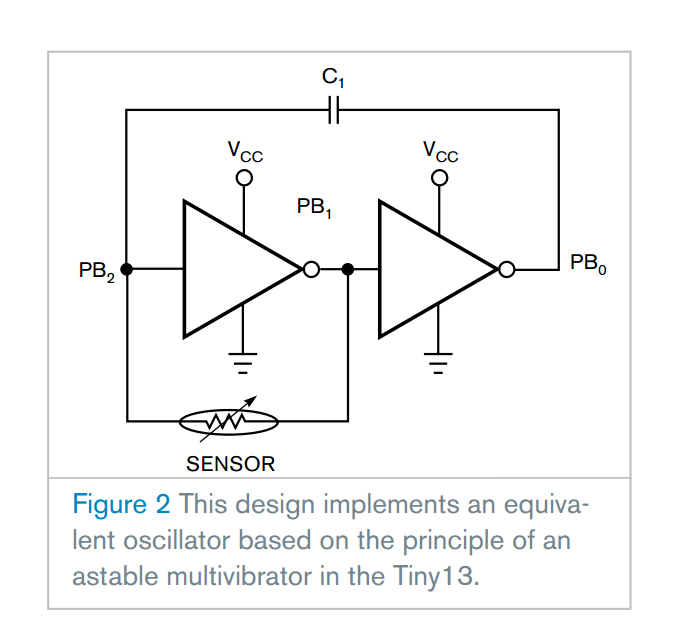
The oscillator has no stable states, and the signal keeps oscillating between two quasistable states. This oscillator produces a frequency that depends on the value of the resistor. As resistance increases, frequency decreases, and you can easily measure this frequency to yield the value of the resistance.
The resistance you want to measure connects between any two general-purpose I/O pins of the microcontroller, and a capacitor, C1, of known value connects across the other general-purpose I/O pin. Note that PB0 and PB1 are always in different states to implement a NOT gate. PB2 measures a high or a low across resistor R1.
Initially, PB0 is high, PB1 is low, and there is a high-impedance state at PB2. As a result, the capacitor starts charging with time-constant RC. Note that the capacitor initially acts as a short, and PB2 senses a high. As the capacitor charges, the voltage across the resistor decreases, and, when PB2 detects a low, PB1 goes high and PB0 goes low.
Next, as the capacitor discharges, the potential across the resistor builds up, and, when PB2 detects a high, PB0 goes high and PB1 goes low. In this fashion, measuring the frequency or half the number of toggles of PB0 in a second gives an inverse relation of resistance, R1 (in Figure 1), with frequency, f: R1=k/f, where k is a proportionality constant. The result travels to a PC through a serial RS-232 interface. Because the Tiny13 has no UART, a software UART program and the program for measuring resistance are available.
Microcontroller measures resistance without an ADC的更多相关文章
- [转]A Guide To using IMU (Accelerometer and Gyroscope Devices) in Embedded Applications.
原文地址http://www.starlino.com/imu_guide.html Introduction There’s now a FRENCH translation of this art ...
- Create a DAC from a microcontroller's ADC
Few microcontrollers include a DAC. Although you can easily find an inexpensive DAC to control from ...
- ADC分类及参数
ADC分类 直接转换模拟数字转换器(Direct-conversion ADC),或称Flash模拟数字转换器(Flash ADC) 循续渐近式模拟数字转换器(Successive approxima ...
- USB ISP(ICSP) Open Programmer < PWM ADC HV PID >
http://sourceforge.net/projects/openprogrammer/?source=navbar Open Programmer http://openprog.alterv ...
- Voltage Translation for Analog to Digital Interface ADC
Voltage Translation for Analog to Digital Interface 孕龙逻辑分析仪 ZeroPlus Logic Analyzer How to modify an ...
- ADC and DAC Analog Filters for Data Conversion
Figure 3-7 shows a block diagram of a DSP system, as the sampling theorem dictates it should be. Bef ...
- Driving proportional valves from microcontroller
Driving proportional valves from microcontroller I am looking to drive a current regulated proportio ...
- AN2820 Driving bipolar stepper motors using a medium-density STM32F103xx microcontroller
AN2820 Driving bipolar stepper motors using a medium-density STM32F103xx microcontroller Introductio ...
- PID DC/DC Converter Controller Using a PICmicro Microcontroller
http://www.microchip.com/stellent/idcplg?IdcService=SS_GET_PAGE&nodeId=1824&appnote=en011794 ...
随机推荐
- ACM International Collegiate Programming Contest World Finals 2014
ACM International Collegiate Programming Contest World Finals 2014 A - Baggage 题目描述:有\(2n\)个字符摆在编号为\ ...
- oracle造成系统CPU过高的检查sql
1. 根据占用CPU高的进程号来查询这个进程执行的SQL语句: CPU过高的进程号: #首先找到CPU过高的进程号 # top -bn1 是静态找到占用最高的进程 [root@localhost ~] ...
- 自动ftp 上传
#!/bin/sh ftp -n<<END_FTP open 192.168.1.4 user codfei duibuqi //用户名codfei 密码duibuqi binary pr ...
- 3.rabbitmq 发布/订阅
1. 发布者 #coding:utf8 import pika import json import sys message = ''.join(sys.argv[1:]) or "hell ...
- LightOJ 1323 Billiard Balls(找规律(蚂蚁爬木棍))
题目链接:https://vjudge.net/contest/28079#problem/M 题目大意: 一个边界长为L宽为W的平面同时发射n个台球,运动K秒,台球碰到桌面及两(多)个台球相撞情况如 ...
- ubuntu 防火墙关闭的80端口,开启方法
#关闭防火墙 /etc/init.d/iptables stopservice iptables stop # 停止服务#查看防火墙信息/etc/init.d/iptables status #开放端 ...
- OOD沉思录 --- 面向动作与面向对象 --- 避免全能类
面向过程的软件开发通过非常集中化的控制机制来分解功能,在程序设计中表现就是大量的条件判断,深层次的循环嵌套等. 这种模式下,我们可以通过分析方法的参数,局部变量及其访问的全局变量来得到方法对数据的依赖 ...
- Python函数-闭包的概念
一个函数和它的环境变量合在一起,就构成了一个闭包(closure).在Python中,所谓的闭包是一个包含有环境变量取值的函数对象.环境变量取值被保存在函数对象的__closure__属性中.比如下面 ...
- Am335x u-boot 代码大概流程
在_面之前的流程和u-boot-spl一样,区别在于_main中. 对于u-boot 2016.03来说 ENTRY(_main) /* * Set up initial C runtime envi ...
- shell 切分文件名提取文件扩展名或提取文件名
有些脚本要根据文件名进行各种处理,有时候需要保留文件名抛弃文件后缀,也有时候需要文件后缀不要文件名,这类提取文件部分的操作使用shell的内建功能就能实现.需要用到的几个操作符有:%.%%.#.##. ...