
[leetcode]381. Insert Delete GetRandom O(1) - Duplicates allowed常数时间插入删除取随机值
Design a data structure that supports all following operations in average O(1) time.
Note: Duplicate elements are allowed.
insert(val): Inserts an item val to the collection.remove(val): Removes an item val from the collection if present.getRandom: Returns a random element from current collection of elements. The probability of each element being returned is linearly related to the number of same value the collection contains.
Example:
// Init an empty collection.

RandomizedCollection collection = new RandomizedCollection();

// Inserts 1 to the collection. Returns true as the collection did not contain 1.

collection.insert(1);

// Inserts another 1 to the collection. Returns false as the collection contained 1. Collection now contains [1,1].

collection.insert(1);

// Inserts 2 to the collection, returns true. Collection now contains [1,1,2].

collection.insert(2);

// getRandom should return 1 with the probability 2/3, and returns 2 with the probability 1/3.

collection.getRandom();

// Removes 1 from the collection, returns true. Collection now contains [1,2].

collection.remove(1);

// getRandom should return 1 and 2 both equally likely.

collection.getRandom();
Solution1: HashMap + ArrayList
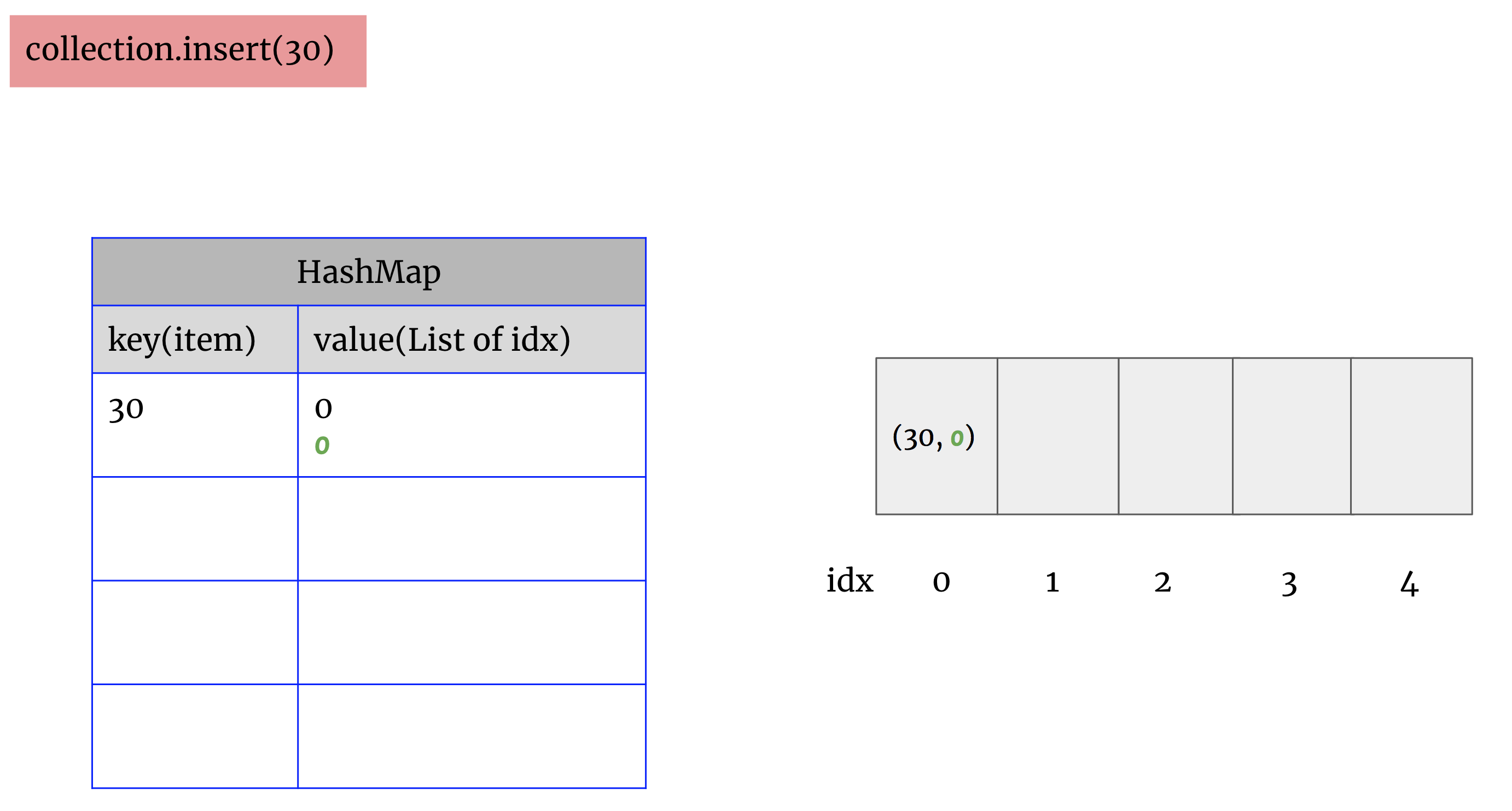
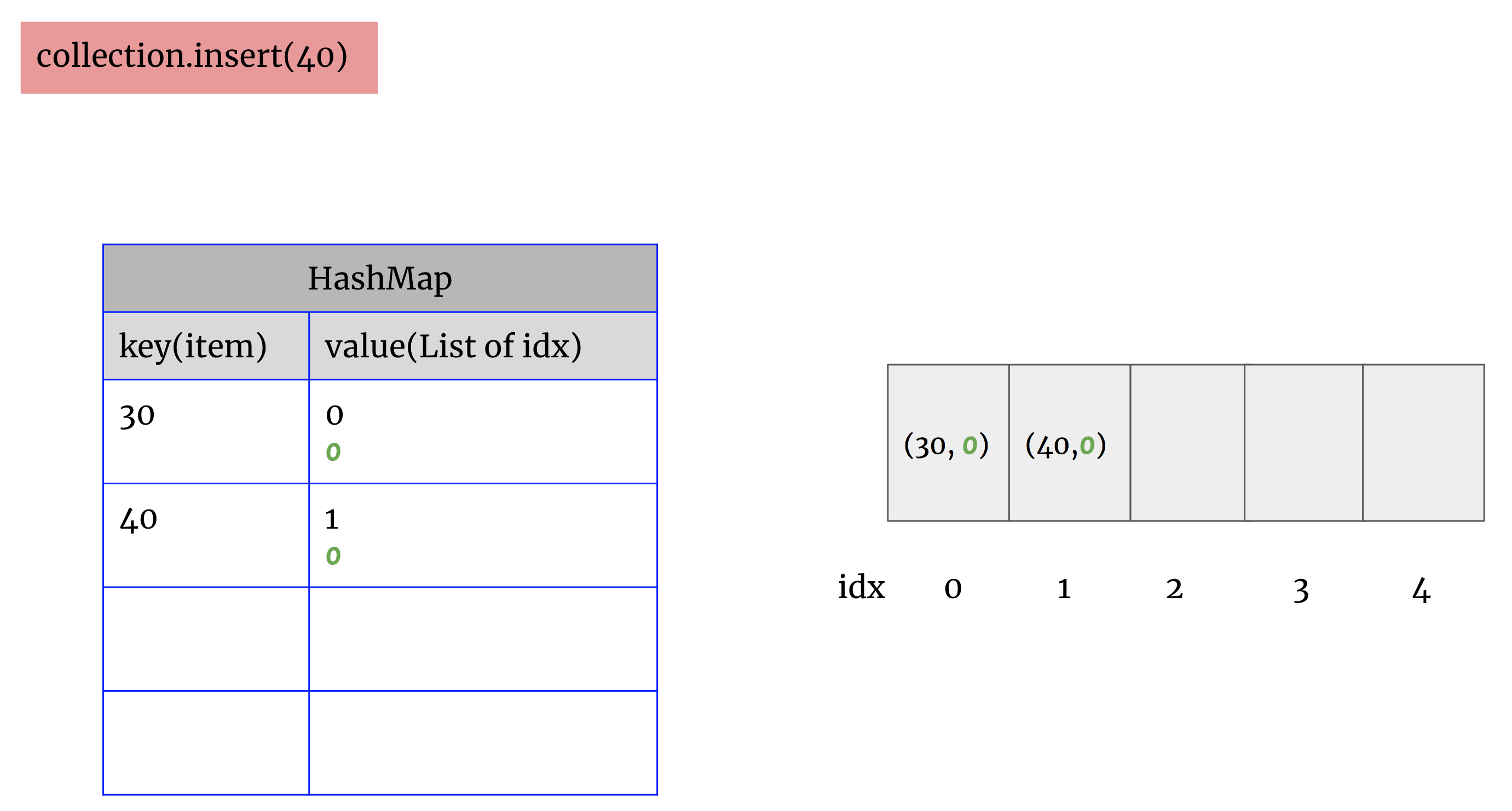
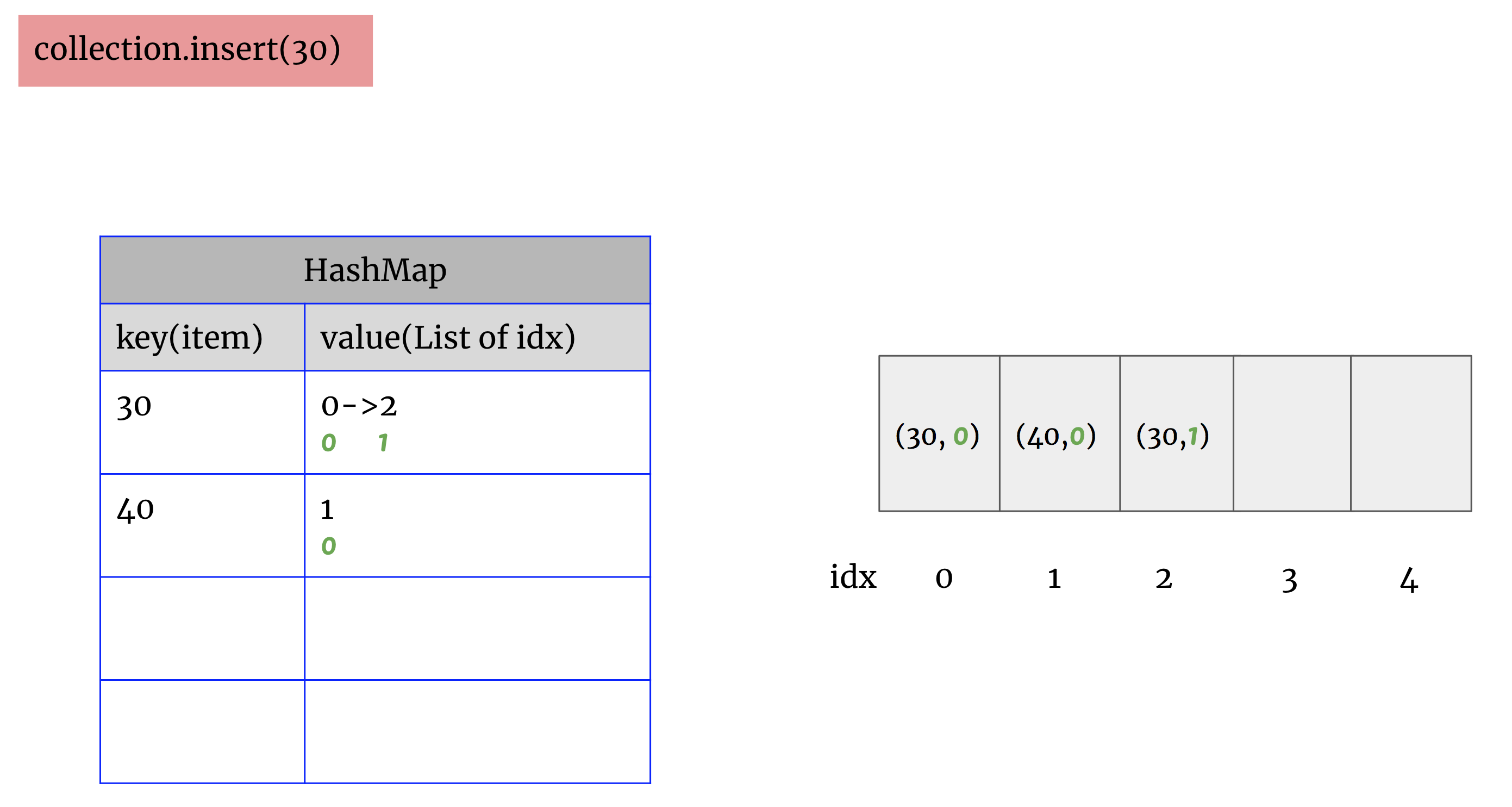
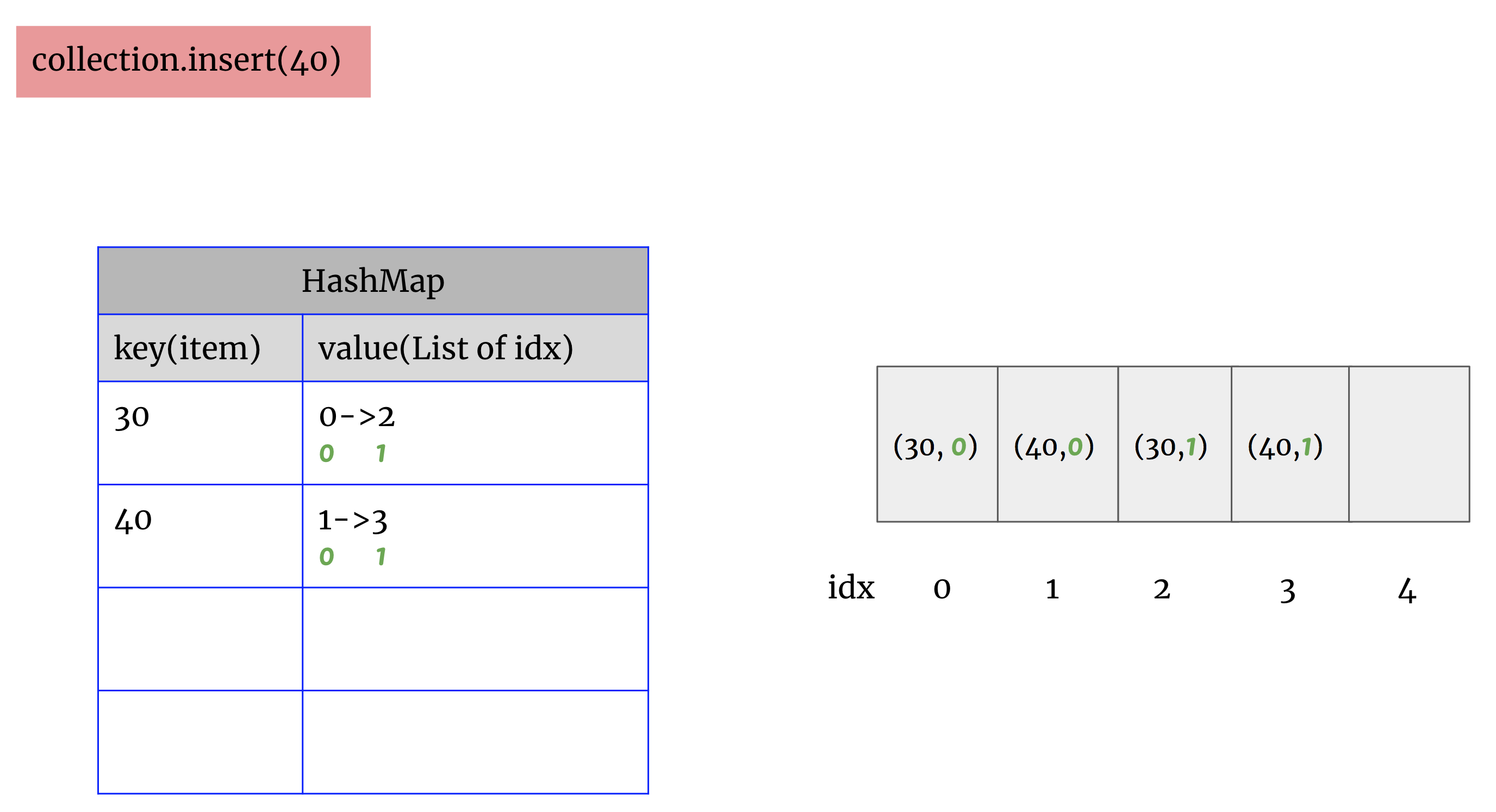
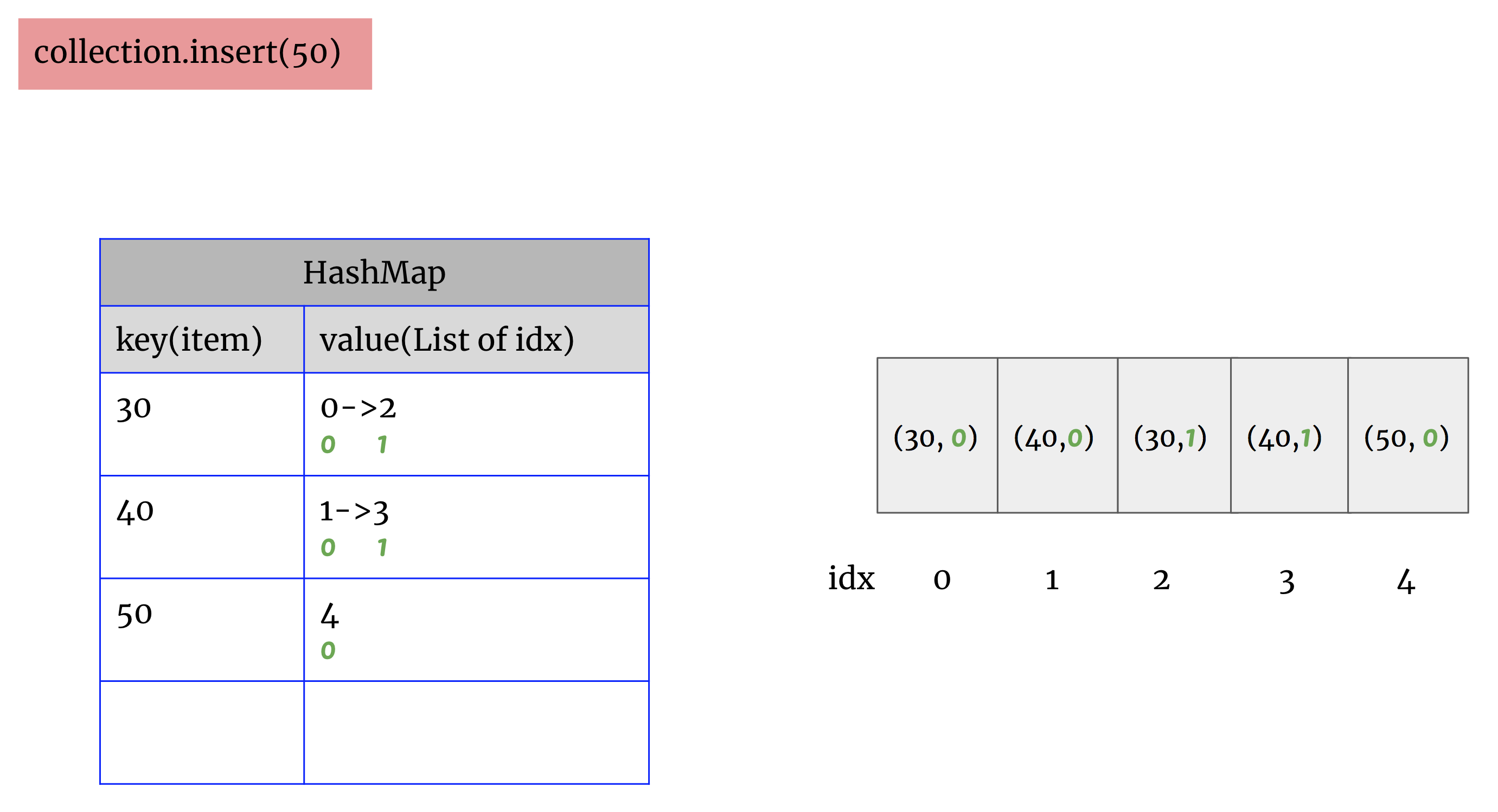
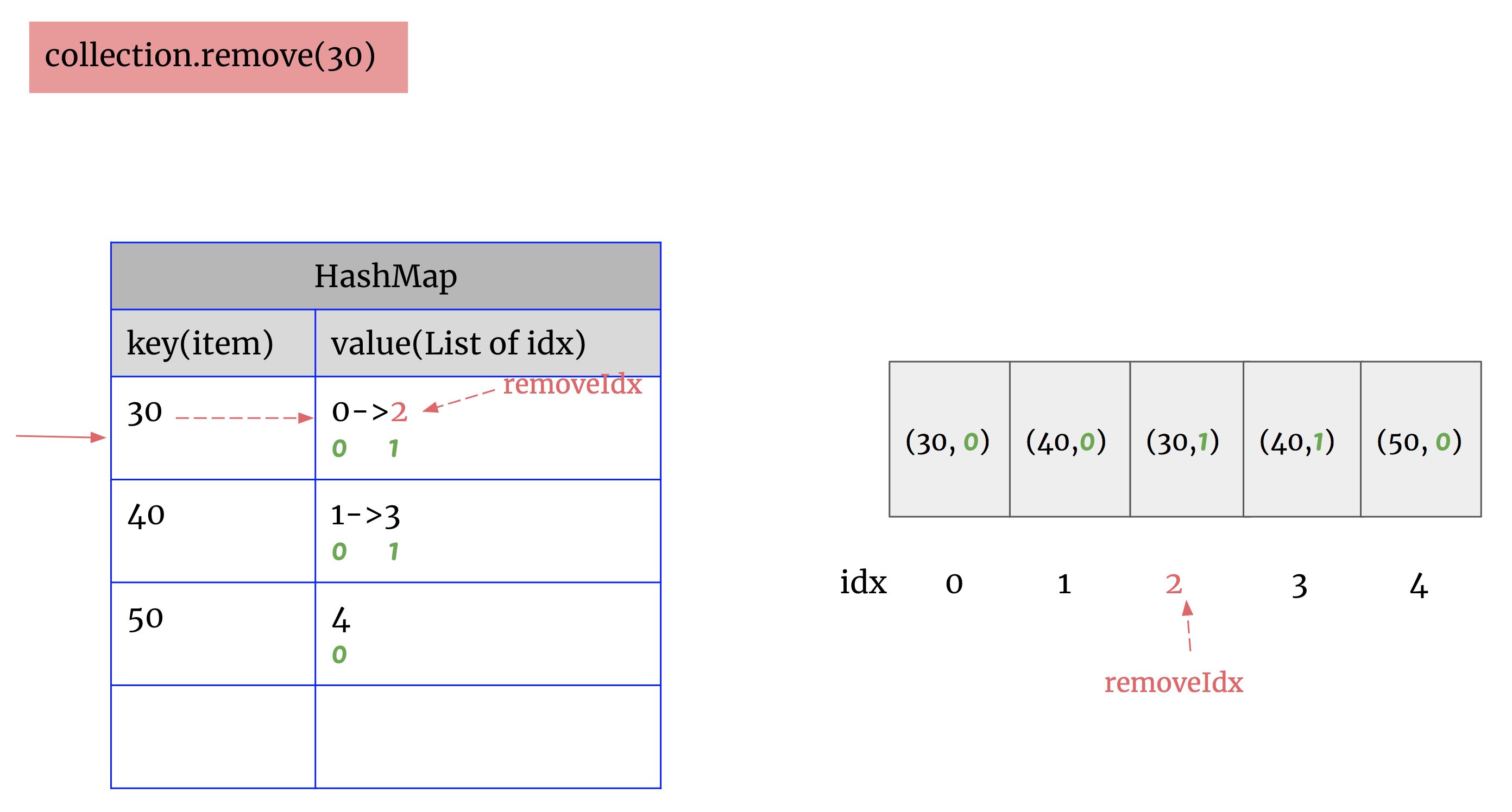
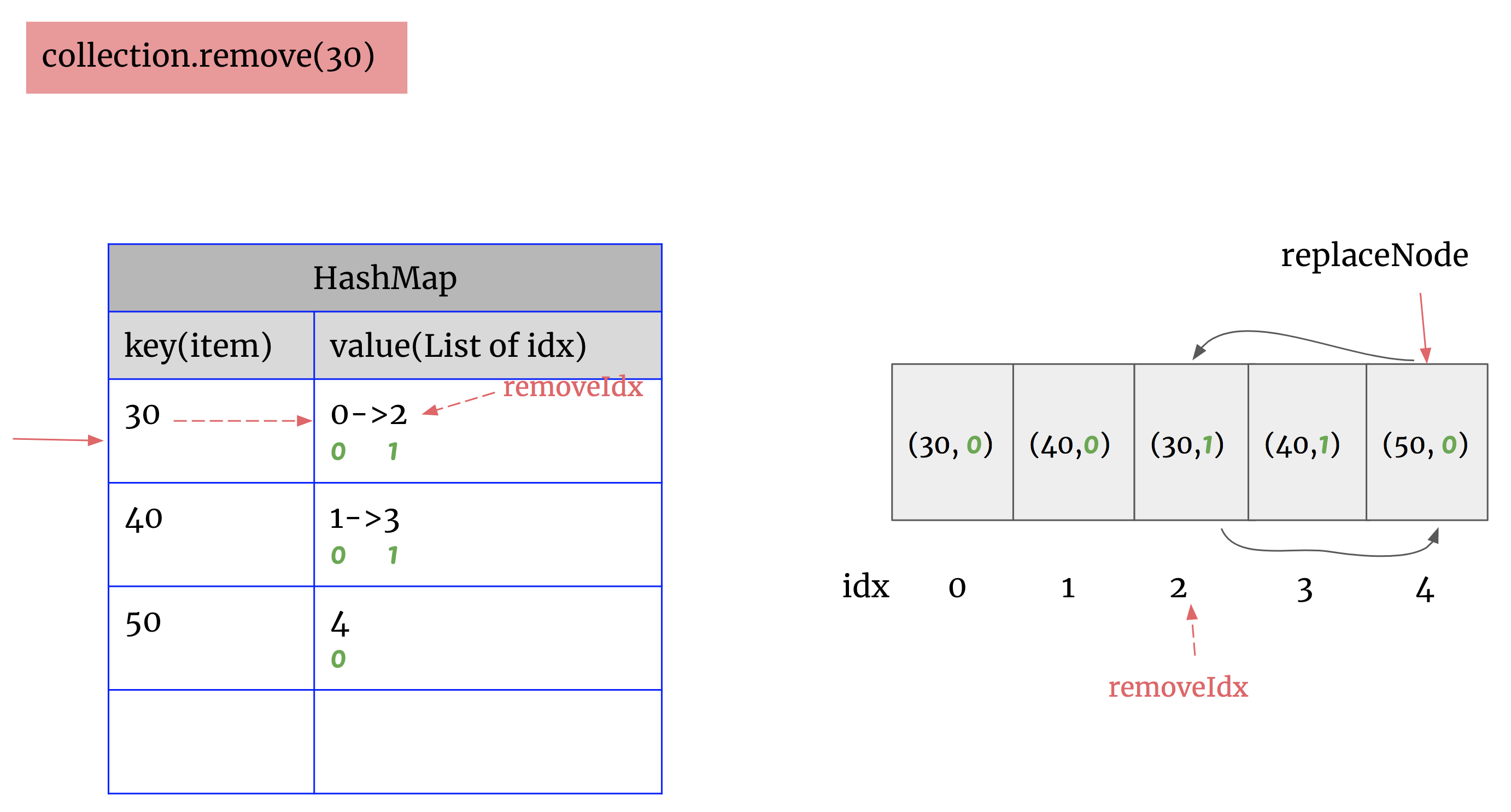
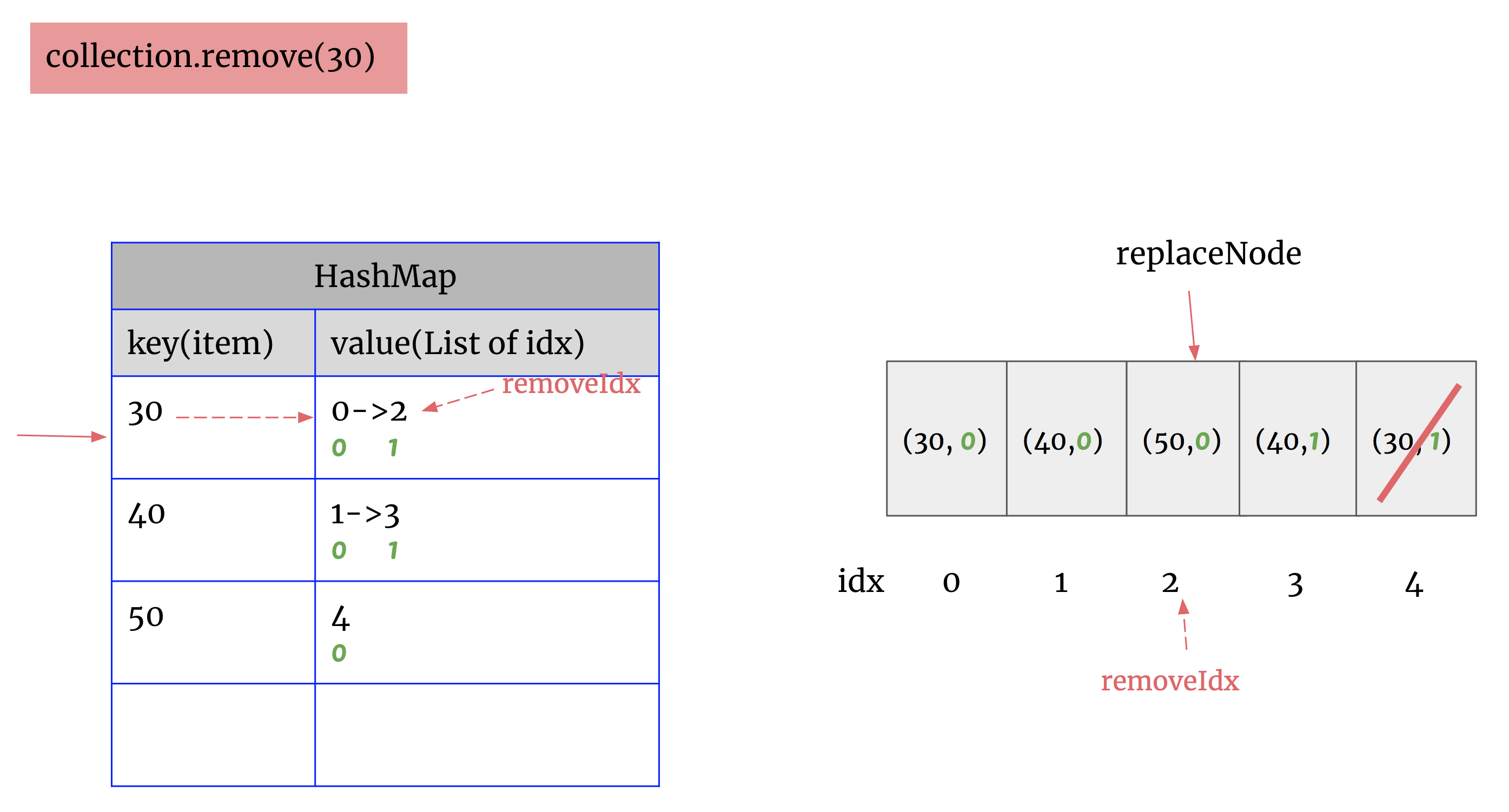
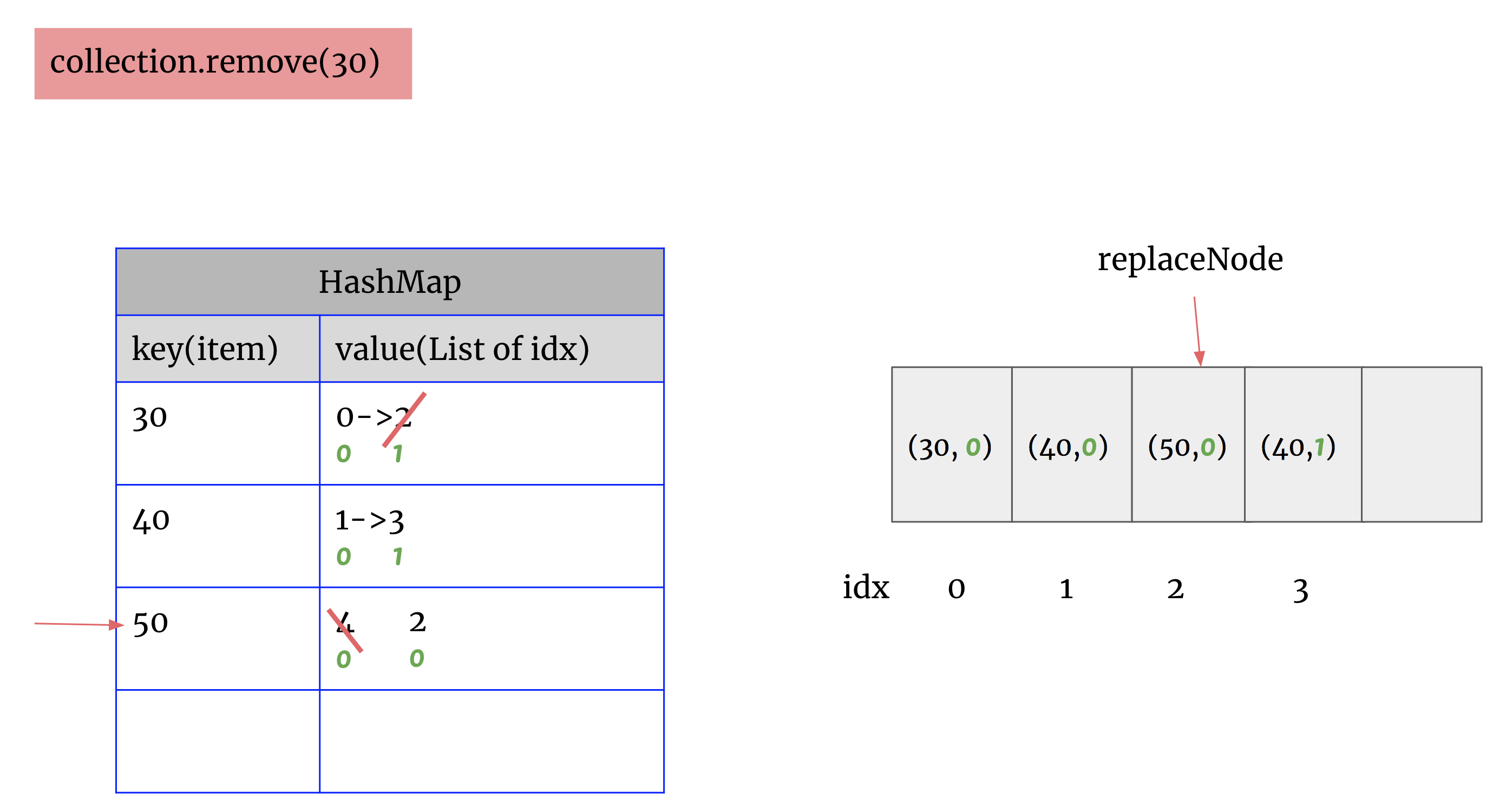
code
 public class RandomizedCollection {

     class Node {

         public int value;

         public int index;

         public Node(int val, int idx) {

             value = val;

             index = idx;

         }

     }

     private Map<Integer, List<Integer>> map;

     private List<Node> list;

     private Random r;

     /** Initialize your data structure here. */

     public RandomizedCollection() {

         map = new HashMap<>();

         list = new ArrayList<>();

         r = new Random();

     }

     /** Inserts a value to the collection. Returns true if the collection did not already contain the specified element. */

     public boolean insert(int val) {

         List<Integer> l = map.getOrDefault(val, new ArrayList<>());

         l.add(list.size());

         map.put(val, l);

         list.add(new Node(val, l.size() - 1));

         return l.size() == 1;

     }

     /** Removes a value from the collection. Returns true if the collection contained the specified element. */

     public boolean remove(int val) {

         if (!map.containsKey(val)) return false;

         List<Integer> l = map.get(val);

         int removeIdx = l.get(l.size() - 1);

         Node replaceNode = list.get(list.size() - 1);

         // deal with HashMap

          map.get(replaceNode.value).set(replaceNode.index, removeIdx);

          l.remove(l.size() - 1);

          if (l.size() == 0) map.remove(val);

         // deal with List

         list.set(removeIdx, replaceNode);

         list.remove(list.size() - 1);

         return true;

     }

     /** Get a random element from the collection. */

     public int getRandom() {

         return list.get(r.nextInt(list.size())).value;

     }

 }
[leetcode]381. Insert Delete GetRandom O(1) - Duplicates allowed常数时间插入删除取随机值的更多相关文章
- [LeetCode] 381. Insert Delete GetRandom O(1) - Duplicates allowed 常数时间内插入删除和获得随机数 - 允许重复
Design a data structure that supports all following operations in average O(1) time. Note: Duplicate ...
- [LeetCode] Insert Delete GetRandom O(1) - Duplicates allowed 常数时间内插入删除和获得随机数 - 允许重复
Design a data structure that supports all following operations in average O(1) time. Note: Duplicate ...
- [LeetCode] 381. Insert Delete GetRandom O(1) - Duplicates allowed 插入删除和获得随机数O(1)时间 - 允许重复
Design a data structure that supports all following operations in average O(1) time. Note: Duplicate ...
- LeetCode 381. Insert Delete GetRandom O(1) - Duplicates allowed O(1) 时间插入、删除和获取随机元素 - 允许重复(C++/Java)
题目: Design a data structure that supports all following operations in averageO(1) time. Note: Duplic ...
- LeetCode 381. Insert Delete GetRandom O(1) - Duplicates allowed
原题链接在这里:https://leetcode.com/problems/insert-delete-getrandom-o1-duplicates-allowed/?tab=Description ...
- LeetCode 381. Insert Delete GetRandom O(1) - Duplicates allowed (插入删除和获得随机数 常数时间 允许重复项)
Design a data structure that supports all following operations in average O(1) time. Note: Duplicate ...
- [leetcode]380. Insert Delete GetRandom O(1)常数时间插入删除取随机值
Design a data structure that supports all following operations in average O(1) time. insert(val): In ...
- leetcode 380. Insert Delete GetRandom O(1) 、381. Insert Delete GetRandom O(1) - Duplicates allowed
380. Insert Delete GetRandom O(1) 实现插入.删除.获得随机数功能,且时间复杂度都在O(1).实际上在插入.删除两个功能中都包含了查找功能,当然查找也必须是O(1). ...
- 381. Insert Delete GetRandom O(1) - Duplicates allowed
Design a data structure that supports all following operations in average O(1) time. Note: Duplicate ...
随机推荐
- LVM逻辑卷创建管理
首先添加三块硬盘 结构关系图 相关命令 查看磁盘 #fdisk -l 分区 #fdisk /dev/sda/ #n新建 ProMary主分区 extended扩展分区 #p查看 #q不保存退出 #w保 ...
- 3dsMax模型转UE4
转自:http://blog.csdn.net/qq_24835213/article/details/68063344 一.模型设置: 1.将Vary材质转成标准材质 2.将模型减面 3.加一套UV ...
- sklearn的GridSearchCV例子
class sklearn.model_selection.GridSearchCV(estimator, param_grid, scoring=None, fit_params=None, n_j ...
- IO基础知识
传统的IO是阻塞的,BIO----基于流的模式,数据与Stream直接通信 NIO非阻塞的基于快的模式.数据与channel不直接交换数据,而是通过buffer进行数据交换. 基于文件的IO 基于网络 ...
- ECCV 2018 | Bi-Real net:超XNOR-net 10%的ImageNet分类精度
这项工作由香港科技大学,腾讯 AI lab,以及华中科技大学合作完成,目的是提升二值化卷积神经网络(1-bit CNN)的精度.虽然 1-bit CNN 压缩程度高,但是其当前在大数据集上的分类精度与 ...
- SQL SERVER回滚恢复误操作的数据
在生产数据库做CURD操作时,可能会有执行某条语句误操作的情况发生,针对这个种情况有两点建议: 1. 在SQL SERVER上开启事务确认功能,当执行完语句后确认无误,再提交事务.(开启方法见附件图片 ...
- InterlliJ IDEA 2017.3.x / 2017.3.4 License Server激活
InterlliJ IDEA 2017.3.x / 2017.3.4 License Server激活 1.Lincense Server激活 // 激活IDEA的License Server 地址 ...
- 并发工具类(二)同步屏障CyclicBarrier
前言 JDK中为了处理线程之间的同步问题,除了提供锁机制之外,还提供了几个非常有用的并发工具类:CountDownLatch.CyclicBarrier.Semphore.Exchanger.Ph ...
- Eclipse变量名自动补全问题 自定义上屏按键为TAB
Eclipse空格等号等都可以上屏,这样有时候输入变量名再按空格就会自动补全,非常讨厌.那么怎么办呢? 1.首先你的Eclipse需要装有 Eclipse plug-in development en ...
- [Delphi] 快速获取文件大小
function GetFileSize(const fName: AnsiString): Int64; var hFile: THandle; begin hFile := _lopen(PAns ...