
[leetcode]380. Insert Delete GetRandom O(1)常数时间插入删除取随机值
Design a data structure that supports all following operations in average O(1) time.
insert(val): Inserts an item val to the set if not already present.remove(val): Removes an item val from the set if present.getRandom: Returns a random element from current set of elements. Each element must have the same probability of being returned.
Example:
// Init an empty set.

RandomizedSet randomSet = new RandomizedSet();

// Inserts 1 to the set. Returns true as 1 was inserted successfully.

randomSet.insert(1);

// Returns false as 2 does not exist in the set.

randomSet.remove(2);

// Inserts 2 to the set, returns true. Set now contains [1,2].

randomSet.insert(2);

// getRandom should return either 1 or 2 randomly.

randomSet.getRandom();

// Removes 1 from the set, returns true. Set now contains [2].

randomSet.remove(1);

// 2 was already in the set, so return false.

randomSet.insert(2);

// Since 2 is the only number in the set, getRandom always return 2.

randomSet.getRandom();
Solution1: HashMap + ArrayList
1. use an ArrayList together with HashMap, making hashmap save key(item)->value(idx)
2. To reverse item in O(1), avoiding traversal the whole arrayList in O(n) time, we swap the toDelete item with last item in the list
3. Go through an example like this:

use HashMap to get removeIdx:

Set the last item in the list as replaceValue, why the last item? In order to maintain other indices.

Deal with HashMap: (1) put (2)delete

Deal with List: (1) set (2)delete
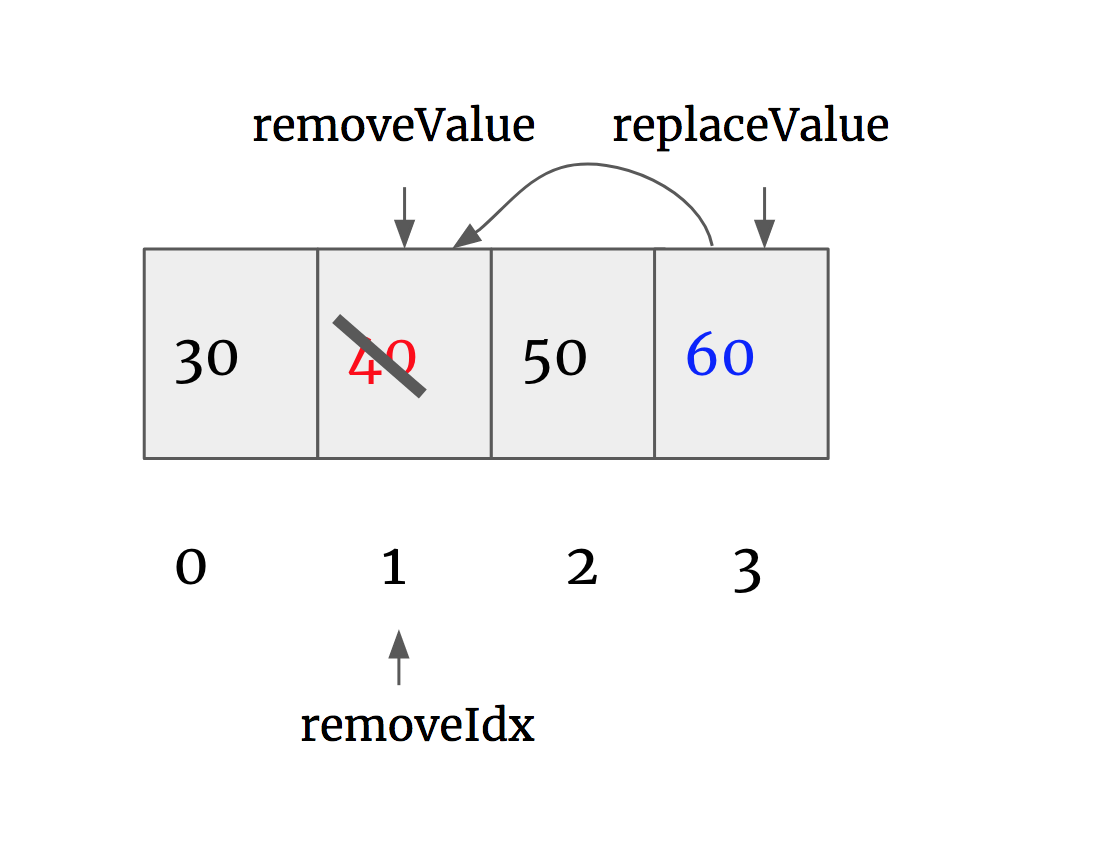
code:
 class RandomizedSet {

     Map<Integer, Integer> map;

     List<Integer> list;

     Random r; // java 自带类

     /** Initialize your data structure here. */

     public RandomizedSet() {

         list = new ArrayList<>();

         map = new HashMap<>();

         r = new Random();

     }

     /** Inserts a value to the set. Returns true if the set did not already contain the specified element. */

     public boolean insert(int val) {

         if (map.containsKey(val)) {

             return false;

         }

         map.put(val, list.size());

         list.add(val);

         return true;

     }

     /** Removes a value from the set. Returns true if the set contained the specified element. */

     public boolean remove(int val) {

         /**

         hashmap

         30 - 0

         40 - 1

         50 - 2

         60 - 3

         list: 30 40  50 60

                0   1  2  3

         **/

         if (!map.containsKey(val))     return false;

         int removeIdx = map.get(val);  // Idx: 1

         int replaceValue = list.get(list.size()-1); // replaceValue : 60

         // deal with map

         map.put(replaceValue, removeIdx);

         map.remove(val);

         // deal with list

         list.set(removeIdx, replaceValue);

         list.remove(list.size() -1);

         return true;

     }

     /** Get a random element from the set. */

     public int getRandom() {

         return list.get(r.nextInt(list.size()));

     }

 }
[leetcode]380. Insert Delete GetRandom O(1)常数时间插入删除取随机值的更多相关文章
- [LeetCode] 380. Insert Delete GetRandom O(1) 常数时间内插入删除和获得随机数
Design a data structure that supports all following operations in average O(1) time. insert(val): In ...
- LeetCode 380. Insert Delete GetRandom O(1) 常数时间插入、删除和获取随机元素(C++/Java)
题目: Design a data structure that supports all following operations in averageO(1) time. insert(val): ...
- [leetcode]381. Insert Delete GetRandom O(1) - Duplicates allowed常数时间插入删除取随机值
Design a data structure that supports all following operations in average O(1) time. Note: Duplicate ...
- [LeetCode] 381. Insert Delete GetRandom O(1) - Duplicates allowed 插入删除和获得随机数O(1)时间 - 允许重复
Design a data structure that supports all following operations in average O(1) time. Note: Duplicate ...
- [LeetCode] Insert Delete GetRandom O(1) 常数时间内插入删除和获得随机数
Design a data structure that supports all following operations in average O(1) time. insert(val): In ...
- [LeetCode] 380. Insert Delete GetRandom O(1) 插入删除获得随机数O(1)时间
Design a data structure that supports all following operations in average O(1) time. insert(val): In ...
- LeetCode 380. Insert Delete GetRandom O(1)
380. Insert Delete GetRandom O(1) Add to List Description Submission Solutions Total Accepted: 21771 ...
- leetcode 380. Insert Delete GetRandom O(1) 、381. Insert Delete GetRandom O(1) - Duplicates allowed
380. Insert Delete GetRandom O(1) 实现插入.删除.获得随机数功能,且时间复杂度都在O(1).实际上在插入.删除两个功能中都包含了查找功能,当然查找也必须是O(1). ...
- LeetCode 380. Insert Delete GetRandom O(1) (插入删除和获得随机数 常数时间)
Design a data structure that supports all following operations in average O(1) time. insert(val): In ...
随机推荐
- day 12
一,什么是装饰器? 装饰器本质上就是一个python函数,他可以让其他函数在不需要做任何代码变动的前提下,增加额外的功能,装饰器的返回值也是一个函数对象. 装饰器的应用场景:比如插入日志,性能测试,事 ...
- DataSource - 常用数据库连接池 (DBCP、c3p0、Druid) 配置说明
1. 引言 1.1 定义 数据库连接是一种关键的有限的昂贵的资源,这一点在多用户的网页应用程序中体现得尤为突出.对数据库连接的管理能显著影响到整个应用程序的伸缩性和健壮性,影响到程序的性能指标.数据库 ...
- bzoj5102: [POI2018]Prawnicy
Description 定义一个区间(l,r)的长度为r-l,空区间的长度为0. 给定数轴上n个区间,请选择其中恰好k个区间,使得交集的长度最大. Input 第一行包含两个正整数n,k(1<= ...
- centos7.6+samba+设置可读可写不可删权限
samba原文 https://www.cnblogs.com/muscleape/p/6385583.html 设置可读可写不可删权限原文: https://blog.51cto.com/guanh ...
- 涨姿势:Java 异常?尝试自定义异常
1.异常 在Java中,每个异常都是一个名叫Throwable的类的一个实例 我们常用的try-catch-finally语句 try 尝试去执行try语句块里的内容,如果有异常,将其捕获,并执行ca ...
- centos 设置中文环境
方法1: [hl@localhost ~]$ LANG=zh_CN.UTF-8 #只对当前shell有效,临时设置 [hl@localhost ~]$ ll 总用量 drwxrwxr-x. hl hl ...
- (转)cenntos 安装mongodb
转自 https://www.cnblogs.com/layezi/p/7290082.html 安装前注意: 此教程是通过yum安装的.仅限64位centos系统 安装步骤: 1.创建仓库文件: 1 ...
- linux git clone 指定分支
git clone -b develop http://192.168.11.11:8888/scm/git/vrmmo 指定下载develop分支
- Android 开发 VectorDrawable 矢量图 (一)了解Android矢量图与获取矢量图
VectorDrawable 矢量图 三部曲: Android 开发 VectorDrawable 矢量图 (一)了解Android矢量图与获取矢量图 Android 开发 VectorDrawabl ...
- android 开发 View _11_ xml动画
请大家尊重原创者版权,转载请标明出处:http://blog.csdn.net/harvic880925/article/details/39996643 谢谢! 一.概述 Android的anima ...