
[leetcode]381. Insert Delete GetRandom O(1) - Duplicates allowed常数时间插入删除取随机值
Design a data structure that supports all following operations in average O(1) time.
Note: Duplicate elements are allowed.
insert(val): Inserts an item val to the collection.remove(val): Removes an item val from the collection if present.getRandom: Returns a random element from current collection of elements. The probability of each element being returned is linearly related to the number of same value the collection contains.
Example:
// Init an empty collection.

RandomizedCollection collection = new RandomizedCollection();

// Inserts 1 to the collection. Returns true as the collection did not contain 1.

collection.insert(1);

// Inserts another 1 to the collection. Returns false as the collection contained 1. Collection now contains [1,1].

collection.insert(1);

// Inserts 2 to the collection, returns true. Collection now contains [1,1,2].

collection.insert(2);

// getRandom should return 1 with the probability 2/3, and returns 2 with the probability 1/3.

collection.getRandom();

// Removes 1 from the collection, returns true. Collection now contains [1,2].

collection.remove(1);

// getRandom should return 1 and 2 both equally likely.

collection.getRandom();
Solution1: HashMap + ArrayList
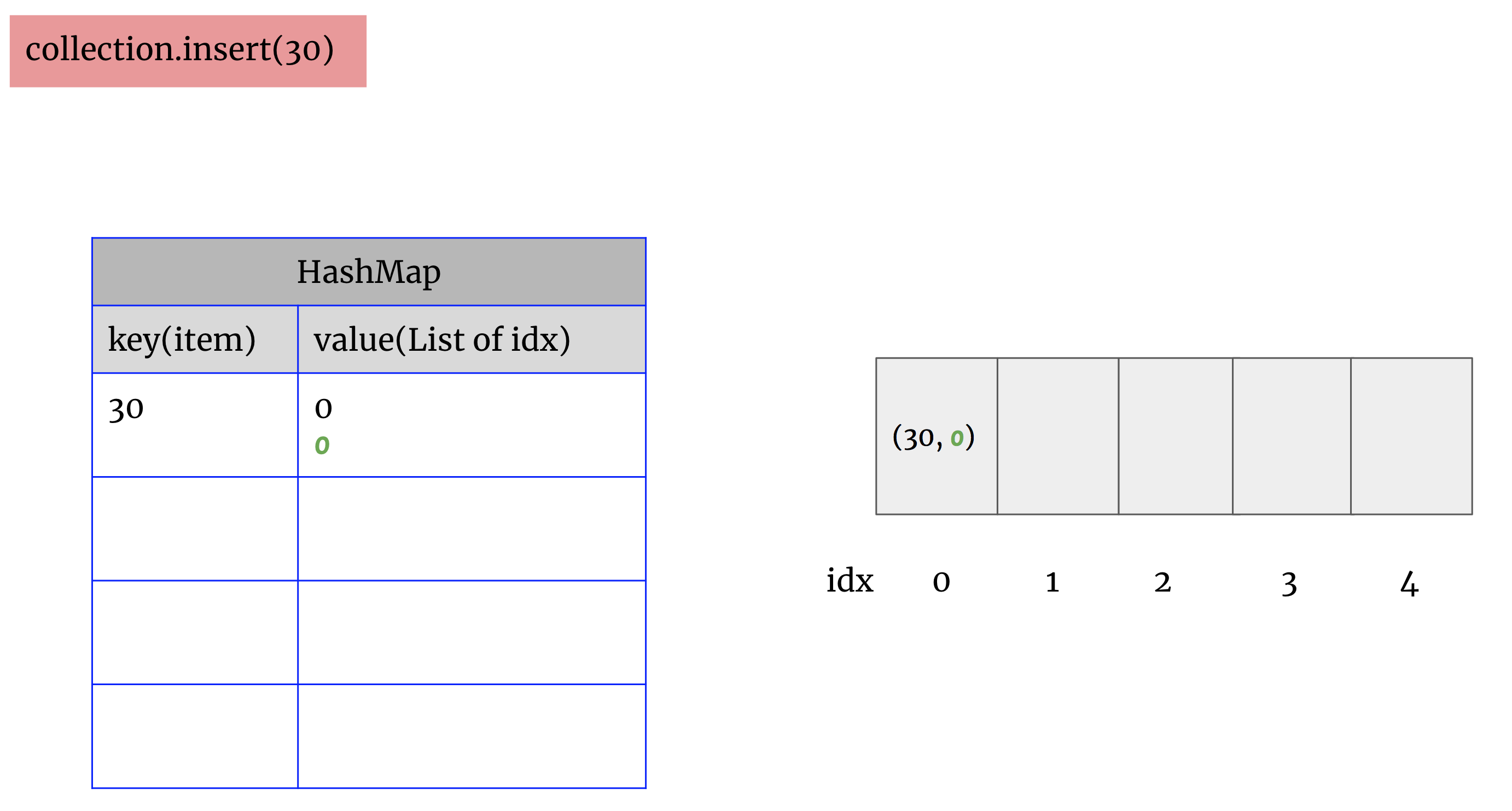
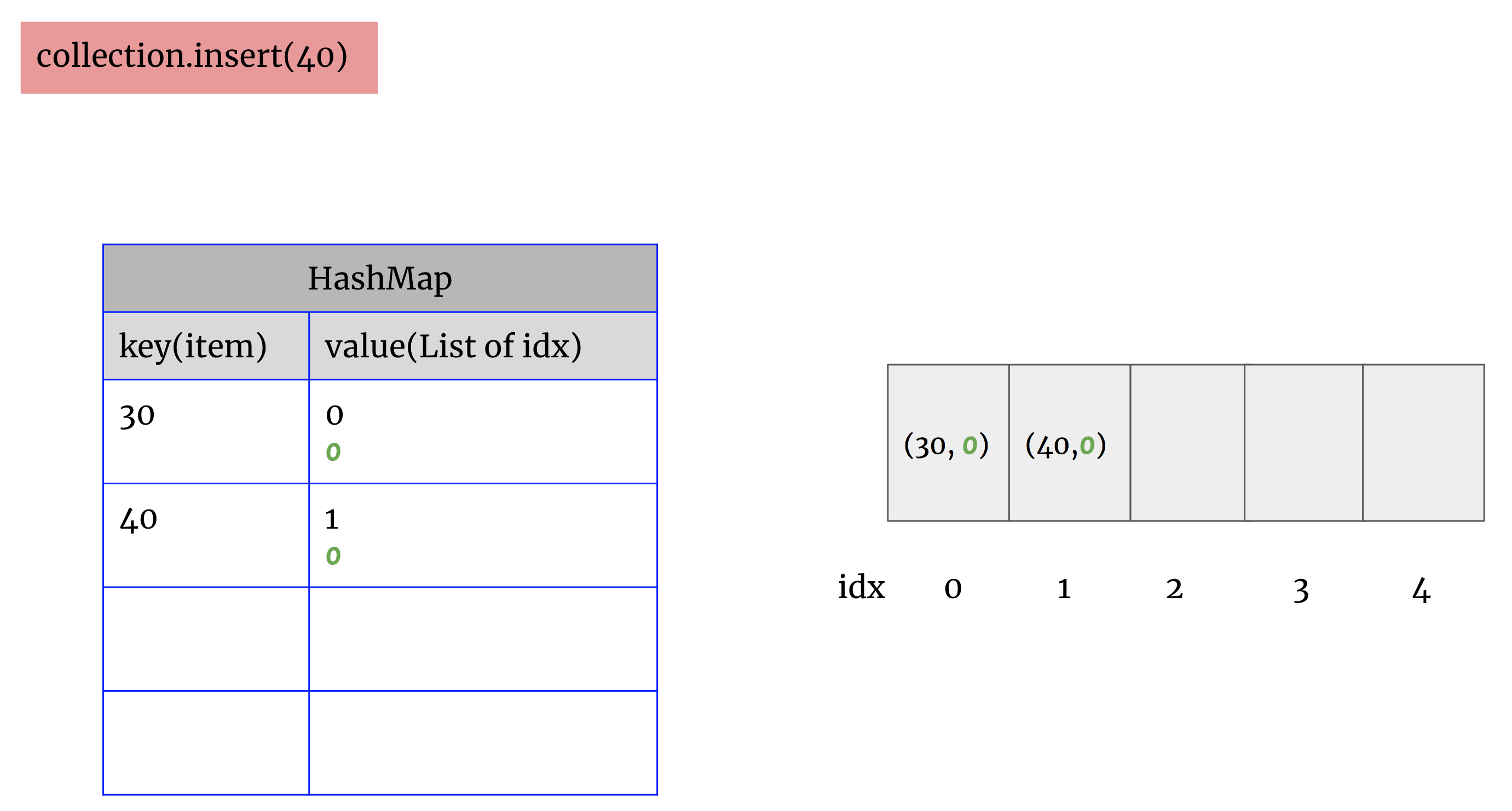
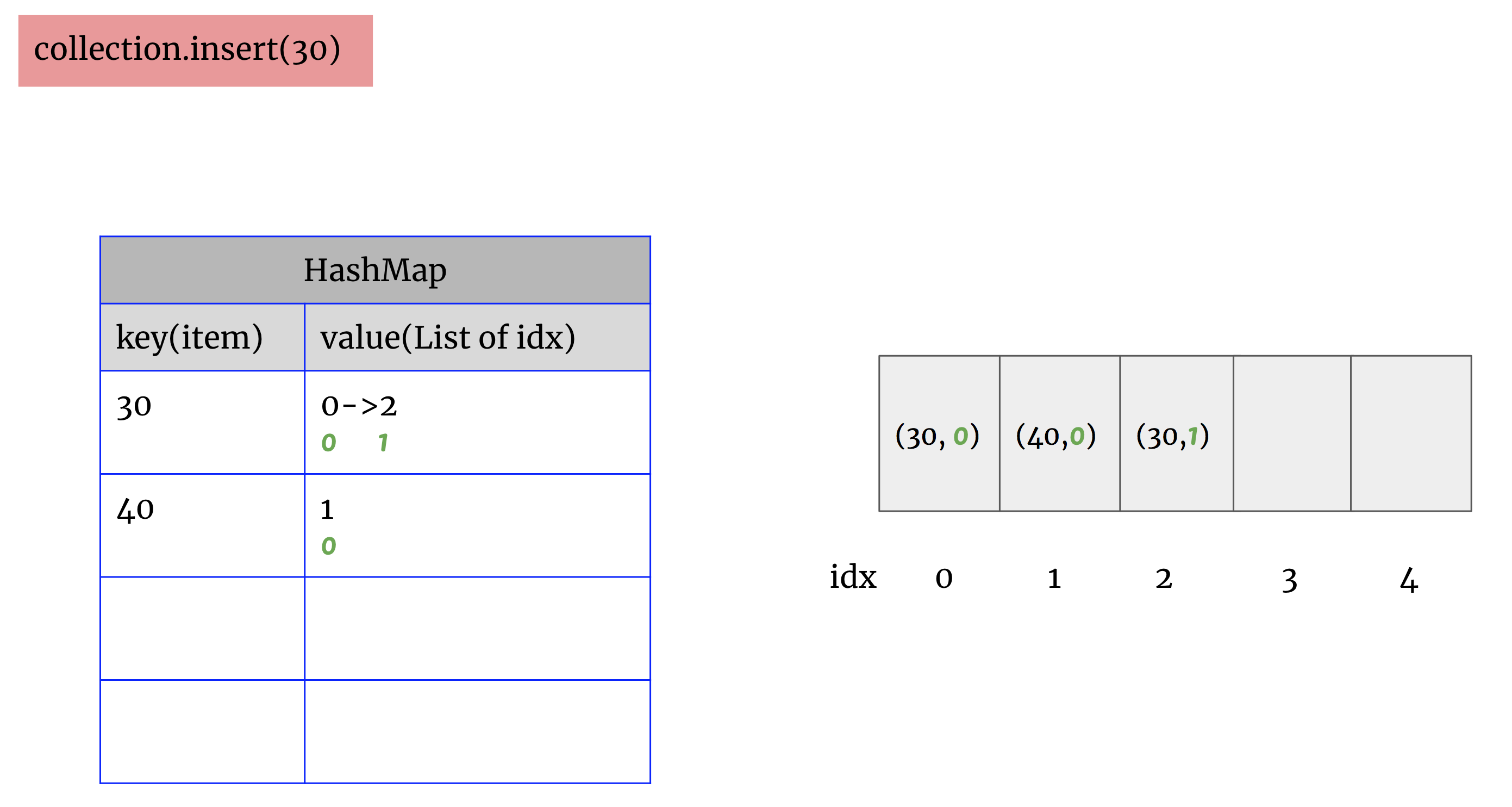
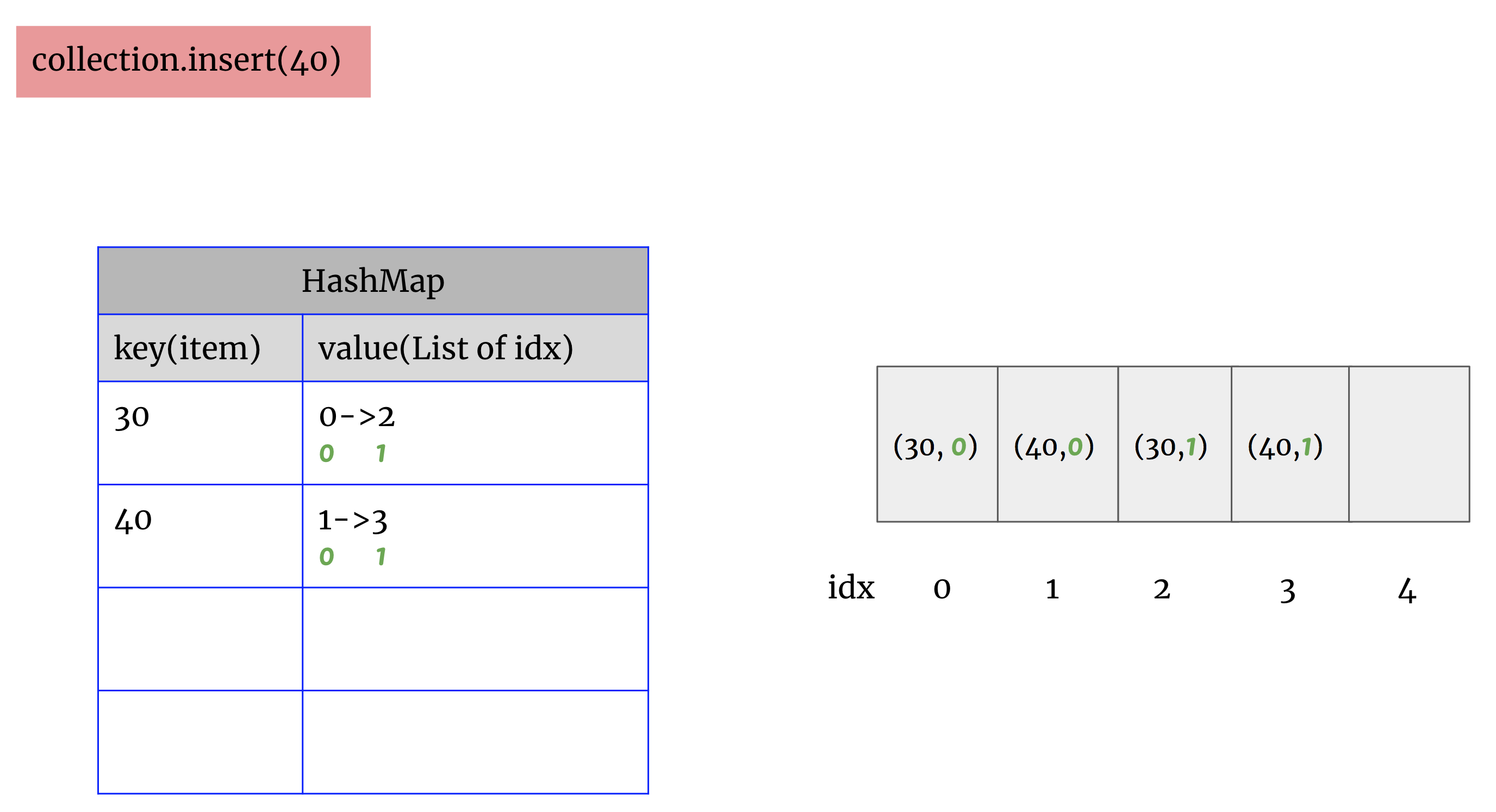
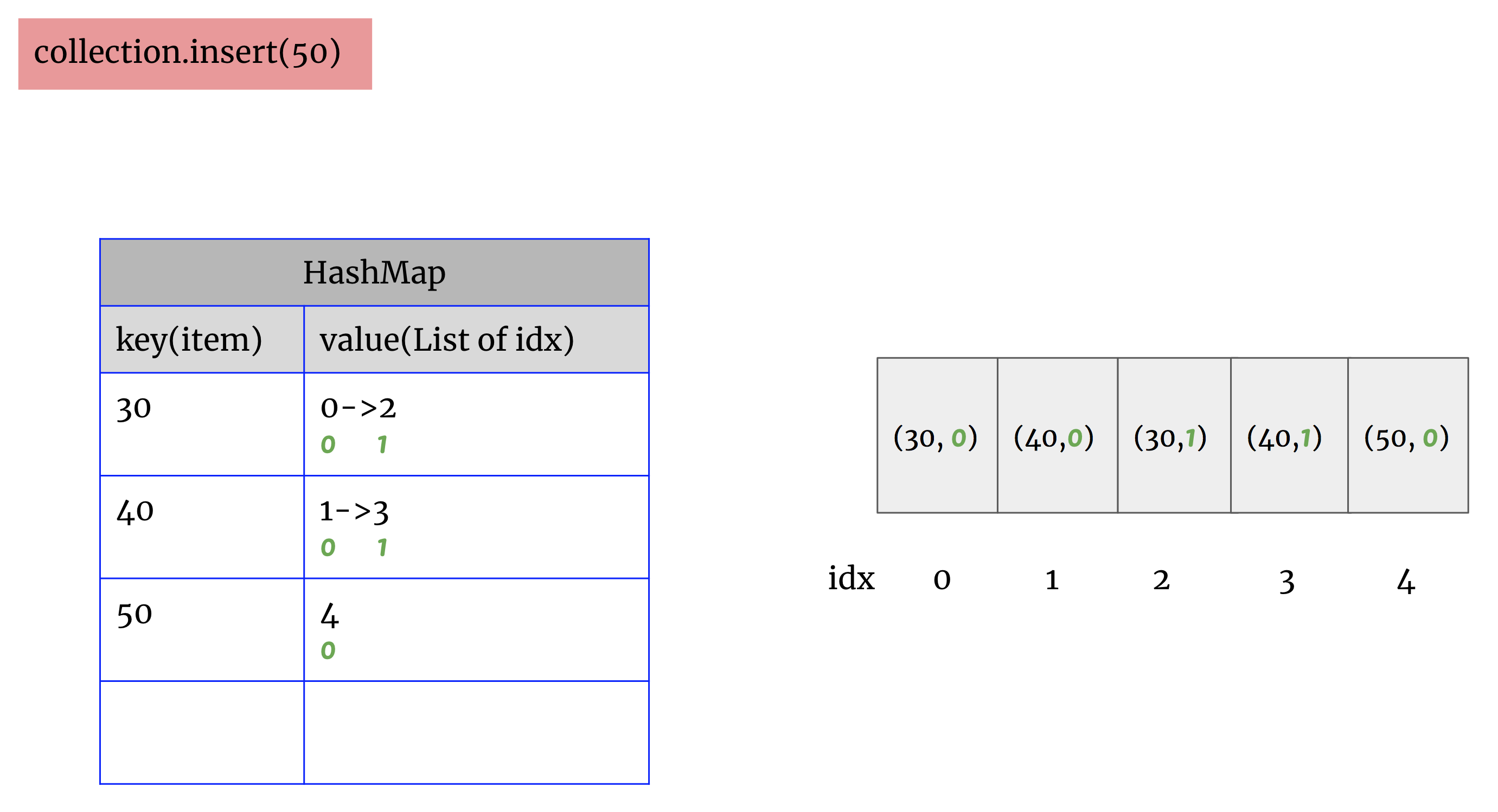
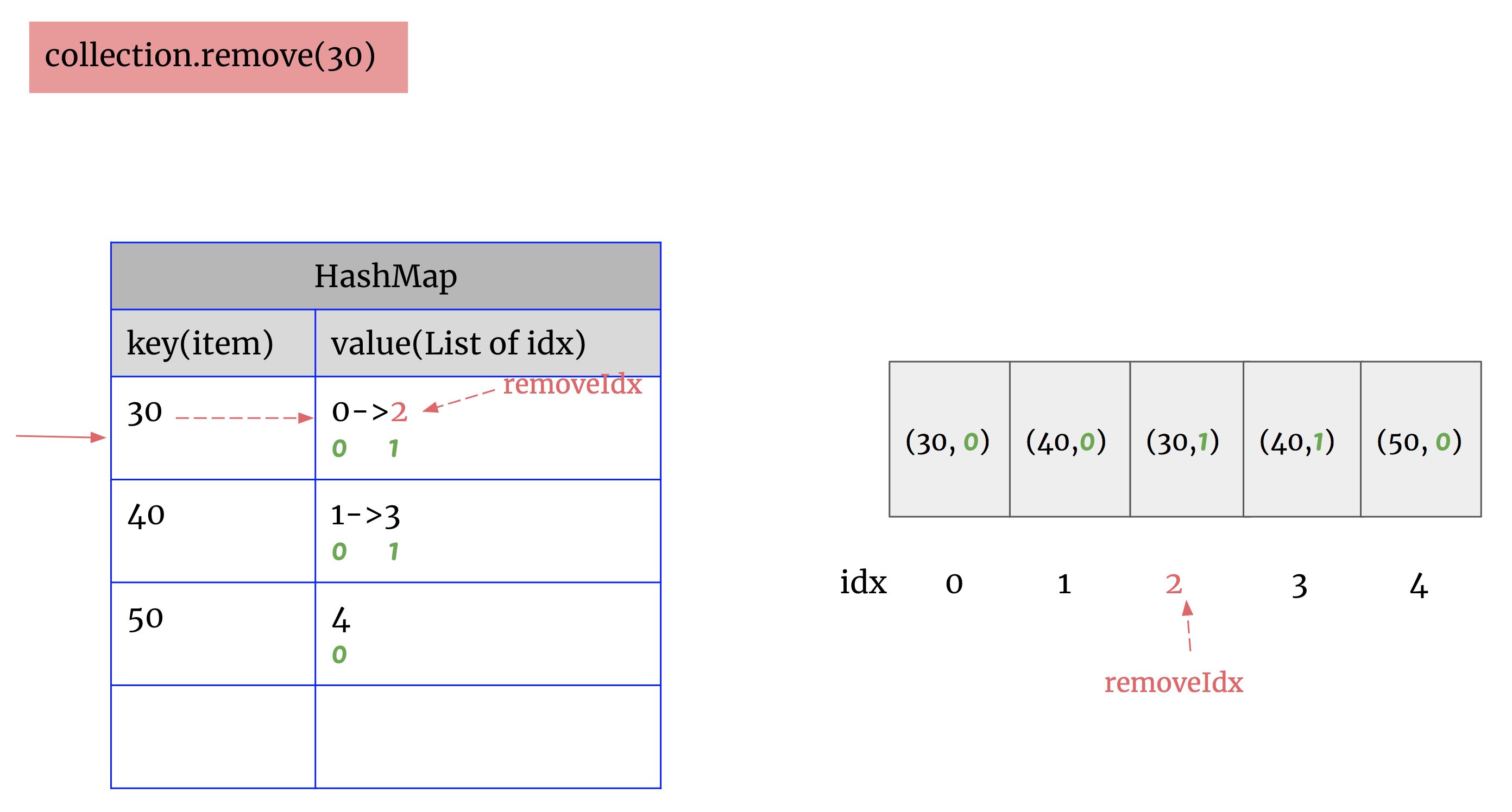
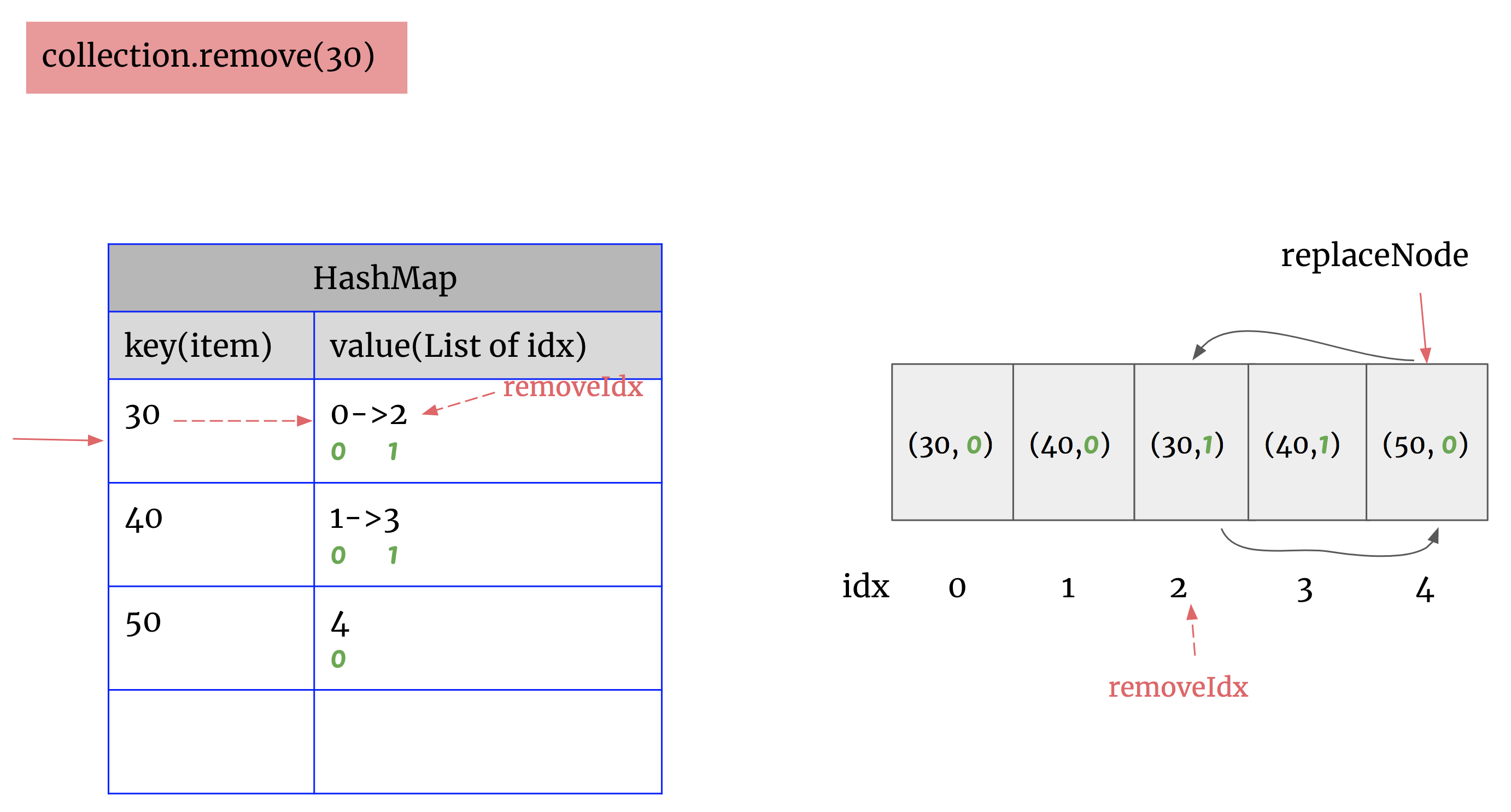
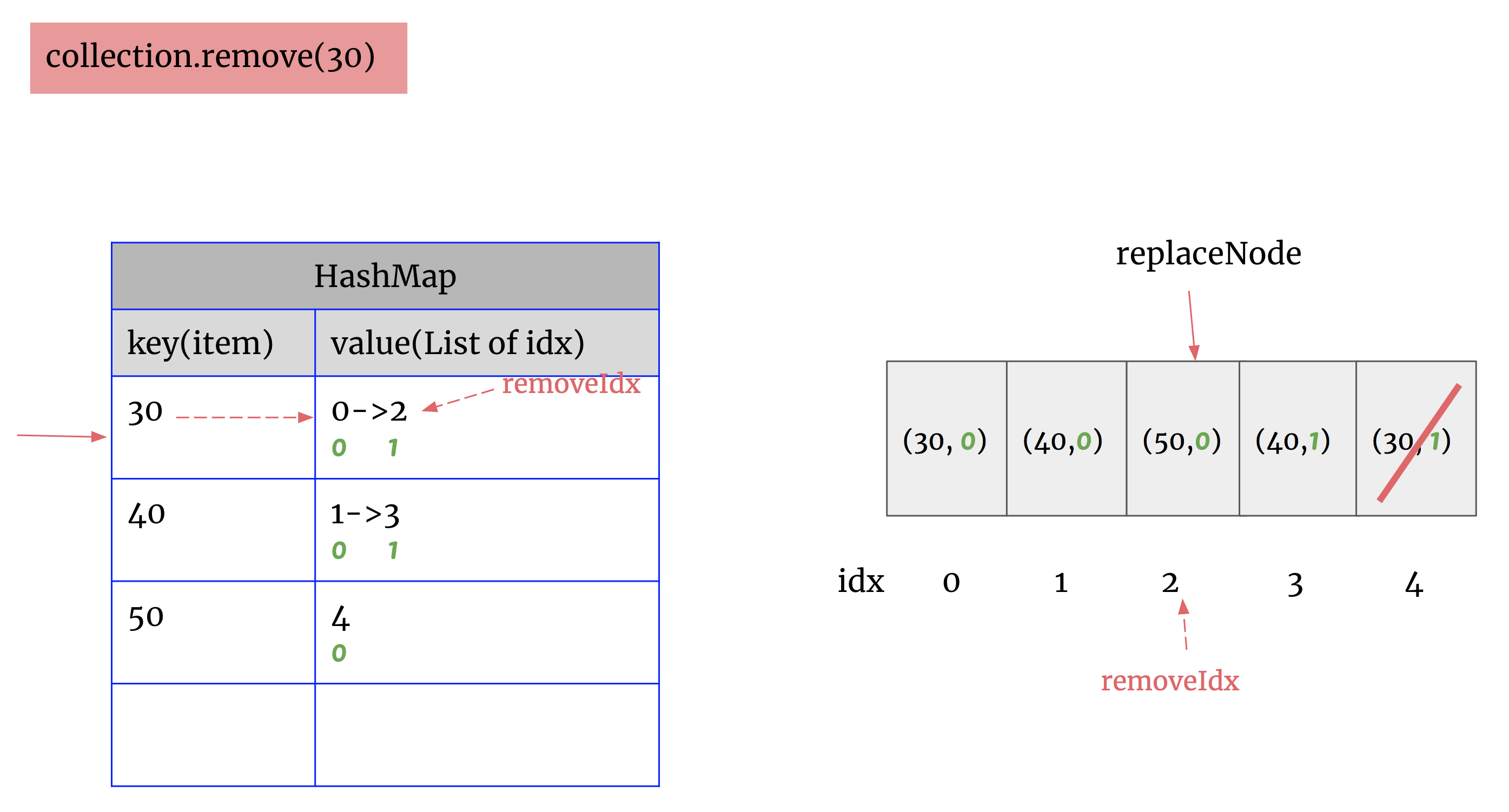
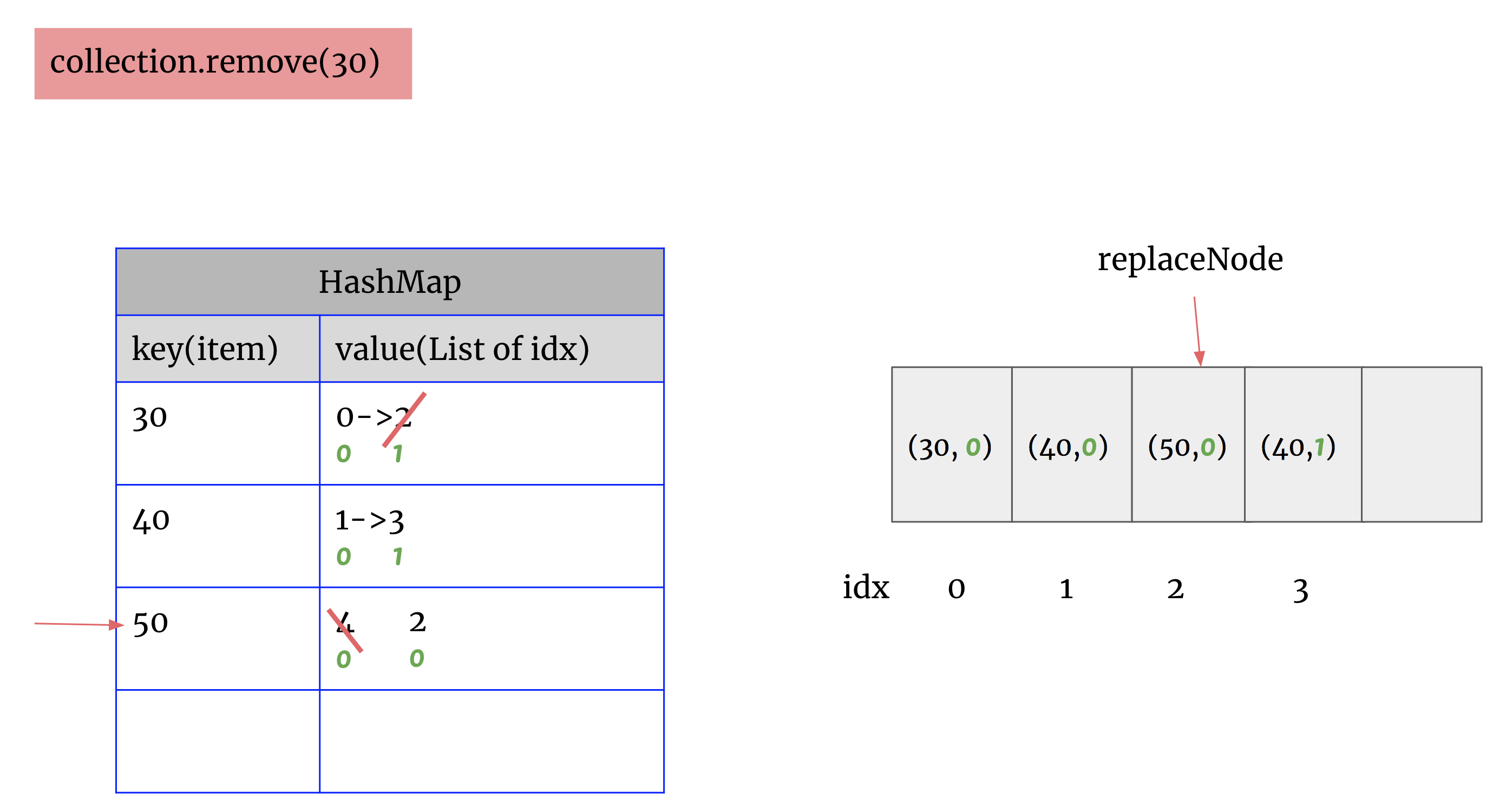
code
 public class RandomizedCollection {

     class Node {

         public int value;

         public int index;

         public Node(int val, int idx) {

             value = val;

             index = idx;

         }

     }

     private Map<Integer, List<Integer>> map;

     private List<Node> list;

     private Random r;

     /** Initialize your data structure here. */

     public RandomizedCollection() {

         map = new HashMap<>();

         list = new ArrayList<>();

         r = new Random();

     }

     /** Inserts a value to the collection. Returns true if the collection did not already contain the specified element. */

     public boolean insert(int val) {

         List<Integer> l = map.getOrDefault(val, new ArrayList<>());

         l.add(list.size());

         map.put(val, l);

         list.add(new Node(val, l.size() - 1));

         return l.size() == 1;

     }

     /** Removes a value from the collection. Returns true if the collection contained the specified element. */

     public boolean remove(int val) {

         if (!map.containsKey(val)) return false;

         List<Integer> l = map.get(val);

         int removeIdx = l.get(l.size() - 1);

         Node replaceNode = list.get(list.size() - 1);

         // deal with HashMap

          map.get(replaceNode.value).set(replaceNode.index, removeIdx);

          l.remove(l.size() - 1);

          if (l.size() == 0) map.remove(val);

         // deal with List

         list.set(removeIdx, replaceNode);

         list.remove(list.size() - 1);

         return true;

     }

     /** Get a random element from the collection. */

     public int getRandom() {

         return list.get(r.nextInt(list.size())).value;

     }

 }
[leetcode]381. Insert Delete GetRandom O(1) - Duplicates allowed常数时间插入删除取随机值的更多相关文章
- [LeetCode] 381. Insert Delete GetRandom O(1) - Duplicates allowed 常数时间内插入删除和获得随机数 - 允许重复
Design a data structure that supports all following operations in average O(1) time. Note: Duplicate ...
- [LeetCode] Insert Delete GetRandom O(1) - Duplicates allowed 常数时间内插入删除和获得随机数 - 允许重复
Design a data structure that supports all following operations in average O(1) time. Note: Duplicate ...
- [LeetCode] 381. Insert Delete GetRandom O(1) - Duplicates allowed 插入删除和获得随机数O(1)时间 - 允许重复
Design a data structure that supports all following operations in average O(1) time. Note: Duplicate ...
- LeetCode 381. Insert Delete GetRandom O(1) - Duplicates allowed O(1) 时间插入、删除和获取随机元素 - 允许重复(C++/Java)
题目: Design a data structure that supports all following operations in averageO(1) time. Note: Duplic ...
- LeetCode 381. Insert Delete GetRandom O(1) - Duplicates allowed
原题链接在这里:https://leetcode.com/problems/insert-delete-getrandom-o1-duplicates-allowed/?tab=Description ...
- LeetCode 381. Insert Delete GetRandom O(1) - Duplicates allowed (插入删除和获得随机数 常数时间 允许重复项)
Design a data structure that supports all following operations in average O(1) time. Note: Duplicate ...
- [leetcode]380. Insert Delete GetRandom O(1)常数时间插入删除取随机值
Design a data structure that supports all following operations in average O(1) time. insert(val): In ...
- leetcode 380. Insert Delete GetRandom O(1) 、381. Insert Delete GetRandom O(1) - Duplicates allowed
380. Insert Delete GetRandom O(1) 实现插入.删除.获得随机数功能,且时间复杂度都在O(1).实际上在插入.删除两个功能中都包含了查找功能,当然查找也必须是O(1). ...
- 381. Insert Delete GetRandom O(1) - Duplicates allowed
Design a data structure that supports all following operations in average O(1) time. Note: Duplicate ...
随机推荐
- 3种方法轻松处理php开发中emoji表情的问题
背景 做微信开发的时候就会发现,存储微信昵称必不可少. 可这万恶的微信支持emoji表情做昵称,这就有点蛋疼了 一般Mysql表设计时,都是用UTF8字符集的.把带有emoji的昵称字段往里面inse ...
- 【Python编程:从入门到实践】chapter4 操作列表
chapter4 操作列表 4.1 遍历整个列表 magicians=['alice','david','carolina'] for magician in magicians: print(mag ...
- 管理11gRAC基本命令 (转载)
在 Oracle Clusterware 11g 第 2 版 (11.2) 中,有许多子程序和命令已不再使用: crs_stat crs_register crs_unregiste ...
- redis 4,0 安装
安装redis : 1,yum install wget -y 2,cd /opt: 3,wget http://download.redis.io/releases/redis-4.0.10.tar ...
- 经典算法 Manacher算法详解
内容: 1.原始问题 =>O(N^2) 2.Manacher算法 =>O(N) 1.原始问题 Manacher算法是由题目“求字符串中长回文子串的长度”而来.比如 abcdcb 的 ...
- jquery函数写法
普通jquery函数写法 <script src="http://code.jquery.com/jquery-1.11.1.min.js"></script&g ...
- Latex 箭头、下标、符号上下写文字、正方形和三角形
0. hat $abc\hat def$ $ab\widehat{cde}f$ 1. 箭头上的文字 $\underrightarrow{\text{你的文字}}$ ($A \xlefta ...
- sql 随机取数
Sql server: select top 10 * from 表 order by newid()Access: SELECT top 10 * FROM 表 ORDER BY ...
- springboot - mybatis - 下划线与驼峰自动转换 mapUnderscoreToCamelCase
以前都是在mybatis.xml中来配置,但是spring boot不想再用xml配置文件.网上搜寻了好久,才找到设置办法:sessionFactoryBean.getObject().getConf ...
- jdk免安装对应配置
通常我们不用配置jdk,tomcat和eclipse会选取系统的环境变量获取jdk,但有时一个系统中部署不同的项目,各版本又不一样,不能完全兼容. 因此就需要采用自己的jdk.将jdk安装后,将安装后 ...