
【转】 Understanding Component-Entity-Systems
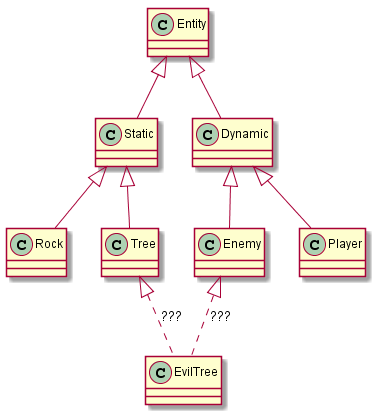
To solve this, game programmers started to build entities
through composition instead of inheritance. An entity is simply an
aggregation (technically a composition) of components. This has some
major benefits over the object-oriented architecture described above:
- It's easy to add new, complex entities
- It's easy to define new entities in data
- It's more efficient
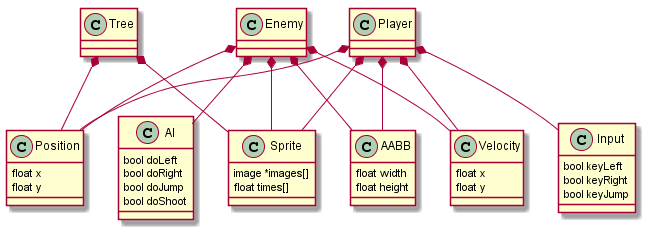
Here's
how a few of the entities above would be implemented. Notice that the
components are all pure data - no methods. This will be explained in
detail below.
The Component
A component can be likened to a C
struct. It has no methods and is only capable of storing data, not
acting upon it. In a typical implementation, each different component
type will derive from an abstract Component class, which
provides facilities for getting a component's type and containing entity
at runtime. Each component describes a certain aspect of an entity and
its parameters. By themselves, components are practically meaningless,
but when used in conjunction with entities and systems, they become
extremely powerful. Empty components are useful for tagging entities.
Examples
- Position (x, y)
- Velocity (x, y)
- Physics (body)
- Sprite (images, animations)
- Health (value)
- Character (name, level)
- Player (empty)
The Entity
An
entity is something that exists in your game world. Again, an entity is
little more than a list of components. Because they are so simple, most
implementations won't define an entity as a concrete piece of data.
Instead, an entity is a unique ID, and all components that make up an
entity will be tagged with that ID. The entity is an implicit
aggregation of the components tagged with its ID. If you want, you can
allow components to be dynamically added to and removed from entities.
This allows you to "mutate" entities on the fly. For example, you could
have a spell that makes its target freeze. To do this, you could simply
remove the Velocity component.
Examples
- Rock (Position, Sprite)
- Crate (Position, Sprite, Health)
- Sign (Position, Sprite, Text)
- Ball (Position, Velocity, Physics, Sprite)
- Enemy (Position, Velocity, Sprite, Character, Input, AI)
- Player (Position, Velocity, Sprite, Character, Input, Player)
The System
Notice
that I've neglected to mention any form of game logic. This is the job
of the systems. A system operates on related groups of components, i.e.
components that belong to the same entity. For example, the character
movement system might operate on a Position, a Velocity, a Collider, and an Input. Each system will be updated once per frame in a logical order. To make a character jump, first the keyJump field of the Input data is checked. If it is true, the system will look through the contacts contained in the Collider data and check if there is one with the ground. If so, it will set the Velocity's y field to make the character jump.
Because
a system only operates on components if the whole group is present,
components implicitly define the behaviour an entity will have. For
example, an entity with a Position component but not a Velocity component will be static. Since the Movement system uses a Position and a Velocity, it won't operate on the Position contained within that entity. Adding a Velocity component will make the Movement
system work on that entity, thus making the entity dynamic and affected
by gravity. This behaviour can be exploited with "tag components"
(explained above) to reuse components in different contexts. For
example, the Input component defines generic flags for jumping, moving, and shooting. Adding an empty Player component will tag the entity for the PlayerControl system so that the Input data will be populated based on controller inputs.
Examples
- Movement (Position, Velocity) - Adds velocity to position
- Gravity (Velocity) - Accelerates velocity due to gravity
- Render (Position, Sprite) - Draws sprites
- PlayerControl (Input, Player) - Sets the player-controlled entity's input according to a controller
- BotControl (Input, AI) - Sets a bot-controlled entity's input according to an AI agent
Conclusion
To
wrap up, OOP-based entity hierarchies need to be left behind in favour
of Component-Entity-Systems. Entities are your game objects, which are
implicitly defined by a collection of components. These components are
pure data and are operated on in functional groups by the systems.
I
hope I've managed to help you to understand how
Component-Entity-Systems work, and to convince you that they are better
than traditional OOP. If you have any questions about the article, I'd
appreciate a comment or message.
A follow-up article has been posted, which provides a sample C implementation and solves some design problems. Implementing Component-Entity-Systems
Article Update Log
1 April 2013 - Initial submission
2 April 2013 - Initial publication; cleaned up formatting
29 September 2013 - Added notice of follow-up article; changed some formatting)
【转】 Understanding Component-Entity-Systems的更多相关文章
- 【转】Entity Systems
“Favour composition over inheritance” If you haven’t already read my previous post on the problems o ...
- 【转】What is an entity system framework for game development?
What is an entity system framework for game development? Posted on 19 January 2012 Last week I relea ...
- Programming Entity Framework 翻译(1)-目录
1. Introducing the ADO.NET Entity Framework ado.net entity framework 介绍 1 The Entity Relationship Mo ...
- 为什么要在游戏开发中使用ECS模式
http://www.richardlord.net/blog/why-use-an-entity-framework Why use an entity system framework for g ...
- 组件-实体-系统 Entiy-Compoent-System ECS架构整理
继承体系的问题,为什么要用ECS 面向对象的问题 当一个新的类型需要多个老类型的不同功能的时候,不能很好的继承出来 游戏开发后期会有非常多的类,很难维护 游戏中子系统很多,它们对一个对象的关注点往往互 ...
- 中间件(middlebox)
Middleboxes (also known as network functions) are systems that perform sophisticated and often state ...
- writing concurrent programs
Computer Systems A Programmer's Perspective Second Edition To this point in our study of computer sy ...
- [Angular 2] Directive intro and exportAs
First, What is directive, what is the difference between component and directive. For my understandi ...
- Why your Games are Unfinished, and What To Do About It (转)
So, you've got a new game idea, and it's going to change what everyone knows about the genre! Great! ...
- uvc摄像头代码解析5
8.初始化uvc控制 8.1 重要结构体 struct uvc_control { //uvc控制 struct uvc_entity *entity; //uvc实体 struct uvc_cont ...
随机推荐
- 安装VC6提示找不到ACME时的解决办法
将安装程序COPY到电脑上1.打开setupwiz.ini,把"acme=acmboot.exe"改为"=acmsetup.exe";2.STF=setup/v ...
- attachEvent ,addEventListener
if (window.attachEvent) { window.attachEvent("onload", remove); ...
- linux apache 自动监护脚本
1 首先安装curl yum install curl 2 编写shell vi restart_apache.sh 写入一下内容 #!/bin/bashURL="http://127.0. ...
- bat产生随机数并复制文件及生成文件列表
有这样一个场景:我需要将同一个文件复制为上千个文件,并且文件名应为随机数.为了简单起见,不想写程序,直接写个BAT来,方便,简单,易用: 1. 搞定用BAT产生32位随机数,存为变量并使用,保存以下代 ...
- 使用ASP.Net WebAPI构建REST服务(五)——客户端
WebAPI是标准的Http协议,支持Http协议的客户端(如浏览器)都可以访问.但是,有的时候我们如果想在自己的程序中使用WebAPI时,此时就要实现自己的客户端了.我之前介绍过在.Net 4.5中 ...
- UTF-8 有BOM和无BOM
BOM(byte order mark)是为 UTF-16 和 UTF-32 准备的,用于标记字节序(byte order).微软在 UTF-8 中使用 BOM 是因为这样可以把 UTF-8 和 AS ...
- 解决VS2010控制台程序运行结束不显示请按任意键继续
在VS2010里的控制台应用程序在运行时,结果画面一闪而过,不管是用F5 还是用Ctrl + F5都是一样,导致无法看到结果. 网上有不少的办法,说是都是在程序最后加一个要程序暂停的语句( syste ...
- [windows操作系统]内核性能剖析
profile这个词有(1)外形.轮廓.外观.形象(2)印象.形象(3)人物简介(4)剖面图.侧面图等意.在计算机和通讯协议中这个词也非常常见.这里主要介绍一下它在软件系统性能分析领域的一个释义. 翻 ...
- [Windows驱动]驱动包(Driver Packages)
在windows下安装一个驱动,我们你需要把所有需要的软件打包-称为驱动包.驱动包里包括系统提供的给所有设备类使用的一般安装工具,还包括了设备商提供的设备特定的组件.下面我们就来看看驱动包里具体需要哪 ...
- android平台手电筒开发源代码
android平台手电筒开发源代码,AndroidManifest.xml文件的入口是startapp,这个文件没上传上来,大家可以自己写. 1. [代码]android 1 2 3 4 5 6 7 ...