
POJ 3845 Fractal(计算几何の旋转缩放)
Description
1. fine structure at arbitrarily small scales;
2. self-similarity, i.e., magnified it looks like a copy of itself;
3. a simple, recursive definition.
Approximate fractals are found a lot in nature, for example, in structures such as clouds, snow flakes, mountain ranges, and river networks.
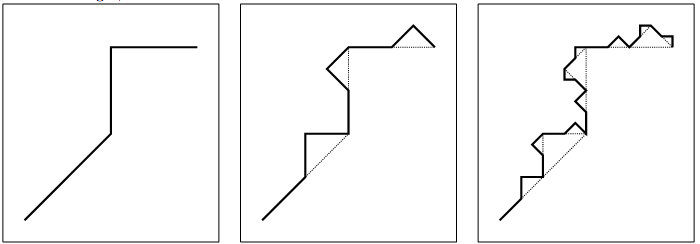
In this problem, we consider fractals generated by the following algorithm: we start with a polyline, i.e., a set of connected line segments. This is what we call a fractal of depth one (see leftmost picture). To obtain a fractal of depth two, we replace each line segment with a scaled and rotated version of the original polyline (see middle picture). By repetitively replacing the line segments with the polyline, we obtain fractals of arbitrary depth and very fine structures arise. The rightmost picture shows a fractal of depth three.
The complexity of an approximate fractal increases quickly as its depth increases. We want to know where we end up after traversing a certain fraction of its length.
Input
The length of each line segment of the polyline is smaller than the distance between the first point (x1, y1) and the last point (xn, yn) of the polyline. The length of the complete polyline is smaller than twice this distance.
Output
 #include <cstdio>

 #include <cstring>

 #include <iostream>

 #include <algorithm>

 #include <cmath>

 using namespace std;

 const int MAXN = ;

 const double EPS = 1e-;

 const double PI = acos(-1.0);//3.14159265358979323846

 const double INF = ;

 inline int sgn(double x) {

     return (x > EPS) - (x < -EPS);

 }

 struct Point {

     double x, y, ag;

     Point() {}

     Point(double x, double y): x(x), y(y) {}

     void read() {

         scanf("%lf%lf", &x, &y);

     }

     bool operator == (const Point &rhs) const {

         return sgn(x - rhs.x) ==  && sgn(y - rhs.y) == ;

     }

     bool operator < (const Point &rhs) const {

         if(y != rhs.y) return y < rhs.y;

         return x < rhs.x;

     }

     Point operator + (const Point &rhs) const {

         return Point(x + rhs.x, y + rhs.y);

     }

     Point operator - (const Point &rhs) const {

         return Point(x - rhs.x, y - rhs.y);

     }

     Point operator * (const double &b) const {

         return Point(x * b, y * b);

     }

     Point operator / (const double &b) const {

         return Point(x / b, y / b);

     }

     double length() {

         return sqrt(x * x + y * y);

     }

     Point unit() {

         return *this / length();

     }

     void print() {

         printf("%.10f %.10f\n", x, y);

     }

 };

 typedef Point Vector;

 double dist(const Point &a, const Point &b) {

     return (a - b).length();

 }

 double cross(const Point &a, const Point &b) {

     return a.x * b.y - a.y * b.x;

 }

 //ret >= 0 means turn left

 double cross(const Point &sp, const Point &ed, const Point &op) {

     return sgn(cross(sp - op, ed - op));

 }

 double area(const Point& a, const Point &b, const Point &c) {

     return fabs(cross(a - c, b - c)) / ;

 }

 //counter-clockwise

 Point rotate(const Point &p, double angle, const Point &o = Point(, )) {

     Point t = p - o;

     double x = t.x * cos(angle) - t.y * sin(angle);

     double y = t.y * cos(angle) + t.x * sin(angle);

     return Point(x, y) + o;

 }

 struct Seg {

     Point st, ed;

     double ag;

     Seg() {}

     Seg(Point st, Point ed): st(st), ed(ed) {}

     void read() {

         st.read(); ed.read();

     }

     void makeAg() {

         ag = atan2(ed.y - st.y, ed.x - st.x);

     }

 };

 typedef Seg Line;

 //ax + by + c > 0

 Line buildLine(double a, double b, double c) {

     if(sgn(a) ==  && sgn(b) == ) return Line(Point(sgn(c) >  ? - : , INF), Point(, INF));

     if(sgn(a) == ) return Line(Point(sgn(b), -c/b), Point(, -c/b));

     if(sgn(b) == ) return Line(Point(-c/a, ), Point(-c/a, sgn(a)));

     if(b < ) return Line(Point(, -c/b), Point(, -(a + c) / b));

     else return Line(Point(, -(a + c) / b), Point(, -c/b));

 }

 void moveRight(Line &v, double r) {

     double dx = v.ed.x - v.st.x, dy = v.ed.y - v.st.y;

     dx = dx / dist(v.st, v.ed) * r;

     dy = dy / dist(v.st, v.ed) * r;

     v.st.x += dy; v.ed.x += dy;

     v.st.y -= dx; v.ed.y -= dx;

 }

 bool isOnSeg(const Seg &s, const Point &p) {

     return (p == s.st || p == s.ed) ||

         (((p.x - s.st.x) * (p.x - s.ed.x) <  ||

           (p.y - s.st.y) * (p.y - s.ed.y) < ) &&

          sgn(cross(s.ed, p, s.st) == ));

 }

 bool isIntersected(const Point &s1, const Point &e1, const Point &s2, const Point &e2) {

     return (max(s1.x, e1.x) >= min(s2.x, e2.x)) &&

         (max(s2.x, e2.x) >= min(s1.x, e1.x)) &&

         (max(s1.y, e1.y) >= min(s2.y, e2.y)) &&

         (max(s2.y, e2.y) >= min(s1.y, e1.y)) &&

         (cross(s2, e1, s1) * cross(e1, e2, s1) >= ) &&

         (cross(s1, e2, s2) * cross(e2, e1, s2) >= );

 }

 bool isIntersected(const Seg &a, const Seg &b) {

     return isIntersected(a.st, a.ed, b.st, b.ed);

 }

 bool isParallel(const Seg &a, const Seg &b) {

     return sgn(cross(a.ed - a.st, b.ed - b.st)) == ;

 }

 //return Ax + By + C =0 's A, B, C

 void Coefficient(const Line &L, double &A, double &B, double &C) {

     A = L.ed.y - L.st.y;

     B = L.st.x - L.ed.x;

     C = L.ed.x * L.st.y - L.st.x * L.ed.y;

 }

 //point of intersection

 Point operator * (const Line &a, const Line &b) {

     double A1, B1, C1;

     double A2, B2, C2;

     Coefficient(a, A1, B1, C1);

     Coefficient(b, A2, B2, C2);

     Point I;

     I.x = - (B2 * C1 - B1 * C2) / (A1 * B2 - A2 * B1);

     I.y =   (A2 * C1 - A1 * C2) / (A1 * B2 - A2 * B1);

     return I;

 }

 bool isEqual(const Line &a, const Line &b) {

     double A1, B1, C1;

     double A2, B2, C2;

     Coefficient(a, A1, B1, C1);

     Coefficient(b, A2, B2, C2);

     return sgn(A1 * B2 - A2 * B1) ==  && sgn(A1 * C2 - A2 * C1) ==  && sgn(B1 * C2 - B2 * C1) == ;

 }

 struct Poly {

     int n;

     Point p[MAXN];//p[n] = p[0]

     void init(Point *pp, int nn) {

         n = nn;

         for(int i = ; i < n; ++i) p[i] = pp[i];

         p[n] = p[];

     }

     double area() {

         if(n < ) return ;

         double s = p[].y * (p[n - ].x - p[].x);

         for(int i = ; i < n; ++i)

             s += p[i].y * (p[i - ].x - p[i + ].x);

         return s / ;

     }

 };

 void Graham_scan(Point *p, int n, int *stk, int &top) {//stk[0] = stk[top]

     sort(p, p + n);

     top = ;

     stk[] = ; stk[] = ;

     for(int i = ; i < n; ++i) {

         while(top && cross(p[i], p[stk[top]], p[stk[top - ]]) >= ) --top;

         stk[++top] = i;

     }

     int len = top;

     stk[++top] = n - ;

     for(int i = n - ; i >= ; --i) {

         while(top != len && cross(p[i], p[stk[top]], p[stk[top - ]]) >= ) --top;

         stk[++top] = i;

     }

 }

 //use for half_planes_cross

 bool cmpAg(const Line &a, const Line &b) {

     if(sgn(a.ag - b.ag) == )

         return sgn(cross(b.ed, a.st, b.st)) < ;

     return a.ag < b.ag;

 }

 //clockwise, plane is on the right

 bool half_planes_cross(Line *v, int vn, Poly &res, Line *deq) {

     int i, n;

     sort(v, v + vn, cmpAg);

     for(i = n = ; i < vn; ++i) {

         if(sgn(v[i].ag - v[i-].ag) == ) continue;

         v[n++] = v[i];

     }

     int head = , tail = ;

     deq[] = v[], deq[] = v[];

     for(i = ; i < n; ++i) {

         if(isParallel(deq[tail - ], deq[tail]) || isParallel(deq[head], deq[head + ]))

             return false;

         while(head < tail && sgn(cross(v[i].ed, deq[tail - ] * deq[tail], v[i].st)) > )

             --tail;

         while(head < tail && sgn(cross(v[i].ed, deq[head] * deq[head + ], v[i].st)) > )

             ++head;

         deq[++tail] = v[i];

     }

     while(head < tail && sgn(cross(deq[head].ed, deq[tail - ] * deq[tail], deq[head].st)) > )

         --tail;

     while(head < tail && sgn(cross(deq[tail].ed, deq[head] * deq[head + ], deq[tail].st)) > )

         ++head;

     if(tail <= head + ) return false;

     res.n = ;

     for(i = head; i < tail; ++i)

         res.p[res.n++] = deq[i] * deq[i + ];

     res.p[res.n++] = deq[head] * deq[tail];

     res.n = unique(res.p, res.p + res.n) - res.p;

     res.p[res.n] = res.p[];

     return true;

 }

 /*******************************************************************************************/

 Point p[MAXN], ans;

 double f[], sum[MAXN];

 double len, sqrt2 = sqrt();

 int c, n, d;

 void dfs(const Point &a, const Point &b, double len, int dep) {

     if(dep == ) {

         ans = (b - a) * len / dist(a, b) + a;

     } else {

         for(int i = ; i < n; ++i) {

             if(sgn(sum[i] * dist(a, b) / dist(p[], p[n - ]) * f[dep] - len) < ) continue;

             double angle1 = atan2(p[n - ].y - p[].y, p[n - ].x - p[].x);

             double angle2 = atan2(b.y - a.y, b.x - a.x);

             Point o = rotate(p[i - ], angle2 - angle1, p[]);

             o = (o - p[]) * dist(a, b) / dist(p[], p[n - ]) + a;

             Point t = rotate(p[i], angle2 - angle1, p[]);

             t = (t - p[]) * dist(a, b) / dist(p[], p[n - ]) + a;

             dfs(o, t, len - sum[i - ] * f[dep] * dist(a, b) / dist(p[], p[n - ]), dep - );

             return ;

         }

     }

 }

 void solve() {

     sum[] = ;

     for(int i = ; i < n; ++i) sum[i] = sum[i - ] + dist(p[i - ], p[i]);

     f[] = ;

     double tmp = sum[n - ] / dist(p[], p[n - ]);

     for(int i = ; i <= d; ++i) f[i] = f[i - ] * tmp;

     dfs(p[], p[n - ], len * sum[n - ] * f[d], d);

 }

 int main() {

     scanf("%d", &c);

     while(c--) {

         scanf("%d", &n);

         for(int i = ; i < n; ++i) p[i].read();

         scanf("%d%lf", &d, &len);

         solve();

         printf("(%.10f,%.10f)\n", ans.x, ans.y);

     }

 }
POJ 3845 Fractal(计算几何の旋转缩放)的更多相关文章
- osg矩阵变换节点-----平移旋转缩放
osg矩阵变换节点-----平移旋转缩放 转自:http://www.cnblogs.com/ylwn817/articles/1973396.html 平移旋转缩放这个三个是osg矩阵操作中,最常见 ...
- osg中使用MatrixTransform来实现模型的平移/旋转/缩放
osg中使用MatrixTransform来实现模型的平移/旋转/缩放 转自:http://www.cnblogs.com/kekec/archive/2011/08/15/2139893.html# ...
- Blender模型导入进Unity,旋转缩放的调整
Blender跟Unity的XYZ轴不同的原因,导致Blender模型导入Unity之后会发生模型朝向不对. 请先看看下边这个情况: 首先,Blender物体模式下,对模型进行 旋转 缩放,将会在右边 ...
- POJ 3608 Bridge Across Islands(计算几何の旋转卡壳)
Description Thousands of thousands years ago there was a small kingdom located in the middle of the ...
- hdu 3934&&poj 2079 (凸包+旋转卡壳+求最大三角形面积)
链接:http://poj.org/problem?id=2079 Triangle Time Limit: 3000MS Memory Limit: 30000K Total Submissio ...
- Android图片旋转,缩放,位移,倾斜,对称完整示例(一)——imageView.setImageMatrix(matrix)和Matrix
MainActivity如下: import android.os.Bundle; import android.view.MotionEvent; import android.view.View; ...
- poj 2187 凸包加旋转卡壳算法
题目链接:http://poj.org/problem?id=2187 旋转卡壳算法:http://www.cppblog.com/staryjy/archive/2009/11/19/101412. ...
- OpenGL绘制简单场景,实现旋转缩放平移和灯光效果
本项目实现了用OpenGL绘制一个简单场景,包括正方体.球体和网格,实现了物体的旋转.缩放.平移和灯光效果.附有项目完整代码.有具体凝视.适合刚開始学习的人熟悉opengl使用. 开发情况 开发环境V ...
- unity3d简单的相机跟随及视野旋转缩放
1.实现相机跟随主角运动 一种简单的方法是把Camera直接拖到Player下面作为Player的子物体,另一种方法是取得Camera与Player的偏移向量,并据此设置Camera位置,便能实现简单 ...
随机推荐
- kafka topic制定规则
kafka topic的制定,我们要考虑的问题有很多,比如生产环境中用几备份.partition数目多少合适.用几台机器支撑数据量,这些方面如何去考量?笔者根据实际的维护经验,写一些思考,希望大家指正 ...
- Spring : JDBC模板, 事务和测试
JDBCTemplate简单配置:-------------------------------jdbc.properties配置----------------------------------- ...
- 爬取猫眼TOP100
学完正则的一个小例子就是爬取猫眼排行榜TOP100的所有电影信息 看一下网页结构: 可以看出要爬取的信息在<dd>标签和</dd>标签中间 正则表达式如下: pattern ...
- 『Python基础-4』字符串
# 『Python基础-4』字符串 目录 1.什么是字符串 2.修改字符串 2.1 修改字符串大小 2.2 合并(拼接)字符串 2.3 使用乘号'*'来实现字符串的叠加效果. 2.4 在字符串中添加空 ...
- ubuntu安装cuda、cudnn
环境: Ubuntu 16.04.4 LTS CUDA:8.0 CUDNN:5.1 CUDA下载:https://developer.nvidia.com/cuda-80-ga2-download-a ...
- VIM 键
输入 vimtutor命令,可以打开Linux使用手册(基本使用). ***. 插入键: A: 行尾插入 a: 字符后面插入 i: 字符前面插入 I: 行首插入 r:只替换一次字符 R:一直替换,直 ...
- 使用ABAP CDS视图创建服务
介绍本文介绍使用ABAP Core Data Services创建OData服务的最快方法. 给出了有关@ OData.publish注释利用率,对数据源CDS实体的引用和从DDIC结构导入的详细信息 ...
- UNIX故障--sun m4000服务器故障硬盘更换案例
一.故障诊断 查看messages日志c0d0t0这块盘不断报错,类型为:retryable,如下: root@gdhx # more /var/adm/messages Aug 5 16:43:0 ...
- 苏州Uber优步司机奖励政策(12月28日到1月3日)
滴快车单单2.5倍,注册地址:http://www.udache.com/ 如何注册Uber司机(全国版最新最详细注册流程)/月入2万/不用抢单:http://www.cnblogs.com/mfry ...
- Android AOSP 编译sdk
首先你要有AOSP 工程. 然后执行下面的命令编译sdk. //运行下面的命令得到编译环境 source build/envsetup.sh lunch sdk make sdk 最后文件输出在哪个位 ...