
POJ2286 The Rotation Game
Description
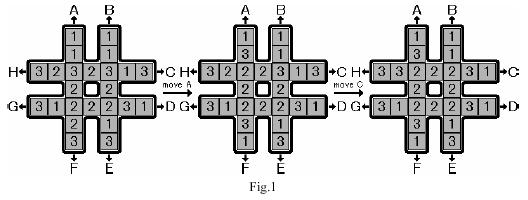
Initially, the blocks are placed on the board randomly. Your task is to move the blocks so that the eight blocks placed in the center square have the same symbol marked. There is only one type of valid move, which is to rotate one of the four lines, each consisting of seven blocks. That is, six blocks in the line are moved towards the head by one block and the head block is moved to the end of the line. The eight possible moves are marked with capital letters A to H. Figure 1 illustrates two consecutive moves, move A and move C from some initial configuration.
Input
Output
Sample Input
1 1 1 1 3 2 3 2 3 1 3 2 2 3 1 2 2 2 3 1 2 1 3 3

1 1 1 1 1 1 1 1 2 2 2 2 2 2 2 2 3 3 3 3 3 3 3 3

0
Sample Output
AC

2

DDHH

2
Source
正解:迭代加深搜索(+大剪枝)
解题报告:
北大信息学夏令营一试第一题,当时考场上看没什么人做于是果断没做,考完再看才发现是个搜索题。
今天考试居然考到了这道题,好吧,就来填这个坑吧。
首先迭代加深,确定搜索深度上界(保证dfs不会gi),然后我们考虑各种奇奇怪怪的剪枝。
显然,我们会在最终得到中间的一圈全是1或2或3,不妨取一个目前已经数量最多的数字来做一个估价若已经超过上界,就直接返回。
还有一个剪枝,如果上一次往上移动,那么这一次就不要往下移动。
代码如下:
 //It is made by jump~

 #include <iostream>

 #include <cstdlib>

 #include <cstring>

 #include <cstdio>

 #include <cmath>

 #include <algorithm>

 #include <ctime>

 #include <vector>

 #include <queue>

 #include <map>

 #ifdef WIN32

 #define OT "%I64d"

 #else

 #define OT "%lld"

 #endif

 using namespace std;

 typedef long long LL;

 /*

 图形一览:

          0     1

          2     3

  4   5   6  7  8  9  10

         11    12

 13  14  15 16 17 18  19

         20    21

     22    23

 */

 int num[][]={{,,,,,,},{,,,,,,},{,,,,,,},{,,,,,,}};

 int ying[]={,,,,,,,};

 int center[]={,,,,,,,};

 int a[];

 int ans,sh;

 char out[];

 inline int getint()

 {

        int w=,q=;

        char c=getchar();

        while((c<'' || c>'') && c!='-') c=getchar();

        if (c=='-')  q=, c=getchar();

        while (c>='' && c<='') w=w*+c-'', c=getchar();

        return q ? -w : w;

 }

 inline bool check(){

     int xun=a[center[]];

     for(int i=;i<=;i++) if(a[center[i]]!=xun) return false;

     return true;

 }

 inline void mov(int x){

     int cun=a[num[x][]];

     for(int i=;i<=;i++) {

     a[num[x][i]]=a[num[x][i+]];

     }

     a[num[x][]]=cun;

 }

 inline int count(int x){

     int total=;

     for(int i=;i<=;i++) if(a[center[i]]!=x) total++;

     return total;

 }

 inline int gu(){

     return min( min(count(),count()) , count());

 }

 inline void init(){

     for(int i=;i<=;i++) for(int j=;j<=;j++) num[i][j]=num[ying[i]][-j];

     ying[]=;

 }

 inline bool dfs(int tim,int limit,int last){

     if(check()){

     //out[tim]=a[center[0]];

     sh=a[center[]];

     return true;

     }

     else {

     if(gu()+tim>limit) return false;

     for(int i=;i<;i++) {

         if(ying[last]==i) continue;

         out[tim]='A'+i;

         mov(i);

         if(dfs(tim+,limit,i)) return true;

         mov(ying[i]);

     }

     }

     return false;

 }

 inline void solve(){

     init();

     while(){

     a[]=getint();

     if(!a[]) break;

     for(int i=;i<=;i++) a[i]=getint();

     if(check()) printf("No moves needed\n%d\n",a[center[]]);

     else{

         for(ans=;;ans++) {

         if(dfs(,ans,)) break;

         }

         printf("%s",out);

         printf("\n%d\n",sh);

     }

     memset(out,'\0',sizeof(out));

     }

 }

 int main()

 {

   solve();

   return ;

 }
POJ2286 The Rotation Game的更多相关文章
- [poj2286]The Rotation Game (IDA*)
//第一次在新博客里发文章好紧张怎么办 //MD巨神早已在一个小时前做完了 The Rotation Game Time Limit: 15000MS Memory Limit: 150000K To ...
- POJ2286 The Rotation Game(IDA*)
The Rotation Game Time Limit: 15000MS Memory Limit: 150000K Total Submissions: 5691 Accepted: 19 ...
- POJ2286 The Rotation Game[IDA*迭代加深搜索]
The Rotation Game Time Limit: 15000MS Memory Limit: 150000K Total Submissions: 6325 Accepted: 21 ...
- A*专题训练
POJ2449 Remmarguts' Date UDF's capital consists of N stations. The hall is numbered S, while the sta ...
- POJ2286:The Rotation Game——题解
http://poj.org/problem?id=2286 题目大意:如图所示有一种玩具,每次可以拉动A-H的开关使得整个行(或列)向字母方向移动一位(如果移动到头的话则到行(列)尾部) 求使得中间 ...
- UVALive 7139 Rotation(矩阵前缀和)(2014 Asia Shanghai Regional Contest)
题目链接:https://icpcarchive.ecs.baylor.edu/index.php?option=com_onlinejudge&Itemid=8&category=6 ...
- The Rotation Game(IDA*算法)
The Rotation Game Time Limit : 30000/15000ms (Java/Other) Memory Limit : 300000/150000K (Java/Othe ...
- unity3d 的Quaternion.identity和transform.rotation区别是什么
Quaternion.identity就是指Quaternion(0,0,0,0),就是每旋转前的初始角度,是一个确切的值,而transform.rotation是指本物体的角度,值是不确定的,比如可 ...
- ios layer 动画-(transform.rotation篇)
x轴旋转: CABasicAnimation *theAnimation; theAnimation=[CABasicAnimation animationWithKeyPath:@"tra ...
随机推荐
- java 21 - 12 IO流的打印流
打印流 字节流打印流 PrintStream 字符打印流 PrintWriter打印流的特点: A:只有写数据的,没有读取数据.只能操作目的地,不能操作数据源.(只能写入数据到文件中,而不能从文件中提 ...
- Android Parcelable和Serializable的区别,androidparcelable
本文主要介绍Parcelable和Serializable的作用.效率.区别及选择,关于Serializable的介绍见Java 序列化的高级认识. 1.作用 Serializable的作用是为了保存 ...
- 报错"the geometry has no Z values"处理
); //将Z值设置为0 //IPoint point = (IPoint)pGeo; //point.Z = 0; } else { IZAwa ...
- localStorage和sessionStorage区别
localStorage和sessionStorage一样都是用来存储客户端临时信息的对象. 他们均只能存储字符串类型的对象(虽然规范中可以存储其他原生类型的对象,但是目前为止没有浏览器对其进行实现) ...
- PHP header函数的几大作用
先看看官方文档的定义 (PHP 4, PHP 5, PHP 7) header - 发送原生 HTTP 头 void header ( string $string [, bool $replace ...
- 我的WCF摸爬滚打之路(2)
昨天抽空写了一个wcf的创建和宿主程序的创建文章,下面也有很多园友给了评论,在此谢谢大家给了我继续记录我的摸爬滚打之路信心……抱拳! 上次的文章<我的WCF摸爬滚打之路(1)>中写到,在测 ...
- Ubuntu优化-修改启动级别
一 修改Ubuntu启动级别 sudo apt-get install sysv-rc-conf 执行: sysv-rc-conf 打x的表示开机启动. 二 启动级别 Ubuntu默认启动级别为2 r ...
- C#事件与接口
using System; namespace ConsoleApplication1d { delegate void MsgDel(string s); interface IMsg { even ...
- [转]开发Visual Studio风格的用户界面--MagicLibrary使用指南
本文的示例代码为可以从这里下载: 1 概述 微软Visual Studio.NET开发工具推出已经好几年了,这个开发工具一推出就以其易用性和强大功能深受开发者的喜爱.尤其是.NET ...
- Table AdvanceTable针对表内行禁用multipleSelection , singleSelection
OATableBean table = (OATableBean)webBean.findChildRecursive("LineTable"); table.setInserta ...