
[LeetCode] 499. The Maze III 迷宫 III
There is a ball in a maze with empty spaces and walls. The ball can go through empty spaces by rolling up (u), down (d), left (l) or right (r), but it won't stop rolling until hitting a wall. When the ball stops, it could choose the next direction. There is also a hole in this maze. The ball will drop into the hole if it rolls on to the hole.
Given the ball position, the hole position and the maze, find out how the ball could drop into the hole by moving the shortest distance. The distance is defined by the number of empty spaces traveled by the ball from the start position (excluded) to the hole (included). Output the moving directions by using 'u', 'd', 'l' and 'r'. Since there could be several different shortest ways, you should output the lexicographically smallest way. If the ball cannot reach the hole, output "impossible".
The maze is represented by a binary 2D array. 1 means the wall and 0 means the empty space. You may assume that the borders of the maze are all walls. The ball and the hole coordinates are represented by row and column indexes.
Example 1
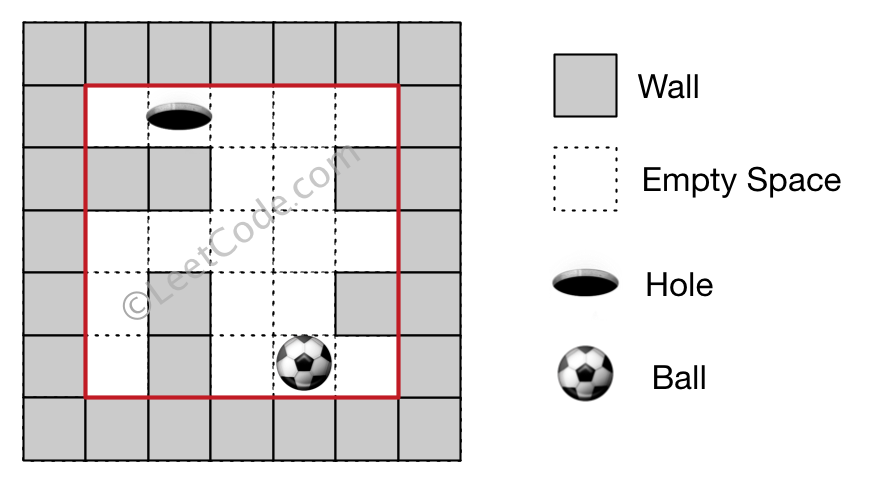
Input 1: a maze represented by a 2D array

0 0 0 0 0

1 1 0 0 1

0 0 0 0 0

0 1 0 0 1

0 1 0 0 0

Input 2: ball coordinate (rowBall, colBall) = (4, 3)

Input 3: hole coordinate (rowHole, colHole) = (0, 1)

Output: "lul"

Explanation: There are two shortest ways for the ball to drop into the hole.

The first way is left -> up -> left, represented by "lul".

The second way is up -> left, represented by 'ul'.

Both ways have shortest distance 6, but the first way is lexicographically smaller because 'l' < 'u'. So the output is "lul".
Example 2
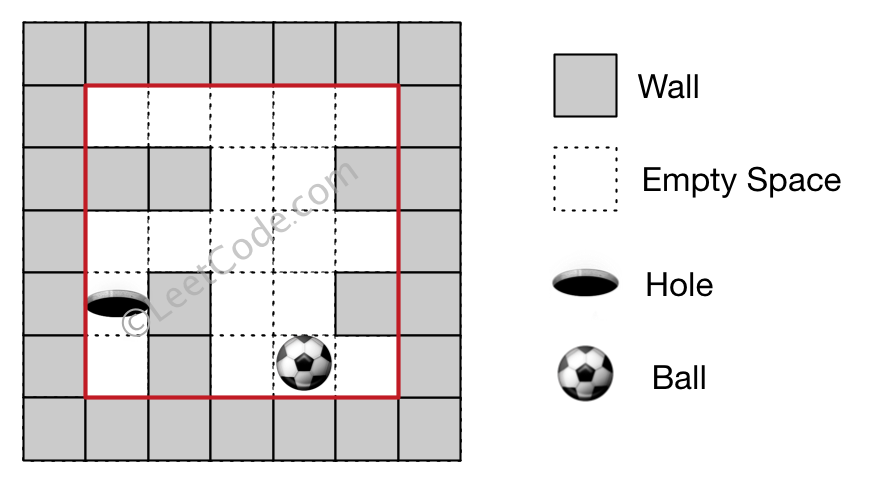
Input 1: a maze represented by a 2D array

0 0 0 0 0

1 1 0 0 1

0 0 0 0 0

0 1 0 0 1

0 1 0 0 0

Input 2: ball coordinate (rowBall, colBall) = (4, 3)

Input 3: hole coordinate (rowHole, colHole) = (3, 0)

Output: "impossible"

Explanation: The ball cannot reach the hole.
Note:
- There is only one ball and one hole in the maze.
- Both the ball and hole exist on an empty space, and they will not be at the same position initially.
- The given maze does not contain border (like the red rectangle in the example pictures), but you could assume the border of the maze are all walls.
- The maze contains at least 2 empty spaces, and the width and the height of the maze won't exceed 30.
490. The Maze 和 505. The Maze II 迷宫 II 的变形,在二维空间中放了洞,用u, r, d, l 这四个字母来分别表示上右下左,求让球掉入洞中的最小移动距离的移动方向字符串。在步数相等的情况下,返回按字母排序最小的答案。
解法1: BFS
解法2: DFS
Java:BFS,时间复杂度O(m * n * Max(m,n)),空间复杂度O(mn)
class Solution {

    class Point {

        int row, col, dist;

        public Point(int row, int col, int dist) {

            this.row = row;

            this.col = col;

            this.dist = dist;

        }

    }

    public String findShortestWay(int[][] maze, int[] ball, int[] hole) {

        if (maze == null || maze.length == 0) {

            return "";

        }

        int m = maze.length, n = maze[0].length;

        int[][] distance = new int[m][n];

        for (int i = 0; i < m; i++) {

            Arrays.fill(distance[i], Integer.MAX_VALUE);

        }

        distance[ball[0]][ball[1]] = 0;

        int[][] directions = {{-1, 0}, {1, 0}, {0, -1}, {0, 1}};

        String[] ways = {"u", "d", "l", "r"};

        Map<Integer, String> map = new HashMap<>();

        Queue<Point> queue = new LinkedList<>();

        queue.add(new Point(ball[0], ball[1], 0));

        findShortestWayByBFS(maze, queue, map, distance, hole, ways, directions);

        return map.containsKey(hole[0] * n + hole[1]) ? map.get(hole[0] * n + hole[1]) : "impossible";

    }

    public void findShortestWayByBFS(int[][] maze, Queue<Point> queue, Map<Integer, String> map, int[][] distance, int[] hole, String[] ways, int[][] directions) {

        int n = maze[0].length;

        while (!queue.isEmpty()) {

            Point curPoint = queue.remove();

            for (int i = 0; i < 4; i++) {

                int row = curPoint.row, col = curPoint.col, dist = curPoint.dist;

                String path = map.getOrDefault(row * n + col, "");

                while (isValid(row, col, maze, hole)) {

                    row += directions[i][0];

                    col += directions[i][1];

                    ++dist;

                }

                if (row != hole[0] || col != hole[1]) {

                    row -= directions[i][0];

                    col -= directions[i][1];

                    --dist;

                }

                path += ways[i];

                if (dist < distance[row][col]) {

                    distance[row][col] = dist;

                    map.put(row * n + col, path);

                    queue.add(new Point(row, col, dist));

                }

                else if (dist == distance[row][col] && path.compareTo(map.getOrDefault(row * n + col, "")) < 0) {

                    map.put(row * n + col, path);

                    queue.add(new Point(row, col, dist));

                }

            }

        }

    }

    public boolean isValid(int row, int col, int[][] maze, int[] hole) {

        return row >= 0 && row < maze.length && col >= 0 && col < maze[0].length && maze[row][col] == 0 && (row != hole[0] || col != hole[1]);

    }

}
Java:
public class Solution {

    public String findShortestWay(int[][] maze, int[] ball, int[] hole) {

        Queue<Point> queue = new LinkedList<>();

        int row = maze.length;

        int col = maze[0].length;

        Point[][] points = new Point[row][col];

        for (int i = 0; i < row; i++) {

            for (int j = 0; j < col; j++) {

                Point point = new Point(i, j);

                points[i][j] = point;

                if (i == hole[0] && j == hole[1]) {

                    point.path = "impossible";

                }

            }

        }

        int[] dirX = {0, -1, 1, 0}; // d, l, r, u

        int[] dirY = {1, 0, 0, -1};

        String[] dir = {"d", "l", "r", "u"};

        Point startPoint = points[ball[0]][ball[1]];

        startPoint.dis = 0;

        queue.add(startPoint);

        while (!queue.isEmpty()) {

            Point point = queue.poll();

            for (int i = 0; i < 4; i++) {

                int x = point.x;

                int y = point.y;

                int dis = point.dis;

                String path = point.path;

                boolean inHole = false;

                while (x >= 0 && x < row && y >= 0 && y < col && maze[x][y] == 0) {

                    x += dirX[i];

                    y += dirY[i];

                    dis++;

                    if (x == hole[0] && y == hole[1]) {

                        inHole = true;

                        break;

                    }

                }

                if (!inHole) {

                    x -= dirX[i];

                    y -= dirY[i];

                    dis--;

                }

                Point newPoint = points[x][y];

                if (newPoint.dis > dis) {

                    newPoint.dis = dis;

                    newPoint.path = String.join("", point.path, dir[i]);

                    if (!inHole) {

                        queue.add(newPoint);

                    }

                } else if (newPoint.dis == dis) {

                    boolean updated = false;

                    String newPath = String.join("", point.path, dir[i]);

                    for (int k = 0; k < newPoint.path.length() && k < newPath.length(); k++) {

                        if (newPoint.path.charAt(k) > newPath.charAt(k)) {

                            updated = true;

                            newPoint.path = newPath;

                            break;

                        }

                    }

                    if (!updated && newPoint.path.length() > newPath.length()) {

                        newPoint.path = newPath;

                    }

                }

            }

        }

        return points[hole[0]][hole[1]].path;

    }

}

class Point {

    int x;

    int y;

    String path;

    int dis;

    public Point(int x, int y) {

        this.x = x;

        this.y = y;

        this.path = "";

        this.dis = Integer.MAX_VALUE;

    }

}
C++:
class Solution {

public:

    string findShortestWay(vector<vector<int>>& maze, vector<int>& ball, vector<int>& hole) {

        int m = maze.size(), n = maze[0].size();

        vector<vector<int>> dists(m, vector<int>(n, INT_MAX));

        vector<vector<int>> dirs{{0,-1},{-1,0},{0,1},{1,0}};

        vector<char> way{'l','u','r','d'};

        queue<pair<int, int>> q;

        unordered_map<int, string> u;

        dists[ball[0]][ball[1]] = 0;

        q.push({ball[0], ball[1]});

        while (!q.empty()) {

            auto t = q.front(); q.pop();

            for (int i = 0; i < 4; ++i) {

                int x = t.first, y = t.second, dist = dists[x][y];

                string path = u[x * n + y];

                while (x >= 0 && x < m && y >= 0 && y < n && maze[x][y] == 0 && (x != hole[0] || y != hole[1])) {

                    x += dirs[i][0]; y += dirs[i][1]; ++dist;

                }

                if (x != hole[0] || y != hole[1]) {

                    x -= dirs[i][0]; y -= dirs[i][1]; --dist;

                }

                path.push_back(way[i]);

                if (dists[x][y] > dist) {

                    dists[x][y] = dist;

                    u[x * n + y] = path;

                    if (x != hole[0] || y != hole[1]) q.push({x, y});

                } else if (dists[x][y] == dist && u[x * n + y].compare(path) > 0) {

                    u[x * n + y] = path;

                    if (x != hole[0] || y != hole[1]) q.push({x, y});

                }

            }

        }

        string res = u[hole[0] * n + hole[1]];

        return res.empty() ? "impossible" : res;

    }

};
C++: DFS
class Solution {

public:

    vector<vector<int>> dirs{{0,-1},{-1,0},{0,1},{1,0}};

    vector<char> way{'l','u','r','d'};

    string findShortestWay(vector<vector<int>>& maze, vector<int>& ball, vector<int>& hole) {

        int m = maze.size(), n = maze[0].size();

        vector<vector<int>> dists(m, vector<int>(n, INT_MAX));

        unordered_map<int, string> u;

        dists[ball[0]][ball[1]] = 0;

        helper(maze, ball[0], ball[1], hole, dists, u);

        string res = u[hole[0] * n + hole[1]];

        return res.empty() ? "impossible" : res;

    }

    void helper(vector<vector<int>>& maze, int i, int j, vector<int>& hole, vector<vector<int>>& dists, unordered_map<int, string>& u) {

        if (i == hole[0] && j == hole[1]) return;

        int m = maze.size(), n = maze[0].size();

        for (int k = 0; k < 4; ++k) {

            int x = i, y = j, dist = dists[x][y];

            string path = u[x * n + y];

            while (x >= 0 && x < m && y >= 0 && y < n && maze[x][y] == 0 && (x != hole[0] || y != hole[1])) {

                x += dirs[k][0]; y += dirs[k][1]; ++dist;

            }

            if (x != hole[0] || y != hole[1]) {

                x -= dirs[k][0]; y -= dirs[k][1]; --dist;

            }

            path.push_back(way[k]);

            if (dists[x][y] > dist) {

                dists[x][y] = dist;

                u[x * n + y] = path;

                helper(maze, x, y, hole, dists, u);

            } else if (dists[x][y] == dist && u[x * n + y].compare(path) > 0) {

                u[x * n + y] = path;

                helper(maze, x, y, hole, dists, u);

            }

        }

    }

};
类似题目:
[LeetCode] 505. The Maze II 迷宫 II
All LeetCode Questions List 题目汇总
[LeetCode] 499. The Maze III 迷宫 III的更多相关文章
- [LeetCode] 505. The Maze II 迷宫 II
There is a ball in a maze with empty spaces and walls. The ball can go through empty spaces by rolli ...
- LeetCode 499. The Maze III
原题链接在这里:https://leetcode.com/problems/the-maze-iii/ 题目: There is a ball in a maze with empty spaces ...
- [LeetCode] 505. The Maze II 迷宫之二
There is a ball in a maze with empty spaces and walls. The ball can go through empty spaces by rolli ...
- 【LeetCode】556. Next Greater Element III 解题报告(Python)
[LeetCode]556. Next Greater Element III 解题报告(Python) 标签(空格分隔): LeetCode 作者: 负雪明烛 id: fuxuemingzhu 个人 ...
- 3299: [USACO2011 Open]Corn Maze玉米迷宫
3299: [USACO2011 Open]Corn Maze玉米迷宫 Time Limit: 10 Sec Memory Limit: 128 MBSubmit: 137 Solved: 59[ ...
- [LeetCode] The Maze III 迷宫之三
There is a ball in a maze with empty spaces and walls. The ball can go through empty spaces by rolli ...
- LC 499. The Maze III 【lock,hard】
There is a ball in a maze with empty spaces and walls. The ball can go through empty spaces by rolli ...
- [LeetCode] The Maze II 迷宫之二
There is a ball in a maze with empty spaces and walls. The ball can go through empty spaces by rolli ...
- [LeetCode] 490. The Maze 迷宫
There is a ball in a maze with empty spaces and walls. The ball can go through empty spaces by rolli ...
随机推荐
- Kotlin属性引用进阶与构造方法引用
继续还是探讨Kotlin反射相关的知识点,说实话这块不是太好理解,待在实际工作中去对它进行实践慢慢来加深印象. 属性引用进阶: 在Kotlin中的反射其实是跟Java的反射有对应关系的,具体相关的定义 ...
- The 16th Zhejiang Provincial Collegiate Programming Contest Sponsored by TuSimple (Mirror)
B题 思路 因为 \[ x=\sum\limits_{k=1}^{n}ka_k\\ y=\sum\limits_{k=1}^{n}ka_{k}^{2} \] 我们设交换前和交换后的这两个等式的值设为\ ...
- 用python+openpyxl从表格中读取测试用例的多条数据,然后将执行结果写入表格中
# -*- coding: utf-8 -*- from selenium import webdriver from openpyxl import load_workbook class mylo ...
- 题解 UVa11752
题目大意 输出所有小于 \(2^{64}-1\) 的正整数 \(n\), 使得 \(\exists p, q, a, b\in \mathbb{N+}, p\neq q\rightarrow a^p= ...
- Impala 介绍(转载)
一.简介 1.概述 Impala是Cloudera公司推出,提供对HDFS.Hbase数据的高性能.低延迟的交互式SQL查询功能. •基于Hive使用内存计算,兼顾数据仓库.具有实时.批处理.多并发等 ...
- packr 方便的潜入静态资源文件到golang 二进制文件中
类似的工具以前有介绍过statik,今天使用的工具是packr 也是很方便的golang tools 安装 go get -u github.com/gobuffalo/packr/packr 或者我 ...
- 洛谷P1577 切绳子题解
洛谷P1577 切绳子题解 题目描述 有N条绳子,它们的长度分别为Li.如果从它们中切割出K条长度相同的 绳子,这K条绳子每条最长能有多长?答案保留到小数点后2位(直接舍掉2为后的小数). 输入输出格 ...
- 干货 | 10分钟掌握branch and cut(分支剪界)算法原理附带C++求解TSP问题代码
00 前言 branch and cut其实还是和branch and bound脱离不了干系的.所以,在开始本节的学习之前,请大家还是要务必掌握branch and bound算法的原理. 01 应 ...
- TEX Quotes
题目链接:https://cn.vjudge.net/problem/UVA-272 AC代码: /* */ #include <iostream> #include <stdio. ...
- mysql 修改字段名称以及长度
//修改字段长度 alter table table1 modify name ); //修改字段名称以及长度 alter table table1 change name name_new ); a ...