
Scrambled Polygon(斜率排序)
| Time Limit: 1000MS | Memory Limit: 30000K | |
| Total Submissions: 7799 | Accepted: 3707 |
Description
A closed polygon is called convex if the line segment joining any two points of the polygon lies in the polygon. Figure 1 shows a closed polygon which is convex and one which is not convex. (Informally, a closed polygon is convex if its border doesn't have any "dents".)
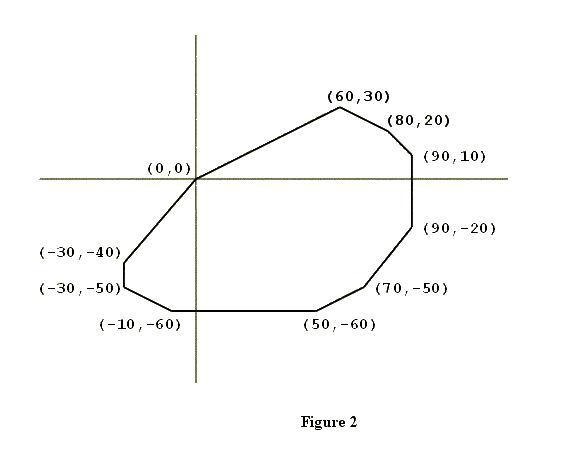
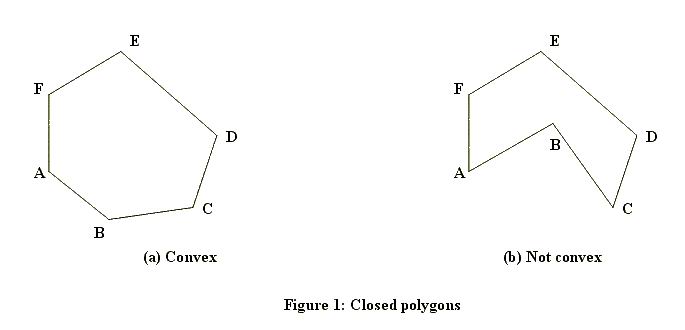 The subject of this problem is a closed convex polygon in the coordinate plane, one of whose vertices is the origin (x = 0, y = 0). Figure 2 shows an example. Such a polygon will have two properties significant for this problem.
 The first property is that the vertices of the polygon will be confined to three or fewer of the four quadrants of the coordinate plane. In the example shown in Figure 2, none of the vertices are in the second quadrant (where x < 0, y > 0).
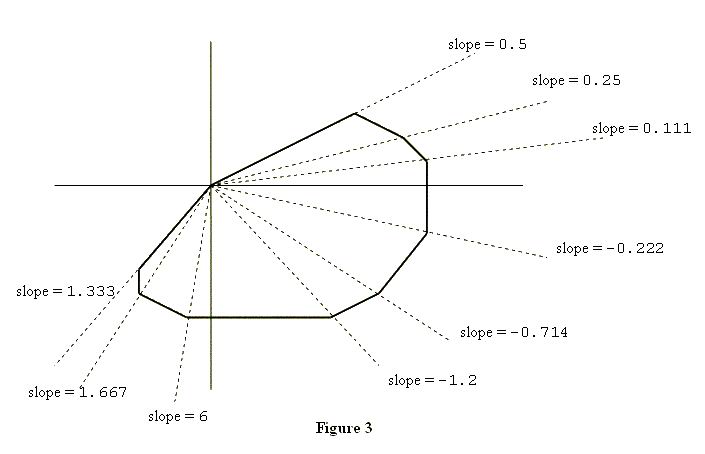
To describe the second property, suppose you "take a trip" around the polygon: start at (0, 0), visit all other vertices exactly once, and arrive at (0, 0). As you visit each vertex (other than (0, 0)), draw the diagonal that connects the current vertex with (0, 0), and calculate the slope of this diagonal. Then, within each quadrant, the slopes of these diagonals will form a decreasing or increasing sequence of numbers, i.e., they will be sorted. Figure 3 illustrates this point.
Input
Output
Sample Input
0 0

70 -50

60 30

-30 -50

80 20

50 -60

90 -20

-30 -40

-10 -60

90 10
Sample Output
(0,0)

(-30,-40)

(-30,-50)

(-10,-60)

(50,-60)

(70,-50)

(90,-20)

(90,10)

(80,20)

(60,30)
题意:给你一系列点,让输出一个凸多边形的各点,把斜率从大到小排序就好了;
代码;
#include<iostream>

#include<cstdio>

#include<cstring>

#include<cmath>

#include<algorithm>

#include<queue>

using namespace std;

const int INF=0x3f3f3f3f;

#define mem(x,y) memset(x,y,sizeof(x))

#define SI(x) scanf("%d",&x);

struct Node{

	int x,y;

	/*friend bool operator < (Node a,Node b){

		if(a.x!=b.x)return a.x<b.x;

		else return a.y<b.y;

	}*/

}dt[100010];

int cross(Node a,Node b){

	return a.x*b.y-a.y*b.x;

}

int cmp(Node a,Node b){

		if(cross(a,b)>0)return 1;

		else return 0;

	}

int main(){

	int k=0;

	while(~scanf("%d%d",&dt[k].x,&dt[k].y))k++;

	sort(dt+1,dt+k,cmp);

	for(int i=0;i<k;i++)printf("(%d,%d)\n",dt[i].x,dt[i].y);

	return 0;

}
Scrambled Polygon(斜率排序)的更多相关文章
- poj 2007 Scrambled Polygon 极角排序
/** 极角排序输出,,, 主要atan2(y,x) 容易失精度,,用 bool cmp(point a,point b){ 5 if(cross(a-tmp,b-tmp)>0) 6 retur ...
- Scrambled Polygon(凸多边形,斜率)
Scrambled Polygon Time Limit: 1000MS Memory Limit: 30000K Total Submissions: 7805 Accepted: 3712 ...
- POJ 2007 Scrambled Polygon [凸包 极角排序]
Scrambled Polygon Time Limit: 1000MS Memory Limit: 30000K Total Submissions: 8636 Accepted: 4105 ...
- POJ 2007 Scrambled Polygon 凸包
Scrambled Polygon Time Limit: 1000MS Memory Limit: 30000K Total Submissions: 7214 Accepted: 3445 ...
- 【BZOJ1007】【HNOI2008】水平可见直线(斜率排序+单调栈)
1007: [HNOI2008]水平可见直线 Time Limit: 1 Sec Memory Limit: 162 MBSubmit: 2605 Solved: 914[Submit][Stat ...
- poj 2007 Scrambled Polygon(极角排序)
http://poj.org/problem?id=2007 Time Limit: 1000MS Memory Limit: 30000K Total Submissions: 6701 A ...
- 简单几何(极角排序) POJ 2007 Scrambled Polygon
题目传送门 题意:裸的对原点的极角排序,凸包貌似不行. /************************************************ * Author :Running_Time ...
- POJ 2007 Scrambled Polygon (简单极角排序)
题目链接 题意 : 对输入的点极角排序 思路 : 极角排序方法 #include <iostream> #include <cmath> #include <stdio. ...
- POJ 2007 Scrambled Polygon(简单极角排序)
水题,根本不用凸包,就是一简单的极角排序. 叉乘<0,逆时针. #include <iostream> #include <cstdio> #include <cs ...
随机推荐
- IOS基础:深入理解Objective-c中@class的含义
objective-c中,当一个类使用到另一个类时,并且在类的头文件中需要创建被引用的指针时, 如下面代码: A.h文件 #import "B.h" @interface A : ...
- ;(function( $, window, undefined ){ }(jQuery,window))为何需要往里面传$,window,undefined这些参数
(function( $, jQuery , undefined ) {})(jQuery); 为什么要将window和undefined作为参数传给它? 因为 ecmascript 执行JS代码是从 ...
- [转载]php 处理上百万条的数据库如何提高处理查询速度
转载自http://www.jb51.net/article/22063.htm ----------------------------------------------------------- ...
- 制作OB图的时候,OB玩家进入后就退出的问题
开始怀疑是 OB玩家没有建筑 所以强行退出了,有朋友说那是因为有无效的触发造成的 我没有测试过 最后解决是给OB玩家在地图中加上建筑 更新 最后测试,把OB玩家放到一个组里 开局KILL掉这个组的建筑 ...
- 解决 winedit 打开tex文件 reading error
从网上下载的论文模板,发现直接双击打开.tex文件(默认关联用winedit打开)时会出现reading error,然后看不到任何文字(网上有人讨论打开是乱码的问题,但是我的是完全看不到任何东西), ...
- 四轴飞行器1.1 Matlab 姿态显示
四轴飞行器1.1 Matlab 姿态显示 开始做四轴了,一步一步来,东西实在很多,比较杂.先做matlab上位机,主要用来做数据分析,等板子到了可以写飞控的程序了,从底层一层一层开始写..希望能好好的 ...
- Html 小插件2
调用google的JS翻译插件实现页面自动翻译功能 网址http://translate.google.com/translate_tools 设置自己需要的配置生成如下代码放到自己站的页面头部 代码 ...
- CCNP路由实验(1) -- EIGRP
EIGRP(Enhanced Interior Gateway Routing Protocol,增强型内部网关路由协议)是Cisco公司开发的一个平衡混合型路由协议,它融合了距离向量和链路状态两种路 ...
- CCNA实验(10) -- Access List
使用包过滤技术在路由器上读取三层及四层报头的信息如源地址.目的地址.源端口.目的端口根据预先定义好的规则对包进行过滤 三种类型:1.标准ACL:表号范围1-99或1300-1999.仅对源IP地址进行 ...
- CentOS6.6普通用户使用sudo命令借用root用户权限
一.描写叙述 普通用户hadoop使用:tar -xzvf ns2.35.tar.gz命令解压文件,系统提示找不到该文件,无法打开该文件夹,于是想到使用sudo命令借用root用户的权限:sudo t ...