
Scrambled Polygon(凸多边形,斜率)
| Time Limit: 1000MS | Memory Limit: 30000K | |
| Total Submissions: 7805 | Accepted: 3712 |
Description
A closed polygon is called convex if the line segment joining any two points of the polygon lies in the polygon. Figure 1 shows a closed polygon which is convex and one which is not convex. (Informally, a closed polygon is convex if its border doesn't have any "dents".) 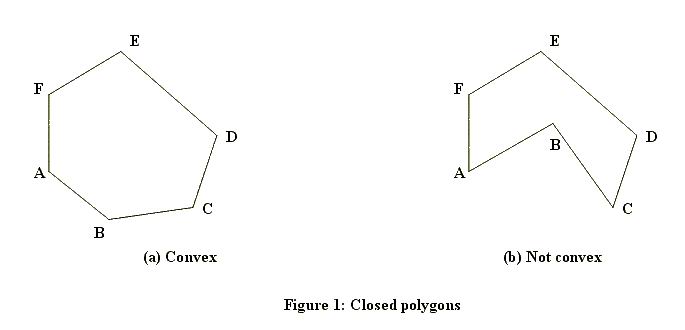
The subject of this problem is a closed convex polygon in the coordinate plane, one of whose vertices is the origin (x = 0, y = 0). Figure 2 shows an example. Such a polygon will have two properties significant for this problem.
The first property is that the vertices of the polygon will be confined to three or fewer of the four quadrants of the coordinate plane. In the example shown in Figure 2, none of the vertices are in the second quadrant (where x < 0, y > 0).
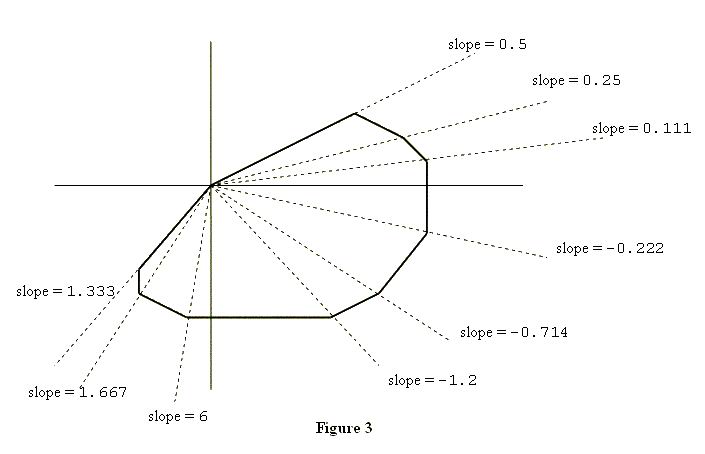
To describe the second property, suppose you "take a trip" around the polygon: start at (0, 0), visit all other vertices exactly once, and arrive at (0, 0). As you visit each vertex (other than (0, 0)), draw the diagonal that connects the current vertex with (0, 0), and calculate the slope of this diagonal. Then, within each quadrant, the slopes of these diagonals will form a decreasing or increasing sequence of numbers, i.e., they will be sorted. Figure 3 illustrates this point. 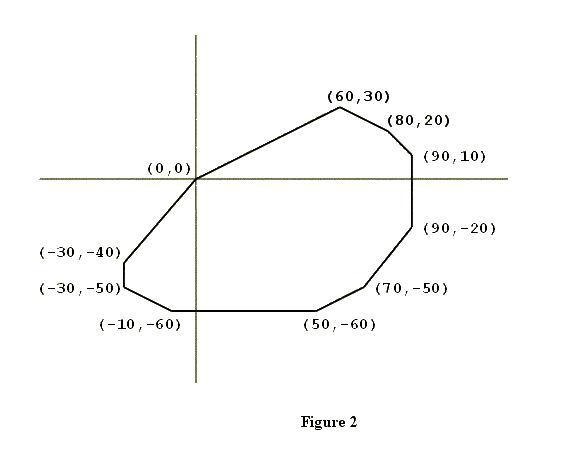
Input
Output
Sample Input
0 0

70 -50

60 30

-30 -50

80 20

50 -60

90 -20

-30 -40

-10 -60

90 10
Sample Output
(0,0)

(-30,-40)

(-30,-50)

(-10,-60)

(50,-60)

(70,-50)

(90,-20)

(90,10)

(80,20)

(60,30)
题意:就是给你一些点,起点已经告诉你是(0,0),让输出这个多边形,斜率从小到大表示;
题解:排下序就好了,注意把除变成乘。。。
代码:
#include<iostream>

#include<cstdio>

#include<cstring>

#include<cmath>

#include<algorithm>

#include<queue>

using namespace std;

const int INF=0x3f3f3f3f;

#define mem(x,y) memset(x,y,sizeof(x))

#define SI(x) scanf("%d",&x);

struct Node{

	int x,y;

	friend bool operator < (Node a,Node b){

		if(a.y*b.x<b.y*a.x)return true;

		else return false;

	}

}dt[100010];

int main(){

	int k=0;

	while(~scanf("%d%d",&dt[k].x,&dt[k].y))k++;

	sort(dt+1,dt+k);

	for(int i=0;i<k;i++)printf("(%d,%d)\n",dt[i].x,dt[i].y);

	return 0;

}
Scrambled Polygon(凸多边形,斜率)的更多相关文章
- Scrambled Polygon(斜率排序)
Scrambled Polygon Time Limit: 1000MS Memory Limit: 30000K Total Submissions: 7799 Accepted: 3707 ...
- POJ 2007 Scrambled Polygon 凸包
Scrambled Polygon Time Limit: 1000MS Memory Limit: 30000K Total Submissions: 7214 Accepted: 3445 ...
- POJ 2007 Scrambled Polygon [凸包 极角排序]
Scrambled Polygon Time Limit: 1000MS Memory Limit: 30000K Total Submissions: 8636 Accepted: 4105 ...
- [LeetCode] Convex Polygon 凸多边形
Given a list of points that form a polygon when joined sequentially, find if this polygon is convex ...
- poj 2007 Scrambled Polygon(极角排序)
http://poj.org/problem?id=2007 Time Limit: 1000MS Memory Limit: 30000K Total Submissions: 6701 A ...
- 简单几何(极角排序) POJ 2007 Scrambled Polygon
题目传送门 题意:裸的对原点的极角排序,凸包貌似不行. /************************************************ * Author :Running_Time ...
- POJ 2007 Scrambled Polygon (简单极角排序)
题目链接 题意 : 对输入的点极角排序 思路 : 极角排序方法 #include <iostream> #include <cmath> #include <stdio. ...
- Scrambled Polygon - POJ 2007(求凸包)
给一些点,这些点都是一个凸包上的顶点,以第一个点为起点顺时针把别的点拍排一下序列. 分析:最简单的极坐标排序了..................... 代码如下: ----------------- ...
- poj 2007 Scrambled Polygon 极角排序
/** 极角排序输出,,, 主要atan2(y,x) 容易失精度,,用 bool cmp(point a,point b){ 5 if(cross(a-tmp,b-tmp)>0) 6 retur ...
随机推荐
- BZOJ 1974: [Sdoi2010]auction 代码拍卖会( dp )
在1, 11, 111……中选<=8个, + 11..(n个1)拼出所有可能...这些数mod p至多有p中可能, 找出循环的处理一下. 那么dp就很显然了...dp(i, j, k)表示前i种 ...
- springmvc结合freemarker,非自定义标签
参考:http://viralpatel.net/blogs/spring-mvc-freemarker-ftl-example/ 上图: 目录层级: 启动后的访问地址:http://localhos ...
- 《JavaScript+DOM编程艺术》的摘要(三)---图片库实例
<!DOCTYPE html> <html> <head> <meta charset="utf-8"> <meta http ...
- sqlplus命令手册
show errorshow allshow usersqlplus show和set命令是两条用于维护SQLPlus系统变量的命令 : SQL> show all --查看所有系统变量值 SQ ...
- 宣布发布全新的 Windows Azure 缓存预览版
全新 Windows Azure 缓存的预览版现已发布.此托管服务可以提供闪电般的数据访问速度,以帮助您构建更具可伸缩性.响应更快的应用程序. 详情如下: · 托管式缓存:这一全新的托管服务为需 ...
- Paths on a Grid(规律)
Paths on a Grid Time Limit: 1000MS Memory Limit: 30000K Total Submissions: 23270 Accepted: 5735 ...
- pv ticketlock解决虚拟环境下的spinlock问题
最近看邮件,有注意到pv ticketlock相关的消息,貌似jeremy 几年前的东东,终于将要被收录到linux 3.12里面. 先说下pv ticketlock这东西,http://blog.x ...
- cc150:实现一个算法来删除单链表中间的一个结点,仅仅给出指向那个结点的指针
实现一个算法来删除单链表中间的一个结点,仅仅给出指向那个结点的指针. 样例: 输入:指向链表a->b->c->d->e中结点c的指针 结果:不须要返回什么,得到一个新链表:a- ...
- Android实现左右滑动指引效果
本文介绍Android中实现左右滑动的指引效果. 关于左右滑动效果,我在以前的一篇博文中提到过,有兴趣的朋友可以查看:http://www.cnblogs.com/hanyonglu/archive/ ...
- 《网络编程》Unix 域套接字
概述 Unix 域套接字是一种client和server在单主机上的 IPC 方法.Unix 域套接字不运行协议处理,不须要加入或删除网络报头,无需验证和,不产生顺序号,无需发送确认报文,比因特网域套 ...