
Scrambled Polygon(斜率排序)
| Time Limit: 1000MS | Memory Limit: 30000K | |
| Total Submissions: 7799 | Accepted: 3707 |
Description
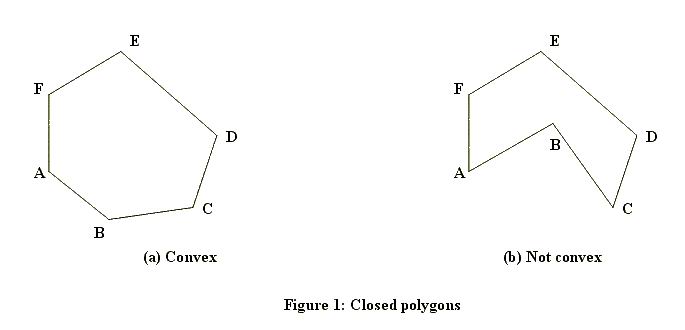
A closed polygon is called convex if the line segment joining any two points of the polygon lies in the polygon. Figure 1 shows a closed polygon which is convex and one which is not convex. (Informally, a closed polygon is convex if its border doesn't have any "dents".)
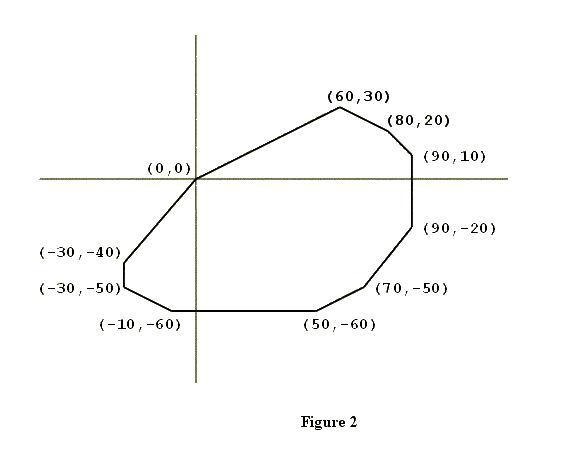
 The subject of this problem is a closed convex polygon in the coordinate plane, one of whose vertices is the origin (x = 0, y = 0). Figure 2 shows an example. Such a polygon will have two properties significant for this problem.
 The first property is that the vertices of the polygon will be confined to three or fewer of the four quadrants of the coordinate plane. In the example shown in Figure 2, none of the vertices are in the second quadrant (where x < 0, y > 0).
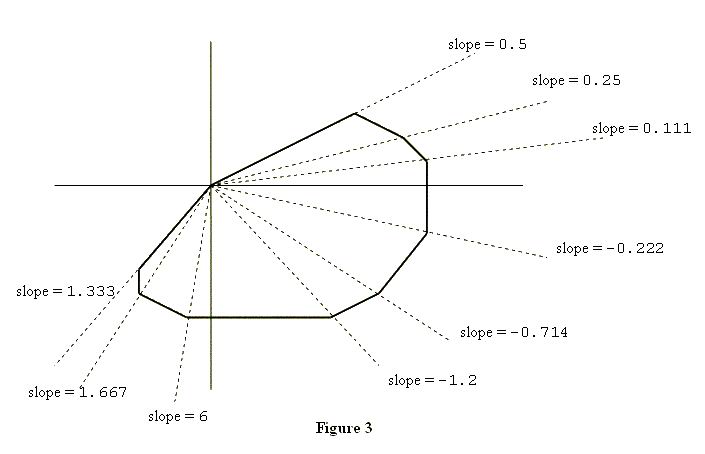
To describe the second property, suppose you "take a trip" around the polygon: start at (0, 0), visit all other vertices exactly once, and arrive at (0, 0). As you visit each vertex (other than (0, 0)), draw the diagonal that connects the current vertex with (0, 0), and calculate the slope of this diagonal. Then, within each quadrant, the slopes of these diagonals will form a decreasing or increasing sequence of numbers, i.e., they will be sorted. Figure 3 illustrates this point.
Input
Output
Sample Input
0 0

70 -50

60 30

-30 -50

80 20

50 -60

90 -20

-30 -40

-10 -60

90 10
Sample Output
(0,0)

(-30,-40)

(-30,-50)

(-10,-60)

(50,-60)

(70,-50)

(90,-20)

(90,10)

(80,20)

(60,30)
题意:给你一系列点,让输出一个凸多边形的各点,把斜率从大到小排序就好了;
代码;
#include<iostream>

#include<cstdio>

#include<cstring>

#include<cmath>

#include<algorithm>

#include<queue>

using namespace std;

const int INF=0x3f3f3f3f;

#define mem(x,y) memset(x,y,sizeof(x))

#define SI(x) scanf("%d",&x);

struct Node{

	int x,y;

	/*friend bool operator < (Node a,Node b){

		if(a.x!=b.x)return a.x<b.x;

		else return a.y<b.y;

	}*/

}dt[100010];

int cross(Node a,Node b){

	return a.x*b.y-a.y*b.x;

}

int cmp(Node a,Node b){

		if(cross(a,b)>0)return 1;

		else return 0;

	}

int main(){

	int k=0;

	while(~scanf("%d%d",&dt[k].x,&dt[k].y))k++;

	sort(dt+1,dt+k,cmp);

	for(int i=0;i<k;i++)printf("(%d,%d)\n",dt[i].x,dt[i].y);

	return 0;

}
Scrambled Polygon(斜率排序)的更多相关文章
- poj 2007 Scrambled Polygon 极角排序
/** 极角排序输出,,, 主要atan2(y,x) 容易失精度,,用 bool cmp(point a,point b){ 5 if(cross(a-tmp,b-tmp)>0) 6 retur ...
- Scrambled Polygon(凸多边形,斜率)
Scrambled Polygon Time Limit: 1000MS Memory Limit: 30000K Total Submissions: 7805 Accepted: 3712 ...
- POJ 2007 Scrambled Polygon [凸包 极角排序]
Scrambled Polygon Time Limit: 1000MS Memory Limit: 30000K Total Submissions: 8636 Accepted: 4105 ...
- POJ 2007 Scrambled Polygon 凸包
Scrambled Polygon Time Limit: 1000MS Memory Limit: 30000K Total Submissions: 7214 Accepted: 3445 ...
- 【BZOJ1007】【HNOI2008】水平可见直线(斜率排序+单调栈)
1007: [HNOI2008]水平可见直线 Time Limit: 1 Sec Memory Limit: 162 MBSubmit: 2605 Solved: 914[Submit][Stat ...
- poj 2007 Scrambled Polygon(极角排序)
http://poj.org/problem?id=2007 Time Limit: 1000MS Memory Limit: 30000K Total Submissions: 6701 A ...
- 简单几何(极角排序) POJ 2007 Scrambled Polygon
题目传送门 题意:裸的对原点的极角排序,凸包貌似不行. /************************************************ * Author :Running_Time ...
- POJ 2007 Scrambled Polygon (简单极角排序)
题目链接 题意 : 对输入的点极角排序 思路 : 极角排序方法 #include <iostream> #include <cmath> #include <stdio. ...
- POJ 2007 Scrambled Polygon(简单极角排序)
水题,根本不用凸包,就是一简单的极角排序. 叉乘<0,逆时针. #include <iostream> #include <cstdio> #include <cs ...
随机推荐
- realloc,c语言
realloc #include <stdlib.h> main() { char* ptr=NULL; char* ptr2=NULL; ptr = malloc(); printf(& ...
- 常用Json
一般Json是页面与页面之间传递使用. Json用途 1 后台与前台数据交互,并且数据较复杂,如果数据单一,直接传递字符串,然后在前台用js分割就行. 2 webservice和html ...
- TextView settextcolor 无效解决方案
viHolder.order_item_tipcolor.setBackgroundColor(context .getResources().getColor(R.color.order_xixie ...
- CSS文本
CSS文字及文本 导航:1.文字及文本2.例子 1.文字及文本文字: 单个字符文本: 多个字符的组合体 2.例子2.1.文字的颜色颜色属性被用来设置文字的颜色格式: color:色值颜色是通过CSS最 ...
- ObjectiveC 文件操作二
10,文件委托,以便操作文件.头部看起来像是这样. @interface MyFileManager : NSObject @property(strong)NSFileManager *fileMa ...
- 深度探索QT窗口系统(五篇)
窗口作为界面编程中最重要的部分,没有窗口就没有界面,是窗口让我们摆脱了DOS时代,按钮是一个窗口,文本框是一个窗口,标签页是一个窗口,...一个窗口可以由多个窗口组成,每天我们都在与窗口打交道,当你打 ...
- Q_D宏
Qt 源码中有很多Q_Q和Q_D宏,使用这些宏的地方总会看到有q指针和d指针,查了查KDE文档,大体搞清了其中的机理,欧也!Qt的这些私有数据访问策略还是挺值得借鉴.下面就简单总结一下. 访问器 , ...
- .NET(C#):XmlReader和Whitespace以及MoveToContent和ReadToFollowing方法
原文 http://www.cnblogs.com/mgen/archive/2012/04/26/2471403.html XmlReader默认是读取XML文件中的Whitespace和注释的. ...
- Unix Shells: Bash, Fish, Ksh, Tcsh, Zsh
Hyperpolyglot Unix Shells: Bash, Fish, Ksh, Tcsh, Zsh grammar | quoting and escaping | charactersvar ...
- 个人信用卡管理 - iOS UI原型