
吴裕雄 python 机器学习——模型选择数据集切分
import  numpy as np

from sklearn.model_selection import train_test_split,KFold,StratifiedKFold,LeaveOneOut,cross_val_score

#模型选择数据集切分train_test_split模型

def test_train_test_split():

    X=[[1,2,3,4],

       [11,12,13,14],

       [21,22,23,24],

       [31,32,33,34],

       [41,42,43,44],

       [51,52,53,54],

       [61,62,63,64],

       [71,72,73,74]]

    y=[1,1,0,0,1,1,0,0]

    # 切分,测试集大小为原始数据集大小的 40%

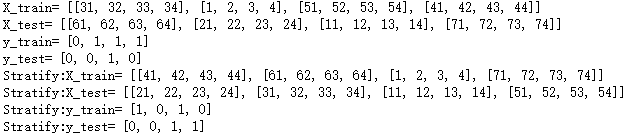
    X_train, X_test, y_train, y_test = train_test_split(X, y,test_size=0.4, random_state=0)

    print("X_train=",X_train)

    print("X_test=",X_test)

    print("y_train=",y_train)

    print("y_test=",y_test)

    # 分层采样切分,测试集大小为原始数据集大小的 40%

    X_train, X_test, y_train, y_test = train_test_split(X, y,test_size=0.4,random_state=0,stratify=y)

    print("Stratify:X_train=",X_train)

    print("Stratify:X_test=",X_test)

    print("Stratify:y_train=",y_train)

    print("Stratify:y_test=",y_test)

test_train_test_split()
#模型选择数据集切分KFold模型

def test_KFold():

    X=np.array([[1,2,3,4],

       [11,12,13,14],

       [21,22,23,24],

       [31,32,33,34],

       [41,42,43,44],

       [51,52,53,54],

       [61,62,63,64],

       [71,72,73,74],

       [81,82,83,84]])

    y=np.array([1,1,0,0,1,1,0,0,1])

    # 切分之前不混洗数据集

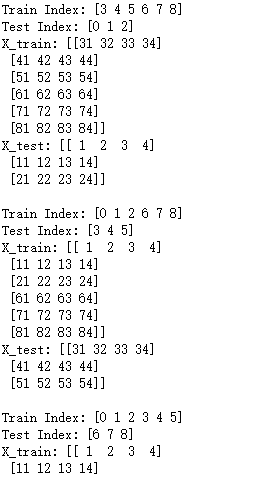
    folder=KFold(n_splits=3,random_state=0,shuffle=False)

    for train_index,test_index in folder.split(X,y):

        print("Train Index:",train_index)

        print("Test Index:",test_index)

        print("X_train:",X[train_index])

        print("X_test:",X[test_index])

        print("")

    # 切分之前混洗数据集

    shuffle_folder=KFold(n_splits=3,random_state=0,shuffle=True)

    for train_index,test_index in shuffle_folder.split(X,y):

        print("Shuffled Train Index:",train_index)

        print("Shuffled Test Index:",test_index)

        print("Shuffled X_train:",X[train_index])

        print("Shuffled X_test:",X[test_index])

        print("")

test_KFold()
#模型选择数据集切分StratifiedKFold模型

def test_StratifiedKFold():

    X=np.array([[1,2,3,4],

       [11,12,13,14],

       [21,22,23,24],

       [31,32,33,34],

       [41,42,43,44],

       [51,52,53,54],

       [61,62,63,64],

       [71,72,73,74]])

    y=np.array([1,1,0,0,1,1,0,0])

    folder=KFold(n_splits=4,random_state=0,shuffle=False)

    stratified_folder=StratifiedKFold(n_splits=4,random_state=0,shuffle=False)

    for train_index,test_index in folder.split(X,y):

        print("Train Index:",train_index)

        print("Test Index:",test_index)

        print("y_train:",y[train_index])

        print("y_test:",y[test_index])

        print("")

    for train_index,test_index in stratified_folder.split(X,y):

        print("Stratified Train Index:",train_index)

        print("Stratified Test Index:",test_index)

        print("Stratified y_train:",y[train_index])

        print("Stratified y_test:",y[test_index])

        print("")

test_StratifiedKFold()

#模型选择数据集切分LeaveOneOut模型

def test_LeaveOneOut():

    X=np.array([[1,2,3,4],

       [11,12,13,14],

       [21,22,23,24],

       [31,32,33,34]])

    y=np.array([1,1,0,0])

    lo=LeaveOneOut()

    for train_index,test_index in lo.split(X):

        print("Train Index:",train_index)

        print("Test Index:",test_index)

        print("X_train:",X[train_index])

        print("X_test:",X[test_index])

        print("")

test_LeaveOneOut()

#模型选择数据集切分cross_val_score模型

def test_cross_val_score():

    from sklearn.datasets import  load_digits

    from sklearn.svm import  LinearSVC

    digits=load_digits() # 加载用于分类问题的数据集

    X=digits.data

    y=digits.target

    # 使用 LinearSVC 作为分类器

    result=cross_val_score(LinearSVC(),X,y,cv=10)

    print("Cross Val Score is:",result)

test_cross_val_score()

吴裕雄 python 机器学习——模型选择数据集切分的更多相关文章
- 吴裕雄 python 机器学习——模型选择验证曲线validation_curve模型
import numpy as np import matplotlib.pyplot as plt from sklearn.svm import LinearSVC from sklearn.da ...
- 吴裕雄 python 机器学习——模型选择学习曲线learning_curve模型
import numpy as np import matplotlib.pyplot as plt from sklearn.svm import LinearSVC from sklearn.da ...
- 吴裕雄 python 机器学习——模型选择回归问题性能度量
from sklearn.metrics import mean_absolute_error,mean_squared_error #模型选择回归问题性能度量mean_absolute_error模 ...
- 吴裕雄 python 机器学习——模型选择分类问题性能度量
import numpy as np import matplotlib.pyplot as plt from sklearn.svm import SVC from sklearn.datasets ...
- 吴裕雄 python 机器学习——模型选择参数优化暴力搜索寻优GridSearchCV模型
import scipy from sklearn.datasets import load_digits from sklearn.metrics import classification_rep ...
- 吴裕雄 python 机器学习——模型选择参数优化随机搜索寻优RandomizedSearchCV模型
import scipy from sklearn.datasets import load_digits from sklearn.metrics import classification_rep ...
- 吴裕雄 python 机器学习——模型选择损失函数模型
from sklearn.metrics import zero_one_loss,log_loss def test_zero_one_loss(): y_true=[1,1,1,1,1,0,0,0 ...
- 吴裕雄 python 机器学习——KNN回归KNeighborsRegressor模型
import numpy as np import matplotlib.pyplot as plt from sklearn import neighbors, datasets from skle ...
- 吴裕雄 python 机器学习——KNN分类KNeighborsClassifier模型
import numpy as np import matplotlib.pyplot as plt from sklearn import neighbors, datasets from skle ...
随机推荐
- 深度优先搜索 DFS(Depath First Search, DFS)
深度优先搜索是一种枚举所有完整路径以遍历所有情况的搜索方法.(不撞南墙不回头) DFS一般用递归来实现,其伪代码思路过程一般如下: void DFS(必要的参数){ if (符和遍历到一条完整路 ...
- python中乱码怎么由来与解决方法
前言曾几何时 Python 中文乱码的问题困扰了我很多很多年,每次出现中文乱码都要去网上搜索答案,虽然解决了当时遇到的问题但下次出现乱码的时候又会懵逼,究其原因还是知其然不知其所以然.现在有的小伙伴为 ...
- 关于Win32串口
因为近段时间接触Hid相对来说多一些,由此忽略了串口中获取cbInQue这个重要的东西,下面是错误代码 // Win32SerialPortLib.cpp : 定义 DLL 应用程序的导出函数. // ...
- Git 添加远程github仓库的时候提示错误:fatal: remote origin already exists.
1.先删除远程 Git 仓库 $ git remote rm origin 2.再添加远程 Git 仓库 $ git remote add origin git@github.com:wsydxian ...
- ts中的类
TypeScript 除了实现了所有 ES6 中的类的功能以外,还添加了一些新的用法(部分ES7). 一.ES6中类的主要用法: 1.使用 class 定义类,使用 constructor 定义构造函 ...
- crowdfunding项目01——感人的错误
四十搭环境,半个小时下载jar包,网速感人,一个半小时找bug真是感动 首先SSM项目,主要功能进行增删改查 建立父工程和子工程,产生依赖关系 父工程:pom 子工程:jar.war(web工程) 错 ...
- goland 2019.1.1破解
https://blog.csdn.net/hi_liuxiansheng/article/details/89078405
- Educational Codeforces Round 76 (Rated for Div. 2) D. Yet Another Monster Killing Problem
You play a computer game. In this game, you lead a party of mm heroes, and you have to clear a dunge ...
- torchvision的理解和学习 加载常用数据集,对主流模型的调用.md
torchvision的理解和学习 加载常用数据集,对主流模型的调用 https://blog.csdn.net/tsq292978891/article/details/79403617 加载常用数 ...
- oracle使用resultMap实现高级结果映射
resultMap的属性: 1.属性 id:resultMap的唯一标识.type:resulMap的映射结果类型(一般为Java实体类).2.子节点 id:一般对应数据库的主键 id,设置此项可以提 ...