
Why do Antennas Radiate?
Obtaining an intuitive idea for why antennas radiate is helpful in understanding the fundamentals of antennas. On this page, I'll attempt to give a low-key explanation with no regard to mathematics on how and why antennas radiate electromagnetic fields.
First, let's start with some basic physics. There is electric charge - this is a quantity of nature (like mass or weight or density) that every object possesses. You and I are most likely electrically neutral - we don't have a net charge that is positive or negative. There exists in every atom in the universe particles that contain positive and negative charge (protons and electrons, respectively). Some materials (like metals) that are very electrically conductive have loosely bound electrons. Hence, when a voltage is applied across a metal, the electrons travel around a circuit - this flow of electrons is electric current (measured in Amps).
Let us get back to charge for a moment. Suppose that for some reason, there is a negatively charged particle sitting somewhere in space. The universe has decided, for unknown reasons, that all charged particles will have an associated electric field with them. This is illustrated in Figure 1.
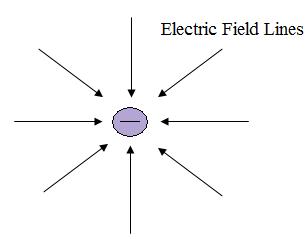
Figure 1. A negative charge has an associated Electric Field with it, everywhere in space.
So this negatively charged particle produces an electric field around it, everywhere in space. The Electric Field is a vector quantity - it has a magnitude (how strong the field strength is) and a direction (which direction does the field point). The field strength dies off (becomes smaller in magnitude) as you move away from the charge. Further, the magnitude of the E-field depends on how much charge exists. If the charge is positive, the E-field lines point away from the charge.
So this negatively charged particle produces an electric field around it, everywhere in space. The Electric Field is a vector quantity - it has a magnitude (how strong the field strength is) and a direction (which direction does the field point). The field strength dies off (becomes smaller in magnitude) as you move away from the charge. Further, the magnitude of the E-field depends on how much charge exists. If the charge is positive, the E-field lines point away from the charge.
The universe has also decided (again, for no apparent reason) that disturbances due to moving (or accelerating) charges will propagate away from the charge at the speed of light - c0 = 300,000,000 meters/second. This means the electric fields around the charge will be disturbed, and this disturbance propagates away from the charge. This is illustrated in Figure 2.
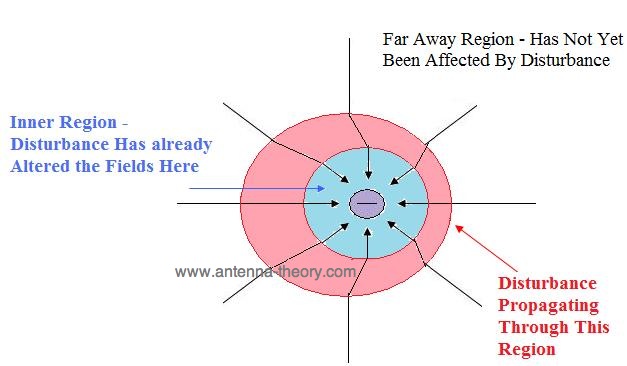
Figure 2. The E-fields when the charge is accelerated.
Once the charge is accelerated, the fields need to re-align themselves. Remember, the fields want to surround the charge exactly as they did in Figure 1. However, the fields can only respond to events at the speed of light. Hence, if a point is very far away from the charge, it will take time for the disturbance (or change in electric fields) to propagate to the point. This is illustrated in Figure 2.
In Figure 2, we have 3 regions. In the light blue (inner) region, the fields close to the charge have readapted themselves and now line up as they do in Figure 1. In the white region (outermost), the fields are still undisturbed and have the same magnitude and direction as they would if the charge had not moved. In the pink region, the fields are changing - from their old magnitude and direction to their new magnitude and direction.
Hence, we have arrived at the fundamental reason for radiation - the fields change because charges are accelerated. The fields always try to align themselves as in Figure 1 around charges. If we can produce a moving set of charges (this is simply electric current), then we will have radiation.
Now, you may have some questions.
First - if all accelerating electric charges radiate, then the wires that connect my computer to the wall should be antennas, correct? The charges on them are oscillating at 60 Hertz as the current travels so this should yield radiation, correct?
Answer: Yes. Your wires do act as antennas. However, they are very poor antennas. The reason (among other things), is that the wires that carry power to your computer are a transmission line - they carry current to your computer (which travels to one of your battery's terminals and out the other terminal) and then they carry the current away from your computer (all current travels in a circuit or loop). Hence, the radiation from one wire is cancelled by the current flowing in the adjacent wire (that is travelling the opposite direction).
Another question that will arise is - if its so simple, then everything could be an antenna. Why don't I just use a metal paper clip as an antenna, hook it up to my receiver and then forget all about antenna theory?
Answer: A paper clip could definitely act as an antenna if you get current flowing on the antenna. However, it is not so simple to do this. The impedance of the paper clip will control how much power your receiver or transmitter could deliver to the paper clip (i.e. whether or not you could get any current flowing on the paper clip at all). The impedance will depend on what frequency you are operating at. Hence, the paper clip will work at certain frequencies as an antenna. However, you will have to know much more about antennas before you can say when and it may work in a given situation.
--------------
In summary, all radiation is caused by accelerating charges which produce changing electric fields. And due to Maxwell's Equations, changing electric fields give rise to changing magnetic fields, and hence we have electromagnetic radiation. The subject of antenna theory is concerned with transferring power from your receiver (the energy is contained in voltages and currents) into electromagnetic radiation (where the energy is contained in the E- and H-fields) travelling away from the antenna. This requires the impedance of your antenna to be roughly matched to your receiver, and that the currents that cause radiation add up in-phase (that is, they don't cancel each other out as they would in a transmission line). A multitude of antenna types produce ways of achieving this, and you can find descriptions about them on the antenna list page.
来源:http://www.antenna-theory.com/basics/whyantennasradiate.php
Why do Antennas Radiate?的更多相关文章
- 扫描线 - UVALive - 6864 Strange Antennas
Strange Antennas Problem's Link: http://acm.hust.edu.cn/vjudge/problem/viewProblem.action?id=87213 M ...
- UVALive - 6864 Strange Antennas 扫描线
题目链接: http://acm.hust.edu.cn/vjudge/problem/87213 Strange Antennas Time Limit: 3000MS 题意 一个雷达能够辐射到的范 ...
- AT3912 Antennas on Tree
AT3912 Antennas on Tree %%zzt 只能考虑性质了. 把最后选择的k个点的连通块求出来,连通块内部的点表示都是互异的 连通块外部的点只能形成若干条链,并且这k个点的每一个最多与 ...
- uvalive6468,51cthink1419 Strange Antennas (离散化)
题意: 在一个 n x n 的平面上,给定 m 个等腰直角三角形(各点均为整数),问该平面上被三角形覆盖奇数次的点有多少个. 思路: 由于 n 较大,不能模拟解决,故使用离散化思想. 考虑每一行有多少 ...
- Radio Basics for RFID
Radio Basics for RFID The following is excerpted from Chapter 3: Radio Basics for UHF RFID from the ...
- RFID 基础/分类/编码/调制/传输
不同频段的RFID产品会有不同的特性,本文详细介绍了无源的感应器在不同工作频率产品的特性以及主要的应用. 目前定义RFID产品的工作频率有低频.高频和甚高频的频率范围内的符合不同标准的不同的产品,而且 ...
- Half Wavelength Dipole Antenna
Reference : 1. wikipedia The dipole antenna is the simplest and most widely used class of antenna.It ...
- IFA Basics
The inverted-F antenna is shown in Figure 1. While this antenna appears to be a wire antenna, after ...
- linux查看端口及端口详解
今天现场查看了TCP端口的占用情况,如下图 红色部分是IP,现场那边问我是不是我的程序占用了tcp的链接,,我远程登陆现场查看了一下,这种类型的tcp链接占用了400多个,,后边查了一下资料,说E ...
随机推荐
- AC自动机专题总结
最近学习了AC自动机,做了notonlysuccess大牛里面的题,也该来个总结了. AC自动机(Aho-Corasick Automaton)在1975年产生于贝尔实验室,是著名的多模匹配算法之一. ...
- hdu 4747 Mex( 线段树? 不,区间处理就行(dp?))
Mex Time Limit: 15000/5000 MS (Java/Others) Memory Limit: 65535/65535 K (Java/Others)Total Submis ...
- [UOJ218]火车管理
建一棵答案线段树存栈顶值,两棵可持久化线段树分别存栈顶值和栈顶元素入栈时间 询问就直接在答案线段树上查,弹栈就用入栈时间在对应版本的可持久化线段树上查询即可,修改就是可持久化线段树的区间覆盖 以前一直 ...
- [UOJ409]Highway Tolls
题意:交互题,给定一个简单无向图和$A,B(1\leq A\lt B)$,你可以对每条边指定其边权为$A$或$B$后通过交互库询问$S\rightarrow T$的最短路($S,T$在程序运行之前已经 ...
- 【AC自动机】【状压dp】【滚动数组】hdu6086 Rikka with String
给你m个01串,问你有多少个长度为2L的01串,满足前半段倒置取反后等于后半段,并且包含所有的m个01串. 考虑单词完全在中线前面或者后面的情况,直接将单词及其倒置取反插入AC自动机,AC自动机每个结 ...
- Problem E: 调用函数,整数逆序输出
#include<stdio.h> int reverse(int number)//定义函数 { ;//result用于储存结果 ) { result=result*; i=number ...
- 使用idea搭建Spring boot开发初始环境
准备工作 将以下代码加入idea的live template,命名为springbootStartup <parent> <groupId>org.springframewor ...
- 关于XUtils框架细解
感谢关注xUitls的网友最近一段时间给予的热心反馈,xUtils近期做了很多细节优化之后,功能和api已经稳定. 1.9.6主要更新内容:Bitmap加载动画有时重复出现的问题修复,加载过程优化; ...
- How to set window title name on Oracle EBS Form?
--1. 置換掉原來Winodw Property上的Title String ex. SET_WINDOW_PROPERTY('XXDII_INV_MISC_TXN_V',TITLE,:misc_t ...
- 靠谱助手 http://www.kpzs.com/
靠谱助手 http://www.kpzs.com/ 靠谱助手是于2013年5月18日推出的一个专为第三方智能安卓引擎提供管理的免费应用程序,是国内最完美的PC端管理软件. 安卓引擎支持微信.陌陌等日常 ...