
POJ 1696 Space Ant(凸包变形)
Description
- It can not turn right due to its special body structure.
- It leaves a red path while walking.
- It hates to pass over a previously red colored path, and never does that.
The pictures transmitted by the Discovery space ship depicts that plants in the Y1999 grow in special points on the planet. Analysis of several thousands of the pictures have resulted in discovering a magic coordinate system governing the grow points of the plants. In this coordinate system with x and y axes, no two plants share the same x or y.
An M11 needs to eat exactly one plant in each day to stay alive. When it eats one plant, it remains there for the rest of the day with no move. Next day, it looks for another plant to go there and eat it. If it can not reach any other plant it dies by the end of the day. Notice that it can reach a plant in any distance.
The problem is to find a path for an M11 to let it live longest.
Input is a set of (x, y) coordinates of plants. Suppose A with the coordinates (xA, yA) is the plant with the least y-coordinate. M11 starts from point (0,yA) heading towards plant A. Notice that the solution path should not cross itself and all of the turns should be counter-clockwise. Also note that the solution may visit more than two plants located on a same straight line. 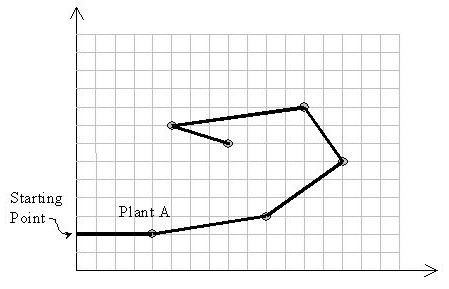
Input
Output
 #include <cstdio>

 #include <cstring>

 #include <iostream>

 #include <algorithm>

 #include <cmath>

 using namespace std;

 const double EPS = 1e-;

 inline int sgn(double x) {

     return (x > EPS) - (x < -EPS);

 }

 struct Point {

     double x, y;

     Point() {}

     Point(double x, double y): x(x), y(y) {}

     void read() {

         scanf("%lf%lf", &x, &y);

     }

     bool operator < (const Point &rhs) const {

         if(y != rhs.y) return y < rhs.y;

         return x < rhs.x;

     }

     Point operator + (const Point &rhs) const {

         return Point(x + rhs.x, y + rhs.y);

     }

     Point operator - (const Point &rhs) const {

         return Point(x - rhs.x, y - rhs.y);

     }

     Point operator * (const int &b) const {

         return Point(x * b, y * b);

     }

     Point operator / (const int &b) const {

         return Point(x / b, y / b);

     }

     double length() const {

         return sqrt(x * x + y * y);

     }

     Point unit() const {

         return *this / length();

     }

 };

 typedef Point Vector;

 double dist(const Point &a, const Point &b) {

     return (a - b).length();

 }

 double across(const Point &a, const Point &b) {

     return a.x * b.y - a.y * b.x;

 }

 //turn left

 bool cross(const Point &sp, const Point &ed, const Point &op) {

     return sgn(across(sp - op, ed - op)) > ;

 }

 /*******************************************************************************************/

 const int MAXN = ;

 Point p[MAXN];

 bool del[MAXN];

 int n, T;

 void solve() {

     memset(del, , sizeof(del));

     int last = ;

     for(int i = ; i < n; ++i)

         if(p[i] < p[last]) last = i;

     for(int i = ; i < n; ++i) {

         printf(" %d", last + );

         del[last] = true;

         int t = ;

         for(t = ; t < n; ++t) if(!del[t]) break;

         for(int j = ; j < n; ++j) {

             if(del[j] || j == t) continue;

             if(cross(p[j], p[t], p[last])) t = j;

         }

         last = t;

     }

 }

 int main() {

     scanf("%d", &T);

     while(T--) {

         scanf("%d", &n);

         int t;

         for(int i = ; i < n; ++i)

             scanf("%d", &t), p[i].read();

         printf("%d", n);

         solve();

         puts("");

     }

 }
POJ 1696 Space Ant(凸包变形)的更多相关文章
- POJ 1696 - Space Ant 凸包的变形
Technorati Tags: POJ,计算几何,凸包 初学计算几何,引入polygon后的第一个挑战--凸包 此题可用凸包算法做,只要把压入凸包的点从原集合中排除即可,最终形成图形为螺旋线. 关于 ...
- poj 1696 Space Ant (极角排序)
链接:http://poj.org/problem?id=1696 Space Ant Time Limit: 1000MS Memory Limit: 10000K Total Submissi ...
- 2018.07.04 POJ 1696 Space Ant(凸包卷包裹)
Space Ant Time Limit: 1000MS Memory Limit: 10000K Description The most exciting space discovery occu ...
- poj 1696:Space Ant(计算几何,凸包变种,极角排序)
Space Ant Time Limit: 1000MS Memory Limit: 10000K Total Submissions: 2876 Accepted: 1839 Descrip ...
- POJ 1696 Space Ant 卷包裹法
Space Ant Time Limit: 1000MS Memory Limit: 10000K Total Submissions: 3316 Accepted: 2118 Descrip ...
- POJ 1696 Space Ant(极角排序)
Space Ant Time Limit: 1000MS Memory Limit: 10000K Total Submissions: 2489 Accepted: 1567 Descrip ...
- poj 1696 Space Ant(模拟+叉积)
Space Ant Time Limit: 1000MS Memory Limit: 10000K Total Submissions: 3840 Accepted: 2397 Descrip ...
- POJ 1696 Space Ant(点积的应用)
Space Ant 大意:有一仅仅蚂蚁,每次都仅仅向当前方向的左边走,问蚂蚁走遍全部的点的顺序输出.開始的点是纵坐标最小的那个点,開始的方向是開始点的x轴正方向. 思路:从開始点開始,每次找剩下的点中 ...
- 简单几何(凸包) POJ 1696 Space Ant
题目传送门 题意:一个蚂蚁一直往左边走,问最多能走多少步,且输出路径 分析:就是凸包的变形题,凸包性质,所有点都能走.从左下角开始走,不停排序.有点纠结,自己的凸包不能AC.待理解透凸包再来写.. 好 ...
随机推荐
- html中的居中问题
1.表格居中:<table>标签的align属性 <table align="center">...... </table> 2.表格内容居中; ...
- .Net core 使用Jenkins + Docker + Azure Devops 傻瓜式部署
这几天一直在搞 Jenkins + Docker + Azure Devops 部署,因为这种方式部署真的非常的省心,而且速度快,方便快捷,等等无数优点,感谢我的单身领导的支持,当然也感谢 晓晨大神, ...
- JS 原型总结
参考: (从内存角度)简单类型与复杂类型及原型链
- thinkphp中的大字母的意思
ThinkPHP 单字母函数 A() 内部实例化控制器 D() 实例化自定义模型类 M() 实例化一个基础模型类 R() 调用某个控制器的操作方法 L() 启用多语言的情况下,设置和获取当前的语言定义 ...
- C++ & java小结
JAVA类: 每个类都属于一个包,private成员:只有该类可以访问,子类不能访问 Public:其他类可以访问 Protected: 只有本包内的类可以访问 如果在声明class时不加public ...
- python神坑系列之深浅拷贝
深浅拷贝 1.注意在拷贝中只有使用了.deepcopy方法才能进行深度拷贝!其余的一律是浅拷贝 #深拷贝import copy lst = copy.deepcopy(lst1) 浅拷贝: 拷贝的是 ...
- python 爬虫(爬取网页的img并下载)
from urllib.request import urlopen # 引用第三方库 import requests #引用requests/用于访问网站(没安装需要安装) from pyquery ...
- Python学习:10.Python装饰器讲解(一)
情景介绍 一天,在你正在努力加班的时候,老板给交给你了一个任务,就是在这段代码里将所有函数开始输出一个‘hello’最后输出当前时间,再输出一个“end”,这段代码里包含了大量的函数,你会怎么做? d ...
- python学习之文件读写入门(文件读的几种方式比较)
1.文件读写简单实例:(以w写的方式打开一个文件,以r读一个文件) # Author : xiajinqi # 文件读写的几种方式 # 文件读写 f = open("D://test.txt ...
- python教程(三)·函数与模块
函数,这和数学中的函数有点关联,但又不是完全等价 概念 不说的这么官方,我就已自己的理解来表达 ^_^ 在数学中,把一个或多个值(输入x)进行一定的计算或者映射,得到一个值(输出y),这个计算或者映射 ...