
吴裕雄 python 神经网络——TensorFlow 卷积神经网络水果图片识别
#-*- coding:utf- -*-

import time

import keras

import skimage

import numpy as np

import tensorflow as tf

import matplotlib.image as img

from scipy import ndimage

from skimage import color, data, transform

%matplotlib inline
#设置文件目录

Training = r'F:\\data\\fruits-360\\Training'

Test = r'F:\\data\\fruits-360\\Test'
import os

from natsort import natsorted

#获取每类水果中的第五张图像

def load_print_img(root):

    print_img = []

    print_label = []

    #遍历水果种类目录

    for i in range(len(os.listdir(root))):

        child1 = os.listdir(root)[i]

        child2 = os.listdir(os.path.join(root, child1))

        #对第二层目录进行自然数排序,os.listder默认为str排序

        child2 = natsorted(child2)

        #取出每类的第五张图像

        path = os.path.join(root, child1, child2[])

        if(path.endswith('.jpg')):

            print_img.append(skimage.data.imread(path))

            print_label.append(child1)

    return print_img, print_label

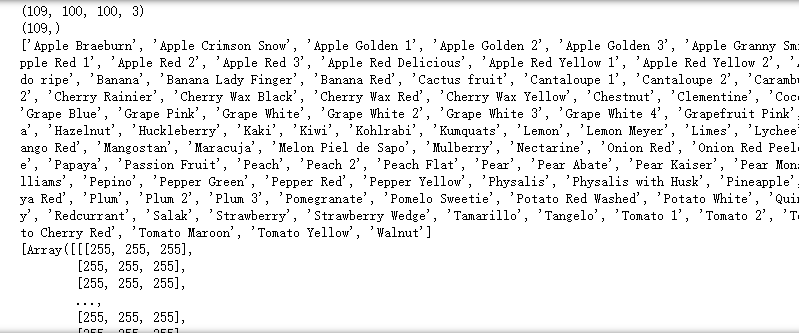
print_img, print_label = load_print_img(Test)

print(np.shape(print_img))

print(np.shape(print_label))

print(print_label)

print(print_img)
import matplotlib.pyplot as plt

from IPython.core.pylabtools import figsize

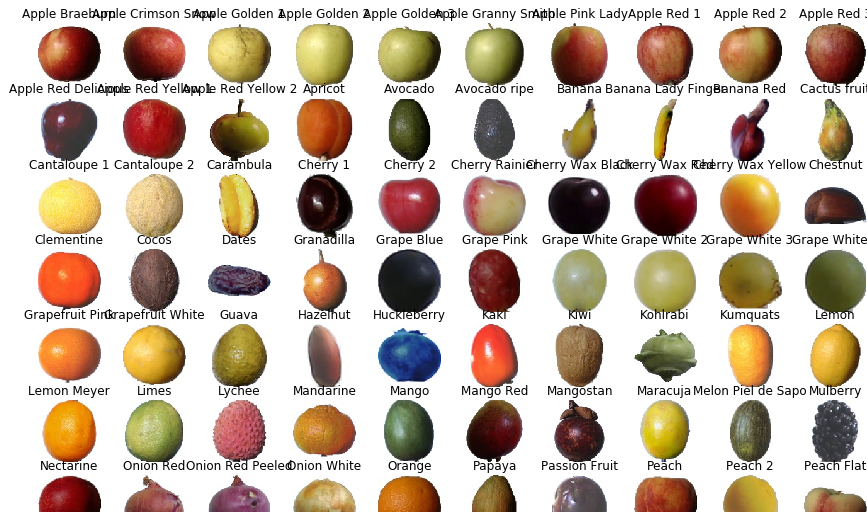
#打印每类水果的第五张图像

def print_fruit(print_img, print_label, size) :

    plt.figure(figsize(size, size))

    for i in range(len(print_img)):

        #图像输出格式为11行10列

        plt.subplot(, ,(i+))

        #打印图像

        plt.imshow(print_img[i])

        #打印水果种类

        plt.title(format(print_label[i]))

        plt.axis('off')

    plt.show()

print_img, print_label = load_print_img(Test)

#打印水果

print_fruit(print_img, print_label, )
import random

#随机获取水果种类

def get_random_fruits(root, n_classes):

    #创建一个1到水果种类总数的list

    fruits = []

    for i in range(len(os.listdir(root))):

        fruits.append(i)

    #随机获取n_classes个随机不重复的水果种类

    random_fruits = random.sample(fruits, n_classes)

    return random_fruits
#获取随机抽取的10类水果的图像

def load(root, random_fruits):

    #存放图像

    image_data = []

    #存放标签

    image_label = []

    #存放图像标签码

    num_label = []

    #遍历水果类型

    for i in range(len(random_fruits)):

        #第一层子目录(水果种类)

        child1 = os.listdir(root)[i]

        #第二层子目录(水果图像)

        child2 = os.listdir(os.path.join(root, child1))

        #对第二层目录进行自然数排序,os.listder默认为str排序

        child2 = natsorted(child2)

        #遍历水果图像

        for j in range(len(child2)):

            #结合第一二层子目录

            path = os.path.join(root, child1, child2[j])

            #只读取'.jpg'文件(文件后缀是否为'.jpg')

            if(path.endswith('.jpg')):

                #把文件读取为图像存入image_data

                image_data.append(skimage.data.imread(path))

                #储存第一层子目录文件名(即水果名)

                image_label.append(child1)

                #把第一层子目录文件名的下标作为水果类型的编码

                num_label.append(i)

                #把水果类型编码转换为one_hot编码

    num_label = keras.utils.to_categorical(num_label, len(random_fruits))

    #print("图片数:{0}, 标签数:{1}".format(len(image_data), len(os.listdir(root))) #输出图片和标签数

    return image_data, image_label, num_label
#裁剪图像

def crop(image_data):

    crop_data = []

    for i in image_data:

        #把图像转换成32*32的格式

        I_crop = skimage.transform.resize(i, (, ))

        #把转换后的图像放入Icrop_data

        crop_data.append(I_crop)

    return crop_data
def fruits_type(random_fruits):

    print('fruits_type:')

    for i in random_fruits:

        print(os.listdir(Training)[i])
#定义水果种类数

n_classes =

#batch_size =  #定义块的大小

#batch_num = int(np.array(crop_img).shape[]/batch_size) #计算取块的次数

#申请四维占位符,数据类型为float32

x = tf.placeholder(tf.float32,[None, , , ])

#申请二维占位符,数据累型为float32

y = tf.placeholder(tf.float32,[None, n_classes])

#申请一维占位符,数据类型为float32

keep_prob = tf.placeholder(tf.float32)

#epochs= #训练次数

#每个神经元保留的概率

dropout=0.75

#卷积核大小

k_size =

Weights = {

"conv_w1" : tf.Variable(tf.random_normal([k_size, k_size, , ]), name = 'conv_w1'),

"conv_w2" : tf.Variable(tf.random_normal([k_size, k_size, , ]), name = 'conv_w2'),

#"conv_w3" : tf.Variable(tf.random_normal([k_size, k_size, , ]), name = 'conv_w3'), \

"den_w1" : tf.Variable(tf.random_normal([int(*//*), ]), name = 'dev_w1'),

"den_w2" : tf.Variable(tf.random_normal([, ]), name = 'den_w2'),

"den_w3" : tf.Variable(tf.random_normal([, n_classes]), name = 'den_w3')

}

bias = {

"conv_b1" : tf.Variable(tf.random_normal([]), name = 'conv_b1'),

"conv_b2" : tf.Variable(tf.random_normal([]), name = 'conv_b2'),

#"conv_b3" : tf.Variable(tf.random_normal([]), name = 'conv_b3'), \

"den_b1" : tf.Variable(tf.random_normal([]), name = 'den_b1'),

"den_b2" : tf.Variable(tf.random_normal([]), name = 'den_b2'),

"den_b3" : tf.Variable(tf.random_normal([n_classes]), name = 'den_b3')

}

def conv2d(x,W,b,stride=):

    x=tf.nn.conv2d(x,W,strides=[,stride,stride,],padding="SAME")

    x=tf.nn.bias_add(x,b)

    return tf.nn.relu(x)

def maxpool2d(x,stride=):

    return tf.nn.max_pool(x,ksize=[,stride,stride,],strides=[,stride,stride,],padding="SAME")
def conv_net(inputs, W, b, dropout):

    ## convolution layer

    ## 输入32**3的数据,输出16**64的数据

    conv1 = conv2d(x, W["conv_w1"], b["conv_b1"])

    conv1 = maxpool2d(conv1, )

    tf.summary.histogram('ConvLayer1/Weights', W["conv_w1"])

    tf.summary.histogram('ConvLayer1/bias', b["conv_b1"])

    ## convolution layer2

    ## 输入16**64的数据,输出8**128的数据

    conv2 = conv2d(conv1, W["conv_w2"], b["conv_b2"])

    conv2 = maxpool2d(conv2, )

    tf.summary.histogram('ConvLayer2/Weights', W["conv_w2"])

    tf.summary.histogram('ConvLayer2/bias', b["conv_b2"])

    ## convolution layer3

    #conv3 = conv2d(conv2, W["conv_w3"], b["conv_b3"])

    #conv3 = maxpool2d(conv3, )

    #tf.summary.histogram('ConvLayer3/Weights', W["conv_w3"])

    #tf.summary.histogram('ConvLayer3/bias', b["conv_b3"])

    ## flatten

    ## 把数据拉伸为长度为8**128的一维数据

    flatten = tf.reshape(conv2,[-, W["den_w1"].get_shape().as_list()[]])

    ## dense layer1

    ## 输入8192*1的数据,输出1024*1的数据

    den1 = tf.add(tf.matmul(flatten, W["den_w1"]), b["den_b1"])

    den1 = tf.nn.relu(den1)

    den1 = tf.nn.dropout(den1, dropout)

    tf.summary.histogram('DenLayer1/Weights', W["den_w1"])

    tf.summary.histogram('DenLayer1/bias', b["den_b1"])

    ## dense layer2

    ## *1的数据,输出512*1的数据

    den2 = tf.add(tf.matmul(den1, W["den_w2"]), b["den_b2"])

    den2 = tf.nn.relu(den2)

    den2 = tf.nn.dropout(den2, dropout)

    tf.summary.histogram('DenLayer2/Weights', W["den_w2"])

    tf.summary.histogram('DenLayer2/bias', b["den_b2"])

    ## out

    ## *1的数据,输出n_classes*1的数据

    out = tf.add(tf.matmul(den2, W["den_w3"]), b["den_b3"])

    tf.summary.histogram('DenLayer3/Weights', W["den_w3"])

    tf.summary.histogram('DenLayer3/bias', b["den_b3"])

    return out
pred=conv_net(x,Weights,bias,keep_prob)

cost=tf.reduce_mean(tf.nn.softmax_cross_entropy_with_logits(logits=pred,labels=y))

tf.summary.histogram('loss', cost)

optimizer=tf.train.AdamOptimizer(0.01).minimize(cost)

correct_pred=tf.equal(tf.argmax(pred,),tf.argmax(y,))

accuracy=tf.reduce_mean(tf.cast(correct_pred,tf.float32))

merged=tf.summary.merge_all()

def train_and_test(train_x, train_y, test_x, test_y, epochs, batch_size, times = ) :

    # 初始化全局变量

    init=tf.global_variables_initializer()

    start_time = time.time()

    with tf.Session() as sess:

        sess.run(init)

        # 把需要可视化的参数写入可视化文件

        writer=tf.summary.FileWriter('F:\\data\\fruits-360\\tensorboard\\Fruit_graph' + str(times), sess.graph)

        for i in range(epochs):

            batch_num = int(np.array(train_x).shape[]/batch_size)

            sum_cost =

            sum_acc =

            for j in range(batch_num):

                batch_x = get_data(train_x, batch_size, j)

                batch_y = get_data(train_y, batch_size, j)

                sess.run(optimizer, feed_dict={x:batch_x,y:batch_y,keep_prob:0.75})

                loss,acc = sess.run([cost,accuracy],feed_dict={x:batch_x,y:batch_y,keep_prob: .})

                sum_cost += loss

                sum_acc += acc

                result=sess.run(merged,feed_dict={x:batch_x, y:batch_y, keep_prob:0.75})

                writer.add_summary(result, i)

            arg_cost = sum_cost/batch_num

            arg_acc = sum_acc/batch_num

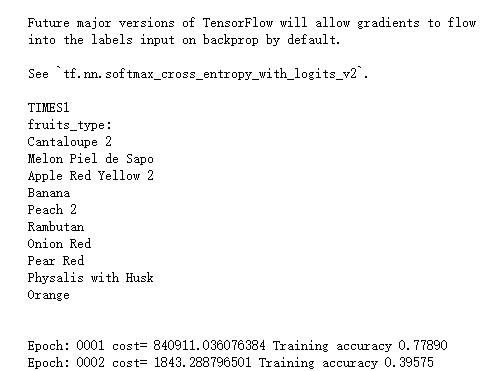
            print("Epoch:", '%04d' % (i+),"cost=", "{:.9f}".format(arg_cost),"Training accuracy","{:.5f}".format(arg_acc))

        end_time = time.time()

        print('Optimization Completed')

        print('Testing Accuracy:',sess.run(accuracy,feed_dict={x:test_x, y:test_y,keep_prob: }))

        print('Total processing time:',end_time - start_time)

for i in range():

    random_fruits = get_random_fruits(Training, n_classes)

    img_data, img_label, num_label = load(Training, random_fruits)

    crop_img = crop(img_data)

    test_data, test_label, test_num_label = load(Test, random_fruits)

    crop_test = crop(test_data)

    print("TIMES"+str(i+))

    fruits_type(random_fruits)

    print("\n")

    train_and_test(crop_img, num_label, crop_test, test_num_label, , , (i+))

    print("\n\n\n")
吴裕雄 python 神经网络——TensorFlow 卷积神经网络水果图片识别的更多相关文章
- 吴裕雄--天生自然 Tensorflow卷积神经网络:花朵图片识别
import os import numpy as np import matplotlib.pyplot as plt from PIL import Image, ImageChops from ...
- 吴裕雄 python 神经网络——TensorFlow 卷积神经网络手写数字图片识别
import os import tensorflow as tf from tensorflow.examples.tutorials.mnist import input_data INPUT_N ...
- Tensorflow卷积神经网络
卷积神经网络(Convolutional Neural Network, CNN)是一种前馈神经网络, 在计算机视觉等领域被广泛应用. 本文将简单介绍其原理并分析Tensorflow官方提供的示例. ...
- Tensorflow卷积神经网络[转]
Tensorflow卷积神经网络 卷积神经网络(Convolutional Neural Network, CNN)是一种前馈神经网络, 在计算机视觉等领域被广泛应用. 本文将简单介绍其原理并分析Te ...
- 深度学习原理与框架-Tensorflow卷积神经网络-cifar10图片分类(代码) 1.tf.nn.lrn(局部响应归一化操作) 2.random.sample(在列表中随机选值) 3.tf.one_hot(对标签进行one_hot编码)
1.tf.nn.lrn(pool_h1, 4, bias=1.0, alpha=0.001/9.0, beta=0.75) # 局部响应归一化,使用相同位置的前后的filter进行响应归一化操作 参数 ...
- TensorFlow 卷积神经网络实用指南 | iBooker·ApacheCN
原文:Hands-On Convolutional Neural Networks with TensorFlow 协议:CC BY-NC-SA 4.0 自豪地采用谷歌翻译 不要担心自己的形象,只关心 ...
- 吴裕雄 python 神经网络——TensorFlow 使用卷积神经网络训练和预测MNIST手写数据集
import tensorflow as tf import numpy as np from tensorflow.examples.tutorials.mnist import input_dat ...
- 吴裕雄 python神经网络 水果图片识别(4)
# coding: utf-8 # In[1]:import osimport numpy as npfrom skimage import color, data, transform, io # ...
- 吴裕雄 python神经网络 水果图片识别(2)
import osimport numpy as npimport matplotlib.pyplot as pltfrom skimage import color,data,transform,i ...
随机推荐
- NiFi_Demo_调度示例
1.背景 要求:每天凌晨1:00后开始每2min执行一次sql查询 2.作业编排 3.各模块配置 3.1 GenerateFlowFile 作用:用于产生flowfile,该flowfile内容为空. ...
- count(1),count(*)和count(列)的比较
转自:https://www.cnblogs.com/Caucasian/p/7041061.html 1.关于count(1),count(*),和count(列名)的区别 相信大家总是在工作中,或 ...
- PAT B1045 快速排序
题目如下: 1045 快速排序 (25 point(s)) 著名的快速排序算法里有一个经典的划分过程:我们通常采用某种方法取一个元素作为主元,通过交换,把比主元小的元素放到它的左边,比主元大的元素放到 ...
- idea抛出异常:org.apache.shiro.authc.AuthenticationException
问题描述 继续在ubuntu下折腾,终于将web项目的所有的东西配置好了,然后运行项目,满怀期待的心情登录系统的时候,突然出现了这个bug,吓得我差点从椅子上跳起来,这两天遇到的bug实在是太多了.. ...
- 并发与高并发(七)-线程安全性-原子性-atomic
一.线程安全性定义 定义:当多个线程访问某个类时,不管运行时环境采用何种调度方式或者这些线程将如何交替执行,并且在主调代码中不需要任何额外的同步或协同,这个类都能表现出正确的行为,那么就称这个类是线程 ...
- TCP协议的学习
1.关于TCP理解的重点(TCP协议可以理解为就是一段代码) (1).TCP协议工作在传输层,对上服务socket接口,对下调用IP层 (2).TCP协议面向连接,通信前必须先3次握手建立连接关系后才 ...
- SeetaFaceEngine系列2:Face Alignment编译和使用
前面一篇写了编译人脸检测部分,现在就介绍下人脸配准部分,SeetaFace的Face Alignment通过人脸的五个关键点来配准人脸,也就是双眼.鼻尖.两个嘴角. 这部分的编译也和上一篇一样,步骤如 ...
- setAttribute 添加属性js_jq
属性js setAttribute document.getElementsByName("test")[0].setAttribute("src", &quo ...
- MyBatis从入门到精通(第9章):Spring集成MyBatis(上)
MyBatis从入门到精通(第9章):Spring集成MyBatis(上) Spring是一个为了解决企业级Web应用开发过程中面临的复杂性,而被创建的一个非常流行的轻量级框架. mybatis-sp ...
- python编程:从入门到实践----第四章>操作列表
一.遍历整个列表 1-1.假设有一个魔术师名单,需要将其中每个魔术师的名字都打印出来. # 用for循环来打印魔术师名单中的名字 magicians=['alice','david','carolin ...