
吴裕雄 python 人工智能——智能医疗系统后台用户注册、登录和初诊简约版代码展示
#用户注册、登录模块

#数据库脚本

CREATE TABLE usertable(

  userid number(8) primary key not  null ,

  username varchar(50)  NULL,

  password varchar(50) NOT NULL,

  sex varchar(10) NOT NULL,

  age number(3) NOT NULL,

  province varchar2(50) null,

  area varchar(50) NOT NULL

  );

commit;

create sequence usertable_seq

minvalue 1

maxvalue 999

start with 1

increment by 1

NOCYCLE

nocache;

commit;

insert into  usertable (userid, username , password, sex,age, province ,area ) values ( usertable_seq.Nextval , '小明','','男',13,'广东省', '广州市' );

insert into  usertable (userid, username , password, sex,age, province ,area ) values ( usertable_seq.Nextval , '小红','','女',14,'广东省', '广州市' );

insert into  usertable (userid, username , password, sex,age, province ,area ) values ( usertable_seq.Nextval , '小东','','男',15,'广东省', '广州市' );

commit;

insert into  usertable (userid, username , password, sex,age, province ,area ) values ( usertable_seq.Nextval , '小东东','','男',15,'广东省', '广州市' );

commit;
#注册

import cx_Oracle

import numpy as np

conn=cx_Oracle.connect('doctor/admin@localhost:1521/tszr')

cursor = conn.cursor()

username = input("请输入用户名:")

password = input("请输入密码:")

sex = input("请输入性别:")

age = int(input("请输入年龄:"))

province = input("请输入省份:")

area = input("请输入所属区:")

sql = "insert into  usertable (userid, username , password, sex,age, province ,area ) values (usertable_seq.Nextval,'%s','%s','%s',%d,'%s','%s')" % (username, password,sex,age,province,area)

cursor.execute(sql)

conn.commit()

print("注册成功!")

#登录

import cx_Oracle

import numpy as np

conn=cx_Oracle.connect('doctor/admin@localhost:1521/tszr')

cursor = conn.cursor()

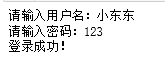
username = input("请输入用户名:")

password = input("请输入密码:")

sql = "select userid from usertable where username='%s' and password='%s'" % (username,password)

cursor.execute(sql)

rows = cursor.fetchall()

uid = []

for row in rows:

    uid.append(row[0])

if(len(uid)==1):

    print("登录成功!")

else:

    print("登录失败!")
#诊断记录表

#数据库脚本

CREATE TABLE zhenduanjilutable(

  userid number(8) not  null ,

  username varchar(50)  NULL,

  sex varchar(10) NOT NULL,

  age number(3) NOT NULL,

  province varchar2(50) null,

  area varchar(50) NOT NULL,

  bumen varchar(26) NOT NULL,

  ke varchar(26) NOT NULL,

  result varchar(26) NOT NULL,

  chufang varchar2(2220),

  jianyi varchar2(1020),

  yiyuaan varchar2(100),

  yisheng varchar2(1100),

  jianchaxiang varchar2(1100),

  zhenduanriqi date default sysdate

  );

commit;

insert into zhenduanjilutable (userid,username,sex,age,province,area,bumen,ke,result,chufang,jianyi,yiuaan,yisheng,jianchaxiang)

values (%d,'%s','%s','%s','%s','%s','%s','%s','%s','%s','%s','%s','%s','%s') % (,,,,,,,,,,,,,)
#智能初诊

import cx_Oracle

import numpy as np

conn=cx_Oracle.connect('doctor/admin@localhost:1521/tszr')

cursor = conn.cursor()

uid = uid[0]

sql = "select username,sex,age,province,area from usertable where userid=%d" % uid

cursor.execute(sql)

rows = cursor.fetchall()

userinfo = []

for row in rows:

    userinfo.append(row[0])

    userinfo.append(row[1])

    userinfo.append(row[2])

    userinfo.append(row[3])

    userinfo.append(row[4])

print(userinfo)

import cx_Oracle

import numpy as np

conn=cx_Oracle.connect('doctor/admin@localhost:1521/tszr')

cursor = conn.cursor()

sql = "select mname from hy_bumen"

cursor.execute(sql)

rows = cursor.fetchall()

bumen = []

for row in rows:

    bumen.append(row[0])

# print(bumen)

bumen = "外科"

sql = "select MENZHENID from hy_bumen where MNAME='%s'" % bumen

cursor.execute(sql)

rows = cursor.fetchall()

bumenid = []

for row in rows:

    bumenid.append(row[0])

sql = "select ke from hy_keid where MENZHENID=%d" % bumenid[0]

cursor.execute(sql)

rows = cursor.fetchall()

kelist = []

for row in rows:

    kelist.append(row[0])

# print(kelist)

ke = "胸外科"

sql = "select keid from hy_keid where ke='%s'" % ke

cursor.execute(sql)

rows = cursor.fetchall()

keid = []

for row in rows:

    keid.append(row[0])

sql = "select QUESTION from HY_QUESTID where QUID=%d" % keid[0]

cursor.execute(sql)

rows = cursor.fetchall()

question = []

for row in rows:

    question.append(row[0])

question = question[0].split(",")

# print(question)

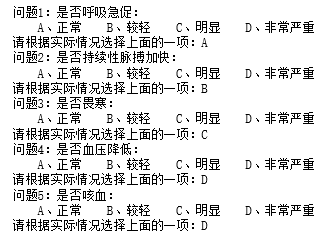
answer = []

for i,j in zip(question,np.arange(len(question))):

    print("问题"+str(j+1)+":是否"+i+":")

    print("    A、正常    B、较轻    C、明显    D、非常严重")

    temp = input("请根据实际情况选择上面的一项:")

    if(temp=="A"):

        answer.append(1)

    elif(temp=="B"):

        answer.append(2)

    elif(temp=="C"):

        answer.append(3)

    else:

        answer.append(4)

# print(answer)
#使用神经网络探索数据集

import sys

import os

import time

import operator

import cx_Oracle

import numpy as np

import pandas as pd

import tensorflow as tf

conn=cx_Oracle.connect('doctor/admin@localhost:1521/tszr')

cursor = conn.cursor()

surgery = "外科"

surgeryChest = "胸外科"

#one-hot编码

def onehot(labels):

    n_sample = len(labels)

    n_class = max(labels) + 1

    onehot_labels = np.zeros((n_sample, n_class))

    onehot_labels[np.arange(n_sample), labels] = 1

    return onehot_labels

#获取数据集

def getdata(surgery,surgeryChest):

    sql = "select feature1,feature2,feature3,feature4,feature5,trainLable from menzhen where surgery='%s' and surgeryChest='%s'" % (surgery,surgeryChest)

    cursor.execute(sql)

    rows = cursor.fetchall()

    dataset = []

    lables = []

    for row in rows:

        temp = []

        temp.append(row[0])

        temp.append(row[1])

        temp.append(row[2])

        temp.append(row[3])

        temp.append(row[4])

        dataset.append(temp)

        if(row[5]==3):

            lables.append(0)

        elif(row[5]==6):

            lables.append(1)

        else:

            lables.append(2)

    dataset = np.array(dataset)

    lables = np.array(lables)

    dataset = dataset.astype(np.float32)

    labless = onehot(lables)

    return dataset,labless

#获取测试数据集

def gettestdata(surgery,surgeryChest):

    sql = "select feature1,feature2,feature3,feature4,feature5,trainLable from test where surgery='%s' and surgeryChest='%s'" % (surgery,surgeryChest)

    cursor.execute(sql)

    rows = cursor.fetchall()

    testdataset = []

    testlables = []

    for row in rows:

        temp = []

        temp.append(row[0])

        temp.append(row[1])

        temp.append(row[2])

        temp.append(row[3])

        temp.append(row[4])

        testdataset.append(temp)

        if(row[5]==3):

            testlables.append(0)

        elif(row[5]==6):

            testlables.append(1)

        else:

            testlables.append(2)

    testdataset = np.array(testdataset)

    testlables = np.array(testlables)

    testdataset = testdataset.astype(np.float32)

    testlabless = onehot(testlables)

    return testdataset,testlabless

dataset,labless = getdata(surgery,surgeryChest)

# testdataset,testlables = gettestdata(surgery,surgeryChest)

# dataset = dataset[0:100]

# labless = labless[0:100]

x_data = tf.placeholder("float32", [None, 5])

y_data = tf.placeholder("float32", [None, 3])

weight = tf.Variable(tf.ones([5, 3]))

bias = tf.Variable(tf.ones([3]))

#使用softmax激活函数

y_model = tf.nn.softmax(tf.matmul(x_data, weight) + bias)

#y_model = tf.nn.relu(tf.matmul(x_data, weight) + bias)

# loss = tf.reduce_sum(tf.pow((y_model - y_data), 2))

#使用交叉熵作为损失函数

loss = -tf.reduce_sum(y_data*tf.log(y_model))

# train_step = tf.train.GradientDescentOptimizer(1e-4).minimize(loss)

#使用AdamOptimizer优化器

# train_step = tf.train.AdamOptimizer(1e-4).minimize(loss)

train_step = tf.train.MomentumOptimizer(1e-4,0.9).minimize(loss)

#评估模型

correct_prediction = tf.equal(tf.argmax(y_model, 1), tf.argmax(y_data, 1))

accuracy = tf.reduce_mean(tf.cast(correct_prediction, "float"))

init = tf.initialize_all_variables()

sess = tf.Session()

sess.run(init)

# start = time.time()

for _ in range(10):

    for i in range(int(len(dataset)/100)):

        sess.run(train_step, feed_dict={x_data:dataset[i:i+100,:], y_data:labless[i:i+100,:]})

# print("模型准确率",sess.run(accuracy, feed_dict={x_data:testdataset , y_data:testlables}))

# end = time.time()

# print("模型训练和测试公耗时:%.2f 秒" % (end-start))

xl_weight = sess.run(weight)

useranswer = [[1, 2, 3, 4, 4]]*3

W = np.dot(xl_weight,useranswer)

result=0

for i in range(len(W[0])):

    for j in range(len(W[0,:])):

        if(i==j):

            result += W[i][j]

result = int(result/5)

# print(result)

if(result<=3):

    result = 3

elif(result<=6):

    result = 6

else:

    result = 9

sql = "select ILL_NAME from ill_result_tbZ where FAMILY='%s' and ILL_ID=%d" % (ke,result)

cursor.execute(sql)

rows = cursor.fetchall()

ILL_NAME = []

for row in rows:

    ILL_NAME.append(row[0])

firstResult = ILL_NAME[0]

##

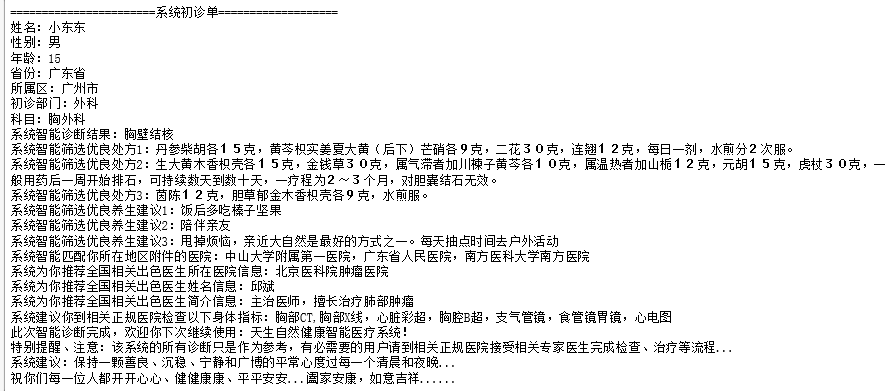
print("=======================系统初诊单===================")

print("姓名:"+userinfo[0])

print("性别:"+userinfo[1])

print("年龄:"+str(userinfo[2]))

print("省份:"+userinfo[3])

print("所属区:"+userinfo[4])

print("初诊部门:"+bumen)

print("科目:"+ke)

##

print("系统智能诊断结果:"+firstResult)

if(firstResult[:2]=="疑似"):

    firstResult = "疑似患病"

sql = "select PRESCRIPTION_1,PRESCRIPTION_2,PRESCRIPTION_3,PRESCRIPTION_4,PRESCRIPTION_5,PRESCRIPTION_6,PRESCRIPTION_7,PRESCRIPTION_8,PRESCRIPTION_9,PRESCRIPTION_10,PRESCRIPTION_11,PRESCRIPTION_12,PRESCRIPTION_13,PRESCRIPTION_14,PRESCRIPTION_15 from PRESCRIPTION where SURGERY='%s'and SURGERYCHEST='%s' and ILLNAME='%s'" % (bumen,ke,firstResult)

cursor.execute(sql)

rows = cursor.fetchall()

chufanggrace = []

for row in rows:

    temp = []

    temp.append(row[0])

    temp.append(row[1])

    temp.append(row[2])

    temp.append(row[3])

    temp.append(row[4])

    temp.append(row[5])

    temp.append(row[6])

    temp.append(row[7])

    temp.append(row[8])

    temp.append(row[9])

    temp.append(row[10])

    temp.append(row[11])

    temp.append(row[12])

    temp.append(row[13])

    temp.append(row[14])

    chufanggrace.append(temp)

PRESCRIPTION_sum = []

for col in range(np.shape(chufanggrace)[1]):

    temp = 0

    for row in range(np.shape(chufanggrace)[0]):

        temp += chufanggrace[row][col]

    PRESCRIPTION_sum.append(temp)

b = sorted(enumerate(PRESCRIPTION_sum),key=lambda x:x[1],reverse=True)[:3]

index = []

for i in b:

    index.append(i[0])

sql = "select PRESCRIPTIONINFO,HEALTH from PRESCRIPTIONINFO where DEPARTMENT='%s' and FAMILY='%s' and ILL_NAME='%s'" % (bumen,ke,firstResult)

cursor.execute(sql)

rows = cursor.fetchall()

chufanglist = []

jianyilist = []

for row in rows:

    chufanglist.append(row[0])

    jianyilist.append(row[1])

best_chufang = []

best_jianyi = []

for i in index:

    best_chufang.append(chufanglist[i])

    best_jianyi.append(jianyilist[i])

chufang_str = ""

jianyi_str = ""

for i,j in zip(best_chufang,range(len(best_chufang))):

    chufang_str += "系统智能筛选优良处方"+str(j+1)+":" + i +"。"

    print("系统智能筛选优良处方"+str(j+1)+":" + i)

for i,j in zip(best_jianyi,range(len(best_jianyi))):

    jianyi_str += "系统智能筛选优良养生建议"+str(j+1)+":" + i+"。"

    print("系统智能筛选优良养生建议"+str(j+1)+":" + i)

sql = "select HOSTITALNAME from DOCTORHOSTITALADRREST where PROVINCE='%s' and ADMINISTRATIVE='%s'" % (userinfo[3],userinfo[4])

cursor.execute(sql)

rows = cursor.fetchall()

yiyuan = []

for row in rows:

    yiyuan.append(row[0])

for i in yiyuan:

    print("系统智能匹配你所在地区附件的医院:"+i)

sql = "select ADDRACTION,NAME,SUMMARY from DOCTORS where FAMILY='%s'" % (ke)

cursor.execute(sql)

rows = cursor.fetchall()

yisheng = []

for row in rows:

    yisheng.append(row[0])

    yisheng.append(row[1])

    yisheng.append(row[2])

print("系统为你推荐全国相关出色医生所在医院信息:"+yisheng[0])

print("系统为你推荐全国相关出色医生姓名信息:"+yisheng[1])

print("系统为你推荐全国相关出色医生简介信息:"+yisheng[2])

yisheng_str = ""

yisheng_str += "医生所在医院:"+yisheng[0]

yisheng_str += "医生姓名:"+yisheng[1]

yisheng_str += "医生简介:"+yisheng[2]

sql = "select CHACKPRO from CHACKPROJECT where FAMILY='%s'" % (ke)

cursor.execute(sql)

rows = cursor.fetchall()

jiancha = []

for row in rows:

    jiancha.append(row[0])

print("系统建议你到相关正规医院检查以下身体指标:"+jiancha[0])

jianchax = ""

jianchax += "系统建议你到相关正规医院检查以下身体指标:"+jiancha[0]

sql = "insert into zhenduanjilutable (userid,username,sex,age,province,area,bumen,ke,result,chufang,jianyi,yiyuaan,yisheng,jianchaxiang) values (%d,'%s','%s','%s','%s','%s','%s','%s','%s','%s','%s','%s','%s','%s')" % (uid,userinfo[0],userinfo[1],userinfo[2],userinfo[3],userinfo[4],bumen,ke,firstResult,chufang_str,jianyi_str,yiyuan[0],yisheng_str,jianchax)

cursor.execute(sql)

conn.commit()

print("此次智能诊断完成,欢迎你下次继续使用:天生自然健康智能医疗系统!")

print("特别提醒、注意:该系统的所有诊断只是作为参考,有必需要的用户请到相关正规医院接受相关专家医生完成检查、治疗等流程...")

print("系统建议:保持一颗善良、沉稳、宁静和广博的平常心度过每一个清晨和夜晚...")

print("祝你们每一位人都开开心心、健健康康、平平安安...阖家安康,如意吉祥......")
吴裕雄 python 人工智能——智能医疗系统后台用户注册、登录和初诊简约版代码展示的更多相关文章
- 吴裕雄 python 人工智能——智能医疗系统后台用户复诊模块简约版代码展示
#复诊 import sys import os import time import operator import cx_Oracle import numpy as np import pand ...
- 吴裕雄 PYTHON 人工智能——智能医疗系统后台智能分诊模块及系统健康养生公告简约版代码展示
#coding:utf-8 import sys import cx_Oracle import numpy as np import pandas as pd import tensorflow a ...
- 吴裕雄 python 人工智能——基于神经网络算法在智能医疗诊断中的应用探索代码简要展示
#K-NN分类 import os import sys import time import operator import cx_Oracle import numpy as np import ...
- 吴裕雄 PYTHON 人工智能——基于MASK_RCNN目标检测(5)
import os import sys import numpy as np import tensorflow as tf import matplotlib import matplotlib. ...
- 吴裕雄 PYTHON 人工智能——基于MASK_RCNN目标检测(4)
import os import sys import random import math import re import time import numpy as np import tenso ...
- 吴裕雄 python 人工智能——基于Mask_RCNN目标检测(3)
import os import sys import random import math import re import time import numpy as np import cv2 i ...
- 吴裕雄 python 人工智能——基于Mask_RCNN目标检测(2)
import os import sys import itertools import math import logging import json import re import random ...
- 吴裕雄 python 人工智能——基于Mask_RCNN目标检测(1)
import os import sys import random import math import numpy as np import skimage.io import matplotli ...
- 吴裕雄--python学习笔记:爬虫基础
一.什么是爬虫 爬虫:一段自动抓取互联网信息的程序,从互联网上抓取对于我们有价值的信息. 二.Python爬虫架构 Python 爬虫架构主要由五个部分组成,分别是调度器.URL管理器.网页下载器.网 ...
随机推荐
- Docker(二)Image 与网络
Docker Image 我们介绍一下如何构造一个自定义的 Docker Image.在Docker 中,我们使用Dokcerfile 构建一个docker的描述. 首先我们定义一下需要启动一个什么 ...
- 线程同步器CountDownLatch
Java程序有的时候在主线程中会创建多个线程去执行任务,然后在主线程执行完毕之前,把所有线程的任务进行汇总,以前可以用线程的join方法,但是这个方法不够灵活,我们可以使用CountDownLatch ...
- Python获取最新电影的信息
这次将从电影天堂获取最新的电影的详细信息,这里电影的信息罗列的比较详细. 本来只是想获取电影的迅雷链接,然后用迅雷去下载.但看到这里的电影的信息比较完整和详细,忍不住把所有信息都爬取下来了. 下图是& ...
- docker跨主机链接
三种方式 一,使用网桥实现跨主机容器连接
- vue 使用 jsonp 请求数据
vue 使用 jsonp 请求数据 vue请求数据的时候,会遇到跨域问题,服务器为了保证信息的安全,对跨域请求进行拦截,因此,为了解决vue跨域请求问题,需要使用jsonp. 安装jsonp npm ...
- 【C语言】指针函数例子
#include<stdio.h> char* getword(char); char* getword(char c) { switch (c) { case'A':return&quo ...
- HTML5学习(3)元素
HTML5元素周期表 详情见:http://www.xuanfengge.com/funny/html5/element/
- 每天进步一点点------创建Microblaze软核(一)
在使用FPGA时,有时会用到它做为主控芯片.对于习惯于单片机及C语言开发的人,使用FPGA做主控芯片,首先还是想到它的嵌入式软核功能.如果能够基于Microblze软核进行C语言程序的开发,相对于使用 ...
- 【转载】Java集合容器全面分析
转自:http://blog.csdn.net/garfielder007/article/details/52143803 简介: 集合类Collection不是Java的核心类,是Java的扩展类 ...
- android关闭屏幕时不锁屏实现
所需权限: <uses-permission android:name="android.permission.DISABLE_KEYGUARD"/> 关闭系统锁屏服务 ...