
吴裕雄 PYTHON 人工智能——基于MASK_RCNN目标检测(4)
import os

import sys

import random

import math

import re

import time

import numpy as np

import tensorflow as tf

import matplotlib

import matplotlib.pyplot as plt

import matplotlib.patches as patches

import utils

import visualize

from visualize import display_images

import model as modellib

from model import log

%matplotlib inline

# Root directory of the project

ROOT_DIR = os.getcwd()

# Directory to save logs and trained model

MODEL_DIR = os.path.join(ROOT_DIR, "logs")

# Local path to trained weights file

COCO_MODEL_PATH = os.path.join(ROOT_DIR, "mask_rcnn_coco.h5")

# Download COCO trained weights from Releases if needed

if not os.path.exists(COCO_MODEL_PATH):

    utils.download_trained_weights(COCO_MODEL_PATH)

# Path to Shapes trained weights

SHAPES_MODEL_PATH = os.path.join(ROOT_DIR, "mask_rcnn_shapes.h5")
# Run one of the code blocks

# Shapes toy dataset

# import shapes

# config = shapes.ShapesConfig()

# MS COCO Dataset

import coco

config = coco.CocoConfig()

COCO_DIR = "path to COCO dataset"  # TODO: enter value here
# Override the training configurations with a few

# changes for inferencing.

class InferenceConfig(config.__class__):

    # Run detection on one image at a time

    GPU_COUNT = 1

    IMAGES_PER_GPU = 1

config = InferenceConfig()

config.display()
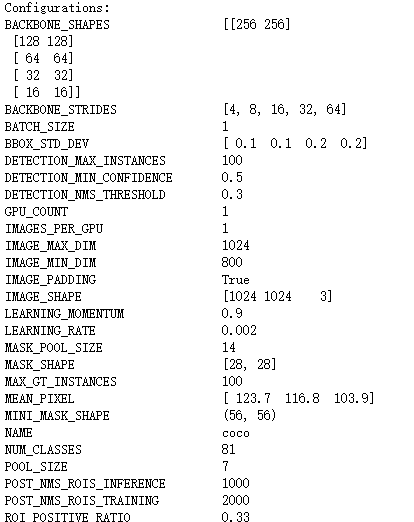
# Device to load the neural network on.

# Useful if you're training a model on the same

# machine, in which case use CPU and leave the

# GPU for training.

DEVICE = "/cpu:0"  # /cpu:0 or /gpu:0

# Inspect the model in training or inference modes

# values: 'inference' or 'training'

# TODO: code for 'training' test mode not ready yet

TEST_MODE = "inference"
def get_ax(rows=1, cols=1, size=16):

    """Return a Matplotlib Axes array to be used in

    all visualizations in the notebook. Provide a

    central point to control graph sizes.

    Adjust the size attribute to control how big to render images

    """

    _, ax = plt.subplots(rows, cols, figsize=(size*cols, size*rows))

    return ax
# Build validation dataset

if config.NAME == 'shapes':

    dataset = shapes.ShapesDataset()

    dataset.load_shapes(500, config.IMAGE_SHAPE[0], config.IMAGE_SHAPE[1])

elif config.NAME == "coco":

    dataset = coco.CocoDataset()

    dataset.load_coco(COCO_DIR, "minival")

# Must call before using the dataset

dataset.prepare()

print("Images: {}\nClasses: {}".format(len(dataset.image_ids), dataset.class_names))
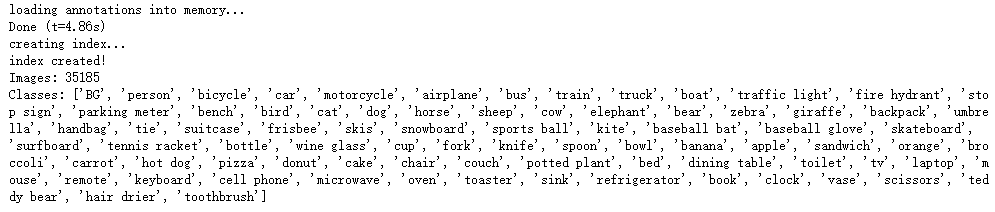
# Create model in inference mode

with tf.device(DEVICE):

    model = modellib.MaskRCNN(mode="inference", model_dir=MODEL_DIR,

                              config=config)

# Set weights file path

if config.NAME == "shapes":

    weights_path = SHAPES_MODEL_PATH

elif config.NAME == "coco":

    weights_path = COCO_MODEL_PATH

# Or, uncomment to load the last model you trained

# weights_path = model.find_last()[1]

# Load weights

print("Loading weights ", weights_path)

model.load_weights(weights_path, by_name=True)
image_id = random.choice(dataset.image_ids)

image, image_meta, gt_class_id, gt_bbox, gt_mask =\

    modellib.load_image_gt(dataset, config, image_id, use_mini_mask=False)

info = dataset.image_info[image_id]

print("image ID: {}.{} ({}) {}".format(info["source"], info["id"], image_id,

                                       dataset.image_reference(image_id)))

# Run object detection

results = model.detect([image], verbose=1)

# Display results

ax = get_ax(1)

r = results[0]

visualize.display_instances(image, r['rois'], r['masks'], r['class_ids'],

                            dataset.class_names, r['scores'], ax=ax,

                            title="Predictions")

log("gt_class_id", gt_class_id)

log("gt_bbox", gt_bbox)

log("gt_mask", gt_mask)
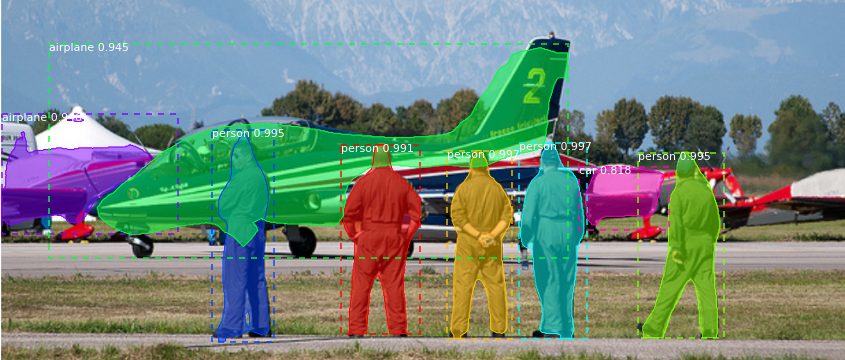
# Draw precision-recall curve

AP, precisions, recalls, overlaps = utils.compute_ap(gt_bbox, gt_class_id, gt_mask,

                                          r['rois'], r['class_ids'], r['scores'], r['masks'])

visualize.plot_precision_recall(AP, precisions, recalls)
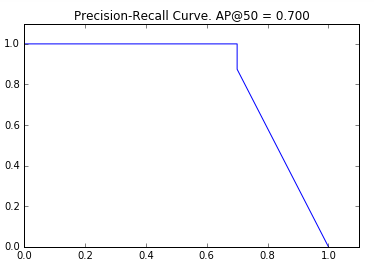
# Grid of ground truth objects and their predictions

visualize.plot_overlaps(gt_class_id, r['class_ids'], r['scores'],

                        overlaps, dataset.class_names)

# Compute VOC-style Average Precision

def compute_batch_ap(image_ids):

    APs = []

    for image_id in image_ids:

        # Load image

        image, image_meta, gt_class_id, gt_bbox, gt_mask =\

            modellib.load_image_gt(dataset, config,

                                   image_id, use_mini_mask=False)

        # Run object detection

        results = model.detect([image], verbose=0)

        # Compute AP

        r = results[0]

        AP, precisions, recalls, overlaps =\

            utils.compute_ap(gt_bbox, gt_class_id, gt_mask,

                              r['rois'], r['class_ids'], r['scores'], r['masks'])

        APs.append(AP)

    return APs

# Pick a set of random images

image_ids = np.random.choice(dataset.image_ids, 10)

APs = compute_batch_ap(image_ids)

print("mAP @ IoU=50: ", np.mean(APs))

# Generate RPN trainig targets

# target_rpn_match is 1 for positive anchors, -1 for negative anchors

# and 0 for neutral anchors.

target_rpn_match, target_rpn_bbox = modellib.build_rpn_targets(

    image.shape, model.anchors, gt_class_id, gt_bbox, model.config)

log("target_rpn_match", target_rpn_match)

log("target_rpn_bbox", target_rpn_bbox)

positive_anchor_ix = np.where(target_rpn_match[:] == 1)[0]

negative_anchor_ix = np.where(target_rpn_match[:] == -1)[0]

neutral_anchor_ix = np.where(target_rpn_match[:] == 0)[0]

positive_anchors = model.anchors[positive_anchor_ix]

negative_anchors = model.anchors[negative_anchor_ix]

neutral_anchors = model.anchors[neutral_anchor_ix]

log("positive_anchors", positive_anchors)

log("negative_anchors", negative_anchors)

log("neutral anchors", neutral_anchors)

# Apply refinement deltas to positive anchors

refined_anchors = utils.apply_box_deltas(

    positive_anchors,

    target_rpn_bbox[:positive_anchors.shape[0]] * model.config.RPN_BBOX_STD_DEV)

log("refined_anchors", refined_anchors, )

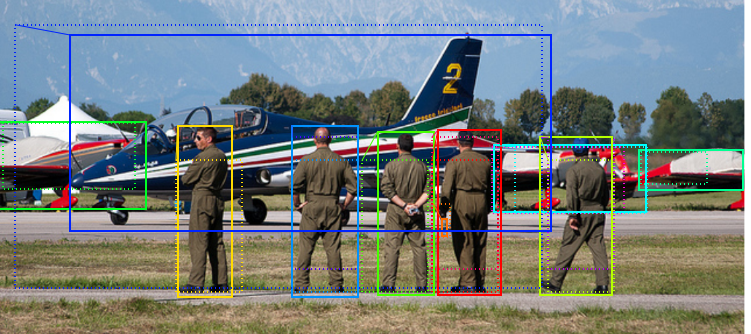
# Display positive anchors before refinement (dotted) and

# after refinement (solid).

visualize.draw_boxes(image, boxes=positive_anchors, refined_boxes=refined_anchors, ax=get_ax())
# Run RPN sub-graph

pillar = model.keras_model.get_layer("ROI").output  # node to start searching from

# TF 1.4 introduces a new version of NMS. Search for both names to support TF 1.3 and 1.4

nms_node = model.ancestor(pillar, "ROI/rpn_non_max_suppression:0")

if nms_node is None:

    nms_node = model.ancestor(pillar, "ROI/rpn_non_max_suppression/NonMaxSuppressionV2:0")

rpn = model.run_graph([image], [

    ("rpn_class", model.keras_model.get_layer("rpn_class").output),

    ("pre_nms_anchors", model.ancestor(pillar, "ROI/pre_nms_anchors:0")),

    ("refined_anchors", model.ancestor(pillar, "ROI/refined_anchors:0")),

    ("refined_anchors_clipped", model.ancestor(pillar, "ROI/refined_anchors_clipped:0")),

    ("post_nms_anchor_ix", nms_node),

    ("proposals", model.keras_model.get_layer("ROI").output),

])

# Show top anchors by score (before refinement)

limit = 100

sorted_anchor_ids = np.argsort(rpn['rpn_class'][:,:,1].flatten())[::-1]

visualize.draw_boxes(image, boxes=model.anchors[sorted_anchor_ids[:limit]], ax=get_ax())

# Show top anchors with refinement. Then with clipping to image boundaries

limit = 50

ax = get_ax(1, 2)

visualize.draw_boxes(image, boxes=rpn["pre_nms_anchors"][0, :limit],

           refined_boxes=rpn["refined_anchors"][0, :limit], ax=ax[0])

visualize.draw_boxes(image, refined_boxes=rpn["refined_anchors_clipped"][0, :limit], ax=ax[1])

# Show refined anchors after non-max suppression

limit = 50

ixs = rpn["post_nms_anchor_ix"][:limit]

visualize.draw_boxes(image, refined_boxes=rpn["refined_anchors_clipped"][0, ixs], ax=get_ax())

# Show final proposals

# These are the same as the previous step (refined anchors

# after NMS) but with coordinates normalized to [0, 1] range.

limit = 50

# Convert back to image coordinates for display

h, w = config.IMAGE_SHAPE[:2]

proposals = rpn['proposals'][0, :limit] * np.array([h, w, h, w])

visualize.draw_boxes(image, refined_boxes=proposals, ax=get_ax())

# Measure the RPN recall (percent of objects covered by anchors)

# Here we measure recall for 3 different methods:

# - All anchors

# - All refined anchors

# - Refined anchors after NMS

iou_threshold = 0.7

recall, positive_anchor_ids = utils.compute_recall(model.anchors, gt_bbox, iou_threshold)

print("All Anchors ({:5})       Recall: {:.3f}  Positive anchors: {}".format(

    model.anchors.shape[0], recall, len(positive_anchor_ids)))

recall, positive_anchor_ids = utils.compute_recall(rpn['refined_anchors'][0], gt_bbox, iou_threshold)

print("Refined Anchors ({:5})   Recall: {:.3f}  Positive anchors: {}".format(

    rpn['refined_anchors'].shape[1], recall, len(positive_anchor_ids)))

recall, positive_anchor_ids = utils.compute_recall(proposals, gt_bbox, iou_threshold)

print("Post NMS Anchors ({:5})  Recall: {:.3f}  Positive anchors: {}".format(

    proposals.shape[0], recall, len(positive_anchor_ids)))

# Get input and output to classifier and mask heads.

mrcnn = model.run_graph([image], [

    ("proposals", model.keras_model.get_layer("ROI").output),

    ("probs", model.keras_model.get_layer("mrcnn_class").output),

    ("deltas", model.keras_model.get_layer("mrcnn_bbox").output),

    ("masks", model.keras_model.get_layer("mrcnn_mask").output),

    ("detections", model.keras_model.get_layer("mrcnn_detection").output),

])

# Get detection class IDs. Trim zero padding.

det_class_ids = mrcnn['detections'][0, :, 4].astype(np.int32)

det_count = np.where(det_class_ids == 0)[0][0]

det_class_ids = det_class_ids[:det_count]

detections = mrcnn['detections'][0, :det_count]

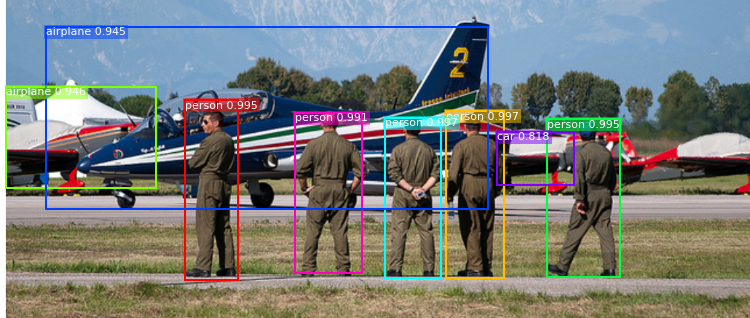
print("{} detections: {}".format(

    det_count, np.array(dataset.class_names)[det_class_ids]))

captions = ["{} {:.3f}".format(dataset.class_names[int(c)], s) if c > 0 else ""

            for c, s in zip(detections[:, 4], detections[:, 5])]

visualize.draw_boxes(

    image,

    refined_boxes=detections[:, :4],

    visibilities=[2] * len(detections),

    captions=captions, title="Detections",

    ax=get_ax())
# Proposals are in normalized coordinates. Scale them

# to image coordinates.

h, w = config.IMAGE_SHAPE[:2]

proposals = np.around(mrcnn["proposals"][0] * np.array([h, w, h, w])).astype(np.int32)

# Class ID, score, and mask per proposal

roi_class_ids = np.argmax(mrcnn["probs"][0], axis=1)

roi_scores = mrcnn["probs"][0, np.arange(roi_class_ids.shape[0]), roi_class_ids]

roi_class_names = np.array(dataset.class_names)[roi_class_ids]

roi_positive_ixs = np.where(roi_class_ids > 0)[0]

# How many ROIs vs empty rows?

print("{} Valid proposals out of {}".format(np.sum(np.any(proposals, axis=1)), proposals.shape[0]))

print("{} Positive ROIs".format(len(roi_positive_ixs)))

# Class counts

print(list(zip(*np.unique(roi_class_names, return_counts=True))))

# Display a random sample of proposals.

# Proposals classified as background are dotted, and

# the rest show their class and confidence score.

limit = 200

ixs = np.random.randint(0, proposals.shape[0], limit)

captions = ["{} {:.3f}".format(dataset.class_names[c], s) if c > 0 else ""

            for c, s in zip(roi_class_ids[ixs], roi_scores[ixs])]

visualize.draw_boxes(image, boxes=proposals[ixs],

                     visibilities=np.where(roi_class_ids[ixs] > 0, 2, 1),

                     captions=captions, title="ROIs Before Refinement",

                     ax=get_ax())

# Class-specific bounding box shifts.

roi_bbox_specific = mrcnn["deltas"][0, np.arange(proposals.shape[0]), roi_class_ids]

log("roi_bbox_specific", roi_bbox_specific)

# Apply bounding box transformations

# Shape: [N, (y1, x1, y2, x2)]

refined_proposals = utils.apply_box_deltas(

    proposals, roi_bbox_specific * config.BBOX_STD_DEV).astype(np.int32)

log("refined_proposals", refined_proposals)

# Show positive proposals

# ids = np.arange(roi_boxes.shape[0])  # Display all

limit = 5

ids = np.random.randint(0, len(roi_positive_ixs), limit)  # Display random sample

captions = ["{} {:.3f}".format(dataset.class_names[c], s) if c > 0 else ""

            for c, s in zip(roi_class_ids[roi_positive_ixs][ids], roi_scores[roi_positive_ixs][ids])]

visualize.draw_boxes(image, boxes=proposals[roi_positive_ixs][ids],

                     refined_boxes=refined_proposals[roi_positive_ixs][ids],

                     visibilities=np.where(roi_class_ids[roi_positive_ixs][ids] > 0, 1, 0),

                     captions=captions, title="ROIs After Refinement",

                     ax=get_ax())

# Remove boxes classified as background

keep = np.where(roi_class_ids > 0)[0]

print("Keep {} detections:\n{}".format(keep.shape[0], keep))

# Remove low confidence detections

keep = np.intersect1d(keep, np.where(roi_scores >= config.DETECTION_MIN_CONFIDENCE)[0])

print("Remove boxes below {} confidence. Keep {}:\n{}".format(

    config.DETECTION_MIN_CONFIDENCE, keep.shape[0], keep))

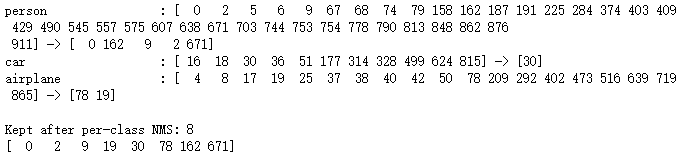
# Apply per-class non-max suppression

pre_nms_boxes = refined_proposals[keep]

pre_nms_scores = roi_scores[keep]

pre_nms_class_ids = roi_class_ids[keep]

nms_keep = []

for class_id in np.unique(pre_nms_class_ids):

    # Pick detections of this class

    ixs = np.where(pre_nms_class_ids == class_id)[0]

    # Apply NMS

    class_keep = utils.non_max_suppression(pre_nms_boxes[ixs],

                                            pre_nms_scores[ixs],

                                            config.DETECTION_NMS_THRESHOLD)

    # Map indicies

    class_keep = keep[ixs[class_keep]]

    nms_keep = np.union1d(nms_keep, class_keep)

    print("{:22}: {} -> {}".format(dataset.class_names[class_id][:20],

                                   keep[ixs], class_keep))

keep = np.intersect1d(keep, nms_keep).astype(np.int32)

print("\nKept after per-class NMS: {}\n{}".format(keep.shape[0], keep))
# Show final detections

ixs = np.arange(len(keep))  # Display all

# ixs = np.random.randint(0, len(keep), 10)  # Display random sample

captions = ["{} {:.3f}".format(dataset.class_names[c], s) if c > 0 else ""

            for c, s in zip(roi_class_ids[keep][ixs], roi_scores[keep][ixs])]

visualize.draw_boxes(

    image, boxes=proposals[keep][ixs],

    refined_boxes=refined_proposals[keep][ixs],

    visibilities=np.where(roi_class_ids[keep][ixs] > 0, 1, 0),

    captions=captions, title="Detections after NMS",

    ax=get_ax())

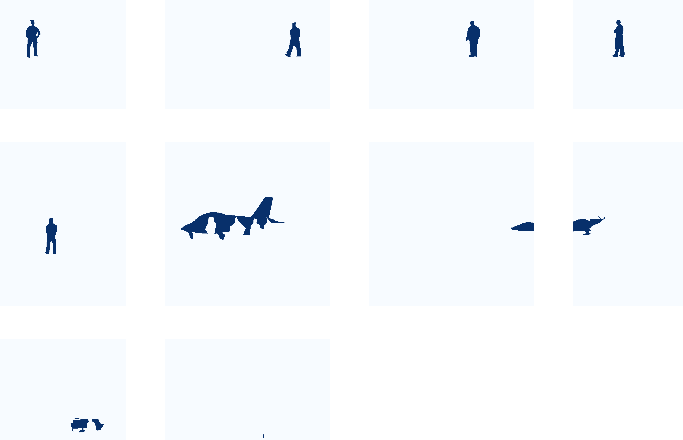
display_images(np.transpose(gt_mask, [2, 0, 1]), cmap="Blues")
# Get predictions of mask head

mrcnn = model.run_graph([image], [

    ("detections", model.keras_model.get_layer("mrcnn_detection").output),

    ("masks", model.keras_model.get_layer("mrcnn_mask").output),

])

# Get detection class IDs. Trim zero padding.

det_class_ids = mrcnn['detections'][0, :, 4].astype(np.int32)

det_count = np.where(det_class_ids == 0)[0][0]

det_class_ids = det_class_ids[:det_count]

print("{} detections: {}".format(

    det_count, np.array(dataset.class_names)[det_class_ids]))

# Masks

det_boxes = mrcnn["detections"][0, :, :4].astype(np.int32)

det_mask_specific = np.array([mrcnn["masks"][0, i, :, :, c]

                              for i, c in enumerate(det_class_ids)])

det_masks = np.array([utils.unmold_mask(m, det_boxes[i], image.shape)

                      for i, m in enumerate(det_mask_specific)])

log("det_mask_specific", det_mask_specific)

log("det_masks", det_masks)

display_images(det_mask_specific[:4] * 255, cmap="Blues", interpolation="none")
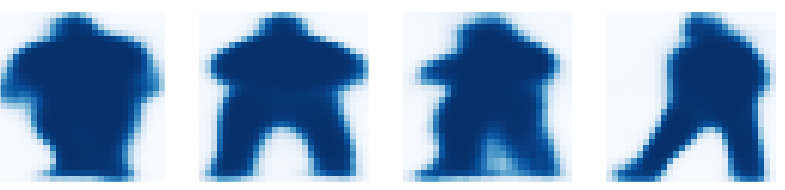
display_images(det_masks[:4] * 255, cmap="Blues", interpolation="none")

# Get activations of a few sample layers

activations = model.run_graph([image], [

    ("input_image",        model.keras_model.get_layer("input_image").output),

    ("res4w_out",          model.keras_model.get_layer("res4w_out").output),  # for resnet100

    ("rpn_bbox",           model.keras_model.get_layer("rpn_bbox").output),

    ("roi",                model.keras_model.get_layer("ROI").output),

])

# Input image (normalized)

_ = plt.imshow(modellib.unmold_image(activations["input_image"][0],config))

# Backbone feature map

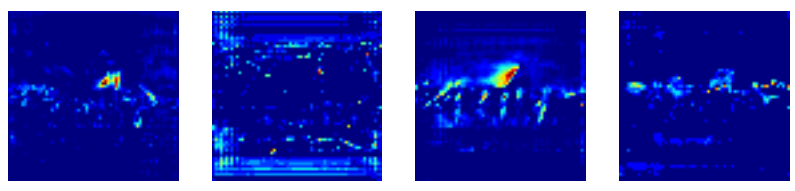
display_images(np.transpose(activations["res4w_out"][0,:,:,:4], [2, 0, 1]))
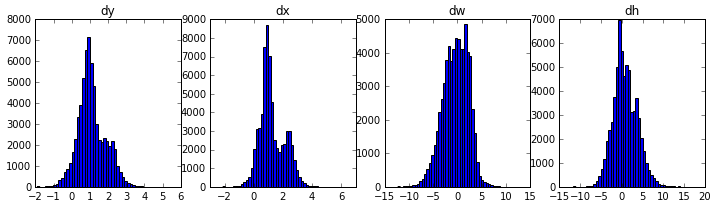
# Histograms of RPN bounding box deltas

plt.figure(figsize=(12, 3))

plt.subplot(1, 4, 1)

plt.title("dy")

_ = plt.hist(activations["rpn_bbox"][0,:,0], 50)

plt.subplot(1, 4, 2)

plt.title("dx")

_ = plt.hist(activations["rpn_bbox"][0,:,1], 50)

plt.subplot(1, 4, 3)

plt.title("dw")

_ = plt.hist(activations["rpn_bbox"][0,:,2], 50)

plt.subplot(1, 4, 4)

plt.title("dh")

_ = plt.hist(activations["rpn_bbox"][0,:,3], 50)
# Distribution of y, x coordinates of generated proposals

plt.figure(figsize=(10, 5))

plt.subplot(1, 2, 1)

plt.title("y1, x1")

plt.scatter(activations["roi"][0,:,0], activations["roi"][0,:,1])

plt.subplot(1, 2, 2)

plt.title("y2, x2")

plt.scatter(activations["roi"][0,:,2], activations["roi"][0,:,3])

plt.show()

吴裕雄 PYTHON 人工智能——基于MASK_RCNN目标检测(4)的更多相关文章
- 吴裕雄 PYTHON 人工智能——基于MASK_RCNN目标检测(5)
import os import sys import numpy as np import tensorflow as tf import matplotlib import matplotlib. ...
- 吴裕雄 python 人工智能——基于Mask_RCNN目标检测(3)
import os import sys import random import math import re import time import numpy as np import cv2 i ...
- 吴裕雄 python 人工智能——基于Mask_RCNN目标检测(2)
import os import sys import itertools import math import logging import json import re import random ...
- 吴裕雄 python 人工智能——基于Mask_RCNN目标检测(1)
import os import sys import random import math import numpy as np import skimage.io import matplotli ...
- 吴裕雄 python 人工智能——基于神经网络算法在智能医疗诊断中的应用探索代码简要展示
#K-NN分类 import os import sys import time import operator import cx_Oracle import numpy as np import ...
- 吴裕雄 PYTHON 人工智能——智能医疗系统后台智能分诊模块及系统健康养生公告简约版代码展示
#coding:utf-8 import sys import cx_Oracle import numpy as np import pandas as pd import tensorflow a ...
- 吴裕雄 python 人工智能——智能医疗系统后台用户复诊模块简约版代码展示
#复诊 import sys import os import time import operator import cx_Oracle import numpy as np import pand ...
- 吴裕雄 python 人工智能——智能医疗系统后台用户注册、登录和初诊简约版代码展示
#用户注册.登录模块 #数据库脚本 CREATE TABLE usertable( userid number(8) primary key not null , username varchar(5 ...
- TF项目实战(基于SSD目标检测)——人脸检测1
SSD实战——人脸检测 Tensorflow 一 .人脸检测的困难: 1. 姿态问题 2.不同种族人, 3.光照 遮挡 带眼睛 4.视角不同 5. 不同尺度 二. 数据集介绍以及转化VOC: 1. F ...
随机推荐
- xshell连接本地虚拟机中的centos
1. 一开始Xshell连接不上(设置为DHCP 动态IP)虚拟机上的centos8 参考这篇博文,将centos上的DHCP改为static 静态IP xshell连接本地虚拟机中的centos 2 ...
- wcf编程资料
如下为WCF编辑资料 链接:https://pan.baidu.com/s/1kZnc6eNOfEggHSfJNXj8Ag 提取码:gj7s 复制这段内容后打开百度网盘手机App,操作更方便哦 第01 ...
- Wannafly Camp 2020 Day 2C 纳新一百的石子游戏
为什么为了这么个简单题发博客呢? 因为我又因为位运算运算符优先级的问题血了 #include <bits/stdc++.h> using namespace std; #define in ...
- codeforces 1288C. Two Arrays(dp)
链接:https://codeforces.com/contest/1288/problem/C C. Two Arrays 题意:给定一个数n和一个数m,让构建两个数组a和b满足条件,1.数组中所有 ...
- Python_内置函数和匿名函数
楔子 在讲新知识之前,我们先来复习复习函数的基础知识. 问:函数怎么调用? 函数名() 如果你们这么说...那你们就对了!好了记住这个事儿别给忘记了,咱们继续谈下一话题... 来你们在自己的环境里打印 ...
- 2019-08-02 纪中NOIP模拟B组
T1 [JZOJ1420] 佳肴 题目描述 佳肴就是非常美味的菜的意思,佳肴最关键的是选择好原料. 现在有N种原料,每种原料都有酸度S和苦度B两个属性,当选择多种原料时,总酸度为每种原料的酸度之积,总 ...
- 第三十一篇 玩转数据结构——并查集(Union Find)
1.. 并查集的应用场景 查看"网络"中节点的连接状态,这里的网络是广义上的网络 数学中的集合类的实现 2.. 并查集所支持的操作 对于一组数据,并查集主要支持两种操作:合并两 ...
- nginx配置访问黑名单-2
在Nginx服务器上屏蔽IP 1.查找要屏蔽的ip awk '{print $1}' nginx.access.log |sort |uniq -c|sort -n nginx.access.log ...
- Go_Redis
Redis介绍 Redis是一个开源的内存数据库,Redis提供了多种不同类型的数据结构,很多业务场景下的问题都可以很自然地映射到这些数据结构上.除此之外,通过复制.持久化和客户端分片等特性,我们可以 ...
- Linux(Mac)常用命令
df -B[G,M,K]查看磁盘剩余空间 free -mh查看内存 netstat -ntlp查看当前监听的网络端口 mount -t auto /dev/cdrom /media/cdrom挂载cd ...