
POJ 2007 Scrambled Polygon 凸包
Scrambled Polygon
Time Limit: 1000MS Memory Limit: 30000K Total Submissions: 7214 Accepted: 3445 Description
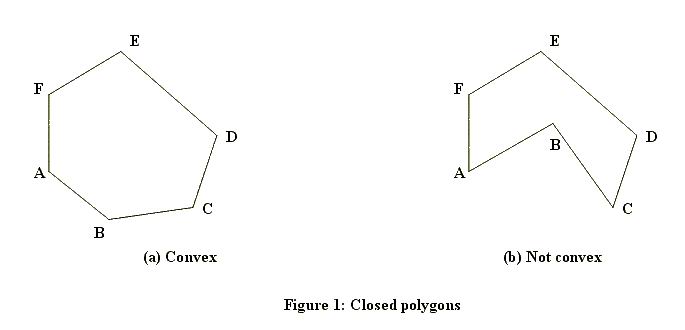
A closed polygon is a figure bounded by a finite number of line segments. The intersections of the bounding line segments are called the vertices of the polygon. When one starts at any vertex of a closed polygon and traverses each bounding line segment exactly once, one comes back to the starting vertex.A closed polygon is called convex if the line segment joining any two points of the polygon lies in the polygon. Figure 1 shows a closed polygon which is convex and one which is not convex. (Informally, a closed polygon is convex if its border doesn't have any "dents".)
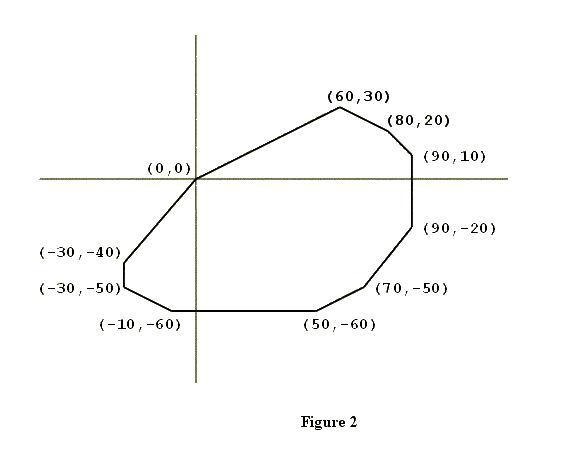
The subject of this problem is a closed convex polygon in the coordinate plane, one of whose vertices is the origin (x = 0, y = 0). Figure 2 shows an example. Such a polygon will have two properties significant for this problem.The first property is that the vertices of the polygon will be confined to three or fewer of the four quadrants of the coordinate plane. In the example shown in Figure 2, none of the vertices are in the second quadrant (where x < 0, y > 0).
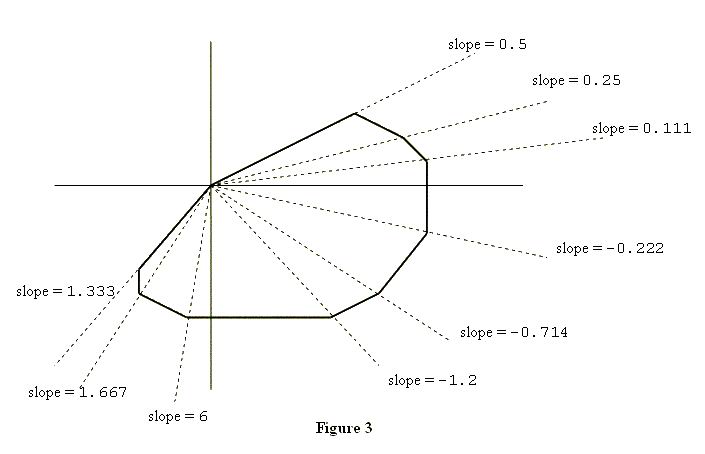
To describe the second property, suppose you "take a trip" around the polygon: start at (0, 0), visit all other vertices exactly once, and arrive at (0, 0). As you visit each vertex (other than (0, 0)), draw the diagonal that connects the current vertex with (0, 0), and calculate the slope of this diagonal. Then, within each quadrant, the slopes of these diagonals will form a decreasing or increasing sequence of numbers, i.e., they will be sorted. Figure 3 illustrates this point.
Input
The input lists the vertices of a closed convex polygon in the plane. The number of lines in the input will be at least three but no more than 50. Each line contains the x and y coordinates of one vertex. Each x and y coordinate is an integer in the range -999..999. The vertex on the first line of the input file will be the origin, i.e., x = 0 and y = 0. Otherwise, the vertices may be in a scrambled order. Except for the origin, no vertex will be on the x-axis or the y-axis. No three vertices are colinear.Output
The output lists the vertices of the given polygon, one vertex per line. Each vertex from the input appears exactly once in the output. The origin (0,0) is the vertex on the first line of the output. The order of vertices in the output will determine a trip taken along the polygon's border, in the counterclockwise direction. The output format for each vertex is (x,y) as shown below.Sample Input
0 0

70 -50

60 30

-30 -50

80 20

50 -60

90 -20

-30 -40

-10 -60

90 10
Sample Output
(0,0)

(-30,-40)

(-30,-50)

(-10,-60)

(50,-60)

(70,-50)

(90,-20)

(90,10)

(80,20)

(60,30)

题目叙述很长,其实就是给出一组包括原点在内的点,求出这组点的凸包的各个定点,按照逆时针方向从原点开始输出整个凸包的顶点
两种方法可以做:一个是Graham-Scan,还有就是直接极坐标排序,选取原点为基准点来排
代码如下
/*极坐标排序方法*/

#include <cstdio>

#include <iostream>

#include <algorithm>

#include <cmath>

#define EPS 1e-8

using namespace std;

struct point{

    double x, y;

};

const int maxn = ;

point p[maxn], pp;//pp是基准点

int n;

int sgn(double x)

{

    if (fabs(x) < EPS)

        return ;

    return x <  ? - : ;

}

double get_direction(point p1, point p2, point p3)

{

    return ((p3.x - p1.x) * (p2.y - p1.y) - (p2.x - p1.x) * (p3.y - p1.y));

}

double get_distance(point p1, point p2)

{

    return sqrt((p1.x - p2.x) * (p1.x - p2.x) + (p1.y - p2.y) * (p1.y - p2.y));

}

bool cmp(const point p1, const point p2)//极坐标排序的比较函数

{

    if (sgn(get_direction(pp, p1, p2)) < )

        return true;

    if (sgn(get_direction(pp, p1, p2)) ==  && get_distance(pp, p1) < get_distance(pp, p2))

        return true;

    return false;

}

int main()

{

    n = ;

    while (~scanf("%lf %lf", &p[n].x, &p[n].y))

        n++;

    int i;

    for (i = ; i < n; i++)

    {

        if (p[i].x ==  && p[i].y == )

            break;

    }

    pp = p[i];

    p[i] = p[];

    p[] = pp;

    sort(p, p + n, cmp);

    for (int i = ; i < n; i++)

        printf("(%.0f,%.0f)\n", p[i].x, p[i].y);

    return ;

}
普通的Graham
/*************************************************************************

    > File Name:            poj_2007.cpp

    > Author:               Howe_Young

    > Mail:                 1013410795@qq.com

    > Created Time:         2015年04月16日 星期四 14时47分43秒

 ************************************************************************/

#include <cstdio>

#include <iostream>

#include <cstring>

#include <cmath>

#include <cstdlib>

#include <algorithm>

#include <cstdio>

#define EPS 1e-8

using namespace std;

struct point{

    double x, y;

};

const int maxn = ;

point p[maxn];

int n, top, convex[maxn];

int sgn(double x)

{

    if (fabs(x) < EPS)

        return ;

    return x <  ? - : ;

}

bool cmp(const point p1, const point p2)

{

    return ((p1.y == p2.y && p1.x < p2.x) || p1.y < p2.y);

}

double get_direction(point p1, point p2, point p3)

{

    return ((p3.x - p1.x) * (p2.y - p1.y) - (p2.x - p1.x) * (p3.y - p1.y));

}

void Graham()

{

    top = ;

    for (int i = ; i < n; i++)

    {

        while (top >  && sgn(get_direction(p[convex[top - ]], p[convex[top - ]], p[i])) >= )

            top--;

        convex[top++] = i;

    }

    int tmp = top;

    for (int i = n - ; i >= ; i--)

    {

        while (top > tmp && sgn(get_direction(p[convex[top - ]], p[convex[top - ]], p[i])) >= )

            top--;

        convex[top++] = i;

    }

}

int main()

{

    n = ;

    while (~scanf("%lf %lf", &p[n].x,  &p[n].y)) n++;

    sort(p, p + n, cmp);

    Graham();

    int k;

    for (k = ; k < top; k++)

        if (p[convex[k]].x ==  && p[convex[k]].y == )

            break;

    for (int i = k; i < top - ; i++)

        printf("(%.0f,%.0f)\n", p[convex[i]].x, p[convex[i]].y);

    for (int i = ; i < k; i++)

        printf("(%.0f,%.0f)\n", p[convex[i]].x, p[convex[i]].y);

    return ;

}
POJ 2007 Scrambled Polygon 凸包的更多相关文章
- POJ 2007 Scrambled Polygon [凸包 极角排序]
Scrambled Polygon Time Limit: 1000MS Memory Limit: 30000K Total Submissions: 8636 Accepted: 4105 ...
- POJ 2007 Scrambled Polygon 凸包点排序逆时针输出
题意:如题 用Graham,直接就能得到逆时针的凸包,找到原点输出就行了,赤果果的水题- 代码: /* * Author: illuz <iilluzen[at]gmail.com> * ...
- POJ 2007 Scrambled Polygon 极角序 水
LINK 题意:给出一个简单多边形,按极角序输出其坐标. 思路:水题.对任意两点求叉积正负判断相对位置,为0则按长度排序 /** @Date : 2017-07-13 16:46:17 * @File ...
- poj 2007 Scrambled Polygon(极角排序)
http://poj.org/problem?id=2007 Time Limit: 1000MS Memory Limit: 30000K Total Submissions: 6701 A ...
- ●POJ 2007 Scrambled Polygon
题链: http://poj.org/problem?id=2007 题解: 计算几何,极角排序 按样例来说,应该就是要把凸包上的i点按 第三像限-第四像限-第一像限-第二像限 的顺序输出. 按 叉积 ...
- 简单几何(极角排序) POJ 2007 Scrambled Polygon
题目传送门 题意:裸的对原点的极角排序,凸包貌似不行. /************************************************ * Author :Running_Time ...
- POJ 2007 Scrambled Polygon(简单极角排序)
水题,根本不用凸包,就是一简单的极角排序. 叉乘<0,逆时针. #include <iostream> #include <cstdio> #include <cs ...
- POJ 2007 Scrambled Polygon (简单极角排序)
题目链接 题意 : 对输入的点极角排序 思路 : 极角排序方法 #include <iostream> #include <cmath> #include <stdio. ...
- poj 2007 Scrambled Polygon 极角排序
/** 极角排序输出,,, 主要atan2(y,x) 容易失精度,,用 bool cmp(point a,point b){ 5 if(cross(a-tmp,b-tmp)>0) 6 retur ...
随机推荐
- Linux学习2
第三讲Linux常用命令04 压缩:gzip: 1.只能压缩文件,不能压缩目录 2.不保留源文件 解压缩:gunzip gzip -d ------------------------------ ...
- WWDC2014之iOS使用动态库
苹果的开放态度 WWDC2014上发布的Xcode6 beta版有了不少更新,其中令我惊讶的一个是苹果在iOS上开放了动态库,在Xcode6 Beta版的更新文档中是这样描述的: Frameworks ...
- 张江在线APP演示
app下载地址:https://itunes.apple.com/cn/app/zhang-jiang-zai-xian/id722630317?mt=8
- Numpy基础笔记
Numpy简介 Numpy(Numerical Python的简称)是高性能科学计算和数据分析的基础包.其部分功能如下: ①ndarray,一个具有矢量算术运算和复杂广播能力的快速且节省空间的多维数组 ...
- 使用iOS8 WKWebView的浏览器模块,脉冲动画层-b
KINWebBrowser是一个可嵌入app的浏览器模块. 它使用iOS 8的 WKWebView API编写,同时在iOS 7上使用UIWebView来兼容. 测试环境: Xcode 6.0 iOS ...
- BZOJ 1588 营业额统计
Description 营业额统计 Tiger最近被公司升任为营业部经理,他上任后接受公司交给的第一项任务便是统计并分析公司成立以来的营业情况. Tiger拿出了公司的账本,账本上记录了公司成立以来每 ...
- SharePoint 2013 WebTemplates
SharePoint 2013 WebTemplates You are here: Home / SharePoint 2013 WebTemplates January 24, 2013 Ta ...
- KVM如何以HADOOP作共享存储?
看到西部数码的作法. 回想IBM的SMARTCLOUD作法,这主要就是应用了HDFS? 外加上HBASE和ZOOKEEPER保驾的? 然后,再想到,这HDFS和OPENSTATCK的SWIFT...纠 ...
- Protues中有源蜂鸣器BUZZER不响的解决办法(有图)
这个是BUZZER有源蜂鸣器的protues连线图(FM是我自己的电压探针,可以删除的) 下面是我个人设置的蜂鸣器的参数(为什么很多人的这个蜂鸣器不响,是参数没有设置正确) 蜂鸣器不响的原因是 Ope ...
- Javascript面向对象编程(二):构造函数的继承 by 阮一峰
今天要介绍的是,对象之间的"继承"的五种方法. 比如,现在有一个"动物"对象的构造函数. function Animal(){ this.species = & ...