
tensorflow在文本处理中的使用——CBOW词嵌入模型
代码来源于:tensorflow机器学习实战指南(曾益强 译,2017年9月)——第七章:自然语言处理
代码地址:https://github.com/nfmcclure/tensorflow-cookbook
数据:http://www.cs.cornell.edu/people/pabo/movie-review-data/rt-polaritydata.tar.gz
CBOW概念图:
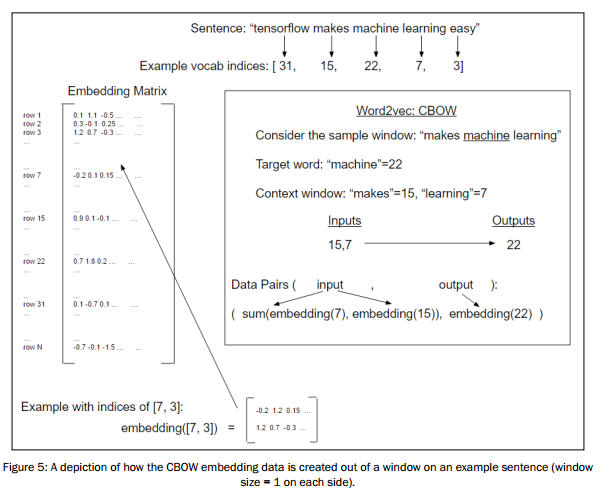
步骤如下:
- 必要包
- 声明模型参数
- 读取数据集
- 创建单词字典,转换句子列表为单词索引列表
- 生成批量数据
- 构建图
- 训练
step1:必要包
参考:tensorflow在文本处理中的使用——skip-gram模型
step2:声明模型参数
# Declare model parameters

batch_size = 500

embedding_size = 200

vocabulary_size = 2000

generations = 50000

model_learning_rate = 0.001

num_sampled = int(batch_size/2)    # Number of negative examples to sample.

window_size = 3       # How many words to consider left and right.

# Add checkpoints to training

save_embeddings_every = 5000

print_valid_every = 5000

print_loss_every = 100

# Declare stop words

stops = stopwords.words('english')

# We pick some test words. We are expecting synonyms to appear

valid_words = ['love', 'hate', 'happy', 'sad', 'man', 'woman']
step3:读取数据集
step4:创建单词字典,转换句子列表为单词索引列表
step5:生成批量数据
看一下单步执行的中间结果,利于更好理解处理过程:
>>> rand_sentence=[, , , , , , , , , ]

>>> window_size =

#类似skip-gram

>>> window_sequences = [rand_sentence[max((ix-window_size),):(ix+window_size+)] for ix, x in enumerate(rand_sentence)]

>>> label_indices = [ix if ix<window_size else window_size for ix,x in enumerate(window_sequences)]

>>> window_sequences

[[, , , ], [, , , , ], [, , , , , ], [, , , , , , ], [, , , , , , ], [, , , , , , ], [, , , , , , ], [, , , , , ], [, , , , ], [, , , ]]

>>> label_indices

[, , , , , , , , , ]

#生成input和label

>>> batch_and_labels = [(x[:y] + x[(y+):], x[y]) for x,y in zip(window_sequences, label_indices)]

>>> batch_and_labels = [(x,y) for x,y in batch_and_labels if len(x)==*window_size]

>>> batch, labels = [list(x) for x in zip(*batch_and_labels)]

>>> batch_and_labels

[([, , , , , ], ), ([, , , , , ], ), ([, , , , , ], ), ([, , , , , ], )]

>>> batch

[[, , , , , ], [, , , , , ], [, , , , , ], [, , , , , ]]

>>> labels

[, , , ]
step6:构建图
# Define Embeddings:

embeddings = tf.Variable(tf.random_uniform([vocabulary_size, embedding_size], -1.0, 1.0))

# NCE loss parameters

nce_weights = tf.Variable(tf.truncated_normal([vocabulary_size, embedding_size], stddev=1.0 / np.sqrt(embedding_size)))

nce_biases = tf.Variable(tf.zeros([vocabulary_size]))

# Create data/target placeholders

x_inputs = tf.placeholder(tf.int32, shape=[batch_size, 2*window_size])

y_target = tf.placeholder(tf.int32, shape=[batch_size, 1])

valid_dataset = tf.constant(valid_examples, dtype=tf.int32)

# Lookup the word embedding

# Add together window embeddings:CBOW模型将上下文窗口内的单词嵌套叠加在一起

embed = tf.zeros([batch_size, embedding_size])

for element in range(2*window_size):

    embed += tf.nn.embedding_lookup(embeddings, x_inputs[:, element])

# Get loss from prediction

loss = tf.reduce_mean(tf.nn.nce_loss(nce_weights, nce_biases, embed, y_target, num_sampled, vocabulary_size))

# Create optimizer

optimizer = tf.train.GradientDescentOptimizer(learning_rate=model_learning_rate).minimize(loss)

# Cosine similarity between words计算验证单词集

norm = tf.sqrt(tf.reduce_sum(tf.square(embeddings), 1, keep_dims=True))

normalized_embeddings = embeddings / norm

valid_embeddings = tf.nn.embedding_lookup(normalized_embeddings, valid_dataset)

similarity = tf.matmul(valid_embeddings, normalized_embeddings, transpose_b=True)

# Create model saving operation该方法默认会保存整个计算图会话,本例中指定参数只保存嵌套变量并设置名字

saver = tf.train.Saver({"embeddings": embeddings})
step7:训练
#Add variable initializer.

init = tf.initialize_all_variables()

sess.run(init)

# Run the skip gram model.

print('Starting Training')

loss_vec = []

loss_x_vec = []

for i in range(generations):

    batch_inputs, batch_labels = text_helpers.generate_batch_data(text_data, batch_size, window_size, method='cbow')

    feed_dict = {x_inputs : batch_inputs, y_target : batch_labels}

    # Run the train step

    sess.run(optimizer, feed_dict=feed_dict)

    # Return the loss

    if (i+1) % print_loss_every == 0:

        loss_val = sess.run(loss, feed_dict=feed_dict)

        loss_vec.append(loss_val)

        loss_x_vec.append(i+1)

        print('Loss at step {} : {}'.format(i+1, loss_val))

    # Validation: Print some random words and top 5 related words

    if (i+1) % print_valid_every == 0:

        sim = sess.run(similarity, feed_dict=feed_dict)

        for j in range(len(valid_words)):

            valid_word = word_dictionary_rev[valid_examples[j]]

            top_k = 5 # number of nearest neighbors

            nearest = (-sim[j, :]).argsort()[1:top_k+1]

            log_str = "Nearest to {}:".format(valid_word)

            for k in range(top_k):

                close_word = word_dictionary_rev[nearest[k]]

                log_str = '{} {},' .format(log_str, close_word)

            print(log_str)

    # Save dictionary + embeddings

    if (i+1) % save_embeddings_every == 0:

        # Save vocabulary dictionary

        with open(os.path.join(data_folder_name,'movie_vocab.pkl'), 'wb') as f:

            pickle.dump(word_dictionary, f)

        # Save embeddings

        model_checkpoint_path = os.path.join(os.getcwd(),data_folder_name,'cbow_movie_embeddings.ckpt')

        save_path = saver.save(sess, model_checkpoint_path)

        print('Model saved in file: {}'.format(save_path))
运行结果:

工作原理:Word2Vec嵌套的CBOW模型和skip-gram模型非常相似。主要不同点是生成数据和单词嵌套的处理。加载文本数据,归一化文本,创建词汇字典,使用词汇字典查找嵌套,组合嵌套并训练神经网络模型预测目标单词。
延伸学习:CBOW方法是在上下文窗口内单词嵌套叠加上进行训练并预测目标单词的。Word2Vec的CBOW方法更平滑,更适用于小文本数据集。
tensorflow在文本处理中的使用——CBOW词嵌入模型的更多相关文章
- tensorflow在文本处理中的使用——Doc2Vec情感分析
代码来源于:tensorflow机器学习实战指南(曾益强 译,2017年9月)——第七章:自然语言处理 代码地址:https://github.com/nfmcclure/tensorflow-coo ...
- tensorflow在文本处理中的使用——Word2Vec预测
代码来源于:tensorflow机器学习实战指南(曾益强 译,2017年9月)——第七章:自然语言处理 代码地址:https://github.com/nfmcclure/tensorflow-coo ...
- tensorflow在文本处理中的使用——skip-gram模型
代码来源于:tensorflow机器学习实战指南(曾益强 译,2017年9月)——第七章:自然语言处理 代码地址:https://github.com/nfmcclure/tensorflow-coo ...
- tensorflow在文本处理中的使用——TF-IDF算法
代码来源于:tensorflow机器学习实战指南(曾益强 译,2017年9月)——第七章:自然语言处理 代码地址:https://github.com/nfmcclure/tensorflow-coo ...
- tensorflow在文本处理中的使用——skip-gram & CBOW原理总结
摘自:http://www.cnblogs.com/pinard/p/7160330.html 先看下列三篇,再理解此篇会更容易些(个人意见) skip-gram,CBOW,Word2Vec 词向量基 ...
- tensorflow在文本处理中的使用——辅助函数
代码来源于:tensorflow机器学习实战指南(曾益强 译,2017年9月)——第七章:自然语言处理 代码地址:https://github.com/nfmcclure/tensorflow-coo ...
- tensorflow在文本处理中的使用——词袋
代码来源于:tensorflow机器学习实战指南(曾益强 译,2017年9月)——第七章:自然语言处理 代码地址:https://github.com/nfmcclure/tensorflow-coo ...
- TensorFlow NMT的词嵌入(Word Embeddings)
本文转载自:http://blog.stupidme.me/2018/08/05/tensorflow-nmt-word-embeddings/,本站转载出于传递更多信息之目的,版权归原作者或者来源机 ...
- TensorFlow实现文本情感分析详解
http://c.biancheng.net/view/1938.html 前面我们介绍了如何将卷积网络应用于图像.本节将把相似的想法应用于文本. 文本和图像有什么共同之处?乍一看很少.但是,如果将句 ...
随机推荐
- ie6中兼容性问题总结
针对firefox ie6 ie7 ie8的css样式中的line-height属性,以前我们大部分都是用!important来hack,对于ie6和firefox测试可以正常显示,但是ie7以上对! ...
- Sum Root to Leaf Numbers深度优先计算路径和
Given a binary tree containing digits from 0-9 only, each root-to-leaf path could represent a number ...
- 【JZOJ4935】【NOIP2017GDKOI模拟1.12】b
Boring 构造一棵包含1号结点的连通子集个数刚好为给定的n的树. 这棵树的结点不能多于60. 1<=n<=109 Gai 容易得到,计算给定一棵树的Ans1,其中Ansi表示包含i号结 ...
- 【JZOJ4922】【NOIP2017提高组模拟12.17】环
题目描述 小A有一个环,环上有n个正整数.他有特殊的能力,能将环切成k段,每段包含一个或者多个数字.对于一个切分方案,小A将以如下方式计算优美程度: 首先对于每一段,求出他们的数字和.然后对于每段的和 ...
- 【JZOJ4833】【NOIP2016提高A组集训第3场10.31】Mahjong
题目描述 解法 搜索. 代码 #include<stdio.h> #include<iostream> #include<string.h> #include< ...
- php json_encode输出为空问题
这种情况一般是json_encode序列化数组时出现错误,错误原因有很多,可以通过json_last_error函数来查看错误原因!!! 可能的原因 ------------------------- ...
- python GBK
- Skiing 2017 ACM-ICPC 亚洲区(乌鲁木齐赛区)网络赛H题(拓扑序求有向图最长路)
参考博客(感谢博主):http://blog.csdn.net/yo_bc/article/details/77917288 题意: 给定一个有向无环图,求该图的最长路. 思路: 由于是有向无环图,所 ...
- tf.cast用法
tf.cast:用于改变某个张量的数据类型 例如: import tensorflow as tf;import numpy as np; A = tf.convert_to_tensor(np.ar ...
- Strange Way to Express Integers
I. Strange Way to Express Integers 题目描述 原题来自:POJ 2891 给定 2n2n2n 个正整数 a1,a2,⋯,ana_1,a_2,\cdots ,a_na ...