
tensorflow在文本处理中的使用——skip-gram模型
代码来源于:tensorflow机器学习实战指南(曾益强 译,2017年9月)——第七章:自然语言处理
代码地址:https://github.com/nfmcclure/tensorflow-cookbook
数据来源:http://www.cs.cornell.edu/people/pabo/movie-review-data/rt-polaritydata.tar.gz
理解互相关联的单词:king - man + woman = queen
如果已知man和woman语义相关联,那我们可以得出单词man和king的关系就如同woman和queen的关系
创建词向量来表现单词上下文关系
skip-gram:给出目标单词进行上下文相关单词的预测
CBOW(continuous bag of words)连续词袋:从上下文相关单词集合中预测目标单词
skip-gram概念图:
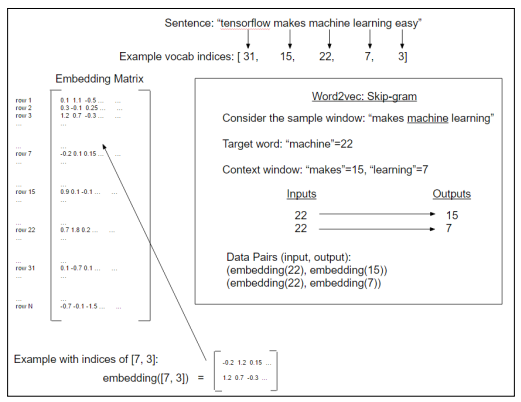
Word2Vec中的skip-gram模型,他是从目标单词中预测上下文窗口大小(上图中两边宽度均为1)内的单词
步骤如下:
- 必要包
- 声明模型参数
- 读取数据集
- 创建单词字典,转换句子列表为单词索引列表
- 生成批量数据
- 构建图
- 训练
step1:必要包
# From this data set we will compute/fit the skipgram model of

#  the Word2Vec Algorithm

#

# Skipgram: based on predicting the surrounding words from the

#  Ex sentence "the cat in the hat"

#  context word:  ["hat"]

#  target words: ["the", "cat", "in", "the"]

#  context-target pairs:

#    ("hat", "the"), ("hat", "cat"), ("hat", "in"), ("hat", "the")

import tensorflow as tf

import matplotlib.pyplot as plt

import numpy as np

import random

import os

import string

import requests

import collections

import io

import tarfile

import urllib.request

from nltk.corpus import stopwords

from tensorflow.python.framework import ops

ops.reset_default_graph()

os.chdir(os.path.dirname(os.path.realpath(__file__)))

# Start a graph session

sess = tf.Session()
step2:声明一些模型参数
# Declare model parameters

batch_size = 50

embedding_size = 200

vocabulary_size = 10000

generations = 50000

print_loss_every = 500

num_sampled = int(batch_size/2)    # Number of negative examples to sample.

window_size = 2       # How many words to consider left and right.

# Declare stop words,去停用词

stops = stopwords.words('english')

# We pick five test words. We are expecting synonyms to appear

print_valid_every = 2000

valid_words = ['cliche', 'love', 'hate', 'silly', 'sad']

# Later we will have to transform these into indices
参数解释:
batch_size:一次将查找50对词嵌套(批量大小)
embedding_size & vocabulary_size:每个单词的嵌套大小是一个长度为200的向量,并且仅考虑频次最高的前10000的单词(其他单词的分类为“unknown”)
print_loss_every:迭代训练时,每500次打印损失函数
num_sampled:在损失函数中使用,本例中采用噪声对比损失函数(noise-contrastive error,NCE),该参数控制多少个批量转换成随机噪声
window_size:skip_gram模型上下文窗口大小,即查找目标单词两边各两个上下文单词
print_valid_every & valid_words:为了检测词向量的性能,选择一些常用的电影影评单词,每迭代2000次训练打印最近邻域单词
step3:读取数据集
# texts是5331条pos+5331条neg,target是5331个1+5331个0

texts, target = load_movie_data()

# 归一化文本

texts = normalize_text(texts, stops)

# 影评至少包含3个单词

target = [target[ix] for ix, x in enumerate(texts) if len(x.split()) > 2]

texts = [x for x in texts if len(x.split()) > 2]
step4:创建单词字典,转换句子列表为单词索引列表
# Build our data set and dictionaries

word_dictionary = build_dictionary(texts, vocabulary_size)

# 逆序单词字典,可以通过索引找单词

# 当我们想打印出验证单词集中每个单词最近的单词时,可使用它

word_dictionary_rev = dict(zip(word_dictionary.values(), word_dictionary.keys()))

text_data = text_to_numbers(texts, word_dictionary)

# Get validation word keys获取待验证单词的索引

valid_examples = [word_dictionary[x] for x in valid_words]
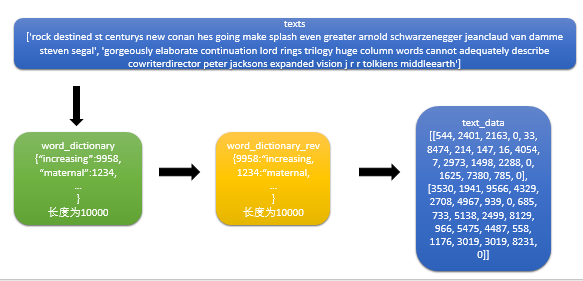
词频不够的单词标记为RARE,他在单词索引列表中的索引值为0
step5:生成批量数据
生成单词对:input:“the cat in the hat”,若in为目标词,窗口大小为2,则output为:(the,in),(cat,in),(the,in),(hat,in)
看一下单步执行的中间结果,利于更好理解处理过程:
#随机选择一个文本

>>> rand_sentence = np.random.choice(text_data)

>>> rand_sentence

[2520, 1421, 146, 1215, 5, 468]

#窗口中的单词

>>> window_sequences = [rand_sentence[max((ix-window_size),0):(ix+window_size+1)] for ix, x in enumerate(rand_sentence)]

>>> window_sequences

[[2520, 1421, 146], [2520, 1421, 146, 1215], [2520, 1421, 146, 1215, 5], [1421, 146, 1215, 5, 468], [146, 1215, 5, 468], [1215, 5, 468]]

#记录窗口中目标词的索引位置

>>> label_indices = [ix if ix<window_size else window_size for ix,x in enumerate(window_sequences)]

>>> label_indices

[0, 1, 2, 2, 2, 2]

#目标词和输出上下文的词做对应

>>> batch_and_labels = [(x[y], x[:y] + x[(y+1):]) for x,y in zip(window_sequences, label_indices)]

>>> batch_and_labels

[(2520, [1421, 146]), (1421, [2520, 146, 1215]), (146, [2520, 1421, 1215, 5]), (1215, [1421, 146, 5, 468]), (5, [146, 1215, 468]), (468, [1215, 5])]

>>> tuple_data = [(x, y_) for x,y in batch_and_labels for y_ in y]

>>> tuple_data

[(2520, 1421), (2520, 146), (1421, 2520), (1421, 146), (1421, 1215), (146, 2520), (146, 1421), (146, 1215), (146, 5), (1215, 1421), (1215, 146), (1215, 5), (1215, 468), (5, 146), (5, 1215), (5, 468), (5, 1815), (468, 1215), (468, 5)]

#提取batch和labels

>>> batch, labels = [list(x) for x in zip(*tuple_data)]

>>> batch

[2520, 2520, 1421, 1421, 1421, 146, 146, 146, 146, 1215, 1215, 1215, 1215, 5, 5, 5, 468, 468]

>>> labels

[1421, 146, 2520, 146, 1215, 2520, 1421, 1215, 5, 1421, 146, 5, 468, 146, 1215, 468, 1215, 5]
step6:构建图
# Define Embeddings初始化待拟合嵌套矩阵:

embeddings = tf.Variable(tf.random_uniform([vocabulary_size, embedding_size], -1.0, 1.0))

# NCE loss parameters

nce_weights = tf.Variable(tf.truncated_normal([vocabulary_size, embedding_size],

                                               stddev=1.0 / np.sqrt(embedding_size)))

nce_biases = tf.Variable(tf.zeros([vocabulary_size]))

# Create data/target placeholders

x_inputs = tf.placeholder(tf.int32, shape=[batch_size])

y_target = tf.placeholder(tf.int32, shape=[batch_size, 1])

valid_dataset = tf.constant(valid_examples, dtype=tf.int32)

# Lookup the word embedding:

embed = tf.nn.embedding_lookup(embeddings, x_inputs)

# Get loss from prediction

loss = tf.reduce_mean(tf.nn.nce_loss(nce_weights, nce_biases, embed, y_target,num_sampled, vocabulary_size))

# Create optimizer

optimizer = tf.train.GradientDescentOptimizer(learning_rate=1.0).minimize(loss)

# Cosine similarity between words先把嵌入矩阵的词向量标准化,再计算验证单词集和所有词向量之间的余弦相似度

norm = tf.sqrt(tf.reduce_sum(tf.square(embeddings), 1, keep_dims=True))

normalized_embeddings = embeddings / norm

valid_embeddings = tf.nn.embedding_lookup(normalized_embeddings, valid_dataset)

similarity = tf.matmul(valid_embeddings, normalized_embeddings, transpose_b=True)
损失函数的选择:softmax损失函数是用来实现多类分类问题常见的损失函数,上一节中其计算预测错误单词分类的损失。本例中目标是10000个分类,所以会导致稀疏性非常高。稀疏性会导致算法模型拟合或者收敛问题。为解决该问题,本例中将使用噪声对比损失函数(noise-contrastive error,NCE)。NCE损失函数将问题转换成一个二值预测,预测单词分类和随机噪声。num_sampled参数控制多少个批量转化成随机噪声。
step7:训练
#Add variable initializer.

init = tf.initialize_all_variables()

sess.run(init)

# Run the skip gram model.

loss_vec = []

loss_x_vec = []

for i in range(generations):

    batch_inputs, batch_labels = generate_batch_data(text_data, batch_size, window_size)

    feed_dict = {x_inputs : batch_inputs, y_target : batch_labels}

    # Run the train step

    sess.run(optimizer, feed_dict=feed_dict)

    # Return the loss

    if (i+1) % print_loss_every == 0:

        loss_val = sess.run(loss, feed_dict=feed_dict)

        loss_vec.append(loss_val)

        loss_x_vec.append(i+1)

        print("Loss at step {} : {}".format(i+1, loss_val))

    # Validation: Print some random words and top 5 related words

    if (i+1) % print_valid_every == 0:

        sim = sess.run(similarity, feed_dict=feed_dict)

        for j in range(len(valid_words)):

            valid_word = word_dictionary_rev[valid_examples[j]]

            top_k = 5 # number of nearest neighbors

            nearest = (-sim[j, :]).argsort()[1:top_k+1]

            log_str = "Nearest to {}:".format(valid_word)

            for k in range(top_k):

                close_word = word_dictionary_rev[nearest[k]]

                log_str = "%s %s," % (log_str, close_word)

            print(log_str)
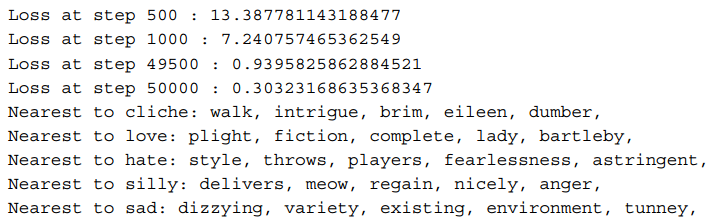
工作原理:在电影影评文本集上通过skip-gram方法训练完Word2Vec模型。下载数据集,把单词转换为单词字典,并使用索引数字作为嵌套查找。最后训练预测每个单词最接近的单词。
延伸学习:期望的最近单词是同义词。但一个句子的每个单词周围很少会出现同义词。我们得到的是数据集中每个单词的同义词的预测。为了使用单词嵌套,必须将其保持和重用。
tensorflow在文本处理中的使用——skip-gram模型的更多相关文章
- tensorflow在文本处理中的使用——Doc2Vec情感分析
代码来源于:tensorflow机器学习实战指南(曾益强 译,2017年9月)——第七章:自然语言处理 代码地址:https://github.com/nfmcclure/tensorflow-coo ...
- tensorflow在文本处理中的使用——CBOW词嵌入模型
代码来源于:tensorflow机器学习实战指南(曾益强 译,2017年9月)——第七章:自然语言处理 代码地址:https://github.com/nfmcclure/tensorflow-coo ...
- tensorflow在文本处理中的使用——Word2Vec预测
代码来源于:tensorflow机器学习实战指南(曾益强 译,2017年9月)——第七章:自然语言处理 代码地址:https://github.com/nfmcclure/tensorflow-coo ...
- tensorflow在文本处理中的使用——TF-IDF算法
代码来源于:tensorflow机器学习实战指南(曾益强 译,2017年9月)——第七章:自然语言处理 代码地址:https://github.com/nfmcclure/tensorflow-coo ...
- tensorflow在文本处理中的使用——词袋
代码来源于:tensorflow机器学习实战指南(曾益强 译,2017年9月)——第七章:自然语言处理 代码地址:https://github.com/nfmcclure/tensorflow-coo ...
- TensorFlow Object Detection API中的Faster R-CNN /SSD模型参数调整
关于TensorFlow Object Detection API配置,可以参考之前的文章https://becominghuman.ai/tensorflow-object-detection-ap ...
- 三分钟快速上手TensorFlow 2.0 (中)——常用模块和模型的部署
本文学习笔记参照来源:https://tf.wiki/zh/basic/basic.html 前文:三分钟快速上手TensorFlow 2.0 (上)——前置基础.模型建立与可视化 tf.train. ...
- tensorflow在文本处理中的使用——辅助函数
代码来源于:tensorflow机器学习实战指南(曾益强 译,2017年9月)——第七章:自然语言处理 代码地址:https://github.com/nfmcclure/tensorflow-coo ...
- tensorflow在文本处理中的使用——skip-gram & CBOW原理总结
摘自:http://www.cnblogs.com/pinard/p/7160330.html 先看下列三篇,再理解此篇会更容易些(个人意见) skip-gram,CBOW,Word2Vec 词向量基 ...
随机推荐
- R语言均值,中位数和模式
R语言均值,中位数和模式 在R统计分析是通过用许多内置函数来执行的. 大多数这些函数是R基本包的一部分.这些函数需要R向量作为输入参数并给出结果. 我们正在讨论本章中的函数是平均数,中位数和模式. 平 ...
- Python学习之路15☞socket编程
一 客户端/服务器架构 即C/S架构,包括 1.硬件C/S架构(打印机) 2.软件C/S架构(web服务) C/S架构与socket的关系: 我们学习socket就是为了完成C/S架构的开发 二 os ...
- TIJ——Chapter Fourteen:Type Information
Runtime type information(RTTI) allows you to discover and use type information while a program is ru ...
- P2532 [AHOI2012]树屋阶梯
题目:P2532 [AHOI2012]树屋阶梯 思路: 打表之后不难看出是裸的Catalan数.简单证明一下: 对于任意一种合法方案,都可以表示为在左下角先放一个\(k*(n+1-k),k\in[1, ...
- Laravel中利用队列发送邮件的方法示例
https://www.jb51.net/article/121647.htm 本文主要给大家介绍了关于Laravel中队列发送邮件的相关内容,分享出来供大家参考学习,下面话不多说了,来一起看看详细的 ...
- PMC亮相IDF展示12G SAS分层存储解决方式
引领大数据连接.传送以及存储,提供创新半导体及软件解决方式的PMC公司(纳斯达克代码:PMCS)出席了2014年4月2-3日在深圳举办的2014 IDF英特尔开发人员论坛. 此次,PMC将在 1层展示 ...
- Mysql 查询一天中每半小时记录的数量
SELECT HOUR(e.time)as Hour,FLOOR(MINUTE(e.time)/30) as M, COUNT(*) as Count FROM error_log e WHERE e ...
- Python深入:02浅拷贝深拷贝
对象赋值实际上是简单的对象引用.也就是说当你创建一个对象,然后把它赋给另一个变量的时候,Python并没有拷贝这个对象,而只是拷贝了这个对象的引用. 假设想创建一对小夫妻的通用档案,名为person. ...
- Project Euler Problem 24-Lexicographic permutations
全排列的生成,c++的next_permutation是O(n)生成全排列的.具体的O(n)生成全排列的算法,在 布鲁迪 的那本组合数学中有讲解(课本之外,我就看过这一本组合数学),冯速老师翻译的,具 ...
- H3C 代理ARP