
tensorflow在文本处理中的使用——词袋
代码来源于:tensorflow机器学习实战指南(曾益强 译,2017年9月)——第七章:自然语言处理
代码地址:https://github.com/nfmcclure/tensorflow-cookbook
解决问题:使用“词袋”嵌入来进行垃圾短信的预测(使用逻辑回归算法)
缺点:不考虑相关单词顺序特征,长文本的处理困难
步骤如下:
step1:导入需要的包
step2:准备数据集
step3:选择参数(每个文本保留多少单词数,最低词频是多少)
step4:构建词袋
step5:分割数据集
step6:构建图
step7:训练
step8:测试
step1:导入需要的包
import tensorflow as tf

import matplotlib.pyplot as plt

import os

import numpy as np

import csv

import string

import requests

import io

from zipfile import ZipFile

from tensorflow.contrib import learn

from tensorflow.python.framework import ops

ops.reset_default_graph()

# Start a graph session

sess = tf.Session()
step2:准备数据集
# Check if data was downloaded, otherwise download it and save for future use

save_file_name = os.path.join('temp','temp_spam_data.csv')

if os.path.isfile(save_file_name):

    text_data = []

    with open(save_file_name, 'r') as temp_output_file:

        reader = csv.reader(temp_output_file)

        for row in reader:

            text_data.append(row)

else:

    zip_url = 'http://archive.ics.uci.edu/ml/machine-learning-databases/00228/smsspamcollection.zip'

    r = requests.get(zip_url)

    z = ZipFile(io.BytesIO(r.content))

    file = z.read('SMSSpamCollection')

    # Format Data

    text_data = file.decode()

    text_data = text_data.encode('ascii',errors='ignore')

    text_data = text_data.decode().split('\n')

    text_data = [x.split('\t') for x in text_data if len(x)>=1]

    # And write to csv

    with open(save_file_name, 'w') as temp_output_file:

        writer = csv.writer(temp_output_file)

        writer.writerows(text_data)

texts = [x[1] for x in text_data]

target = [x[0] for x in text_data]

# Relabel 'spam' as 1, 'ham' as 0

target = [1 if x=='spam' else 0 for x in target]

# Normalize text,为减少无意义的词汇,对文本进行规则化处理

# Lower case

texts = [x.lower() for x in texts]

# Remove punctuation

texts = [''.join(c for c in x if c not in string.punctuation) for x in texts]

# Remove numbers

texts = [''.join(c for c in x if c not in '') for x in texts]

# Trim extra whitespace

texts = [' '.join(x.split()) for x in texts]
step3:选择参数
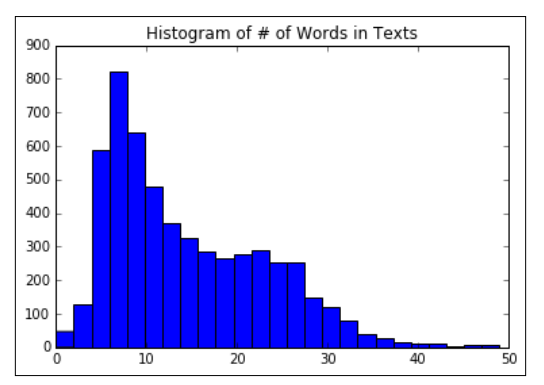
# Plot histogram of text lengths文本数据中的单词数的直方图

text_lengths = [len(x.split()) for x in texts]

text_lengths = [x for x in text_lengths if x < 50]

plt.hist(text_lengths, bins=25)

plt.title('Histogram of # of Words in Texts')
step4:构建词袋
# Choose max text word length at 25,也可以设为30或者40

sentence_size = 25

min_word_freq = 3

# Setup vocabulary processor

vocab_processor = learn.preprocessing.VocabularyProcessor(sentence_size, min_frequency=min_word_freq)

# Have to fit transform to get length of unique words.

vocab_processor.fit_transform(texts)

embedding_size = len(vocab_processor.vocabulary_)
step5:分割数据集
# Split up data set into train/test

train_indices = np.random.choice(len(texts), round(len(texts)*0.8), replace=False)

test_indices = np.array(list(set(range(len(texts))) - set(train_indices)))

texts_train = [x for ix, x in enumerate(texts) if ix in train_indices]

texts_test = [x for ix, x in enumerate(texts) if ix in test_indices]

target_train = [x for ix, x in enumerate(target) if ix in train_indices]

target_test = [x for ix, x in enumerate(target) if ix in test_indices]
step6:构建图
step6.1:构建出文本的向量
# Setup Index Matrix for one-hot-encoding,使用该矩阵为每个单词查找稀疏向量

identity_mat = tf.diag(tf.ones(shape=[embedding_size]))

# Create variables for logistic regression

A = tf.Variable(tf.random_normal(shape=[embedding_size,1]))

b = tf.Variable(tf.random_normal(shape=[1,1]))

# Initialize placeholders

x_data = tf.placeholder(shape=[sentence_size], dtype=tf.int32)

y_target = tf.placeholder(shape=[1, 1], dtype=tf.float32)

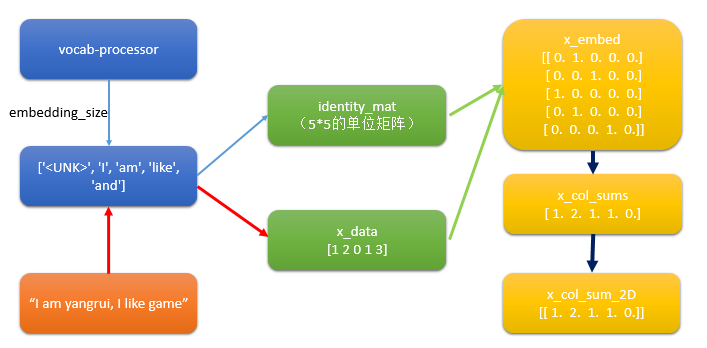
# Text-Vocab Embedding,使用tf的嵌入查找函数来映射句子中的单词为单位矩阵的one-hot向量,再进行求和

# tf.nn.embedding_lookup(y,x)x为索引,找出y中对应索引的值

x_embed = tf.nn.embedding_lookup(identity_mat, x_data)

x_col_sums = tf.reduce_sum(x_embed, 0)

# Declare model operations

x_col_sums_2D = tf.expand_dims(x_col_sums, 0)
疑问:如何利用词袋将文本变成向量?
step6.2 构建图
model_output = tf.add(tf.matmul(x_col_sums_2D, A), b)

# Declare loss function (Cross Entropy loss)

loss = tf.reduce_mean(tf.nn.sigmoid_cross_entropy_with_logits(model_output, y_target))

# Prediction operation

prediction = tf.sigmoid(model_output)

# Declare optimizer

my_opt = tf.train.GradientDescentOptimizer(0.001)

train_step = my_opt.minimize(loss)
step7:训练
# Intitialize Variables

init = tf.initialize_all_variables()

sess.run(init)

# Start Logistic Regression

print('Starting Training Over {} Sentences.'.format(len(texts_train)))

loss_vec = []

train_acc_all = []

train_acc_avg = []

for ix, t in enumerate(vocab_processor.fit_transform(texts_train)):

    y_data = [[target_train[ix]]]

    sess.run(train_step, feed_dict={x_data: t, y_target: y_data})

    temp_loss = sess.run(loss, feed_dict={x_data: t, y_target: y_data})

    loss_vec.append(temp_loss)

    if (ix+1)%10==0:

        print('Training Observation #' + str(ix+1) + ': Loss = ' + str(temp_loss))

    # Keep trailing average of past 50 observations accuracy

    # Get prediction of single observation

    [[temp_pred]] = sess.run(prediction, feed_dict={x_data:t, y_target:y_data})

    # Get True/False if prediction is accurate

    train_acc_temp = target_train[ix]==np.round(temp_pred)

    train_acc_all.append(train_acc_temp)

    if len(train_acc_all) >= 50:

        train_acc_avg.append(np.mean(train_acc_all[-50:]))
step8:测试
# Get test set accuracy

print('Getting Test Set Accuracy For {} Sentences.'.format(len(texts_test)))

test_acc_all = []

for ix, t in enumerate(vocab_processor.fit_transform(texts_test)):

    y_data = [[target_test[ix]]]

    if (ix+1)%50==0:

        print('Test Observation #' + str(ix+1))

    # Keep trailing average of past 50 observations accuracy

    # Get prediction of single observation

    [[temp_pred]] = sess.run(prediction, feed_dict={x_data:t, y_target:y_data})

    # Get True/False if prediction is accurate

    test_acc_temp = target_test[ix]==np.round(temp_pred)

    test_acc_all.append(test_acc_temp)

print('\nOverall Test Accuracy: {}'.format(np.mean(test_acc_all)))

# Plot training accuracy over time

plt.plot(range(len(train_acc_avg)), train_acc_avg, 'k-', label='Train Accuracy')

plt.title('Avg Training Acc Over Past 50 Generations')

plt.xlabel('Generation')

plt.ylabel('Training Accuracy')

plt.show()
tensorflow在文本处理中的使用——词袋的更多相关文章
- tensorflow在文本处理中的使用——TF-IDF算法
代码来源于:tensorflow机器学习实战指南(曾益强 译,2017年9月)——第七章:自然语言处理 代码地址:https://github.com/nfmcclure/tensorflow-coo ...
- tensorflow在文本处理中的使用——CBOW词嵌入模型
代码来源于:tensorflow机器学习实战指南(曾益强 译,2017年9月)——第七章:自然语言处理 代码地址:https://github.com/nfmcclure/tensorflow-coo ...
- tensorflow在文本处理中的使用——Doc2Vec情感分析
代码来源于:tensorflow机器学习实战指南(曾益强 译,2017年9月)——第七章:自然语言处理 代码地址:https://github.com/nfmcclure/tensorflow-coo ...
- tensorflow在文本处理中的使用——skip-gram模型
代码来源于:tensorflow机器学习实战指南(曾益强 译,2017年9月)——第七章:自然语言处理 代码地址:https://github.com/nfmcclure/tensorflow-coo ...
- tensorflow在文本处理中的使用——Word2Vec预测
代码来源于:tensorflow机器学习实战指南(曾益强 译,2017年9月)——第七章:自然语言处理 代码地址:https://github.com/nfmcclure/tensorflow-coo ...
- tensorflow在文本处理中的使用——skip-gram & CBOW原理总结
摘自:http://www.cnblogs.com/pinard/p/7160330.html 先看下列三篇,再理解此篇会更容易些(个人意见) skip-gram,CBOW,Word2Vec 词向量基 ...
- tensorflow在文本处理中的使用——辅助函数
代码来源于:tensorflow机器学习实战指南(曾益强 译,2017年9月)——第七章:自然语言处理 代码地址:https://github.com/nfmcclure/tensorflow-coo ...
- (数据科学学习手札71)在Python中制作个性化词云图
本文对应脚本及数据已上传至我的Github仓库https://github.com/CNFeffery/DataScienceStudyNotes 一.简介 词云图是文本挖掘中用来表征词频的数据可视化 ...
- TensorFlow实现文本情感分析详解
http://c.biancheng.net/view/1938.html 前面我们介绍了如何将卷积网络应用于图像.本节将把相似的想法应用于文本. 文本和图像有什么共同之处?乍一看很少.但是,如果将句 ...
随机推荐
- tftp-server服务器搭建
学习搭建TFTP服务器(步骤来于网上) 以contos6.5为例 执行下面的命令能够看到服务是否已经启动,若已经启动则不用安装,否则需要安装下面的步骤安装tftp-server服务器 netstat ...
- iOS 检测耳机插入/拔出
http://www.verydemo.com/demo_c134_i28481.html 开发过程中录音和播放这块碰到了一些问题,麻烦的主要有三个: 检测是否有声音输入设备 当有多个声音输出设备时, ...
- python 类的创建
- 在 Linux Mint 19 上安装 zsh 和设置小键盘一步到位
在 Linux Mint 19 上安装 zsh 和设置小键盘 安装 zsh 并设置 zsh 为默认 shell 安装 sudo apt install zsh 设置 zsh 为默认 shell,注意没 ...
- C++中的union
1:,像任何类一样,union可以指定保护标记使成员成为公用的.私有的或受保护的.默认情况下,union 表现得像 struct:除非另外指定,否则 union 的成员都为 public 成员. 2: ...
- 【Leetcode链表】回文链表(234)
题目 请判断一个链表是否为回文链表. 示例 1: 输入: 1->2 输出: false 示例 2: 输入: 1->2->2->1 输出: true 进阶: 你能否用 O(n) ...
- CODE FESTIVAL 2017 qual B B - Problem Set【水题,stl map】
CODE FESTIVAL 2017 qual B B - Problem Set 确实水题,但当时没想到map,用sort后逐个比较解决的,感觉麻烦些,虽然效率高很多.map确实好写点. 用map: ...
- POJ1664 放苹果
#include <iostream> #include <cstdio> #include <cstring> using namespace std; int ...
- react 问题记录
1.控制台报错: Uncaught Error: addComponentAsRefTo(...): Only a ReactOwner can have refs. You might be add ...
- sspanel 常用审计规则
规则 禁用 BT 防止版权争议 BitTorrent protocol 数据包明文匹配 禁止 百度高精度定位 防止IP与客户端地理位置被记录 (api|ps|sv|offnavi|newvector| ...