
吴裕雄 python 机器学习——集成学习随机森林RandomForestClassifier分类模型
import numpy as np

import matplotlib.pyplot as plt

from sklearn import datasets,ensemble

from sklearn.model_selection import train_test_split

def load_data_classification():

    '''

    加载用于分类问题的数据集

    '''

    # 使用 scikit-learn 自带的 digits 数据集

    digits=datasets.load_digits()

    # 分层采样拆分成训练集和测试集,测试集大小为原始数据集大小的 1/4

    return train_test_split(digits.data,digits.target,test_size=0.25,random_state=0,stratify=digits.target)

#集成学习随机森林RandomForestClassifier分类模型

def test_RandomForestClassifier(*data):

    X_train,X_test,y_train,y_test=data

    clf=ensemble.RandomForestClassifier()

    clf.fit(X_train,y_train)

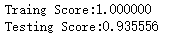
    print("Traing Score:%f"%clf.score(X_train,y_train))

    print("Testing Score:%f"%clf.score(X_test,y_test))

# 获取分类数据

X_train,X_test,y_train,y_test=load_data_classification()

# 调用 test_RandomForestClassifier

test_RandomForestClassifier(X_train,X_test,y_train,y_test)
def test_RandomForestClassifier_num(*data):

    '''

    测试 RandomForestClassifier 的预测性能随 n_estimators 参数的影响

    '''

    X_train,X_test,y_train,y_test=data

    nums=np.arange(1,100,step=2)

    fig=plt.figure()

    ax=fig.add_subplot(1,1,1)

    testing_scores=[]

    training_scores=[]

    for num in nums:

        clf=ensemble.RandomForestClassifier(n_estimators=num)

        clf.fit(X_train,y_train)

        training_scores.append(clf.score(X_train,y_train))

        testing_scores.append(clf.score(X_test,y_test))

    ax.plot(nums,training_scores,label="Training Score")

    ax.plot(nums,testing_scores,label="Testing Score")

    ax.set_xlabel("estimator num")

    ax.set_ylabel("score")

    ax.legend(loc="lower right")

    ax.set_ylim(0,1.05)

    plt.suptitle("RandomForestClassifier")

    plt.show()

# 调用 test_RandomForestClassifier_num

test_RandomForestClassifier_num(X_train,X_test,y_train,y_test)

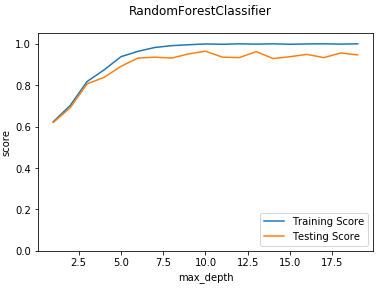
def test_RandomForestClassifier_max_depth(*data):

    '''

    测试 RandomForestClassifier 的预测性能随 max_depth 参数的影响

    '''

    X_train,X_test,y_train,y_test=data

    maxdepths=range(1,20)

    fig=plt.figure()

    ax=fig.add_subplot(1,1,1)

    testing_scores=[]

    training_scores=[]

    for max_depth in maxdepths:

        clf=ensemble.RandomForestClassifier(max_depth=max_depth)

        clf.fit(X_train,y_train)

        training_scores.append(clf.score(X_train,y_train))

        testing_scores.append(clf.score(X_test,y_test))

    ax.plot(maxdepths,training_scores,label="Training Score")

    ax.plot(maxdepths,testing_scores,label="Testing Score")

    ax.set_xlabel("max_depth")

    ax.set_ylabel("score")

    ax.legend(loc="lower right")

    ax.set_ylim(0,1.05)

    plt.suptitle("RandomForestClassifier")

    plt.show()

# 调用 test_RandomForestClassifier_max_depth

test_RandomForestClassifier_max_depth(X_train,X_test,y_train,y_test)
def test_RandomForestClassifier_max_features(*data):

    '''

    测试 RandomForestClassifier 的预测性能随 max_features 参数的影响

    '''

    X_train,X_test,y_train,y_test=data

    max_features=np.linspace(0.01,1.0)

    fig=plt.figure()

    ax=fig.add_subplot(1,1,1)

    testing_scores=[]

    training_scores=[]

    for max_feature in max_features:

        clf=ensemble.RandomForestClassifier(max_features=max_feature)

        clf.fit(X_train,y_train)

        training_scores.append(clf.score(X_train,y_train))

        testing_scores.append(clf.score(X_test,y_test))

    ax.plot(max_features,training_scores,label="Training Score")

    ax.plot(max_features,testing_scores,label="Testing Score")

    ax.set_xlabel("max_feature")

    ax.set_ylabel("score")

    ax.legend(loc="lower right")

    ax.set_ylim(0,1.05)

    plt.suptitle("RandomForestClassifier")

    plt.show()

# 调用 test_RandomForestClassifier_max_features

test_RandomForestClassifier_max_features(X_train,X_test,y_train,y_test)

吴裕雄 python 机器学习——集成学习随机森林RandomForestClassifier分类模型的更多相关文章
- 吴裕雄 python 机器学习——集成学习随机森林RandomForestRegressor回归模型
import numpy as np import matplotlib.pyplot as plt from sklearn import datasets,ensemble from sklear ...
- 吴裕雄 python 机器学习——集成学习梯度提升决策树GradientBoostingRegressor回归模型
import numpy as np import matplotlib.pyplot as plt from sklearn import datasets,ensemble from sklear ...
- 吴裕雄 python 机器学习——集成学习AdaBoost算法回归模型
import numpy as np import matplotlib.pyplot as plt from sklearn import datasets,ensemble from sklear ...
- 吴裕雄 python 机器学习——集成学习AdaBoost算法分类模型
import numpy as np import matplotlib.pyplot as plt from sklearn import datasets,ensemble from sklear ...
- 机器学习:集成学习:随机森林.GBDT
集成学习(Ensemble Learning) 集成学习的思想是将若干个学习器(分类器&回归器)组合之后产生一个新学习器.弱分类器(weak learner)指那些分类准确率只稍微好于随机猜测 ...
- 吴裕雄 python 机器学习——伯努利贝叶斯BernoulliNB模型
import numpy as np import matplotlib.pyplot as plt from sklearn import datasets,naive_bayes from skl ...
- 吴裕雄 python 机器学习——数据预处理过滤式特征选取SelectPercentile模型
from sklearn.feature_selection import SelectPercentile,f_classif #数据预处理过滤式特征选取SelectPercentile模型 def ...
- 吴裕雄 python 机器学习——数据预处理过滤式特征选取VarianceThreshold模型
from sklearn.feature_selection import VarianceThreshold #数据预处理过滤式特征选取VarianceThreshold模型 def test_Va ...
- 吴裕雄 python 机器学习——数据预处理字典学习模型
from sklearn.decomposition import DictionaryLearning #数据预处理字典学习DictionaryLearning模型 def test_Diction ...
随机推荐
- vue制作滚动条幅-跑马灯效果实例代码
<!DOCTYPE html> <html> <head> <meta charset="UTF-8"> <title> ...
- bootstrap-datatimepicker插件的使用
1.引入相关的css.js文件(因为是bootstrap的,首先应该引入bootstrap.css和bootstrap.js): <link rel="stylesheet" ...
- yii2表单提交CSRF验证
Yii2表单提交默认需要验证CSRF,如果CSRF验证不通过,则表单提交失败,解决方法如下: 第一种解决办法是关闭Csrf public $enableCsrfValidation = false; ...
- linux - mysql 异常:Ignoring query to other database
问题描述 Ignoring query to other database(忽略其他数据库查询) 问题原因 登录方式错误,登录命令用的是 “mysql -root -p”,应该用命令 “mysql - ...
- Java面向对象--类和对象
面向对象是相对于面向过程而言的,是软件开发方法.面向对象把相关的数据和方法组织为一个整体来看待,从更高的层次来进行系统设计,更贴近事物的自然运行模式.本篇博客介绍Java面向对象的类和对象 目录: 面 ...
- pymysql模块学习
#Pymysql 用于连接mysql数据库 #连接数据库 data_ip = "192.168.34.128" data_name = "lch" data_p ...
- shell问题汇总
1. sudo执行脚本找不到变量 当普通用户下,设置并export一个变量,然后利用sudo执行echo命令,能得到变量的值,但是如果把echo命令写入脚本,然后再sudo执行脚本,就找不到变量,未能 ...
- SequoiaDB 巨杉数据库Docker镜像使用教程
为方便用户快速体验,SequoiaDB 巨杉数据库提供基于 Docker 的镜像.本文介绍如何在 Docker 环境下部署 SequoiaDB 分布式集群环境. 集群规划 我们准备在五个容器中部署 ...
- X shell安装 以及使用
X shell 百度搜索 X shell 然后下载软件 然后会进入主页面
- 基于约束条件的SQL攻击
一.背景 今天看了一篇基于约束条件的SQL攻击的文章,感觉非常不错,但亲自实践后又发现了很多问题,虽然利用起来有一定要求,不过作者的思想还是很值得学习的.原文中的主旨思想是利用数据库对空格符的特殊处理 ...