
吴裕雄 python深度学习与实践(17)
import tensorflow as tf

from tensorflow.examples.tutorials.mnist import input_data

import time

# 声明输入图片数据,类别

x = tf.placeholder('float', [None, 784])

y_ = tf.placeholder('float', [None, 10])

# 输入图片数据转化

x_image = tf.reshape(x, [-1, 28, 28, 1])

#第一层卷积层,初始化卷积核参数、偏置值,该卷积层5*5大小,一个通道,共有6个不同卷积核

filter1 = tf.Variable(tf.truncated_normal([5, 5, 1, 6]))

bias1 = tf.Variable(tf.truncated_normal([6]))

conv1 = tf.nn.conv2d(x_image, filter1, strides=[1, 1, 1, 1], padding='SAME')

h_conv1 = tf.nn.relu(conv1 + bias1)

maxPool2 = tf.nn.max_pool(h_conv1, ksize=[1, 2, 2, 1],strides=[1, 2, 2, 1], padding='SAME')

filter2 = tf.Variable(tf.truncated_normal([5, 5, 6, 16]))

bias2 = tf.Variable(tf.truncated_normal([16]))

conv2 = tf.nn.conv2d(maxPool2, filter2, strides=[1, 1, 1, 1], padding='SAME')

h_conv2 = tf.nn.relu(conv2 + bias2)

maxPool3 = tf.nn.max_pool(h_conv2, ksize=[1, 2, 2, 1],strides=[1, 2, 2, 1], padding='SAME')

filter3 = tf.Variable(tf.truncated_normal([5, 5, 16, 120]))

bias3 = tf.Variable(tf.truncated_normal([120]))

conv3 = tf.nn.conv2d(maxPool3, filter3, strides=[1, 1, 1, 1], padding='SAME')

h_conv3 = tf.nn.relu(conv3 + bias3)

# 全连接层

# 权值参数

W_fc1 = tf.Variable(tf.truncated_normal([7 * 7 * 120, 80]))

# 偏置值

b_fc1 = tf.Variable(tf.truncated_normal([80]))

# 将卷积的产出展开

h_pool2_flat = tf.reshape(h_conv3, [-1, 7 * 7 * 120])

# 神经网络计算,并添加relu激活函数

h_fc1 = tf.nn.relu(tf.matmul(h_pool2_flat, W_fc1) + b_fc1)

# 输出层,使用softmax进行多分类

W_fc2 = tf.Variable(tf.truncated_normal([80, 10]))

b_fc2 = tf.Variable(tf.truncated_normal([10]))

y_conv = tf.nn.softmax(tf.matmul(h_fc1, W_fc2) + b_fc2)

# 损失函数

cross_entropy = -tf.reduce_sum(y_ * tf.log(y_conv))

# 使用GDO优化算法来调整参数

train_step = tf.train.GradientDescentOptimizer(0.0001).minimize(cross_entropy)

sess = tf.InteractiveSession()

# 测试正确率

correct_prediction = tf.equal(tf.argmax(y_conv, 1), tf.argmax(y_, 1))

accuracy = tf.reduce_mean(tf.cast(correct_prediction, "float"))

# 所有变量进行初始化

sess.run(tf.initialize_all_variables())

# 获取mnist数据

mnist_data_set = input_data.read_data_sets('F:\\TensorFlow_deep_learn\\MNIST\\', one_hot=True)

# 进行训练

start_time = time.time()

for i in range(20000):

    # 获取训练数据

    batch_xs, batch_ys = mnist_data_set.train.next_batch(200)

    # 每迭代100个 batch,对当前训练数据进行测试,输出当前预测准确率

    if i % 2 == 0:

        train_accuracy = accuracy.eval(feed_dict={x: batch_xs, y_: batch_ys})

        print("step %d, training accuracy %g" % (i, train_accuracy))

        # 计算间隔时间

        end_time = time.time()

        print('time: ', (end_time - start_time))

        start_time = end_time

    # 训练数据

    train_step.run(feed_dict={x: batch_xs, y_: batch_ys})

# 关闭会话

sess.close()
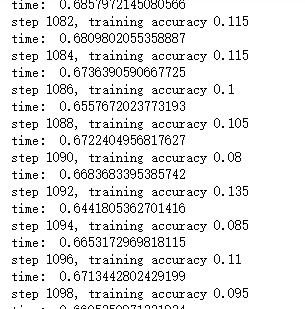
import time

import tensorflow as tf

import matplotlib.pyplot as plt

from tensorflow.examples.tutorials.mnist import input_data

def weight_variable(shape):

    initial = tf.truncated_normal(shape, stddev=0.1)

    return tf.Variable(initial)

#初始化单个卷积核上的偏置值

def bias_variable(shape):

    initial = tf.constant(0.1, shape=shape)

    return tf.Variable(initial)

#输入特征x,用卷积核W进行卷积运算,strides为卷积核移动步长,

#padding表示是否需要补齐边缘像素使输出图像大小不变

def conv2d(x, W):

    return tf.nn.conv2d(x, W, strides=[1, 1, 1, 1], padding='SAME')

#对x进行最大池化操作,ksize进行池化的范围,

def max_pool_2x2(x):

    return tf.nn.max_pool(x, ksize=[1, 2, 2, 1],strides=[1, 2, 2, 1], padding='SAME')

sess = tf.InteractiveSession()

# 声明输入图片数据,类别

x = tf.placeholder('float32', [None, 784])

y_ = tf.placeholder('float32', [None, 10])

# 输入图片数据转化

x_image = tf.reshape(x, [-1, 28, 28, 1])

W_conv1 = weight_variable([5, 5, 1, 6])

b_conv1 = bias_variable([6])

h_conv1 = tf.nn.relu(conv2d(x_image, W_conv1) + b_conv1)

h_pool1 = max_pool_2x2(h_conv1)

W_conv2 = weight_variable([5, 5, 6, 16])

b_conv2 = bias_variable([16])

h_conv2 = tf.nn.relu(conv2d(h_pool1, W_conv2) + b_conv2)

h_pool2 = max_pool_2x2(h_conv2)

W_fc1 = weight_variable([7*7*16,120])

# 偏置值

b_fc1 = bias_variable([120])

# 将卷积的产出展开

h_pool2_flat = tf.reshape(h_pool2, [-1, 7 * 7 * 16])

# 神经网络计算,并添加relu激活函数

h_fc1 = tf.nn.relu(tf.matmul(h_pool2_flat, W_fc1) + b_fc1)

W_fc2 = weight_variable([120,10])

b_fc2 = bias_variable([10])

y_conv = tf.nn.softmax(tf.matmul(h_fc1, W_fc2) + b_fc2)

# 代价函数

cross_entropy = -tf.reduce_sum(y_ * tf.log(y_conv))

# 使用Adam优化算法来调整参数

train_step = tf.train.GradientDescentOptimizer(1e-4).minimize(cross_entropy)

# 测试正确率

correct_prediction = tf.equal(tf.argmax(y_conv, 1), tf.argmax(y_, 1))

accuracy = tf.reduce_mean(tf.cast(correct_prediction, "float32"))

# 所有变量进行初始化

sess.run(tf.initialize_all_variables())

# 获取mnist数据

mnist_data_set = input_data.read_data_sets('F:\\TensorFlow_deep_learn\\MNIST\\', one_hot=True)

c = []

# 进行训练

start_time = time.time()

for i in range(1000):

    # 获取训练数据

    batch_xs, batch_ys = mnist_data_set.train.next_batch(200)

    # 每迭代10个 batch,对当前训练数据进行测试,输出当前预测准确率

    if i % 2 == 0:

        train_accuracy = accuracy.eval(feed_dict={x: batch_xs, y_: batch_ys})

        c.append(train_accuracy)

        print("step %d, training accuracy %g" % (i, train_accuracy))

        # 计算间隔时间

        end_time = time.time()

        print('time: ', (end_time - start_time))

        start_time = end_time

    # 训练数据

    train_step.run(feed_dict={x: batch_xs, y_: batch_ys})

sess.close()

plt.plot(c)

plt.tight_layout()

plt.savefig('F:\\cnn-tf-cifar10-2.png', dpi=200)

plt.show()
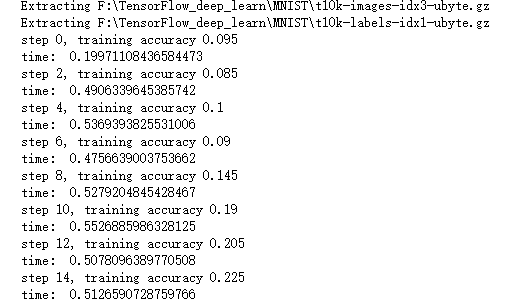
import time

import tensorflow as tf

import matplotlib.pyplot as plt

from tensorflow.examples.tutorials.mnist import input_data

def weight_variable(shape):

    initial = tf.truncated_normal(shape, stddev=0.1)

    return tf.Variable(initial)

#初始化单个卷积核上的偏置值

def bias_variable(shape):

    initial = tf.constant(0.1, shape=shape)

    return tf.Variable(initial)

#输入特征x,用卷积核W进行卷积运算,strides为卷积核移动步长,

#padding表示是否需要补齐边缘像素使输出图像大小不变

def conv2d(x, W):

    return tf.nn.conv2d(x, W, strides=[1, 1, 1, 1], padding='SAME')

#对x进行最大池化操作,ksize进行池化的范围,

def max_pool_2x2(x):

    return tf.nn.max_pool(x, ksize=[1, 2, 2, 1],strides=[1, 2, 2, 1], padding='SAME')

sess = tf.InteractiveSession()

# 声明输入图片数据,类别

x = tf.placeholder('float32', [None, 784])

y_ = tf.placeholder('float32', [None, 10])

# 输入图片数据转化

x_image = tf.reshape(x, [-1, 28, 28, 1])

W_conv1 = weight_variable([5, 5, 1, 32])

b_conv1 = bias_variable([32])

h_conv1 = tf.nn.relu(conv2d(x_image, W_conv1) + b_conv1)

h_pool1 = max_pool_2x2(h_conv1)

W_conv2 = weight_variable([5, 5, 32, 64])

b_conv2 = bias_variable([64])

h_conv2 = tf.nn.relu(conv2d(h_pool1, W_conv2) + b_conv2)

h_pool2 = max_pool_2x2(h_conv2)

W_fc1 = weight_variable([7*7*64,1024])

# 偏置值

b_fc1 = bias_variable([1024])

# 将卷积的产出展开

h_pool2_flat = tf.reshape(h_pool2, [-1, 7 * 7 * 64])

# 神经网络计算,并添加relu激活函数

h_fc1 = tf.nn.relu(tf.matmul(h_pool2_flat, W_fc1) + b_fc1)

W_fc2 = weight_variable([1024,10])

b_fc2 = bias_variable([10])

y_conv = tf.nn.softmax(tf.matmul(h_fc1, W_fc2) + b_fc2)

# 代价函数

cross_entropy = -tf.reduce_sum(y_ * tf.log(y_conv))

# 使用Adam优化算法来调整参数

train_step = tf.train.GradientDescentOptimizer(1e-4).minimize(cross_entropy)

# 测试正确率

correct_prediction = tf.equal(tf.argmax(y_conv, 1), tf.argmax(y_, 1))

accuracy = tf.reduce_mean(tf.cast(correct_prediction, "float32"))

# 所有变量进行初始化

sess.run(tf.initialize_all_variables())

# 获取mnist数据

mnist_data_set = input_data.read_data_sets('F:\\TensorFlow_deep_learn\\MNIST\\', one_hot=True)

c = []

# 进行训练

start_time = time.time()

for i in range(1000):

    # 获取训练数据

    batch_xs, batch_ys = mnist_data_set.train.next_batch(200)

    # 每迭代10个 batch,对当前训练数据进行测试,输出当前预测准确率

    if i % 2 == 0:

        train_accuracy = accuracy.eval(feed_dict={x: batch_xs, y_: batch_ys})

        c.append(train_accuracy)

        print("step %d, training accuracy %g" % (i, train_accuracy))

        # 计算间隔时间

        end_time = time.time()

        print('time: ', (end_time - start_time))

        start_time = end_time

    # 训练数据

    train_step.run(feed_dict={x: batch_xs, y_: batch_ys})

sess.close()

plt.plot(c)

plt.tight_layout()

plt.savefig('F:\\cnn-tf-cifar10-1.png', dpi=200)

plt.show()
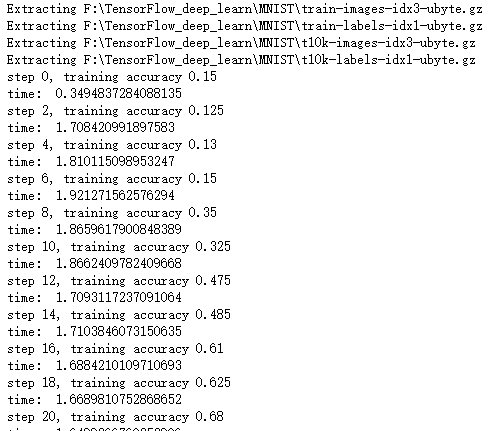
import time

import tensorflow as tf

import matplotlib.pyplot as plt

from tensorflow.examples.tutorials.mnist import input_data

def weight_variable(shape):

    initial = tf.truncated_normal(shape, stddev=0.1)

    return tf.Variable(initial)

#初始化单个卷积核上的偏置值

def bias_variable(shape):

    initial = tf.constant(0.1, shape=shape)

    return tf.Variable(initial)

#输入特征x,用卷积核W进行卷积运算,strides为卷积核移动步长,

#padding表示是否需要补齐边缘像素使输出图像大小不变

def conv2d(x, W):

    return tf.nn.conv2d(x, W, strides=[1, 1, 1, 1], padding='SAME')

#对x进行最大池化操作,ksize进行池化的范围,

def max_pool_2x2(x):

    return tf.nn.max_pool(x, ksize=[1, 2, 2, 1],strides=[1, 2, 2, 1], padding='SAME')

sess = tf.InteractiveSession()

# 声明输入图片数据,类别

x = tf.placeholder('float32', [None, 784])

y_ = tf.placeholder('float32', [None, 10])

# 输入图片数据转化

x_image = tf.reshape(x, [-1, 28, 28, 1])

W_conv1 = weight_variable([5, 5, 1, 32])

b_conv1 = bias_variable([32])

h_conv1 = tf.nn.relu(conv2d(x_image, W_conv1) + b_conv1)

h_pool1 = max_pool_2x2(h_conv1)

W_conv2 = weight_variable([5, 5, 32, 64])

b_conv2 = bias_variable([64])

h_conv2 = tf.nn.relu(conv2d(h_pool1, W_conv2) + b_conv2)

h_pool2 = max_pool_2x2(h_conv2)

W_fc1 = weight_variable([7*7*64,1024])

# 偏置值

b_fc1 = bias_variable([1024])

# 将卷积的产出展开

h_pool2_flat = tf.reshape(h_pool2, [-1, 7 * 7 * 64])

# 神经网络计算,并添加relu激活函数

h_fc1 = tf.nn.relu(tf.matmul(h_pool2_flat, W_fc1) + b_fc1)

W_fc2 = weight_variable([1024,128])

b_fc2 = bias_variable([128])

h_fc2 = tf.nn.relu(tf.matmul(h_fc1, W_fc2) + b_fc2)

W_fc3 = weight_variable([128,10])

b_fc3 = bias_variable([10])

y_conv = tf.nn.softmax(tf.matmul(h_fc2, W_fc3) + b_fc3)

# 代价函数

cross_entropy = -tf.reduce_sum(y_ * tf.log(y_conv))

# 使用Adam优化算法来调整参数

train_step = tf.train.GradientDescentOptimizer(1e-5).minimize(cross_entropy)

# 测试正确率

correct_prediction = tf.equal(tf.argmax(y_conv, 1), tf.argmax(y_, 1))

accuracy = tf.reduce_mean(tf.cast(correct_prediction, "float32"))

# 所有变量进行初始化

sess.run(tf.initialize_all_variables())

# 获取mnist数据

mnist_data_set = input_data.read_data_sets('F:\\TensorFlow_deep_learn\\MNIST\\', one_hot=True)

c = []

# 进行训练

start_time = time.time()

for i in range(1000):

    # 获取训练数据

    batch_xs, batch_ys = mnist_data_set.train.next_batch(200)

    # 每迭代10个 batch,对当前训练数据进行测试,输出当前预测准确率

    if i % 2 == 0:

        train_accuracy = accuracy.eval(feed_dict={x: batch_xs, y_: batch_ys})

        c.append(train_accuracy)

        print("step %d, training accuracy %g" % (i, train_accuracy))

        # 计算间隔时间

        end_time = time.time()

        print('time: ', (end_time - start_time))

        start_time = end_time

    # 训练数据

    train_step.run(feed_dict={x: batch_xs, y_: batch_ys})

sess.close()

plt.plot(c)

plt.tight_layout()

plt.savefig('F:\\cnn-tf-cifar10-11.png', dpi=200)

plt.show()
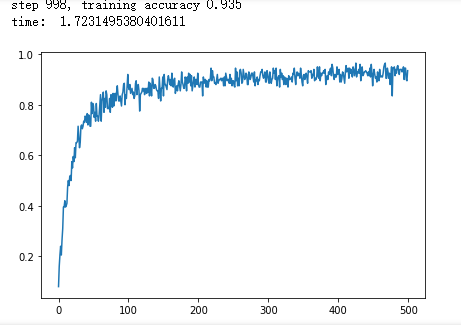
吴裕雄 python深度学习与实践(17)的更多相关文章
- 吴裕雄 python深度学习与实践(12)
import tensorflow as tf q = tf.FIFOQueue(,"float32") counter = tf.Variable(0.0) add_op = t ...
- 吴裕雄 python深度学习与实践(18)
# coding: utf-8 import time import numpy as np import tensorflow as tf import _pickle as pickle impo ...
- 吴裕雄 python深度学习与实践(16)
import struct import numpy as np import matplotlib.pyplot as plt dateMat = np.ones((7,7)) kernel = n ...
- 吴裕雄 python深度学习与实践(15)
import tensorflow as tf import tensorflow.examples.tutorials.mnist.input_data as input_data mnist = ...
- 吴裕雄 python深度学习与实践(14)
import numpy as np import tensorflow as tf import matplotlib.pyplot as plt threshold = 1.0e-2 x1_dat ...
- 吴裕雄 python深度学习与实践(13)
import numpy as np import matplotlib.pyplot as plt x_data = np.random.randn(10) print(x_data) y_data ...
- 吴裕雄 python深度学习与实践(11)
import numpy as np from matplotlib import pyplot as plt A = np.array([[5],[4]]) C = np.array([[4],[6 ...
- 吴裕雄 python深度学习与实践(10)
import tensorflow as tf input1 = tf.constant(1) print(input1) input2 = tf.Variable(2,tf.int32) print ...
- 吴裕雄 python深度学习与实践(9)
import numpy as np import tensorflow as tf inputX = np.random.rand(100) inputY = np.multiply(3,input ...
随机推荐
- ActiveMQ (三)—持久化消息
ActiveMQ的另一个问题就是只要是软件就有可能挂掉,挂掉不可怕,怕的是挂掉之后把信息给丢了,所以本节分析一下几种持久化方式: 一.持久化为文件 ActiveMQ默认就支持这种方式,只要在发消息时设 ...
- python随机数学习笔记
#coding:utf-8 import random # random.randint(1,10)产生1,10的随机整数 for i in range(1,5): ranint = random.r ...
- 联想扬天3900c电脑BIOS设置U盘启动图文教程
有联想扬天3900c的用户反映说,制作好U大侠U盘后,按快捷键却识别不到U盘,不能进行U盘启动,这是怎么回事呢?其实这是BIOS设置的问题,下面U大侠教大家如何对联想扬天3900c电脑进行BIOS设置 ...
- 异常:tomcat与windows时间不同步
调试一个项目时发现用户那里服务器的Tomcat命令行中log4j输出的时间与操作系统时间不一致,因此日志记录的时间与操作系统时间也不一致,且正好相差8个小时.产生原因是因为Tomcat中的时区设置与操 ...
- K-means之亚洲杯
import numpy as np import xlrd from sklearn.cluster import KMeans from sklearn import preprocessing ...
- SVN迁移到GitLab,保留提交记录
1.下载GitBash 此工具自带git svn命令,无需再下载git-svn工具 2.GitBash终端中输入以下命令 git svn clone svnurl srcPath 3.push本地仓库 ...
- subprocess模块 sys模块
常用模块学习—subprocess模块详解 要通过Python去执行一条系统命令或脚本,系统的shell命令是独立于你的python进程之外的,每执行一条命令,就是发起一个新进程,通过python调用 ...
- 进阶路上有你我-相互相持篇之ES6里箭头函数里的this指向问题
首先复习下普通函数里的this指向: function test(){ console.log(this) } test() 你会秒杀的毫无疑问的回答:window,针对普通函数:谁调用了函数 函数 ...
- SpringBoot aop 注解 数据权限校验
注解类: @Retention(RetentionPolicy.RUNTIME) public @interface DataAuthValid { //位置 public int index() d ...
- Unity的Write Defaults->从一个例子谈起
Write Defaults是什么? 在Unity的Animator中点击任何一个手动创建的State,我们就会在Inspector面板中看到下图的WriteDefaults选项 (图1,Animat ...