
吴裕雄 python深度学习与实践(15)
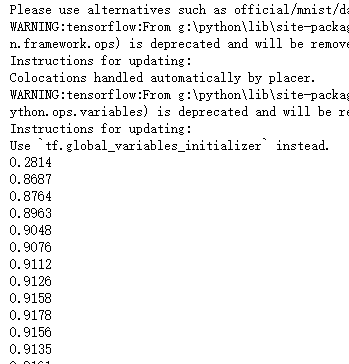
import tensorflow as tf

import tensorflow.examples.tutorials.mnist.input_data as input_data

mnist = input_data.read_data_sets("D:\\F\\TensorFlow_deep_learn\\MNIST\\", one_hot=True)

x_data = tf.placeholder("float32", [None, 784])

weight = tf.Variable(tf.ones([784, 10]))

bias = tf.Variable(tf.ones([10]))

y_model = tf.nn.softmax(tf.matmul(x_data, weight) + bias)

y_data = tf.placeholder("float32", [None, 10])

loss = tf.reduce_sum(tf.pow((y_model - y_data), 2))

train_step = tf.train.GradientDescentOptimizer(0.01).minimize(loss)

init = tf.initialize_all_variables()

sess = tf.Session()

sess.run(init)

for _ in range(1000):

    batch_xs, batch_ys = mnist.train.next_batch(100)

    sess.run(train_step, feed_dict={x_data:batch_xs, y_data:batch_ys})

    if _ % 50 == 0:

        correct_prediction = tf.equal(tf.argmax(y_model, 1), tf.argmax(y_data, 1))

        accuracy = tf.reduce_mean(tf.cast(correct_prediction, "float"))

        print(sess.run(accuracy, feed_dict={x_data: mnist.test.images, y_data: mnist.test.labels}))
import tensorflow as tf

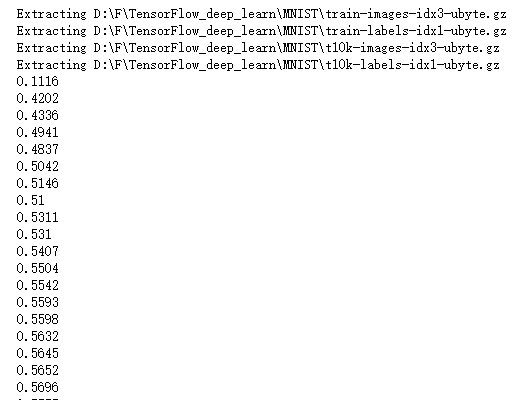
import tensorflow.examples.tutorials.mnist.input_data as input_data

mnist = input_data.read_data_sets("D:\\F\\TensorFlow_deep_learn\\MNIST\\", one_hot=True)

x_data = tf.placeholder("float32", [None, 784])

weight = tf.Variable(tf.ones([784, 10]))

bias = tf.Variable(tf.ones([10]))

y_model = tf.nn.relu(tf.matmul(x_data, weight) + bias)

y_data = tf.placeholder("float32", [None, 10])

loss = -tf.reduce_sum(y_data*tf.log(y_model))

train_step = tf.train.GradientDescentOptimizer(0.01).minimize(loss)

init = tf.initialize_all_variables()

sess = tf.Session()

sess.run(init)

for _ in range(1000):

    batch_xs, batch_ys = mnist.train.next_batch(50)

    sess.run(train_step, feed_dict={x_data:batch_xs, y_data:batch_ys})

    if _ % 50 == 0:

        correct_prediction = tf.equal(tf.argmax(y_model, 1), tf.argmax(y_data, 1))

        accuracy = tf.reduce_mean(tf.cast(correct_prediction, "float"))

        print(sess.run(accuracy, feed_dict={x_data: mnist.test.images, y_data: mnist.test.labels}))
import tensorflow as tf

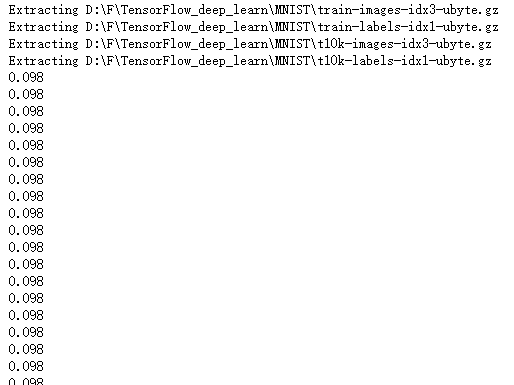
import tensorflow.examples.tutorials.mnist.input_data as input_data

mnist = input_data.read_data_sets("D:\\F\\TensorFlow_deep_learn\\MNIST\\", one_hot=True)

x_data = tf.placeholder("float32", [None, 784])

weight1 = tf.Variable(tf.ones([784, 256]))

bias1 = tf.Variable(tf.ones([256]))

y1_model1 = tf.matmul(x_data, weight1) + bias1

weight2 = tf.Variable(tf.ones([256, 10]))

bias2 = tf.Variable(tf.ones([10]))

y_model = tf.nn.softmax(tf.matmul(y1_model1, weight2) + bias2)

y_data = tf.placeholder("float32", [None, 10])

loss = -tf.reduce_sum(y_data*tf.log(y_model))

train_step = tf.train.GradientDescentOptimizer(0.01).minimize(loss)

init = tf.initialize_all_variables()

sess = tf.Session()

sess.run(init)

for _ in range(1000):

    batch_xs, batch_ys = mnist.train.next_batch(50)

    sess.run(train_step, feed_dict={x_data:batch_xs, y_data:batch_ys})

    if _ % 50 == 0:

        correct_prediction = tf.equal(tf.argmax(y_model, 1), tf.argmax(y_data, 1))

        accuracy = tf.reduce_mean(tf.cast(correct_prediction, "float"))

        print(sess.run(accuracy, feed_dict={x_data: mnist.test.images, y_data: mnist.test.labels}))
import tensorflow as tf

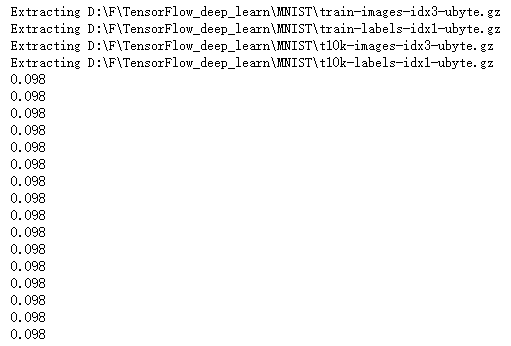
import tensorflow.examples.tutorials.mnist.input_data as input_data

mnist = input_data.read_data_sets("D:\\F\\TensorFlow_deep_learn\\MNIST\\", one_hot=True)

x_data = tf.placeholder("float32", [None, 784])

x_image = tf.reshape(x_data, [-1,28,28,1])

w_conv = tf.Variable(tf.ones([5,5,1,32]))

b_conv = tf.Variable(tf.ones([32]))

h_conv = tf.nn.relu(tf.nn.conv2d(x_image, w_conv, strides=[1, 1, 1, 1], padding='SAME') + b_conv)

h_pool = tf.nn.max_pool(h_conv, ksize=[1, 2, 2, 1],strides=[1, 2, 2, 1], padding='SAME')

w_fc = tf.Variable(tf.ones([14*14*32,1024]))

b_fc = tf.Variable(tf.ones([1024]))

h_pool_flat = tf.reshape(h_pool, [-1, 14*14*32])

h_fc = tf.nn.relu(tf.matmul(h_pool_flat, w_fc) + b_fc)

W_fc2 = tf.Variable(tf.ones([1024,10]))

b_fc2 = tf.Variable(tf.ones([10]))

y_model = tf.nn.softmax(tf.matmul(h_fc, W_fc2) + b_fc2)

y_data = tf.placeholder("float32", [None, 10])

loss = -tf.reduce_sum(y_data*tf.log(y_model))

train_step = tf.train.GradientDescentOptimizer(0.01).minimize(loss)

init = tf.initialize_all_variables()

sess = tf.Session()

sess.run(init)

for _ in range(1000):

    batch_xs, batch_ys = mnist.train.next_batch(200)

    sess.run(train_step, feed_dict={x_data:batch_xs, y_data:batch_ys})

    if _ % 50 == 0:

        correct_prediction = tf.equal(tf.argmax(y_model, 1), tf.argmax(y_data, 1))

        accuracy = tf.reduce_mean(tf.cast(correct_prediction, "float"))

        print(sess.run(accuracy, feed_dict={x_data: mnist.test.images, y_data: mnist.test.labels}))
import tensorflow as tf

import tensorflow.examples.tutorials.mnist.input_data as input_data

mnist = input_data.read_data_sets("D:\\F\\TensorFlow_deep_learn\\MNIST\\", one_hot=True)

x_data = tf.placeholder("float", shape=[None, 784])

y_data = tf.placeholder("float", shape=[None, 10])

def weight_variable(shape):

    initial = tf.truncated_normal(shape, stddev=0.1)

    return tf.Variable(initial)

def bias_variable(shape):

    initial = tf.constant(0.1, shape=shape)

    return tf.Variable(initial)

def conv2d(x, W):

    return tf.nn.conv2d(x, W, strides=[1, 1, 1, 1], padding='VALID')

def max_pool_2x2(x):

    return tf.nn.max_pool(x, ksize=[1, 2, 2, 1], strides=[1, 2, 2, 1], padding='VALID')

W_conv1 = weight_variable([5, 5, 1, 32])

b_conv1 = bias_variable([32])

x_image = tf.reshape(x_data, [-1, 28, 28, 1])

h_conv1 = tf.nn.relu(conv2d(x_image, W_conv1) + b_conv1)

h_pool1 = max_pool_2x2(h_conv1)

W_conv2 = weight_variable([5, 5, 32, 64])

b_conv2 = bias_variable([64])

h_conv2 = tf.nn.relu(conv2d(h_pool1, W_conv2) + b_conv2)

h_pool2 = max_pool_2x2(h_conv2)

W_fc1 = weight_variable([4 * 4 * 64, 1024])

b_fc1 = bias_variable([1024])

h_pool2_flat = tf.reshape(h_pool2, [-1, 4*4*64])

h_fc1 = tf.nn.relu(tf.matmul(h_pool2_flat, W_fc1) + b_fc1)

keep_prob = tf.placeholder("float")

h_fc1_drop = tf.nn.dropout(h_fc1, keep_prob)

W_fc2 = weight_variable([1024, 10])

b_fc2 = bias_variable([10])

y_conv=tf.nn.softmax(tf.matmul(h_fc1_drop, W_fc2) + b_fc2)

cross_entropy = -tf.reduce_sum(y_data * tf.log(y_conv))

train_step = tf.train.AdamOptimizer(1e-2).minimize(cross_entropy)

correct_prediction = tf.equal(tf.argmax(y_conv,1), tf.argmax(y_data, 1))

accuracy = tf.reduce_mean(tf.cast(correct_prediction, "float"))

sess = tf.Session()

sess.run(tf.initialize_all_variables())

for i in range(1000):

    batch = mnist.train.next_batch(50)

    if i%5 == 0:

        train_accuracy = sess.run(accuracy, feed_dict={x_data:batch[0], y_data: batch[1], keep_prob: 1.0})

        print("step %d, training accuracy %g"%(i, train_accuracy))

    sess.run(train_step, feed_dict={x_data: batch[0], y_data: batch[1], keep_prob: 0.5})

吴裕雄 python深度学习与实践(15)的更多相关文章
- 吴裕雄 python深度学习与实践(13)
import numpy as np import matplotlib.pyplot as plt x_data = np.random.randn(10) print(x_data) y_data ...
- 吴裕雄 python深度学习与实践(18)
# coding: utf-8 import time import numpy as np import tensorflow as tf import _pickle as pickle impo ...
- 吴裕雄 python深度学习与实践(17)
import tensorflow as tf from tensorflow.examples.tutorials.mnist import input_data import time # 声明输 ...
- 吴裕雄 python深度学习与实践(16)
import struct import numpy as np import matplotlib.pyplot as plt dateMat = np.ones((7,7)) kernel = n ...
- 吴裕雄 python深度学习与实践(14)
import numpy as np import tensorflow as tf import matplotlib.pyplot as plt threshold = 1.0e-2 x1_dat ...
- 吴裕雄 python深度学习与实践(12)
import tensorflow as tf q = tf.FIFOQueue(,"float32") counter = tf.Variable(0.0) add_op = t ...
- 吴裕雄 python深度学习与实践(11)
import numpy as np from matplotlib import pyplot as plt A = np.array([[5],[4]]) C = np.array([[4],[6 ...
- 吴裕雄 python深度学习与实践(10)
import tensorflow as tf input1 = tf.constant(1) print(input1) input2 = tf.Variable(2,tf.int32) print ...
- 吴裕雄 python深度学习与实践(9)
import numpy as np import tensorflow as tf inputX = np.random.rand(100) inputY = np.multiply(3,input ...
随机推荐
- 关于idea的debug
idea的debug真的是超级好用哎.分享几个今天学会的新方式: 1.右键会发现此选项 ,点击出现 在输入框中输入,可以通过某些公式单独计算. 2.点击属性值,右键点击set values 会出现一个 ...
- python基础--列表、元祖、字典、集合
列表(List) 1.列表特点 列表是可变的!! list 是一种有序的序列,可以添加.删除其中的元素,并且可以通过下标(索引)访问 数据 2.简单的常用操作 A.通过下表访问元素 print(lis ...
- 【oracle入门】数据模型
数据模式也是一这种模型,它是数据库中用于提供信息表示的操作手段的形式架构,是数据库中用来对现实世界惊喜抽象的工具.数据模型按不同的应用层次分为3种类型,分别为概念数据模型.逻辑数据模型.物理数据模型. ...
- webpack配置(入口出口)
const path=require('path'); //是node.js的path模块 //单入口,单出口 module.exports={ // 入口文件 entry:{ entry:'./sr ...
- scrapy框架的日志等级和请求传参
日志等级 请求传参 如何提高scrapy的爬取效率 一.Scrapy的日志等级 - 在使用scrapy crawl spiderFileName运行程序时,在终端里打印输出的就是scrapy的日志信息 ...
- Excel转datatable
如果想支持 .xls,.xlsx 两种格式 则必须安装一个exe文件,下载路径https://www.microsoft.com/zh-CN/download/details.aspx?id=1325 ...
- live555 交叉编译移植到海思开发板
本文章参考了.http://blog.csdn.net/lawishere/article/details/8182952,写了hi3518的配置说明.特此感谢 https://blog.csdn.n ...
- 小程序 去掉 <button /> 组件默认 border 边框样式
代码: <button class="btn">点击</button> 效果图: 目的:去掉 <button /> 默认样式中的 backgro ...
- svn安装和使用
https://www.cnblogs.com/webStyle/p/3696003.html
- onOptionsItemSelected、onMenuItemSelected、onContextItemSelected 区别
1.在点击选项菜单(OptionsMenu:点击menu弹出的菜单)的菜单项时即调用了onMenuItemSelected 也调用了onOptionsItemSelected ,于是疑惑他们 ...